Shanxi · Xinzhou
Mount Wutai: Five Terraces, One Living Pilgrimage
Begin among Taihuai's bells and incense, then decide whether to climb one sacred terrace, trace a millennium of timber architecture, or simply watch a living pilgrimage unfold.
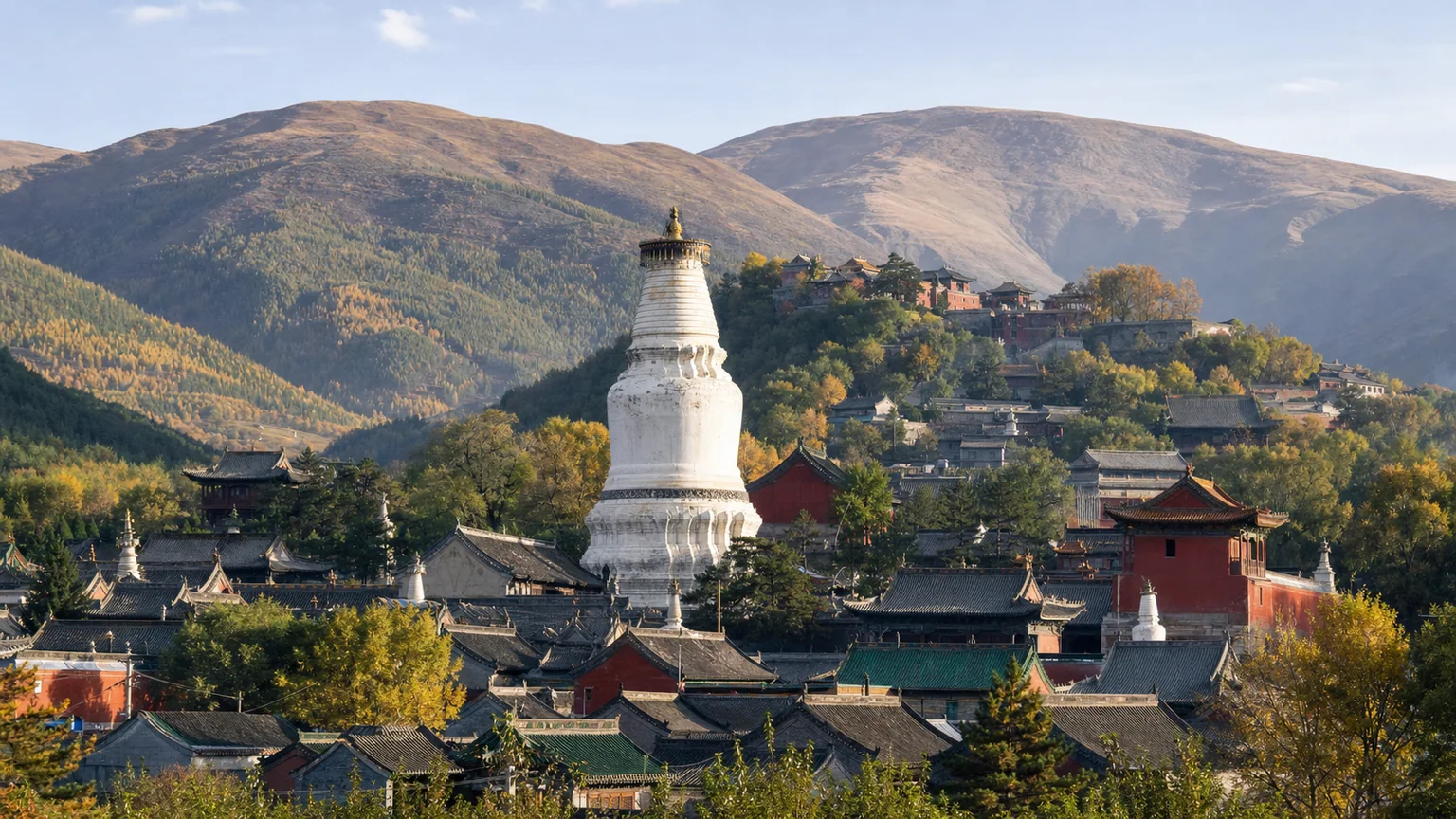
5A View location, maps and nearby scenic areasStand near Tayuan Temple’s Great White Pagoda and turn slowly. Bells and chanting come from one direction; coaches, breakfast steam and shop signs from another. Above the roofs, five broad highlands enclose the valley, yet none behaves like the single pointed summit suggested by the word “mountain.”
That first turn reveals Mount Wutai more honestly than a summit photograph. It is simultaneously a highland system, a collection of historic monasteries, the sacred mountain of the bodhisattva Manjusri, a home and workplace, and one of China’s busiest living pilgrimage landscapes.
Use two maps at once: the inner map is the Taihuai temple cluster around the White Pagoda; the outer map is the five terraces—east, west, south, north and centre. Most first visits should understand the inner map before attempting the outer one.
Five terraces around one inhabited valley
Wutai means “five terraces.” Their conventional names are East Terrace, Wanghai (“Viewing the Sea”); West Terrace, Guayue (“Hanging Moon”); South Terrace, Jinxiu (“Brocade”); North Terrace, Yedou; and Central Terrace, Cuiyan (“Green Rock”). Their rounded, table-like tops ring the valleys rather than forming a neat five-pointed crown.
North Terrace rises to about 3,058 metres, while Taihuai, the settlement and monastic centre in the basin, lies roughly around 1,700 metres. Those figures describe very different visitor environments. A person comfortable among Taihuai’s courtyards may still feel cold, short of breath or unsteady on an exposed terrace.
UNESCO inscribed the Mount Wutai cultural landscape in 2009. Its recognised components and protected boundaries are not identical to every place sold under the scenic area’s name. UNESCO describes a landscape of 41 monasteries; other temple totals use wider geographic areas, different dates or definitions. Read the Mount Wutai 5A profile and map for regional orientation, but do not treat one number as a count of buildings open today.
Why Manjusri is believed to dwell here
Manjusri—Wenshu in Chinese—is the bodhisattva associated with transcendent wisdom. A passage in the Avatamsaka Sutra, in one common translation, speaks of a “Clear and Cool Mountain” in the northeast where Manjusri teaches. Chinese Buddhists came to identify that sacred geography with Wutai; Qingliang Shan, “Clear and Cool Mountain,” remains another name for it.
The text does not function like a modern survey coordinate. The identification grew through scripture, commentaries, imperial patronage, monastic networks, pilgrimage accounts and stories of visions. Records describe seekers encountering unusual lights, clouds, animals or humble strangers interpreted as Manjusri’s manifestations. These are devotional testimonies, not events a guide can promise or a historian can verify in the same way as a dated inscription.
That distinction does not make the tradition unimportant. It explains why pilgrims bow towards a terrace hidden in fog, why five different images of Manjusri can belong to one sacred presence, and why completing a circuit is an ethical and devotional act rather than peak collecting. Visitors may observe the practice; they should not stage it.
From early foundation stories to an international Buddhist centre
Local tradition connects Wutai’s first monastery with the Eastern Han period and an imperial dream of a golden figure. Presenting that as an exact foundation record goes beyond the surviving evidence. What is documented is a long development: by the Northern Dynasties Wutai was an important Buddhist centre, and Sui and Tang patronage helped its monasteries, texts and image traditions reach far beyond Shanxi.
The traffic moved in both directions. In the ninth century, the Japanese monk Ennin visited Wutai during his years in Tang China and described its ritual world in his travel diary. Pilgrims from elsewhere in East Asia carried texts, images and memories home; Wutai imagery later appeared in places such as the Mogao caves at Dunhuang. The mountain was never only a remote local sanctuary.
Imperial support also changed its religious geography. Tibetan Buddhist institutions and Mongol patronage became especially visible under the Yuan and Qing, while Chinese Buddhist traditions continued. Yellow-glazed roofs, Tibetan-style stupas and different ritual lineages therefore belong to a history of exchange, faith and state power—not to a timeless decorative mixture.
War, suppression, fire, weather and rebuilding repeatedly altered the monasteries. A temple may claim a very early origin while the halls you see are Ming, Qing or modern reconstructions around older fragments. Ask two separate questions: “When was this institution founded?” and “When was this particular structure built?”
Timber, sculpture and the people who made them
The most famous architectural evidence lies outside the compact Taihuai route. Foguang Temple’s East Main Hall, dated to 857, preserves a Tang timber frame, sculpture, wall painting and inscriptions in an exceptional ensemble. In 1937, the architectural historians Liang Sicheng and Lin Huiyin, working with their colleagues, surveyed the hall and helped establish its Tang date. Their fieldwork changed the modern understanding of surviving Chinese wooden architecture.
Nanchan Temple’s main hall, dated by an inscription to 782, is generally recognised as China’s earliest surviving timber building. Neither monument is simply “an old temple.” Their bracket sets, columns and roof loads record decisions by carpenters whose names are mostly lost; clay figures preserve the work of modelers, painters and patrons. Repairs add further layers, because keeping timber alive requires intervention as well as restraint.
Within the main cluster, Shuxiang Temple offers a different encounter. Its Manjusri hall contains a dense Ming-period sculpted world of roughly five hundred figures arranged as a three-dimensional sacred landscape. The ensemble matters as spatial storytelling, not as a backdrop for flash photography. Pusading’s processional stairs and yellow roof tiles reveal strong Qing imperial and Tibetan Buddhist associations. Tayuan’s White Pagoda belongs to a Tibetan-style stupa tradition, but its present fabric also reflects rebuilding and repair.
Interior access and photography rules vary by hall, conservation needs and ceremony. A closed door is not an invitation to lean over a barrier. Exterior proportions, roof silhouettes, axial movement and the sound of a courtyard remain part of the architecture.
A sacred mountain sustained by living communities
Morning makes the human system visible. Monastics open halls and prepare rituals. Pilgrims carry incense, prayer beads or provisions. Residents cook noodles, heat rooms, drive vehicles, clean lanes and guide visitors. Artisans repair painted surfaces and timber; conservators monitor fire, pests and moisture. The sacred landscape is maintained labour, not scenery that survived by itself.
Religious life also changes the rhythm of a visit. Chanting may begin without a visitor timetable; a courtyard may be restricted for a service; a line may form because worshippers are making offerings rather than waiting for an attraction. Festival periods on the lunar calendar can bring intense demand, but exact ceremonies, access and crowd controls should be confirmed locally.
Tourism creates income and infrastructure while increasing traffic, waste, water demand, incense smoke and pressure to commercialise the valley. Controls on construction, vehicles and fire can feel inconvenient, yet old timber monasteries and highland ecology are unusually vulnerable. Conservation must also consider residents who need transport, heat and livelihoods. The responsible visitor sees neither an untouched refuge nor a theme park, but a negotiated living place.
A first day through Taihuai
Begin early at Shuxiang Temple, before tour groups fill its relatively compact courtyard. Look at the sculpted assembly as a world with foreground, middle distance and imagined peaks. Then walk towards Tayuan Temple, using the White Pagoda as a navigation marker rather than merely a photograph.
Continue to Xiantong Temple, where multiple courtyards reveal how a major monastery expands through repeated thresholds. Names and foundation legends reach deep into antiquity, but read each surviving hall by its own materials and rebuilding history. From here, climb towards Pusading. The long approach gives a strong view back across Taihuai and makes the relationship between imperial patronage, yellow roofs and valley temples legible.
If energy remains, choose Dailuoding. The direct staircase is commonly counted at 1,080 steps; an operating lift or cable service may offer an alternative, but it should never be assumed. Its “small pilgrimage,” xiaochao tai, gathers forms of Manjusri associated with all five terraces, allowing devotees to honour the five without completing the remote outer circuit. It is a devotional solution to distance, not a claim that the terraces are interchangeable.
This sequence is already a full day when you pause, remove shoes or hats where requested, wait through crowds and look closely. Temple admission arrangements, opening times, identity checks and scenic buses change. Carry your passport and confirm current requirements through the official scenic-area or booking channel rather than relying on an old screenshot.
Choosing the outer terraces and early halls
A terrace circuit by designated vehicle may be offered when roads, weather and demand permit. It compresses great distance but not altitude. Stops can be brief, road surfaces tiring and visibility absent. Private-car access should not be assumed, and summit vehicles may be suspended for wind, snow, ice, thunderstorms, maintenance or crowd control.
A walking pilgrimage of the five terraces is a serious highland undertaking over multiple days. Long exposed sections, scarce shelter, navigation, lightning and rapid weather changes demand experience and conservative decisions. Arrange local guidance if appropriate, carry offline navigation and emergency supplies, and do not treat online completion times as guarantees.
For architectural history, use another day for Foguang Temple and, if current access and transport allow, Nanchan Temple. They are not casual add-ons within the Taihuai walking cluster. Road journeys, opening conditions and conservation closures can consume the day. The reward is comparison: a Tang hall’s structural clarity after Taihuai’s layered ritual density.
If you have only one extra half-day, Dailuoding or one carefully confirmed terrace visit usually makes more sense than chasing every direction. Wutai rewards continuity of attention, not a large pin collection.
Altitude, weather, access and physical limits
Even in summer, carry a warm layer and rain protection. Taihuai can be cool after sunset; the terraces can add strong wind, fog and a much lower apparent temperature. Thunderstorms make open ridges dangerous. In colder months, snow and black ice can close roads or turn temple steps hazardous. Weather forecasts describe a region, not every terrace.
Drink regularly, eat, pace climbs and notice headache, nausea, dizziness or unusual breathlessness. Descend and seek help if symptoms worsen. North Terrace’s 3,058 metres is moderate by mountaineering standards but high enough to affect unacclimatised visitors, especially after a rapid vehicle ascent.
For a lower-strain visit, stay mainly in the Taihuai basin and select temples reachable close to road level. “Reachable by vehicle” does not mean step-free: high thresholds, rough stone, narrow gates and stairs remain common. Pusading and Dailuoding demand substantial climbing unless a current service reduces part of it. Ask about accessible entrances, toilets, wheelchairs and vehicle drop-off points before purchase.
Children need close supervision around incense burners, traffic and steep steps. On remote routes, do not separate from your group. Mobile signal and rescue response should not be treated as universal.
Photograph without interrupting worship
For the classic Taihuai frame, place the White Pagoda off-centre and include lower roofs or a pilgrim path to show its scale. From Pusading’s authorised viewpoints, photograph roof layers leading into the basin. On a terrace, let grass, prayer activity or a winding road occupy the foreground; fog may tell the story better than an empty blue sky.
Inside halls, follow the posted rule even if another visitor ignores it. Flash, tripods and crowding can harm objects or block worship. Ask before photographing monastics, pilgrims, children or people making full-body prostrations. Never step across a prostrating person’s path for a cleaner composition, touch statues, sit on altars or place equipment on thresholds. Do not assume drones are permitted.
Incense does not need to be large or numerous to be sincere. Use designated burners and respect fire restrictions. Lower your voice, move clockwise where local signs or practice direct, and avoid standing at the centre of a doorway. Donations and vegetarian meals should be approached as participation in a religious community, not as props.
Leave the mountain larger than your itinerary
At the end of the day, return to the White Pagoda and turn once more. You may now recognise that the visible monuments carry different dates, traditions and patrons. Behind them stand remote terraces, early timber halls, monastic discipline, local work and constant conservation.
Nearby, Yungang Grottoes preserves another northern Buddhist world shaped through patronage and artistic exchange; Yanmen Pass reads the same highland region through movement and defence; Jinci and Tianlong Mountain joins ritual water, architecture and carved images. Wutai differs because pilgrimage still reorganises ordinary time here.
The mountain does not require a vision, a clear summit or all five terraces to be complete. Its deeper lesson is the coexistence of documented fabric and devotional truth: a Tang bracket can be measured, while Manjusri’s presence is lived through faith. Hold both without forcing one to impersonate the other.
Use the LoreLens app to identify Mount Wutai’s halls and pagodas on site, then hear the longer human stories behind what your camera sees.
Location profile
Where it is

Frequently asked questions
How many days do I need for Mount Wutai?
One full day can cover a selective Taihuai temple route; two days allow a slower cluster visit plus Dailuoding or one feasible terrace excursion. Foguang and Nanchan temples need separate transport. Confirm current admissions, road access and temple openings before fixing the plan.
Can I visit all five terraces in one day?
A vehicle circuit may sometimes make a one-day outer pilgrimage possible, but weather, road controls, demand and seasonal operations can cancel or shorten it. A walking circuit is a serious multi-day highland route, not an ordinary sightseeing stroll.
What should I wear in Mount Wutai's temples?
Choose clothing that covers shoulders and knees, remove hats where signs or custom request it, and wear shoes suitable for steps and uneven paving. High terraces can be cold and windy even when Taihuai feels mild, so carry warm and weatherproof layers.
Is Mount Wutai accessible for visitors with limited mobility?
Parts of the Taihuai basin can be reached by road and offer the gentlest visit, but temple thresholds, stone paving, stairs and long distances remain. Pusading, Dailuoding and the outer terraces are much harder. Ask the official visitor service about current step-free entrances, vehicles and toilets.