Shanxi · Datong
Yungang Grottoes: Reading a Buddhist Empire in Stone
Walk an east-to-west cliff of colossal Buddhas, painted chambers and tiny donor figures, and see how Northern Wei rulers, monks and artisans made a new visual language for Buddhism in China.
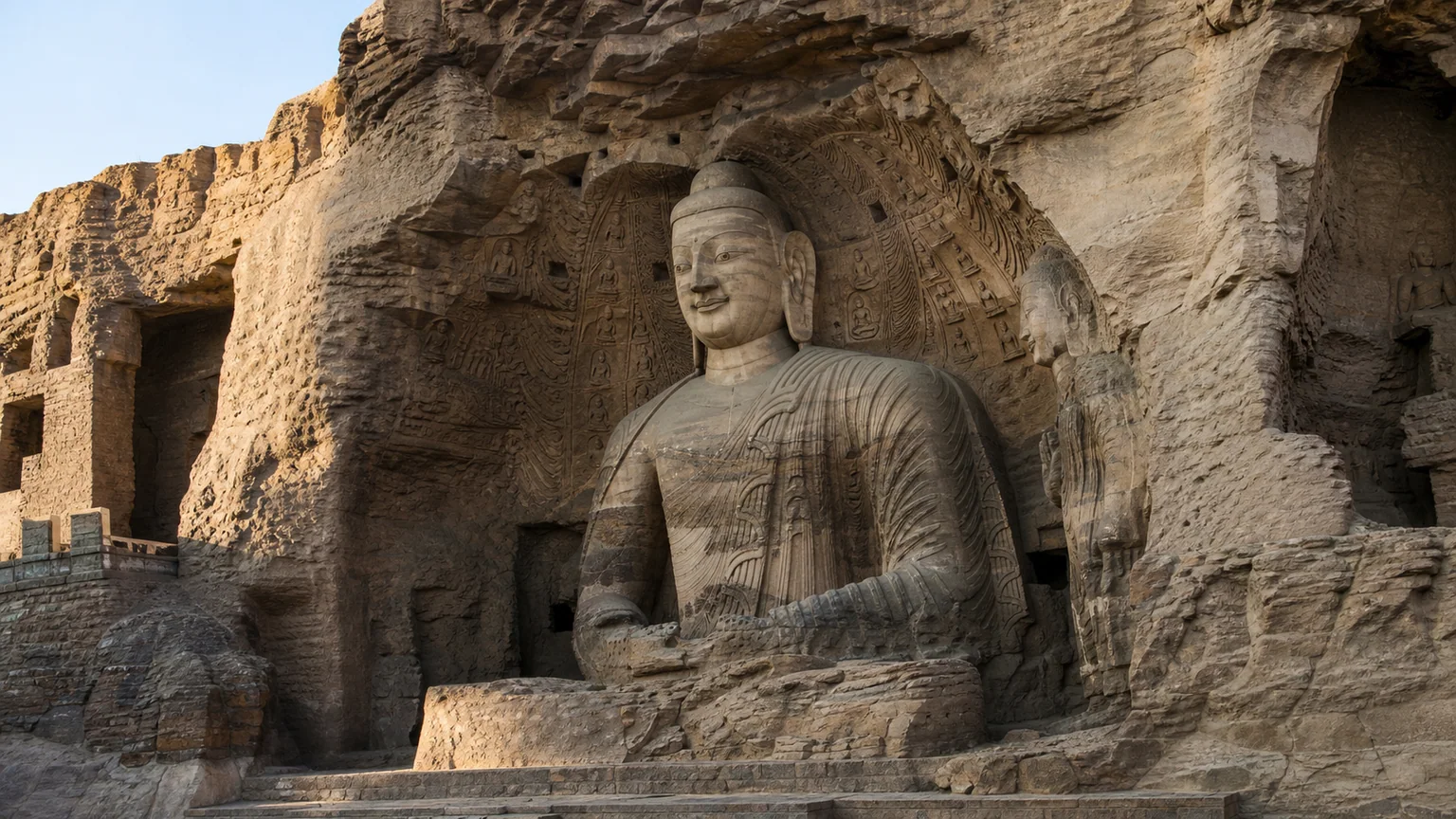
5A View location, maps and nearby scenic areasStand outside Cave 20 and look first at the empty space around the great Buddha. The missing cave front is not a theatrical frame: the rock face collapsed long ago, exposing a seated figure commonly measured at about 13.7 metres.
That contrast is the key to Yungang Grottoes. This is not a row of isolated statues but the surviving interior of a fifth-century Buddhist landscape: caves, niches, wooden facades, colour, chanting and devotion. Walk slowly enough to read both the carving and the absences.
A useful first route: enter the numbered caves from east to west; let Caves 5–13 introduce architecture, colour and narrative detail; then give most of your attention to Caves 16–20, the early imperial group associated with the monk Tanyao. Continue west only if time and the current visitor route allow. Cave access can rotate for conservation.
Read the cliff before entering it
Yungang lies at the foot of Wuzhou Mountain, about 16 kilometres west of central Datong. Its principal caves and niches extend for roughly one kilometre along a sandstone cliff. UNESCO and Chinese heritage descriptions commonly count 252 caves and niches and more than 51,000 statues. Those totals combine spaces and figures of radically different size—from colossal Buddhas to images only a few centimetres high—and inventories can differ according to what qualifies as a separate niche or surviving figure.
The Yungang Grottoes 5A profile gives the mapped location. On site, cave numbers are more useful than a compass. They supply order, not a simple timeline: work proceeded in phases, older caves were repaired, wooden structures disappeared, and worshippers added clay and pigment.
Before entering, notice how the cliff faces outward. Many openings once had timber fronts or temple buildings. Rows of square holes in the rock are evidence for beams rather than decorative scars. During the Liao period, wooden halls were built against several caves; warfare and fire destroyed much of that architecture. What looks today like exposed sculpture was often designed as a layered encounter: exterior monastery, painted threshold, dark chamber, luminous image.
A monastery carved into sandstone
Inside a major cave, do not look only at the central Buddha. Turn around. Ceilings may imitate timber coffers; pillars take the form of miniature pagodas; walls multiply into hundreds of niches. Flying beings, lotus motifs, worshippers and stories occupy surfaces that a quick photograph compresses into ornament.
The caves served overlapping purposes. They were places for worship and merit-making, demonstrations of imperial support, memorial acts by families and communities, and visual teaching environments for people who might never read a Buddhist scripture. A colossal figure established presence. Repeated small Buddhas expressed abundance and the reach of awakening. Donor images, usually much smaller, placed human patrons within that sacred order.
Scale is therefore moral and political as well as physical. The largest Yungang image, in Cave 5, is commonly described as about 17 metres high, but the experience depends on the chamber: the Buddha nearly fills it, forcing a visitor to look upward at close range. By contrast, Cave 20 now permits distance and daylight. Comparing the two shows how architecture controls devotion.
Pigment changes the reading again. Caves 9–13 are often called the Five Splendid Caves because of their dense carving and surviving colour. Much visible paint is the result of more than one historical campaign, including later repairs; it should not all be labelled “original Northern Wei colour.” Look for layers, fading and differences in surface rather than imagining a single frozen date.
Persecution, return and Tanyao’s great commission
Yungang’s beginning belongs to the Northern Wei, a dynasty ruled by the Tuoba branch of the Xianbei that unified much of northern China. Their capital was Pingcheng, present-day Datong. Buddhism had travelled into China over centuries through translation, pilgrimage and networks across Central Asia, but its relationship with rulers was never automatic.
In the 440s, Emperor Taiwu ordered a major suppression of Buddhism. Monasteries were damaged, clergy were forced back into lay life, and texts and images were destroyed. After his death, the court reversed course. Emperor Wencheng restored official support, and the monk Tanyao became a leading figure in that return.
Traditional and scholarly accounts connect Tanyao with the first great group, Caves 16–20, begun around 460. A much-quoted Chinese Buddhist historical record says Tanyao requested five caves with a Buddha in each. The striking political interpretation is that the five colossal images also honoured recent Northern Wei emperors: Buddhist kingship could absorb the memory of a persecutor and present the ruling line as protectors of the faith. The association is influential, but matching every surviving face to one emperor is an interpretation, not a set of labelled portraits.
The cause, reversal and consequence matter more than a list of reigns. Persecution exposed Buddhism’s vulnerability; restoration produced images on a scale no visitor to the capital could ignore. Cave 20’s Buddha remains the modern emblem of Yungang because that answer in stone still reads clearly after the chamber around it was lost.
Three phases, not one building campaign
Art historians usually describe Yungang in three broad phases. The boundaries are useful, though caves were not always completed neatly within them.
The early phase, beginning around 460, centres on Tanyao’s Five Caves. Their enormous, relatively self-contained images favour mass and direct presence. Some details—robust bodies, garment treatment and facial types—show the movement of Buddhist forms from South and Central Asia into a northern Chinese court setting.
The middle phase, especially during Emperor Xiaowen’s reign in the 470s and 480s, brought more elaborate paired caves, axial plans and crowded narrative programmes. Caves 5 and 6, 7 and 8, and 9 and 10 reward comparison as ensembles. Cave 12, the Music Cave, preserves carved performers and instruments, though not a literal record of one concert.
In 494, the court moved its capital from Pingcheng to Luoyang. Imperial attention shifted, yet carving at Yungang did not abruptly stop. Officials, monks, local groups and private donors continued commissioning smaller caves and niches into the early sixth century, commonly to around 525. The later western caves often trade colossal scale for repetition and intimate acts of merit.
Cave 3 complicates any tidy story. It is the site’s largest cave and remained unfinished. Its principal images are often assigned to a later period, but dating has been debated. Treat it as evidence that sacred sites grow through interrupted projects, reuse and reinterpretation—not as a flaw in an otherwise perfect sequence.
Faces, garments and a Silk Road visual language
Yungang is often presented as a meeting of “East and West.” The phrase is too simple if it suggests two sealed cultures meeting once. Buddhist images, texts and craftsmen moved through connected regions over generations; Gandharan, Central Asian, Indian and Chinese conventions were repeatedly translated.
Compare the early colossi with later figures. Some early Buddhas appear broad-shouldered and powerful, with robes articulated in strong bands. Later images can have more elongated bodies, flowing garments and features associated with changing court taste and the increasing sinicisation of Northern Wei culture. These are tendencies, not a rule for dating every face.
Look also at the architecture carved around the figures. Towers and bracket-like forms echo Chinese timber construction; lotus thrones and devotional imagery belong to Buddhist cosmology; some decorative patterns travelled through Central Asian networks. The achievement is not that one source defeated another. Artisans made foreign religious ideas legible in a capital populated by different languages, ancestries and political loyalties.
That process continued after the Northern Wei. Later dynasties repaired, repainted and worshipped here. Modern labels such as “fusion” should not erase unequal imperial power or the specific beliefs of worshippers, but they can name a real creative fact: Yungang helped establish a Buddhist visual vocabulary that would develop at Longmen and elsewhere in China.
Patrons, artisans and worshippers behind the stone
Imperial names dominate histories because courts left records and financed the largest work. The cliff itself points to a wider population. Quarrymen cut chambers into variable sandstone. Sculptors established proportions, assistants repeated niche figures, painters completed surfaces, carpenters built facades, and monks organised ritual and patronage. Some workers may have come through long-distance networks; identifying the ethnicity of a specific anonymous hand from style alone is rarely secure.
Donor figures are a useful correction to the giant Buddhas. Seek the small kneeling people below or beside sacred images. Their scale expresses hierarchy, yet their presence records agency: an official, monk, household or devotional association could turn wealth and labour into religious merit. Later, smaller western niches suggest patronage continuing beyond the court’s move.
For worshippers, these were not simply works of “art.” A cave could embody a Buddha’s presence and a donor’s hope for protection, rebirth or benefit to relatives. The Lotus Sutra describes Buddhas as appearing so that living beings may “open the Buddha-wisdom.” At Yungang, that abstract promise became a physical programme: image after image made an unseen religious universe available to the senses.
Its modern echo is complex. Yungang is a museum, a protected monument, a tourism economy and a place whose imagery still carries religious meaning. Quiet behaviour is appropriate even when no ceremony is taking place. Avoid touching stone, leaning on carved surfaces or treating donor images as comic miniatures.
Choose a route that matches your attention
For a first visit of about three hours, follow the main east-to-west sequence but ration your attention. Caves 1 and 2 orient you to the cliff; Cave 3 shows ambition and interruption. Give substantial time to Caves 5 and 6, then compare paired Caves 7 and 8. In Caves 9–13, look for pigment, architecture and musical detail. Finish the essential sequence with Caves 16–20.
If you have only ninety minutes, prioritise quality over completion: Cave 5 or 6, one of the coloured or paired groups, then the Tanyao caves and Cave 20 exterior. If you have half a day, add the western niches and the on-site museum, where diagrams and excavated material can restore context lost in the cliff.
The principal promenade is comparatively level and many exteriors can be seen without steps, but thresholds, dim chambers and crowd controls make access uneven. Visitors with mobility, vision or balance needs should ask which caves and internal transport are currently accessible.
Datong has a dry continental climate. Summer sun can be strong on the exposed promenade; winter is often severely cold; spring may be windy or dusty. Carry water, sun protection and a layer for cooler interiors, and use shoes with secure grip. Opening hours, ticketing, passport checks, public buses and shuttle arrangements are operational details: verify them through the official Yungang Grottoes service channels shortly before travel.
Look closely, photograph lightly
Begin each cave with your eyes. Allow a minute for them to adjust before deciding that the chamber is too dark. Scan from the central image to ceiling, side walls, donor register and entrance. A phone screen often brightens pigment while flattening relief; looking from a slight angle lets shallow carving catch available light.
Where photography is permitted, turn off flash. Use a steady stance, a higher ISO or night mode, and keep the camera close to your body. Never rest equipment on the rock. Tripods, selfie sticks and filming may be restricted, and rules can differ between adjacent caves or change with conservation needs. The sign at the entrance and staff instruction outrank any online guide.
For exterior photographs, include visitors at a respectful distance to convey scale. Cave 20 works well with part of the broken cliff edge in frame: the composition explains why an indoor Buddha stands under the sky. Harsh sun produces deep contrast, while overcast conditions reveal sandstone texture; neither light is guaranteed. Do not hold a doorway while waiting for an empty scene.
The most important photographic restraint is simple: no image is worth touching a carving, crossing a barrier or adding flash exposure to a fragile painted surface.
Conservation is part of what you are seeing
Yungang’s sandstone made carving possible and also makes survival difficult. Water infiltration, soluble salts, wind-blown particles, freeze-thaw cycles and daily changes in temperature and humidity all affect the rock. Industrial pollution and coal activity in the wider Datong area have also formed part of the conservation history, although causes and exposure vary across the cliff.
Human intervention has its own layers. Wooden fronts disappeared; later worshippers repaired figures with clay and paint; collectors and dealers removed some sculptures in the early twentieth century; modern teams have stabilised surfaces, improved drainage, documented caves digitally and sometimes limited access. A clean-looking surface is not necessarily “original,” and a closed cave is not a failure of hospitality. Rest and monitoring can be the reason it survives.
China placed Yungang among its first group of nationally protected cultural sites in 1961. UNESCO inscribed it on the World Heritage List in 2001, recognising both outstanding artistic achievement and evidence for the transformation of Buddhist art in China. Protection does not stop time; it makes change observable and decisions accountable.
Return at the end to Cave 20. The exposed Buddha is memorable because it appears permanent, yet almost everything around it demonstrates vulnerability: a vanished wall, softened details, lost colour, generations of repair. Yungang’s deepest lesson is not that stone defeats time. It is that belief, power and skilled labour can give an idea a body—and that each later generation must decide how carefully to receive it.
Use the LoreLens app on site to distinguish the major cave groups, identify recurring figures and hear the human stories behind the cliff.
Location profile
Where it is

Frequently asked questions
How much time should I allow for Yungang Grottoes?
Allow roughly three hours for the principal caves and museum, or half a day if you want to study the carvings without rushing. Temporary cave closures, queues and the current internal route can change the pace, so confirm access on the official Yungang Grottoes channels before travelling.
Which Yungang caves should a first-time visitor prioritise?
A strong first visit includes Caves 5 and 6, the paired Caves 7 and 8, the colourful Caves 9 to 13, musical Cave 12, and Tanyao's Five Caves, Nos. 16 to 20. If time is short, do not skip Cave 20's open-air Buddha, but check which interiors are open that day.
Can visitors take photographs inside the caves?
Photography, flash, tripods and filming can be restricted by cave and may change for conservation or crowd control. Obey the sign at each entrance and staff instructions; where photography is allowed, switch off flash and avoid blocking narrow thresholds.
How do I reach Yungang Grottoes from Datong?
The grottoes are about 16 kilometres west of central Datong. Taxis, ride-hailing and public or tourist buses are commonly used, but routes, stops and journey times can change. Ask your hotel or the scenic area's official service channel to confirm the current return option before departure.