Shanxi · Jinzhong
Pingyao Ancient City: Walls, Courtyards and Draft Banks
Read a remarkably complete Ming–Qing county town through its wall, street axes, county yamen, residential lanes and Rishengchang—then choose a route that respects both heritage and the people who still use it.
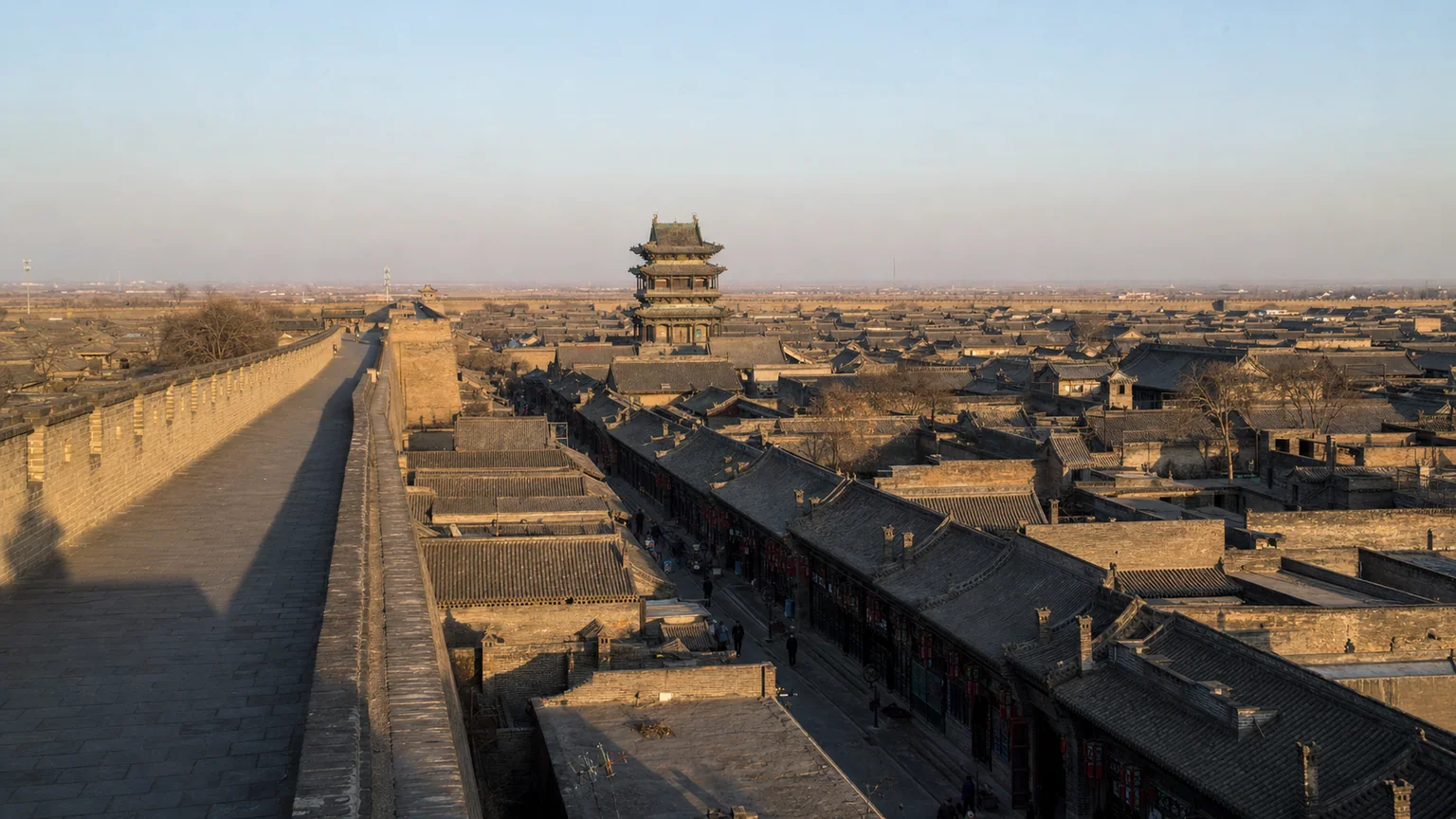
5A View location, maps and nearby scenic areasBefore following the busiest shop signs, climb to an authorised wall section if conditions and your mobility allow. Look inward. Grey roofs flatten into a dense field, the Market Tower rises over South Street, and the county yamen occupies a different part of the grid. Pingyao becomes legible not as one “ancient street,” but as a complete county town where defence, government, ritual, trade and domestic life were fitted together.
Now look down at the nearest lane. Delivery workers, residents, guesthouse staff and visitors still have to pass through that inherited geometry. The view is historic, but the city below is not a stage emptied for tourism.
Orient yourself through four anchors: the city wall defines the enclosure; South Street and the Market Tower reveal the commercial spine; the county yamen explains local government; Rishengchang and the side lanes connect finance to courtyards, clerks and households. The Pingyao Ancient City 5A scenic-area profile supplies the regional map point. Use the current official visitor map for actual wall entrances, ticketed compounds and temporary closures.
The wall is a map before it is a monument
Pingyao’s surviving brick-faced wall was built in 1370, early in the Ming dynasty, around an older settlement. It was repaired and altered repeatedly rather than frozen in that year. Its roughly six-kilometre circuit encloses about 2.25 square kilometres, with six principal gates: one north, one south, and two on each of the east and west sides.
That arrangement generated the popular image of a turtle—the south gate as head, the north as tail and the paired side gates as legs. Treat “Turtle City” as a useful local reading, not proof that every wall decision followed one symbolic master plan. The fortification also answered practical questions: where travellers entered, where goods could be checked, how patrols moved, and how a county seat separated controlled urban space from surrounding fields and roads.
Walk only where access is authorised. From above, compare the broad commercial axes with narrow lanes and deep courtyards. The wall makes repetition visible: roof ridge after roof ridge, then a temple roof or tower breaking the pattern. Looking outward is equally important. Modern Pingyao, rail and road connections, farmland and visitor facilities remind you that the protected town survives inside a much larger county economy.
A Ming–Qing fabric, not a city created in one reign
UNESCO inscribed the Ancient City of Ping Yao on the World Heritage List in 1997, recognising an exceptionally complete traditional Han Chinese county town and its record of urban, social, commercial and architectural change. The World Heritage property also includes Shuanglin Temple and Zhenguo Temple outside the wall. They require separate travel planning and should not be assumed to share the walled city’s admission or transport arrangements.
Inside the enclosure, the pattern is often summarised as four major streets, eight smaller streets and many lanes. The memorable numbers matter less than the hierarchy they describe. Main routes connect gates, markets and institutions; secondary streets distribute movement; courtyard passages create a quieter domestic grain behind the public façades.
Most of what gives Pingyao its character belongs to the Ming and Qing periods, but “Ming–Qing city” does not mean every beam or brick is original. Fires, weather, structural failure, changing households and organised conservation have required repair. Some compounds preserve substantial old fabric; others contain replaced timber, rebuilt walls or modern services. Read dated plaques carefully. Authenticity lies partly in the whole urban relationship, not in a fantasy that nothing has been touched.
Follow the axes from market to magistrate
South Street is the obvious commercial spine. The Market Tower—often called Shilou—marks the central townscape and gives photographers an instant symbol. Resist letting it become only a decorative lantern backdrop. Its position tells you where movement and exchange concentrated, while shops below reveal how a public route was narrowed by counters, awnings, carts and customers.
The county yamen belongs to a different system of power. A yamen was the magistrate’s administrative and judicial headquarters, not merely a grand residence. Offices, courts, archives, tax work, custodial spaces and service yards supported a local official whose responsibilities mixed functions now divided among many agencies. Labels and staged hearings can help explain procedure, but a scheduled performance is modern interpretation, not a surviving Qing court session. Check times on the day rather than organising the visit around an assumed show.
Moving between market and yamen reveals how a county town joined commerce to rule. Merchants needed contracts, tax arrangements and dispute settlement; government depended on clerks, runners, guards, cooks and people who copied, carried and stored documents. Look beyond the magistrate’s seat. The small rooms and repeated thresholds show how much ordinary labour made authority function.
Courtyards turn street fronts into lived space
On a main street, façades form an almost continuous commercial wall. Turn into a permitted side lane and the city changes scale. A doorway may lead through a narrow entrance court into a sequence of yards, rooms and service spaces arranged along an axis. High exterior walls protect privacy and help manage wind, dust and security; inner courtyards bring light into deep plots.
Do not treat every courtyard as a universal “traditional Chinese home.” Plot width, wealth, date, family structure and later subdivision produced different plans. Carved brick, timber screens and stone bases may display status, but kitchens, wells, heating, storage and drainage made residence possible. Builders, carpenters, masons, tile makers and repair workers belong to the story as much as the merchant who paid for a decorated gate.
Many compounds are still homes, workplaces or small lodgings. An open doorway is not automatic permission to enter. Keep voices low in residential lanes, do not photograph residents through windows, and ask before using a domestic threshold as a portrait set. A heritage city remains credible only if daily life is allowed more than a supporting role.
Rishengchang made distance an accounting problem
At Rishengchang, pronounced roughly ree-shung-chahng, the most important object is not a vault full of picturesque silver. It is the idea of a verified claim travelling farther and more safely than the metal it represented. Founded in 1823, Rishengchang is conventionally identified as the first piaohao—a branch-based draft bank.
Its roots lay in the Xiyucheng dye business. As long-distance trade expanded, carrying silver created cost and robbery risk. A customer could deposit funds at one branch and receive a draft; another branch could pay the named recipient after checking the document, account and coded authentication. Funds still had to be balanced across the network, and silver did not disappear. The system reduced how often one customer had to carry a heavy fortune across dangerous routes.
Displays commonly use the phrase “汇通天下”, which can be translated as “remittances reach all under heaven.” Read it as a commercial ambition and a modern echo, not a claim that one firm controlled every transaction in China. Rishengchang’s achievement depended on trusted branches, timely information and disciplined bookkeeping—an analogue to correspondent banking, though it operated in a very different legal and technological world.
Merchants prospered because clerks carried trust
The romance of “Shanxi merchants” often centres on owners who left imposing houses and family names. Draft banking also relied on managers, travelling agents, bookkeepers, code keepers, apprentices, guards and domestic workers. Clerks copied figures accurately by hand; branch staff judged documents and people; messengers carried information; families absorbed long absences. A beautiful account room is evidence of controlled labour as well as commercial sophistication.
Trust did not remove risk. A branch could face delayed news, forged instructions, robbery, bad debt, political upheaval or a shortage of liquid silver. Secret codes helped authenticate drafts, but they were procedures used by people, not magic encryption. Piaohao later handled substantial merchant and government remittances, tying private firms to public finance. That closeness created opportunity and vulnerability.
Modern-style banks, fiscal reform, war and the political shocks of the late Qing and early Republic undermined the old system. Rishengchang eventually ceased operating. The lesson is not that Pingyao invented modern banking fully formed, nor that commerce advanced without cost. It is that merchants and employees built a practical answer to distance—and that every network of credit depends on institutions, information and human judgement.
Conservation must keep a city habitable
World Heritage status protects more than famous compounds. The wall, roofscape, street widths, drainage, ordinary courtyard houses and relationships among them create Pingyao’s integrity. Yet a dense timber-and-masonry city also needs fire safety, sanitation, structural maintenance, heating, wiring and access for emergency services. Conservation that preserves a façade while making a house impossible to inhabit simply transfers the problem.
Tourism supplies income for guides, lodging owners, food businesses, craftspeople and repair work. It can also concentrate souvenir retail on a few streets, raise pressure to convert homes into commercial space, overload lanes and encourage repairs chosen for speed or appearance. Night lighting makes the axes legible, but it can turn a working neighbourhood into a continuous backdrop.
Look for repair evidence rather than demanding an untouched city: numbered components, new mortar beside old brick, protected carved panels, modern pipes placed with care. Good conservation is often visible as restraint. It also depends on resident participation, skilled crafts and regulations that may frustrate both owners and investors. The tension is not a flaw outside the heritage story; it is the present chapter of that story.
Choose a route by attention, not by ticket count
For a focused half day, begin with a wall section if it is open, then descend toward South Street and the Market Tower. Give Rishengchang enough time to understand one draft from deposit to payment. Finish at the county yamen, reading the work spaces rather than collecting every courtyard on the combined pass.
For a full day, add the Confucian Temple or another ritual complex, then leave the main axis for residential lanes. Alternate enclosed museums with outdoor walking; dozens of similar compounds quickly blur if you never pause to compare plan, function and restoration. A combined ticket is not a challenge to visit every included site.
An overnight stay changes the city’s rhythm. Early morning can reveal deliveries, breakfast stalls and quieter brickwork; after day groups leave, evening light clarifies the axes. The trade-off is practical. Heritage inns may have high thresholds, steep stairs, firm kang-style beds, limited lifts, thin sound insulation or a walk from the vehicle drop-off. Confirm the exact room, luggage help, heating or cooling and late arrival route rather than booking only from courtyard photographs.
Photograph relationships and plan for real surfaces
For the most informative wall photograph, include a gate or tower in the foreground and let roofs lead toward the Market Tower. From street level, step to one side of South Street so its commercial axis converges through signs and upper storeys instead of filling the frame with a single shop. In courtyards, expose for the bright sky carefully and avoid flash where rules or fragile decoration make it unsuitable.
Tripods, drones, professional shoots and photography inside particular museums may require permission. Performances, projection, lighting and wall openings can change with season, weather, maintenance and crowd management. Check current official notices. Summer can bring heat, storms and slippery brick; winter brings cold, wind and possible ice. Neither a clear skyline nor a sunset wall walk can be promised.
Main lanes are relatively level, but stone paving, drains, thresholds, crowds and courtyard steps interrupt a step-free route. The wall usually requires substantial stairs and has exposed, uneven surfaces. Ask the visitor centre for the current accessible itinerary and accessible toilets; treat scenic shuttles as variable services, not guaranteed door-to-door transport. Carry the passport or identity document used for any reservation if current rules require it, and confirm how combined tickets are validated.
Return at last to the wall or a gate and look both ways. Inside is a city shaped by magistrates, traders, clerks, builders and families; outside is the transport and service landscape that keeps it connected. Pingyao is moving not because old bricks imitate life, but because people continue to negotiate what those bricks are allowed to hold.
Continue through Shanxi by comparing the merchant county town with the mountain routes of Mian Mountain, the contested memory landscape of the Hongdong Locust Tree, or the long architectural history of Jinci and Tianlong Mountain.
The LoreLens app can help you distinguish Pingyao’s wall, civic institutions, draft-bank exhibits and residential fabric while you walk.
Location profile
Where it is

Frequently asked questions
How much time should I allow for Pingyao Ancient City?
A focused half day can combine one wall section, the South Street axis, Rishengchang and the county yamen. A full day leaves time for residential lanes and serious museum reading. Staying overnight adds quieter early and late walks, but heritage lodgings can have steps, thin sound insulation and limited vehicle access.
Is it free to enter Pingyao Ancient City?
Walking through parts of the walled town is commonly separate from admission to the wall and ticketed compounds, which are often sold through a combined pass. Inclusions, validity, entry gates, passport or identity checks and individual-site arrangements can change, so confirm the current official rules before arrival.
Is Rishengchang really China’s first bank?
It is conventionally described as China’s first piaohao, or draft bank, founded in 1823. That is more precise than calling it the first Chinese financial institution: money shops, pawnshops, merchant credit and state finance all existed earlier. Rishengchang’s importance lies in its branch-based remittance system.
Can everyone walk on the full city wall?
Do not assume the entire circuit or every stair is open. Access points can close for maintenance, crowd control, ice, rain, wind or other safety reasons. The wall involves steep stairs, exposed weather and uneven paving; ask about current accessible alternatives and keep children away from parapet edges.