Shanxi · Linfen
Hongdong Great Locust Tree: Where Migration Became Memory
Stand beside the stele marking a vanished tree, then trace how early-Ming resettlement records, family stories and modern ancestor rites made Hongdong a symbolic homeland.
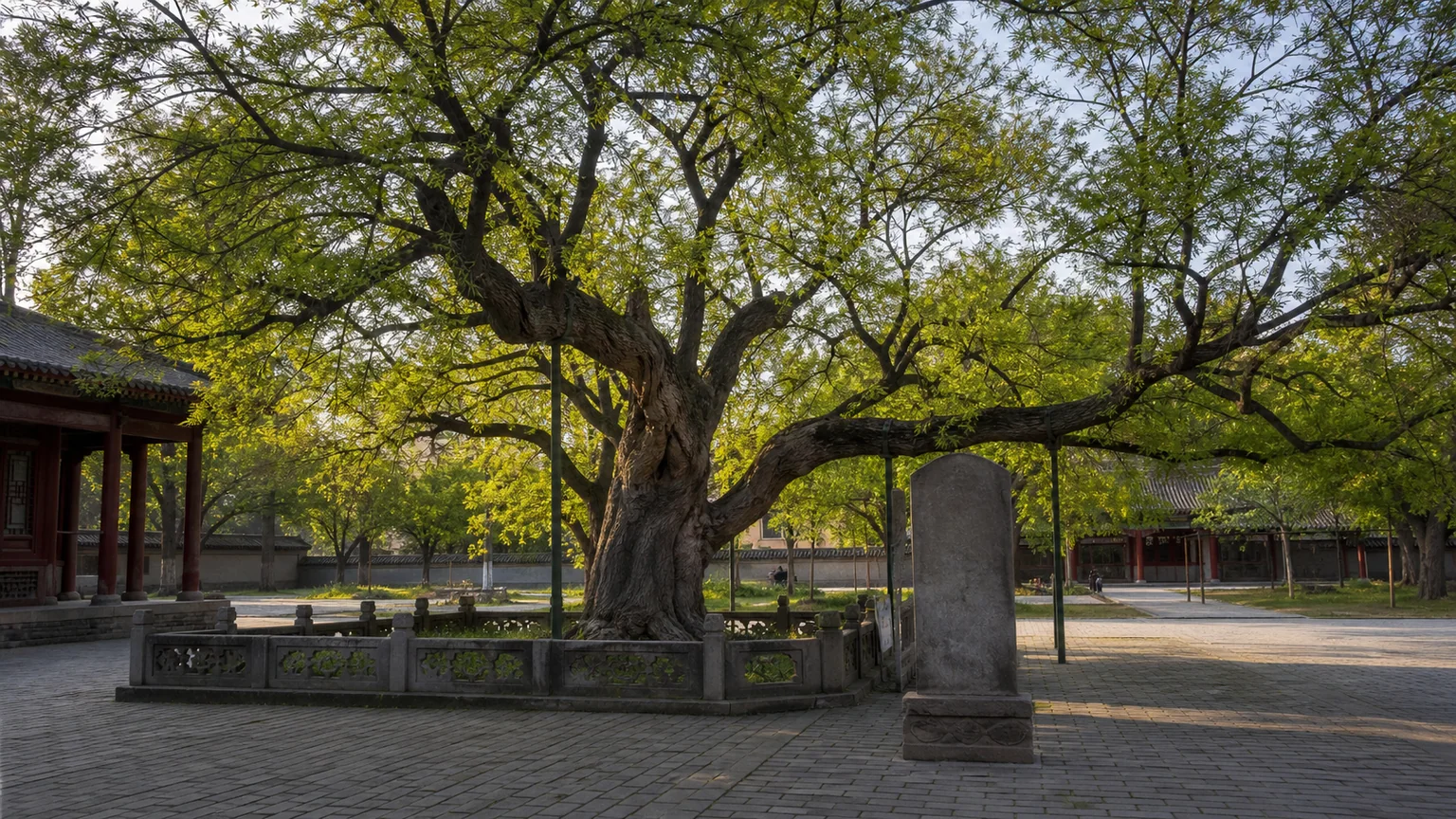
5A View location, maps and nearby scenic areasBegin with the stone inscription, not the biggest tree. The characters “Site of the Ancient Great Locust Tree” point to an absence: the tree remembered as the last landmark seen by early-Ming migrants is gone. Living canopies around you belong to successor plantings and a memorial landscape built later.
That absence is the key to Hongdong Great Locust Tree Root-Seeking and Ancestor Memorial Garden. Its value does not depend on pretending one living trunk watched every departure. The site joins three different things: documented state-organised migration, family memory transmitted over centuries, and modern public ritual.
Read in this order: location stele and tree generations → migration history exhibition → surname and genealogy displays → ancestral halls and ritual space. Evidence comes first; memory and ceremony then show what later generations did with it.
The original tree, the stele and the trees you see today
The Chinese word huai usually refers to the Chinese scholar tree (Styphnolobium japonicum), not the North American black locust. A large huai once stood near Guangji Temple and a north–south road. In the departure tradition, officials assembled migrants in this vicinity before groups travelled onward.
The medieval tree did not survive into the modern memorial garden. An early-twentieth-century stele marks the place remembered as its site. Nearby trees are identified locally as later generations or successors, and different plantings carry different relationships to the original—claimed root growth, propagated descendants or commemorative replacement. Onsite labels matter.
This does not make the landscape “fake.” Memorials often preserve a location and relationship after the original object is lost. But the distinction should remain visible. Say “the place associated with the ancient tree,” not “this trunk is six hundred years old,” unless the label for that exact tree supports it.
Look for how designers frame the stele with branches. Stone fixes a location; living foliage supplies continuity. The tension between them is more meaningful than a forced claim that nothing changed.
What early-Ming records actually establish
The fall of the Yuan and founding of the Ming followed decades of war, rebellion, flood, epidemic and displacement. Damage was not uniform, and no single cause emptied all of North China. Many districts in Hebei, Henan, Shandong and adjoining regions had lost population and cultivated land, while parts of Shanxi remained comparatively populous.
Ming rulers used organised resettlement to reopen fields, rebuild tax-paying households, supply strategic areas and support the northern capitals. Court records document repeated orders moving people from more populous districts, including Shanxi, to places classified as underpopulated. This was administration on a human scale: acreage and revenue in the memorial became a family’s departure in practice.
The scenic area’s standard account counts 18 major migration mobilisations from 1370 to 1417, across the Hongwu and Yongle reigns, and maps descendants across a very wide area. Treat that as a widely used synthesis of records and later local research, not as one complete passenger list. Sources differ over which orders to count, which assembly points they used and how later movements should be linked to Hongdong.
Hongdong was therefore a major historical and symbolic node, but not the only origin or processing point for every Shanxi migrant. “We came from the Great Locust Tree” can preserve a real regional migration memory even when a particular household cannot be placed beneath one canopy on one day.
How a state migration became a family rupture
Officials did not simply point east and let people wander. Resettlement required household registration, quotas, destinations, travel documents, provisions and escorts. Clerks copied names and family categories; local officials selected or reported households; guards and route officers moved groups; receiving administrations allocated land and entered newcomers into new obligations.
The degree of choice varied. Some migrants may have seen land and tax concessions as opportunity; others resisted a coercive order. Families could be divided by quotas, death or flight. Women, children and older relatives experienced the journey as well as adult men, although official documents often foreground taxable male household heads.
Arrival was not an ending. Migrants had to build shelter, clear or reclaim fields, find water and negotiate with people already present. Receiving communities were not empty scenery: they could gain labour and restored cultivation while also facing competition, changed land rights and new administrative burdens. Place names, foodways, speech and ritual adjusted across generations.
The memorial garden naturally emphasises departure. While viewing a route map, also imagine the desks at both ends and the villages between. State reconstruction produced new communities, but it did so through disrupted old ones.
The locust tree became a portable homeland
A rhyme repeated in many northern families asks, in varying wording:
Where is my ancestral home? At the Great Locust Tree in Hongdong, Shanxi.
What was the old home called? By the old bird’s nest beneath the tree.
The rhyme is not a migration register. It is a memory device: place, tree and nest compressed into lines a child could carry. A tree glimpsed while leaving became the image used by descendants who had never seen Shanxi.
Other stories explain shared bodily marks or words. One says officials tied migrants’ hands and that requests to have them “untied” produced a modern expression for using the toilet. Another links a split little toenail to a mark placed on departing families. These are powerful folk etymologies and kinship legends, not established linguistic or biological evidence.
Their endurance still matters. They turn a vast bureaucratic process into something intimate: wrists, toes, a nest and a final backward glance. Read them as evidence of how displacement was narrated, not as a test for who is a “real” descendant.
Surnames begin research; they do not finish it
Surname walls and lineage displays create an immediate thrill of recognition. Yet one Chinese surname may contain many unrelated lines, and a family line may change surnames through adoption, remarriage, official error, concealment or cultural assimilation. The same village origin can also be claimed by unrelated genealogies.
A stronger inquiry moves backwards from the known. Start with living relatives, dated family books and graves; compare local gazetteers, land deeds, temple inscriptions and household records. Note when the earliest surviving genealogy was compiled and whether it cites older documents. A Qing- or Republican-era text describing a Ming migration may preserve earlier knowledge, but it is not contemporary testimony.
Genealogies can be lost to war, poverty, political campaigns, insects and migration itself. Later reconstruction is not automatically dishonest. Families often rebuild identity from fragments. The responsible conclusion may be “consistent with the Hongdong migration tradition,” not “proven to have stood beneath the original tree.”
At the displays, search your surname for curiosity, then photograph the explanatory context as well as the character. A name without date, branch and place cannot carry a six-century argument alone.
Ancestor worship makes history a relationship
The garden is not only a migration museum. Descendant groups come to offer flowers or incense, read memorial texts, present genealogy and bow before ancestral symbols. Large public rites are commonly organised around Qingming, the spring season for tending graves and remembering the dead, while private visits occur throughout the year.
Ritual does not require every genealogical link to meet a modern archival standard. Participants may honour named ancestors, the suffering of migrants more broadly, or an idea of shared origin. Public ceremony can transform scattered households into a temporary community.
Observe with restraint. Do not cross between participants and an altar, touch offerings or ancestral tablets, or occupy the centre line for a photograph. Ask before recording a family reading names or displaying a genealogy; those details may be private even in a public garden. Follow instructions about incense and fire.
Ceremonies advertised by the scenic area may include formal music, processions and staged elements. Their schedule and choreography are contemporary heritage practice, not an unchanged Ming ritual. That does not make them meaningless; it identifies when and why the present community shaped them.
Whose labour built the migration story?
The famous narrative starts with emperors and orders, but implementation depended on magistrates, clerks, runners, guards, cart drivers and local headmen. Their paperwork decided whose household was legible to the state. Mistakes, bargaining and unequal influence could change who moved.
Migrants carried seed, skills, devotional practices and memories, but they also left property and graves. Women sustained households during travel and established kin networks after arrival. Children grew up with a remembered Shanxi they might never revisit. Receiving villagers negotiated marriage, boundaries, markets and ritual with newcomers.
Centuries later, genealogists, local scholars, donors, craftspeople, gardeners and ritual organisers turned an absent tree into a public memorial. Tourism workers now translate that history for school groups and returning families. Their work creates access but can also simplify many migrations into one departure scene.
Listen for plural experiences. State policy could restore production and still inflict coercion; migration could create opportunity and still carry grief. A root-seeking site is strongest when it can hold both.
A practical route through the memorial garden
Start at the ancient-tree location stele and identify which nearby trees the current map calls successor generations. Continue to the migration exhibition before the surname halls. Dates, maps and administrative terms will keep later displays from becoming free-floating legend.
Use the Hongtong Great Locust Tree 5A profile and map to locate the wider attraction, then rely on the current onsite map for open halls, ceremony controls and the exact labels attached to each tree.
Next, explore surname or lineage material selectively. Choose one family story and ask what kind of source supports it. Then enter the ancestor memorial and ritual spaces. Finish in the landscaped grounds, where roots, branches and returning birds repeat the site’s central metaphor.
Two to three hours suits a careful first visit. A shorter route can prioritise the stele, one history gallery and the main memorial hall. Tickets, opening hours, passport or identity checks, guided programmes and public transport change; carry your passport and confirm the official current arrangement. Hongdong is connected by rail and road, but station transfers and tourist shuttles should not be assumed without checking.
During a major ceremony or school holiday, decide whether atmosphere or quiet reading matters more. Festival crowds show the site functioning as a shared homeland; an ordinary weekday makes inscriptions and exhibit text easier to study.
Photography, crowds and accessible choices
For the essential image, place the location stele beneath living branches. The frame then states the truth: remembered place, lost original and continuing life. A person standing at respectful distance supplies scale. In the ritual area, photograph architecture and public processions only where allowed; private grief, genealogies and offerings deserve consent.
The garden is generally gentler than a mountain or walled-city route, with broad landscaped paths in many areas. Nevertheless, distances can be long, thresholds or steps remain at some halls, and dense festival crowds create their own barrier. Ask about step-free entrances, wheelchair availability, accessible toilets and seating before arrival.
Summer sun and humidity can make open plazas tiring; rain makes paving slick, and winter can be cold. Carry water, use shade and wear stable shoes. Keep children close in processions and avoid backing into incense stands or other visitors while photographing.
Tripods and drones may be restricted, and performance routes can close viewpoints temporarily. Confirm current rules rather than copying another visitor. The most respectful photograph may be the one taken after a family has finished its rite.
Keep the memory broad enough for uncertainty
The memorial garden preserves no complete list of all migrants and no untouched medieval tree. What it does preserve is a rare convergence: Ming policies recorded at court, local and family documents scattered across receiving regions, repeated oral formulas, and descendants who turned Hongdong into a place of return.
Pingyao Ancient City shows how registration, finance and family enterprise organised a settled urban community. Mian Mountain approaches remembrance through ritual landscape, while Yunqiu Mountain connects village tradition, seasonal practice and upland ecology. Each asks how communities make continuity visible.
Return to the stele before leaving. It does not claim to be the vanished tree; it tells you where people chose to remember one. Historical discipline asks which migration can be documented. Ancestral memory asks what loss meant to those who carried the story. Hongdong becomes most truthful when neither question silences the other.
Use the LoreLens app to identify Hongdong’s stele, memorial trees and ritual spaces, then hear how migration records became family memory.
Location profile
Where it is

Frequently asked questions
Is the tree at Hongdong the original Ming-dynasty locust tree?
No. The medieval tree associated with the departure tradition no longer survives. A stele marks its remembered site, while living trees in the garden are presented as later-generation or commemorative successors. Read the onsite labels rather than treating every large tree as the original.
Can my surname prove that my ancestors migrated from Hongdong?
A surname or family saying is a useful research lead, not proof by itself. Compare dated genealogies, tomb inscriptions, local gazetteers, land and household records, and migration histories; allow for adoption, surname changes, lost documents and later family reconstruction.
How much time should I allow for the memorial garden?
Two to three hours usually allows the stele and successor trees, migration exhibitions, surname displays and ancestral halls without rushing. Ceremonies, school groups and holiday crowds can add time, while current open areas and tickets should be checked officially.
When are the major ancestor-worship ceremonies held?
The largest public programme is commonly associated with the Qingming season in early April, but dates, access, rehearsals and crowd controls can change. Confirm the official annual schedule, and remember that private family rites may occur at other times.