Shanxi · Jinzhong
Mian Mountain: Cliffs, Pilgrimage and Cold Food
Move through cliff-built temples, ravines and shuttle-linked valleys while separating the Jie Zitui fire legend from early records—and deciding how much steep terrain your day should hold.
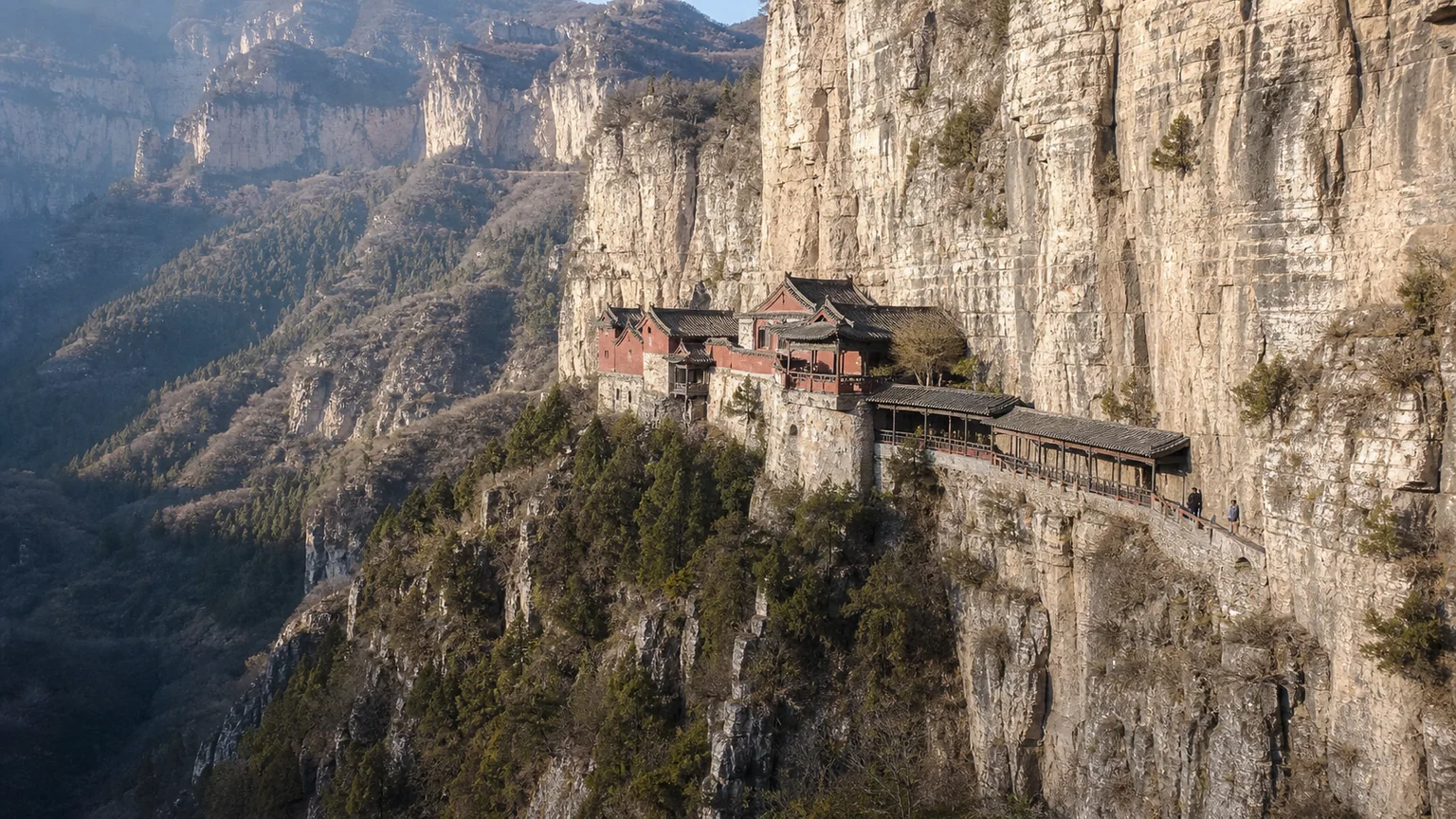
5A View location, maps and nearby scenic areasStand across the valley from one of Mian Mountain’s cliff-hugging complexes before walking into it. Balconies, roofs and stair towers seem pressed between rock and air. Then follow the structure with your eyes: some rooms occupy natural recesses, some sit on terraces, and modern roads, railings and service buildings make today’s approach possible.
That layered view is the honest beginning. Mian Mountain—Mianshan, pronounced roughly myen-shahn—is neither one ancient temple nor one wild summit. It is a long mountain destination where religious rebuilding, Jie Zitui memory, forest and water, road engineering and mass tourism now share the same ravines.
Plan by zones, not by a summit: a cliff-built cluster such as Yunfeng Temple or Daluo Palace explains architecture and worship; Jiegong Ridge carries the Jie Zitui tradition; a ravine route such as Qixian Valley or Shuitaogou brings water and ecology into the visit. The Jiexiu Mian Mountain 5A scenic-area profile provides the map anchor. Use the current official route map for actual shuttle stops, lift access, one-way controls and closures.
The mountain works as a corridor, not one viewpoint
Mian Mountain lies in the Taiyue mountain system southeast of Jiexiu. Official and conservation sources give different elevations and extents because “Mianshan” can mean a broad mountain range, a protected landscape or the managed scenic area. For a visitor, the useful scale is simpler: attractions are distributed for many kilometres along steep roads and branching gullies. A name that looks adjacent on a diagram may require a shuttle transfer and a substantial stair climb.
The topography alternates between exposed cliff bands, forested slopes, rock recesses and narrow water-cut valleys. Built spaces occupy ledges where foundations, retaining walls and access could be negotiated. From a road turnout, look for the engineering before the decoration: drainage channels above roofs, piers below terraces, protective netting or repaired rock, and the service route by which food, fuel and building material arrive.
Internal buses or shuttles commonly organise movement because the road distances and gradients are too large for an ordinary continuous walk. Their stops, frequency, direction and last departure can change with season, crowding, weather and works. Do not read a schematic tourist map as a promise that every branch is operating.
Cliff architecture records repeated rebuilding
The great recess known as Baofu Rock—the “rock embracing the belly”—shelters the Yunfeng Temple area. The cave-like overhang is geological; the stairs, halls, railings and service structures beneath it are human layers. Looking sideways is more revealing than looking straight at a façade. You can see how builders used rock as roof, back wall and visual authority while still needing beams, masonry, drainage and continual repair.
Elsewhere, the large Daluo Palace complex climbs the cliff in stacked terraces. Its present appearance includes substantial modern reconstruction and expansion. That does not make it irrelevant, but it changes the question. Instead of assuming every painted bracket is ancient, ask what earlier sacred claims the reconstruction presents, what materials are new, and how a late-twentieth- or twenty-first-century visitor economy reshaped the mountain silhouette.
Fire, weather, rockfall and political change have repeatedly damaged mountain buildings. Temple histories often preserve an early foundation date while the visible hall belongs to a much later rebuilding. Read plaques for the date of the current fabric, not only the claimed origin of worship. Original rock setting, repaired historic components, reconstructed halls and new tourist infrastructure can all appear in one photograph.
Jie Zitui stands between record and legend
Mian Mountain’s most famous human story concerns Jie Zitui, also written Jie Zhitui, a follower of Chong’er. Chong’er spent years in exile before returning to rule the state of Jin as Duke Wen in the seventh century BCE. The early Zuo Commentary says that Jie refused to claim reward after the restoration, withdrew, and died. The duke then set aside land at Mianshang, saying it would “mark my fault and honour the worthy man.”
That early account gives the story its moral tension: service without self-promotion, a ruler who rewarded allies unevenly, and remorse that arrived too late. It does not describe Duke Wen setting the mountain on fire to force Jie out, nor Jie dying with his mother beside a willow. Those dramatic elements belong to later tradition.
The distinction does not make the legend meaningless. The burning episode turned political memory into a story that can be retold beside a real forest: power tries to compel loyalty, destroys what it wants to recover, then creates ritual from remorse. At Jiegong Ridge and memorial halls, look for labels that separate classical text, later literature, local custom and modern scenic presentation.
Cold Food memory became larger than one biography
According to the familiar tradition, Duke Wen prohibited fire after Jie’s death, and people ate cold food in remembrance. Mian Mountain is therefore promoted locally as a birthplace of the Cold Food Festival, or Hanshi. Historical scholarship is more cautious. Seasonal fire-renewal customs and prohibitions had their own histories, while the association with Jie developed over time. Cold Food observance later overlapped and blended with Qingming, the spring tomb-sweeping festival.
That evolution is the modern echo. Jie is remembered not only as a person in an ancient political text but through food, ancestral visits, moral education and place branding. “Loyalty” is not a simple virtue here. Jie’s refusal can be read as integrity, protest or withdrawal from compromised reward; the ruler’s memorial can be read as repentance and as an attempt to control memory after death.
If a ceremony, food demonstration or festival event takes place during your visit, watch respectfully but do not assume it is performed daily or in an unchanged ancient form. Schedules, access and content vary. Do not light your own fire, burn offerings or imitate the mountain-burning story outside an explicitly authorised ritual area. Forest protection is a more urgent form of respect than reenactment.
Buddhist and Daoist layers share the cliffs
Mian Mountain contains both Buddhist and Daoist sacred spaces, along with shrines shaped by local devotion and the cult of Jie Zitui. Their presence does not form a neat timeline in which one religion simply replaced another. Patrons, monks, priests, pilgrims and political authorities supported different sites at different moments, and reconstruction can place several traditions close together on the current route.
At a Buddhist hall, identify the central image and attendant figures before photographing ornament. At a Daoist complex, look for the hierarchy of deities, mountain immortality traditions and the upward sequencing of terraces. A scenic label may compress a complex theology into “culture.” Give the worship space time to explain itself through incense tables, donor inscriptions, ritual movement and the behaviour of present visitors.
These are not merely collections of photogenic roofs. Keep voices low during chanting or prayer, dress for active temples, do not step over offerings, and ask before photographing monks, priests or worshippers. Where revered remains, relics or memorial images are displayed, avoid jokes, touching and sensational close-ups. A ticket gives access; it does not erase religious etiquette.
Pilgrims, builders and workers made the route possible
The cliff view celebrates daring architecture, but a building does not cling to a mountain by metaphor. Masons shaped retaining walls, carpenters assembled frames, roofers and painters worked above drop-offs, and labourers carried materials along paths that were far less engineered than today’s road. Later repair crews added drainage, rock protection, wiring and fire systems. Every terrace records risk transferred to workers.
Pilgrims also produced the landscape by returning, donating, carrying incense and attaching stories to particular caves, springs and ridges. Nearby communities supplied food, transport and knowledge of weather. Today the chain includes shuttle drivers, cleaners, vendors, guides, ticket staff, maintenance teams and rescue workers. Their schedules determine whether an apparently simple itinerary functions.
Tourism creates income and can fund repair, yet large roads, lifts, hotels, performance spaces and reconstructed palaces change the mountain they help people see. The choice is not “pure nature” versus “fake tourism.” It is how much construction a fragile cliff corridor can carry, whose access improves, who bears the maintenance cost, and whether sacred and ecological limits remain visible.
Water reveals both ecology and management
Routes such as Shuitaogou are valued for streams, shaded forest and cascades. Qixian Valley offers a narrower gorge experience where steps, bridges or assisted passages can bring visitors close to rock and water. These names should not become guarantees. Flow responds to rain, drought, freezing, upstream conditions and sometimes visitor-area management. A promotional waterfall photograph may represent one season or one release.
Water also explains the buildings. Springs and runoff supplied worshippers and residents, but storm water can undercut paths, enter roofs and dislodge rock. Drainage channels and retaining structures are part of heritage survival. In winter, a wet stair becomes ice; after heavy rain, a narrow gorge can be a poor place to wait for instructions.
Stay on authorised paths, do not enter pools or cross barriers for a clean photograph, and carry out litter. Hotels, toilets, restaurants and large visitor volumes all use water and produce waste in a mountain catchment. The stream is not scenery separate from tourism infrastructure; it is the system that infrastructure must not overwhelm.
Choose one cultural spine and one landscape route
For a culture-focused day, use internal transport to connect one cliff complex—Yunfeng Temple or Daluo Palace, depending on current access—with Jiegong Ridge. This gives time to compare visible construction with the Jie Zitui narrative. Do not add every named hall simply because the shuttle diagram lists it.
For a mixed route, spend the first part of the day at a religious cluster, then choose either a water valley or a shorter road-served overlook. Qixian Valley may involve close rock, water, metal steps or steep transitions; Shuitaogou can require a longer out-and-back walk. Exact conditions vary, so ask staff which route matches current weather and your group’s slowest walker.
A mobility-limited visit can still use selected shuttle-served terraces and distant cliff views, but “served by bus” does not mean step-free. Temple thresholds, stair towers, slopes and gaps between stops remain. Lifts or escalator-like facilities, where offered, may require separate tickets or be unavailable. Confirm accessible toilets, boarding assistance and the return route before committing to an upper stop.
Transport from Jiexiu, parking controls, scenic admission, internal vehicle fees and identity requirements can change. Carry the passport or document used for any reservation if current rules call for it. Leave a margin before the last return rather than treating the published final shuttle as a target.
Mountain safety should shape the photographs
On a cliff walk, keep one hand free for railings and stop before composing a photograph. Do not back toward an edge, climb a parapet or block a narrow stair. Rain makes polished paving and metal steps slippery; wind, lightning, ice, rockfall risk, maintenance or wildfire conditions can close apparently sheltered routes. Follow barriers even when another visitor crosses them.
For a strong photograph, shoot across the valley so architecture and supporting rock share the frame. A close façade hides the scale that makes Mian Mountain distinctive. In a gorge, include a person only with consent and from a safe position; the figure can explain scale without requiring a risky ledge pose. Drones, tripods and professional shoots may be restricted, especially near temples and narrow paths.
Weather and altitude within the route can change faster than conditions in Jiexiu. Carry water and a layer, but do not assume vendors operate at every stop. Visitors with heart, balance or knee concerns should choose road-served views over ladders and long descents. Families should keep children between adults on crowded stairs. Emergency access is slower in a ravine than at a city attraction.
End from a safe turnout across the valley. The buildings no longer seem to float by miracle: behind them are rock ledges, drains, repeated rebuilding, religious practice, workers and an internal road. Jie Zitui’s story also looks different. The useful memorial is not the certainty of a fire legend, but the harder question preserved in the mountain—what does a society owe to service it recognises too late?
Continue through central Shanxi with the urban commerce of Pingyao Ancient City, the household and statecraft of Huangcheng Chancellor’s Mansion, or the migration memory gathered at the Hongdong Locust Tree.
The LoreLens app can help you separate Mian Mountain’s cliff geology, sacred spaces, Jie Zitui memorials and modern visitor infrastructure as you move between zones.
Location profile
Where it is

Frequently asked questions
How much time should I allow for Mian Mountain?
Treat a full day as the minimum for one cliff-built religious cluster and one valley or memorial route without rushing. The scenic area extends along mountain roads, and transfers, queues, stairs and closures consume time. An overnight stay may allow a slower visit, but confirm current lodging, last-shuttle and road arrangements.
Is Mian Mountain the origin of the Cold Food Festival?
Local tradition strongly links Mian Mountain, Jie Zitui and the Cold Food Festival, and the association has shaped ritual and public memory for centuries. Early accounts record Jie withdrawing and dying but do not contain the familiar mountain-burning episode. The festival’s origins and its later fusion with Qingming are historically more complex.
Can I visit Mian Mountain without climbing many stairs?
Some zones are commonly reached by internal road transport, but major temples and cliff walks still involve stairs, slopes and uneven surfaces. Lifts or other assistance may exist in particular areas but can close or require separate arrangements. Ask the visitor centre for the current least-stepped route before buying or boarding.
Do the waterfalls and cliff paths operate all year?
No natural water feature or mountain path should be treated as guaranteed. Flow changes with rainfall, drought, freezing and local water management; paths can close for ice, rockfall, storms, maintenance or fire risk. Check same-day official notices and keep a road-served alternative.