Shanxi · Jincheng
Huangcheng Xiangfu: A Household Built Like a Fortress
Read defensive walls before elegant courtyards, then follow a multigenerational Chen household from late-Ming insecurity to Kangxi-era office, scholarship and modern heritage tourism.
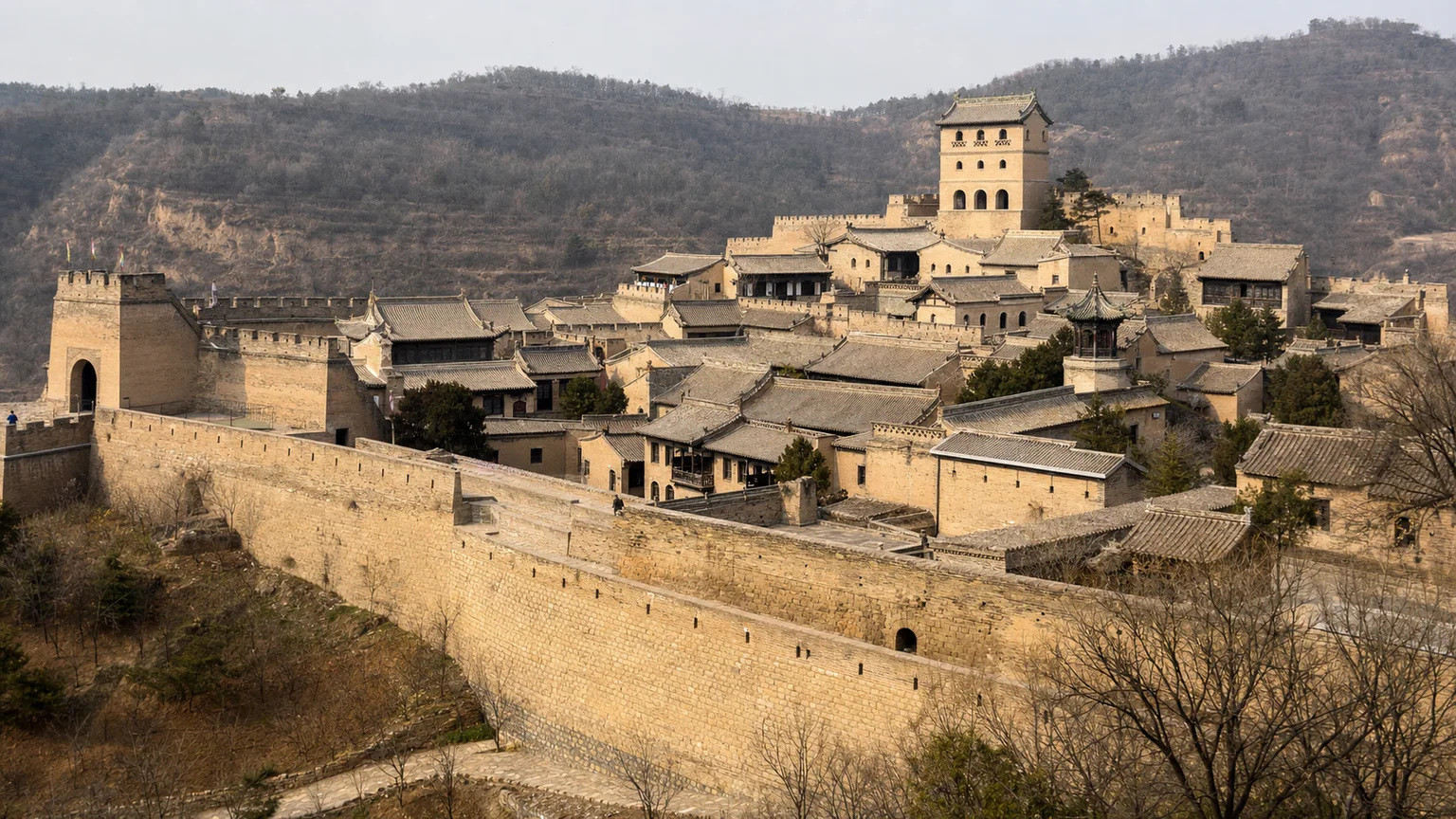
5A View location, maps and nearby scenic areasBefore looking for the grandest gate, place one hand near the rough wall—without touching fragile masonry—and look upward. Crenellations, narrow passages and a tall refuge tower belong to defence. Turn towards the next courtyard: carved lintels, reception halls and an honourific arch belong to status. Huangcheng Xiangfu makes sense only when those two architectural languages are read together.
The usual English name, House of the Huangcheng Chancellor, centres the Qing official Chen Tingjing. He matters greatly, but this was not a purpose-built palace for one celebrity. It grew across generations as a fortified clan settlement, working household, study environment and statement of bureaucratic success.
Follow four movements: outer ceremonial courts → residential and study spaces → older fortified inner city → an authorised wall or high viewpoint. Reverse the order if a performance or crowd blocks the entrance, but preserve the contrast between office and refuge.
A double city rather than a single mansion
The compound stands in Huangcheng village, Yangcheng County, on the southern edge of the Taihang region. Its terrain rises irregularly, so walls, lanes and courtyards step with the slope rather than obeying one perfectly flat palace grid.
The older inner section is commonly called Douzhuju. It was developed by Chen family elders in the troubled final decades of the Ming dynasty and combines residence with fortification. The outer section, Zhongdaozhuang, became more closely associated with Chen Tingjing’s household and official standing. Construction dates on site descriptions do not reduce neatly to one year: buildings began in the late Ming and were repeatedly altered into the Qing, with major residential work continuing to around 1703.
That layered chronology explains why published room counts and total-area figures differ. Some count only the historic walled residence; others include gardens, village streets or the larger tourist zone. “Hundreds of rooms” communicates the scale more honestly than pretending every restored chamber belonged to one unchanged plan. The 5A profile and map helps locate the attraction; the walls reveal how unevenly its parts fit together.
Defence came before display
The most forceful building is Heshan Tower, dated by the site to 1632. It was designed as a multi-storey refuge amid late-Ming violence. Thick walls, elevated access and internal provisions made it different from a normal viewing tower. Nearby defensive cave rooms, often called cangbingdong, fit into the slope and wall system, supporting shelter, storage and defence.
Site interpretation says hundreds of people once survived an attack inside the tower. That story conveys the building’s remembered refuge function, but the exact crowd and every dramatic detail are difficult to verify independently. The material evidence is enough: this household invested heavily in collective protection before it advertised courtly prestige.
Who was being protected? Not only a future grand secretary. A large compound contained relatives of different branches, children, servants, stewards and guards; surrounding villagers might also seek security during crisis. The architecture reveals unequal access—some rooms were more protected and comfortable than others—but a siege forced elite and local survival into the same enclosure.
From an open wall section, look down rather than only out. Angled lanes, controlled gates and inward-facing courtyards break a direct approach. Defence here was not one heroic tower; it was movement slowed and observed at several layers.
Courtyards turned family rank into space
In the more ceremonial section, gates repeatedly sort public from private. A front hall could receive visitors and conduct household business; deeper rooms served residence. Side yards supported study, management and service. The Grand Secretary’s Residence, stone archway, ancestral spaces, gardens and quarters carrying modern labels such as “steward’s court” or “young ladies’ court” make hierarchy visible.
Treat those labels carefully. They help visitors navigate but can imply that every room had one fixed function for centuries. Households change, buildings are rebuilt and museum displays simplify. A narrow side lane may reveal more than a furnished room: it shows how food, fuel, messages and cleaning could move without granting every worker the same ceremonial route as a senior guest.
The stone memorial arch records degrees and offices achieved by Chen family members across generations. Examination success converted study into state service, and state service returned as money, titles and architectural permission. Yet the polished narrative of “a family of scholars” depended on teachers, paper makers, cooks, carriers, masons, carpenters and agricultural income. Women’s labour and alliances sustained lineage continuity even when official genealogies gave men most of the named achievements.
Chen Tingjing served the Kangxi court, but was not a modern prime minister
Chen Tingjing (1638–1712) passed the highest imperial examination in 1658 and spent more than five decades in government. His posts included court lecturer, Minister of Personnel and grand secretary. Those positions placed him near policy, appointments and the emperor’s classical education.
Calling him a “chancellor” makes the site legible in English, but Qing government did not map neatly onto a modern cabinet led by one prime minister. A grand secretary was a very senior official within a changing institutional system. Chen was also not Kangxi’s sole private teacher: as a court lecturer, he participated in formal sessions where ruler and officials discussed the Confucian classics.
Official biographies and later memory praise his literary learning and careful conduct. The Imperial Calligraphy Tower, built in 1714, displays calligraphy attributed to Kangxi in honour of him. One associated couplet may be translated:
Spring returns, and tall trees gather luxuriant shade;
autumn comes, and yellow flowers keep their late fragrance.
The “late fragrance” praises integrity sustained into old age. It also shows how memory was constructed: Chen died in 1712, while this tower organised imperial words into a permanent family monument two years later.
The Kangxi Dictionary was a collective court project
Chen’s connection to the Kangxi Dictionary is real and frequently oversimplified. Kangxi ordered the compilation in 1710. It drew heavily on earlier lexicographic works, arranged characters under 214 radicals, and included roughly 47,000 character entries, many rare or variant forms rather than everyday modern vocabulary.
Chen Tingjing and Zhang Yushu served as senior overseeing editors, with a board of scholars doing compilation, comparison and proofreading. Both men died before the dictionary was presented in 1716. Calling Chen its sole “author” erases predecessors and colleagues; denying his leadership would be equally wrong.
The dictionary mattered because an imperial edition could standardise reference practice across scholarship and administration. It was not the first Chinese dictionary and is not a neutral modern linguistic survey. Quotations, classifications and accepted forms reflected inherited texts and Qing editorial decisions.
At any dictionary-themed exhibition on site, look for facsimile pages rather than only a giant book prop. Find the radical heading, pronunciation gloss, definitions and cited classical usage. The page is a bureaucracy in miniature: knowledge broken into categories, checked by many hands and authorised in the emperor’s name.
A household history needs more than one great man
Chen Tingjing’s career explains the grandest Qing additions, not the whole compound. The fortified inner city was initiated by his elders. Other Chen men earned degrees and offices recorded on the arch. Household women managed domestic production, kinship and ritual; children studied; servants carried water and fuel; stewards accounted for stores; builders translated family resources into walls.
Individual names survive unevenly. That is a limit of the archive, not proof that unnamed people were unimportant. Museum rooms often fill this silence with generic figures or tidy scenes. Use them as interpretations, then return to evidence: kitchen smoke routes, wells, storage, secondary doors, worn thresholds and the physical distance between reception hall and service yard.
The village also matters. Labour, land and security tied the residence to surrounding communities. Today’s residents work in guiding, transport, accommodation, performance, cleaning, retail and conservation. Heritage tourism did not simply “save an empty mansion”; it reorganised a living village around visitors, bringing income as well as noise, crowding and dependence on ticket flows.
Build a route around walls or interiors
For a first visit, begin at the entrance and Imperial Calligraphy Tower, then pass the stone arch and principal Qing courtyards. Continue into the older Douzhuju section, climb only where safe towards Heshan Tower and the defensive cave lanes, and finish with a permitted wall viewpoint. The sequence moves backwards from commemoration to insecurity.
If architecture is the priority, spend less time in furnished displays. Compare masonry joints, drainage, timber frames, roof levels and the way new courts attach to old fortifications. A guide or official map helps where reconstructed interiors blur the boundary between original fabric and exhibition.
For a lower-strain route, remain mainly in the entrance and lower ceremonial courtyards. Even there, high thresholds, polished stone and short flights of steps recur. The wall, tower approaches and cave lanes add steep, narrow or uneven surfaces. Ask about step-free entries, resting places, toilets and assistance before committing to a full circuit.
Ticket combinations, opening hours, identity checks, parking transfers and nearby attraction shuttles may change. Carry your passport and verify current arrangements through the official scenic-area channel. Road journeys from Jincheng or Yangcheng also vary with traffic and construction; do not build a tight onward connection around a best-case transfer time.
Performances are theatre, not a time machine
The scenic area is known for staged programmes such as an imperial welcome. Costumes, drums and processions make hierarchy easy to see, and the show can be enjoyable. Its timetable, cast and route are operational, however, and may change with season, weather, crowd control or special events.
More importantly, a performance is not documentary proof that every represented meeting happened exactly that way. Scenic interpretation prominently tells of Kangxi visiting or staying with the Chen family; claims about the number and details of such visits should be checked against court itineraries and contemporary records rather than inferred from a modern script.
Use three labels as you move: documented for a dated inscription or office record; interpretive for a reconstructed room or guide’s explanation; traditional/promotional for a memorable story whose evidence is not shown. This does not spoil the visit. It gives each kind of story the right weight.
If a show draws the entrance crowd, use that period to see a side courtyard or wall exterior, then return. If the performance matters to you, confirm the day’s published schedule after arrival rather than assuming an online time remains valid.
Photograph depth, and protect your footing
At the outer courts, frame one doorway through another to show controlled depth. Include the stone arch with a smaller human figure so scale and family ambition appear together. For Heshan Tower, an oblique view that includes adjoining walls explains defence better than a tight vertical portrait. From an authorised high point, photograph the compound’s roofs pressing into the village rather than cropping out its living context.
Bright midday light flattens grey masonry; early or late light can reveal texture, but access times and weather decide whether that is possible. After rain, stone can become slick. Summer brings heat and thunderstorms; winter can add ice. Hold rails where available, keep away from unguarded edges and do not step backwards on stairs while composing.
Follow interior photography notices, avoid flash on painted or paper objects, and keep tripods out of narrow passages. Ask before photographing residents, workers or performers at close range. Do not climb battlements, sit on carved thresholds, touch inscriptions or assume drones are permitted.
Leave through the village, not through a legend
Conservation here has preserved a remarkable compound and built a major local visitor economy. It also poses hard questions: how much reconstruction makes a room readable, how much performance turns history into spectacle, and how a village protects both private life and public heritage. Visitor wear, fire, drainage, commercial signage and pressure for new facilities all need continuing management.
Pingyao Ancient City expands the comparison from one elite household to an urban commercial system. Mian Mountain shows architecture negotiating much steeper terrain and ritual memory, while Guan Gong’s Hometown demonstrates how a historical person can grow into a vast moral and devotional afterlife.
At Huangcheng Xiangfu, resist leaving with only “the home of the man who wrote the dictionary.” The walls were raised before Chen reached power; the dictionary had many hands; the courtyards depended on people whose names rarely reached official biography. The most revealing view is the seam where fortress meets residence—family vulnerability and family ambition built into the same stone.
Use the LoreLens app to identify Huangcheng Xiangfu’s towers, arches and courtyards on site, then hear the layered stories behind their walls.
Location profile
Where it is

Frequently asked questions
How much time should I allow for Huangcheng Xiangfu?
Allow three to four hours for the principal courtyards, defensive inner section and selected wall viewpoints, and longer if you read exhibitions or add nearby heritage sites. Opening areas, tickets and performances can change, so confirm the current map and schedule before arrival.
Did Chen Tingjing write the Kangxi Dictionary by himself?
No. The emperor commissioned a large court compilation that drew on earlier dictionaries. Zhang Yushu and Chen Tingjing served as senior overseers, supported by a board of scholars; the work was completed in 1716 after both had died.
Are the imperial welcome performances historical evidence?
No. They are modern visitor theatre inspired by site traditions about Kangxi and the Chen family. Enjoy them as interpretation, but use dated buildings, inscriptions and archival biographies—not costumes or dialogue—as evidence for what happened.
Is Huangcheng Xiangfu accessible for visitors with limited mobility?
Lower courtyards offer the least demanding visit, but high thresholds, uneven stone and repeated steps remain. The walls, Heshan Tower approaches and defensive cave lanes are substantially harder. Ask the official visitor service about current step-free entrances, toilets and assistance.