Shanxi · Yuncheng
Guan Gong Hometown: From General to God
Walk the courtyards of Guan Yu's home region and separate a documented third-century commander from the red-faced hero of fiction, the god of loyalty and wealth, and the modern scenic-area image.
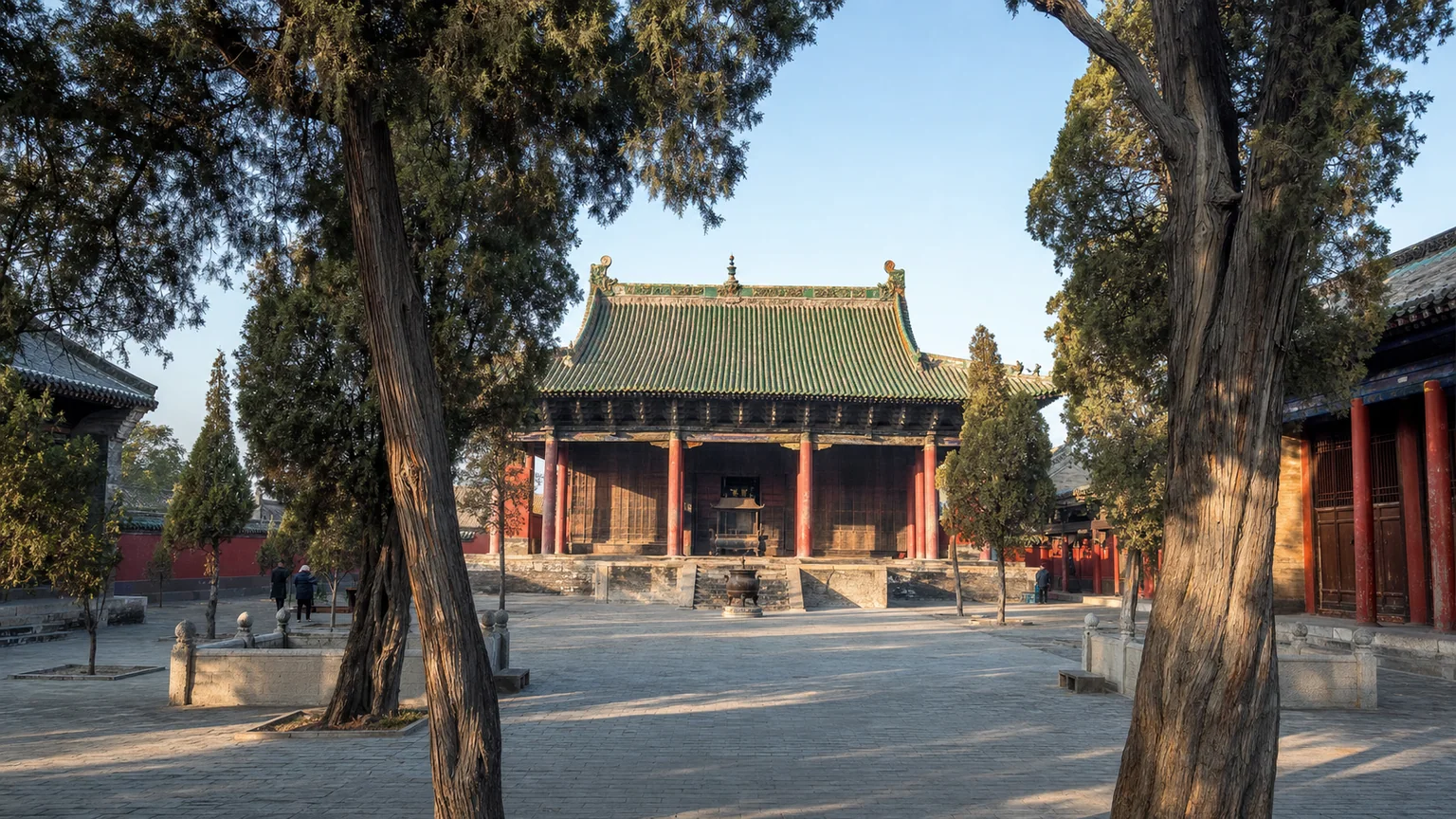
5A View location, maps and nearby scenic areasAt Jiezhou Guan Di Temple, stand on the main axis before following the crowd. Gates, courtyards and halls lead your eye towards a red-faced, bearded figure who seems instantly familiar. Yet nearly every layer of that image arrived at a different time: a third-century commander, a hero reshaped by fiction and theatre, a deity recognised by several religious traditions, and a modern cultural emblem.
The temple makes those layers look continuous. Your work as a visitor is to separate them without tearing them apart. Incense belongs to living worship; palace-like architecture records imperial patronage; theatrical weapons and painted episodes often belong to later storytelling; the recent 5A identity belongs to tourism administration.
Read in this order: first follow the Jiezhou temple’s south–north axis, noting where gardens and display spaces give way to the protected ritual core. Compare Chongning Hall with the rear Spring and Autumn Tower. Only then add Changping’s family temple if transport and time permit. The two sites tell public cult and hometown memory differently.
A hometown claim grounded in an old source
The earliest substantial biography of Guan Yu appears in Chen Shou’s third-century Records of the Three Kingdoms. It identifies him as a man of Xie County in Hedong Commandery, within the region of modern Yuncheng. That makes the broad hometown connection unusually strong even though exact boundaries and place names changed.
His birth year is another matter. 160 CE is widely repeated, but the early biography does not state an exact year; later genealogies and traditions supply greater precision. Changping village is honoured as his birthplace, yet a ritual marker or later family shrine is not the same thing as an excavated birth house.
The combined Guan Gong Hometown 5A profile provides the current mapped scenic-area entry. It joins places associated with Guan’s public worship and local lineage memory. A 5A grade evaluates a tourist area’s overall management, service and visitor experience under a national system. It does not certify every legend as historical evidence.
This distinction lets the hometown matter for the right reason. Hedong was real; Guan’s association with it is documented; the exact room, well or tree attached to his childhood may belong to later commemorative geography.
The historical Guan Yu, in a short and difficult life
Guan Yu joined Liu Bei during the wars that ended the Han dynasty. Early sources show a capable commander bound to Liu, but not the invulnerable saint of later images. In 200, after becoming separated from Liu Bei, Guan served Cao Cao temporarily and killed the rival general Yan Liang at the Battle of Boma. He then left Cao and returned to Liu.
Chen Shou’s appraisal says, in effect, “Guan Yu repaid Lord Cao.” That line complicates a simple loyalty story. Guan fulfilled an obligation to a temporary patron before returning to his longer allegiance. Later merchants could see in such conduct not blind obedience, but recognition of debt, trust and a promise kept.
Guan later controlled the strategically important Jing Province for Liu Bei. In 219 he attacked north towards Fancheng and achieved dramatic early successes, but his position collapsed when Sun Quan’s forces struck his rear. Captured during the retreat, Guan was executed around the turn of 219–220.
The biography also tells of a physician scraping poison from Guan’s arm bone while he continued eating and drinking. It does not name the famous doctor Hua Tuo; that identification and much dramatic detail belong to later storytelling. Even a story with an early textual core can accumulate new actors.
The novel and stage supplied the face we recognise
The fourteenth-century novel Romance of the Three Kingdoms and generations of opera transformed scattered records into a complete moral hero. The Peach Garden Oath with Liu Bei and Zhang Fei, the Green Dragon Crescent Blade, many single combats and the long solitary ride are literary or theatrical traditions, not secure entries in the contemporary record.
The red face also belongs above all to performance and iconography. In Chinese opera, colour communicates character; red came to signal loyalty and upright courage. The long beard, green robe and great blade made Guan identifiable across a noisy stage or crowded temple.
Calling these features “not documented” does not make them meaningless. Fiction standardised a visual language through which people debated loyalty, brotherhood, courage and pride. It also made Guan’s failures narratively useful: virtues can become rigidity, and confidence can make a commander misread alliances.
At the temple, ask what kind of evidence you are seeing. An inscription may document a repair or title. A mural may illustrate the novel. A weapon may be ritual symbolism. A performance may interpret all three. The labels should not collapse them into “what happened.”
How one commander became many kinds of god
Guan Yu was not declared a god in one ceremony. His cult developed over centuries through local worship, Buddhist and Daoist adoption, imperial titles, temples sponsored by officials, and stories carried by soldiers and merchants.
In Buddhist settings he came to be treated as a protector of monasteries, often called a sangharama guardian. Daoist traditions recognised him as Guan Sheng Di Jun, Lord Guan the Sacred Emperor. Imperial governments repeatedly raised his titles and promoted him as a model of loyalty. Popular religion asked him for protection, justice, success and moral witness.
His role as a wealth god seems surprising because the historical commander was not a merchant. The bridge is trust. Business communities and guilds valued the image of a man who kept faith, repaid obligation and punished betrayal. Shared worship could provide a moral language for contracts where formal enforcement was distant.
These meanings do not form one tidy theology. Police, martial communities, traders, household worshippers, Buddhists and Daoists may approach the same figure differently. Overseas Chinese communities carried Guan temples across maritime trade networks. The global cult is therefore not merely a copy of Jiezhou; local communities continually remade it.
Sui foundation, Qing buildings: the temple’s time layers
Temple histories commonly date the first Jiezhou shrine to 589, in the Sui dynasty. That date describes a foundation tradition, not an unbroken set of standing halls. The complex was enlarged, burned, repaired and rebuilt under successive dynasties.
A devastating fire in 1702, during the Qing, destroyed much of the temple. Major reconstruction followed, and many principal buildings visible today belong fundamentally to the early eighteenth-century rebuilding, with later repairs. Earlier plans, titles, foundations, plaques or reused components can coexist with Qing timber above them.
This is why the phrase “1,400-year-old temple” needs translation. The institution and worship tradition claim that depth; the individual beam or roof does not automatically share it. Look for dated steles, repair records, differences in masonry and museum explanations.
Fire remains central to conservation. Historic timber, painted surfaces and dense ritual activity require strict control of incense and open flame. A barrier around a burner or a ban inside a hall is not hostility towards religion. It is a negotiation between continuing worship and preventing another loss.
Walk the axis as a history of titles
The approach may begin through landscaped or interpretive areas associated with brotherhood and Guan’s life. Treat recreated scenes as an introduction, then notice when the architecture becomes a formal ritual sequence. Gates restrict the view; courtyards release it; halls grow in rank as you move north.
Chongning Hall takes its name from an honour bestowed during the Song period, when Guan’s official cult was accelerating. The current structure reflects later rebuilding, so the name’s date and the timber’s date are not identical. Dragon imagery, plaques and imperial proportions present Guan not simply as a dead general but as an enthroned sacred ruler.
Farther back, the Spring and Autumn Tower refers to the enduring image of Guan reading the Spring and Autumn Annals. The historical biography praises his interest in that classic, but the familiar night-reading scene, lamp, posture and surrounding drama were elaborated through later art and literature. The building visible now likewise carries multiple construction and repair phases.
Do not rush only to the largest statue. Side halls, steles, roof animals, carved brackets and worn thresholds show how officials, donors and craftspeople turned titles into a built hierarchy. Turn around at each courtyard: the gate behind you is part of the composition.
Jiezhou and Changping tell different hometown stories
Jiezhou presents Guan at public scale: an ancestral temple for a cult that spread across China and overseas. Its halls resemble an imperial compound because centuries of state titles and elite sponsorship raised the general into a sacred sovereign.
Changping, traditionally identified as Guan’s native village, presents a family scale. The Guan family temple and associated birth traditions place the hero among parents, ancestors and local landscape. Existing buildings and markers are later memorial constructions; they show how communities locate memory, not a preserved third-century household.
The separation is useful. Public religion needs ceremony, rank and crowds. Hometown memory needs genealogy, graves, wells, fields and stories told as local inheritance. Visiting both can reveal how one person is claimed by empire and village at once.
Ordinary people built and maintained that claim. Carpenters, tile makers, painters and stonecutters produced the complex; temple keepers and ritual specialists organised worship; merchants financed repairs; food sellers, guides, cleaners and residents support today’s visitor economy. Guan culture is not only the story represented—it is the labour that keeps representation possible.
A recent 5A identity and an old living temple
The Guan Gong Hometown cultural-tourism area entered the national 5A system recently. The designation can bring improved signs, visitor services, coordinated routes and larger crowds. It also encourages multiple heritage places and performances to be presented as one destination.
That administrative unity should not hide differences. A protected hall, a functioning incense altar, a new exhibition, a staged oath ceremony and a souvenir street require different kinds of attention. Service grading is not archaeological dating, and a polished display is not automatically older or more sacred.
For a focused visit, give the Jiezhou axis two to three hours. Add Changping only with confirmed transport and enough time to understand its different emphasis. Special festivals can make worship more vivid but also bring queues, controlled circulation and limited photography. Performance schedules are not guaranteed daily.
Opening hours, separate or combined tickets, shuttle links, guided routes, identity checks and ritual access can change. Confirm them through the official scenic-area or temple channels shortly before travel. If arriving from Yuncheng city, arrange the return as well as the outward journey; do not assume a late taxi or bus will be available at every component.
Photograph and move with ritual awareness
The main Jiezhou route is comparatively level, but high stone thresholds, steps into halls and crowded gateways interrupt it. Wheelchair users and visitors with limited balance should ask which side entries, ramps and accessible toilets are currently available. Changping requires a separate road transfer and may have fewer visitor services.
Yuncheng summers can be very hot, while winter is dry and cold. Courtyards offer limited shade between halls, and rain makes polished stone slippery. Carry water, sun protection or a warm layer according to season, and wear stable shoes.
For photographs, use the repeating gates to frame the next hall, and include a person at a respectful distance to show scale. Side light brings out roof tiles, brackets and painted surfaces. Inside, low light may protect vulnerable colour. Where photography is allowed, switch off flash and avoid tripods in narrow ritual routes.
Never interrupt a bow, incense offering or family prayer for a portrait. Ask before photographing worshippers or ritual specialists. Do not pose with a weapon against a statue, touch the beard or robe, or place objects on an altar. A temple can be a scenic area without ceasing to be a moral and religious space.
Loyalty is a question, not a souvenir label
Return at the end to the red face on the axis. It no longer represents one thing. Behind it stands a Hedong commander whose career included courage, obligation, ambition and defeat; a novel hero; a Buddhist and Daoist protector; an imperial exemplar; a merchant’s guardian of trust; and a local source of identity and income.
“Loyalty and righteousness” are often presented as simple virtues. Guan’s long afterlife shows that societies keep renegotiating what they require: loyalty to a lord, a promise, a brother, a community or an ethical standard. Governments, guilds and families all selected different answers.
The most respectful visit does not decide that every legend is fact or dismiss devotion because it grew later. It asks how history became memory, how memory became worship, and how worship became architecture and tourism. Leave with that question, and the courtyards will feel less like a museum of one perfect man—and more like a record of the many communities that needed him.
Use the LoreLens app on site to distinguish documented biography, Romance episodes, religious titles and architectural layers as you move through the Guan Gong hometown landscape.
Location profile
Where it is

Frequently asked questions
What does the Guan Gong Hometown scenic area include?
The cultural-tourism area is centred on the large Jiezhou Guan Di ancestral temple and commonly links it with the Guan family temple at Changping, traditionally identified as Guan Yu's native village. They are separate sites, so confirm current ticket, transfer and opening arrangements officially.
How much time should I allow for Guan Gong Hometown?
Allow two to three hours for a careful visit to the Jiezhou temple. Add more time and a road transfer for Changping or any performances and exhibitions included in the current route. A half day is comfortable for the main temple; both components can require longer.
Is the Jiezhou Guan Di Temple an original Sui dynasty building?
Temple tradition dates its foundation to 589 in the Sui dynasty, but that does not describe the age of the visible buildings. Fire, war and repeated rebuilding changed the complex; much of today's principal architecture reflects Qing reconstruction after a devastating fire in 1702, with later repairs.
Can visitors photograph inside the Guan Di temples?
Photography, flash, tripods and filming can be restricted by hall, ritual or temporary exhibition. Follow each sign and staff instruction, do not photograph worshippers without consent, and never touch statues, plaques or timber for a better angle.