Shanxi · Taiyuan
Jinci and Tianlongshan: Water, Wood and Stone
Listen to Jinci's water beneath ancient timber and Song clay attendants, then climb to Tianlongshan's Buddhist caves—a full-day encounter with worship, craft, loss and careful restoration.
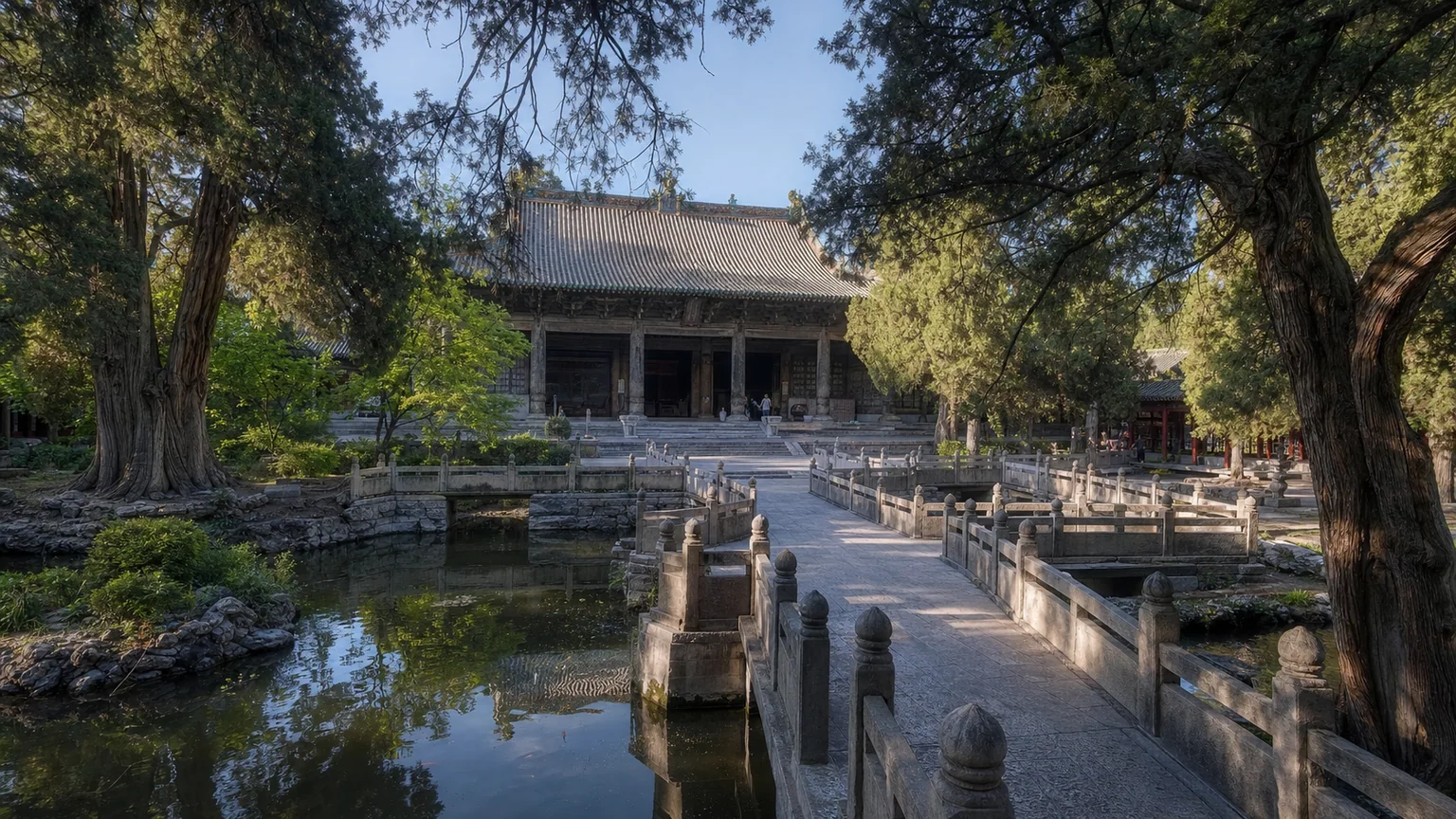
5A View location, maps and nearby scenic areasAt Jinci, stop where water slips beneath old trees and timber eaves. Listen before entering the next hall. The sound binds together things a photograph separates: a spring-fed ritual landscape, wooden architecture, irrigated fields beyond the walls and painted clay figures whose individual faces still hold a room.
Later, at Tianlongshan, the sensory order reverses. Wind moves across a cliff punctured by Buddhist caves; some niches retain figures, others show scars where sculptures were removed. These are not two wings of one walkable park. They are distinct sites joined administratively and thematically—water and wood below, mountain and carved stone above.
Plan around the separation: Jinci needs at least two focused hours; Tianlongshan needs a mountain transfer plus stairs and cave time. A full day can cover both only when roads, internal transport and cave access cooperate. If conditions are uncertain, choose one deeply rather than turning both into a race.
One scenic-area name, two different places
The combined Jinci–Tianlongshan 5A profile maps the scenic-area listing. It should not be read as proof of a single gate, continuous footpath or permanent combined ticket.
Jinci lies southwest of central Taiyuan at the foot of Xuanweng Mountain. Its historic core combines ancestral shrine, temple halls, bridges, canals, springs, inscriptions and trees. A landscaped public park and the protected museum precinct can have different access or ticket arrangements; confirm the current boundary rather than relying on an old itinerary.
Tianlongshan sits farther into the mountains, reached by a winding road. Its grottoes occupy cliff faces around the mountain, with paths and stairs linking cave groups. Distance alone understates the transfer because traffic, road controls, weather and scenic-area transport all affect it. A shuttle or through ticket may be offered at some times, but neither should be assumed.
The pairing makes cultural sense. Jinci shows how ritual, water management and timber construction accumulated in a settled landscape. Tianlongshan shows court patronage and Buddhist image-making in rock—and what happens when those images are weathered, removed, documented and partially reassembled.
A Zhou origin story, but not Zhou buildings
Jinci began as a shrine associated with Shu Yu of Tang, a younger brother of King Cheng in the early Zhou royal house. Shu Yu was enfeoffed in the state of Tang; his son later used the name Jin, traditionally linked to the local Jin River. This lineage gives Shanxi’s abbreviation, Jin, a powerful local origin story.
The famous “tung-leaf enfeoffment” says the young king cut a leaf into the shape of a jade tablet and jokingly granted land to his brother. A court historian insisted that a ruler’s words could not be treated as play, so the grant became real. The enfeoffment belongs to early history; the leaf episode is a literary tradition told in more than one version. It expresses an enduring political idea: royal speech creates obligation.
The shrine later expanded to honour Yi Jiang, traditionally identified as Shu Yu’s mother, in the role of Holy Mother. Patronage and ritual emphasis changed across centuries. Texts attest a shrine in the area long before the buildings now standing, but no visitor should call the visible halls “three-thousand-year-old Zhou architecture.”
What survives is more interesting than that slogan. Jinci contains buildings and objects from multiple later dynasties, especially the Song, Jin, Ming and Qing, along with repeated repairs. Its value lies in a long architectural sequence anchored to an older cult—not an untouched foundation date.
The Holy Mother Hall: power seen through attendants
The Hall of the Holy Mother is Jinci’s central encounter. Its present structure is generally dated to the Northern Song, with construction in the 1023–1032 period and major work recorded in the early twelfth century. Eight carved wooden dragons on the front columns bear an 1087 date. Repairs have occurred since, so “Song hall” describes the fundamental structure and design, not every tile or painted surface.
Before looking inside, read the deep front porch. Its broad overhang creates a shaded stage between courtyard and sacred interior. Bracket sets transfer roof weight through layered timber; the building communicates rank without requiring enormous height.
Inside, the polychrome clay ensemble is commonly counted as 43 figures: the Holy Mother at the centre, with female officials, attendants and other court servants around her. Most are attributed to the Song period, while individual figures and surfaces have histories of repair or later replacement. Museum labels should guide exact dating.
The surprise is psychological variety. One attendant appears alert, another tired, reserved or ready to speak. Clothing and gesture establish court hierarchy, but faces prevent the group becoming a diagram. These are idealised roles made through observation of real bodies. They also make visible the women and service labour normally absent from monumental histories.
Photography may be limited inside. Do not use a phone screen as a substitute for looking. Let your eyes adjust, compare hands and expressions, and leave space for worshippers or guided groups.
A bridge that makes ritual into movement
Directly before the hall, Yuzhao Feiliang—often translated as the Flying Bridge over the Fish Pond—forms a cross above a rectangular pool. The bridge widens on the main east–west axis and extends north and south like wings. Its present arrangement is associated with the Song complex, though components have been repaired and restored.
The unusual cross plan is not simply picturesque. It slows approach, opens side views and turns crossing water into preparation for entering the Holy Mother Hall. Low stone supports make the platform seem to hover when the pool is full; when water is low, its engineering becomes easier to read.
Nearby, the Offering Hall belongs fundamentally to the Jin dynasty and is commonly dated to 1168, with later repairs. Its open character suited the presentation of offerings. Together, bridge, offering space and main hall form a sequence: cross water, prepare gifts, meet the sacred figure.
This is why a checklist of “three treasures” can be less useful than walking the axis. Jinci’s popular lists—the “three treasures,” “three wonders,” famous plaques—help memory, but the site was designed through relationships. Turn around at each threshold and see how the previous structure frames the next.
Nanlao Spring and the people downstream
South of the central axis, Nanlao Spring is traditionally named from a line in the Book of Songs that wishes someone age “without end.” The name means “Never-Aging.” It turned flowing water into a blessing, and later inscriptions and pavilions reinforced that association.
The spring was not only symbolic. Jin water fed channels, gardens and agricultural land around Jinci; communities negotiated its use for irrigation and daily life. Rice cultivation and local livelihoods depended on a wider hydrological system, not just the ornamental pool visible to visitors. Water users, channel maintainers and farmers belong to Jinci’s history alongside patrons and priests.
Groundwater extraction and regional environmental change affected spring flow in modern times. Conservation and water-management projects have sought recovery, but visible discharge can vary and some water within a landscaped system may be managed. Do not promise that Nanlao will surge at a particular season or treat a full pool as proof of an untouched aquifer.
The celebrated Zhou cypress carries its own chronological caution. Tradition gives the tree an age reaching back to the Zhou; scientific estimates and definitions of the surviving living structure may differ. Its leaning trunk is genuinely old and culturally important without requiring a perfectly exact birthday.
Tianlongshan: caves made across dynasties
Tianlongshan’s numbered grottoes are commonly counted as 25, with heritage inventories describing more than 500 surviving figures and fragments. Totals vary depending on whether damaged reliefs and small images are counted separately. Compared with Yungang, this is a smaller complex, but its sequence across dynasties is unusually instructive.
Carving began under the Eastern Wei and continued through the Northern Qi, Sui and especially the Tang, with later intervention. The mountain was connected to the ruling elite around Jinyang, the old political centre near Taiyuan. Court patrons, monastic communities and private donors funded different caves; “built by one emperor” is not an adequate history.
Early figures carry the stylised bodies and devotional programmes of the Northern Dynasties. Tang work often becomes fuller, more balanced and sensuous in the treatment of bodies and drapery. These are broad tendencies, not a quick formula for dating every damaged torso. Cave plans, inscriptions, carving technique and comparison all matter.
Approach the cliff as a religious environment. Buddhas, bodhisattvas and guardians formed ensembles for worship and merit-making. Empty sockets are not intentional minimalist design, and a headless body is not a curiosity staged for visitors. It is a damaged sacred and historical object.
Removal, dispersal and one returning head
Tianlongshan suffered extensive removal in the early twentieth century, particularly during the 1920s, when sculptures were cut from caves and sold through an international art market. Heads and reliefs entered collections in Japan, Europe and North America. Museum ownership histories differ, but the physical result on the mountain is unmistakable: figures were separated from bodies, companions and architectural context.
In 2021, a Buddha head identified as belonging to the north wall of Tianlongshan’s Cave 8 returned to China from Japan. Its return carried strong symbolic weight, yet one object cannot repair the entire cliff. Repatriation requires evidence: old photographs, measurements, stylistic comparison, tool marks and collection records help establish where a piece came from.
Digital documentation offers another form of return. Museum and conservation teams have scanned caves and dispersed works, allowing virtual reconstruction of ensembles that cannot presently be reunited physically. A screen does not replace stone in its original setting, but it can restore relationships and make provenance visible.
This history changes how to look. Do not photograph only the best-preserved face. Record the cut surface, neighbouring body and whole niche where permitted. Absence is evidence of a global collecting history, and conservation staff are now part of the site’s human story.
Patrons, makers, worshippers and caretakers
At Jinci, rulers and officials financed halls, but carpenters calculated joints, sculptors modelled wet clay, painters added colour, and water workers maintained channels. The Holy Mother attendants preserve close study of court service; they should prompt attention to labour rather than only elite costume.
At Tianlongshan, quarry workers opened chambers, master sculptors established central figures, assistants cut repeated details, monks shaped ritual programmes and donors sought merit. Individual origins are rarely recoverable from style alone. “Indian,” “Central Asian” and “Chinese” influences describe networks of Buddhist art, not passports for anonymous hands.
Worshippers completed both places. Incense, offerings, prayer, seasonal rites and family memory gave buildings and images purpose. Today, guards, museum researchers, conservators, guides, road crews and cleaners keep the sites usable. Tourism supports jobs but also brings humidity, touch, crowd pressure, traffic and demands for simplified stories.
Respect follows from this continuity. Do not touch painted clay, lean on timber, place coins on statues, cross cave barriers or treat a damaged Buddha as a comic photograph.
Build a route around the mountain, not the ticket name
For a full day, reserve roughly two to three hours at each site and generous transfer time. If mountain weather or road access is the fragile part of the plan, confirm Tianlongshan first and consider visiting it earlier, then return to Jinci. If your priority is architecture and you cannot risk a winding road, give Jinci the unhurried morning and treat Tianlongshan as conditional.
At Jinci, follow the central axis to the Offering Hall, Flying Bridge and Holy Mother Hall, then turn south to Nanlao Spring. Add the northern halls, inscriptions and old trees only after the core. The main garden routes are relatively gentle, but stone thresholds, bridges and protected interiors create partial barriers.
At Tianlongshan, use the authorised cave path and pace the stairs. Not every cave may be open, and seeing all numbered caves may require more climbing than expected. Cliff edges, wet stone, summer heat and winter ice increase risk. The site is substantially less accessible for wheelchairs and visitors with limited balance; ask which viewpoints can be reached by current internal transport.
Tickets, opening times, separate or combined entry, mountain shuttles, road access and identity checks are operational details. Confirm them through the official Jinci Museum and scenic-area channels shortly before visiting. Arrange a return ride rather than assuming cars or buses will be waiting at Tianlongshan.
Photograph with the material, not against it
At Jinci, photograph architecture from an angle that shows the Flying Bridge, water and Holy Mother Hall in one sequence. Side light reveals bracket sets and carved dragons. Reflections can be effective when water is present, but never step onto a pool edge or protected base for symmetry.
Inside halls, low light protects sensitive surfaces and creates difficult exposures. Where photography is allowed, turn off flash, raise ISO and hold the camera steady without touching wood or sculpture. Tripods can block narrow routes. Rules at one hall do not automatically apply to the next.
At Tianlongshan, an oblique exterior view can show how caves occupy the cliff. Use people on the authorised stairs for scale, then move close only where barriers permit. Cave photography, video and drones may be restricted; staff signs override online advice.
Weather changes the mountain rapidly. Haze may soften distant Taiyuan views; rain makes stone slippery; wind affects balance near railings. A missed panorama is safer than entering a closed path.
Preservation is the link between the two sites
Jinci preserves timber, clay, pigment, water and living trees—materials that require different moisture, fire, pest and visitor controls. Tianlongshan preserves rock exposed to water, temperature change and wind, plus a fragmented collection distributed around the world. Neither can be protected by a single kind of repair.
Modern intervention is visible and necessary: replaced roof elements, stabilised sculpture, managed water, repaired paths, cave monitoring, digital models. It must also remain honest about uncertainty. A restored colour is not automatically Song; a refilled channel is not the same as natural spring recovery; a digital head is not a physical return.
End where the day began, with a relationship rather than an object. At Jinci, water passes under a bridge towards communities beyond the shrine. At Tianlongshan, an empty neck points towards a sculpture now far from the mountain—or newly returned after careful research. One place asks how traditions remain alive; the other asks what it means to restore context. Both answers depend on people choosing to look closely and preserve without pretending loss never happened.
Use the LoreLens app to identify Jinci’s architectural sequence and Tianlongshan’s cave groups, then hear the stories of the makers, water users and conservators connecting them.
Location profile
Where it is

Frequently asked questions
Are Jinci Temple and Tianlongshan Grottoes in the same place?
They form one scenic-area listing but are physically separate. Jinci is a temple-and-garden complex on the plain; Tianlongshan is reached by a winding mountain road and involves more climbing. Do not assume one entrance, ticket or shuttle automatically covers both—confirm the current arrangement officially.
How much time do I need for Jinci and Tianlongshan?
Allow two to three hours for Jinci and a similar amount for Tianlongshan, plus the mountain transfer. A full day is the practical minimum for both without rushing. Cave openings, road conditions, queues and shuttle schedules can change the plan.
Which site should I choose if I only have half a day?
Choose Jinci for the denser combination of historic timber buildings, sculpture, gardens and easier walking. Choose Tianlongshan if Buddhist caves, mountain views and the story of dispersed sculpture are your priority and steep steps are manageable. Check cave and road access before committing.
Can I photograph the sculptures and caves?
Photography, flash, tripods and filming may be restricted in Jinci halls and individual Tianlongshan caves. Rules can change for conservation and crowd control. Read the sign at each entrance, follow staff instructions and never use flash or touch a surface where photography is permitted.