Shanxi · Xinzhou
Yanmen Pass: Reading a Great Wall Gateway
Climb above the restored gates and read the terrain that made Yanmen consequential: a narrow north–south corridor shaped by armies, diplomacy, trade, hard labour and stories larger than the surviving stone.
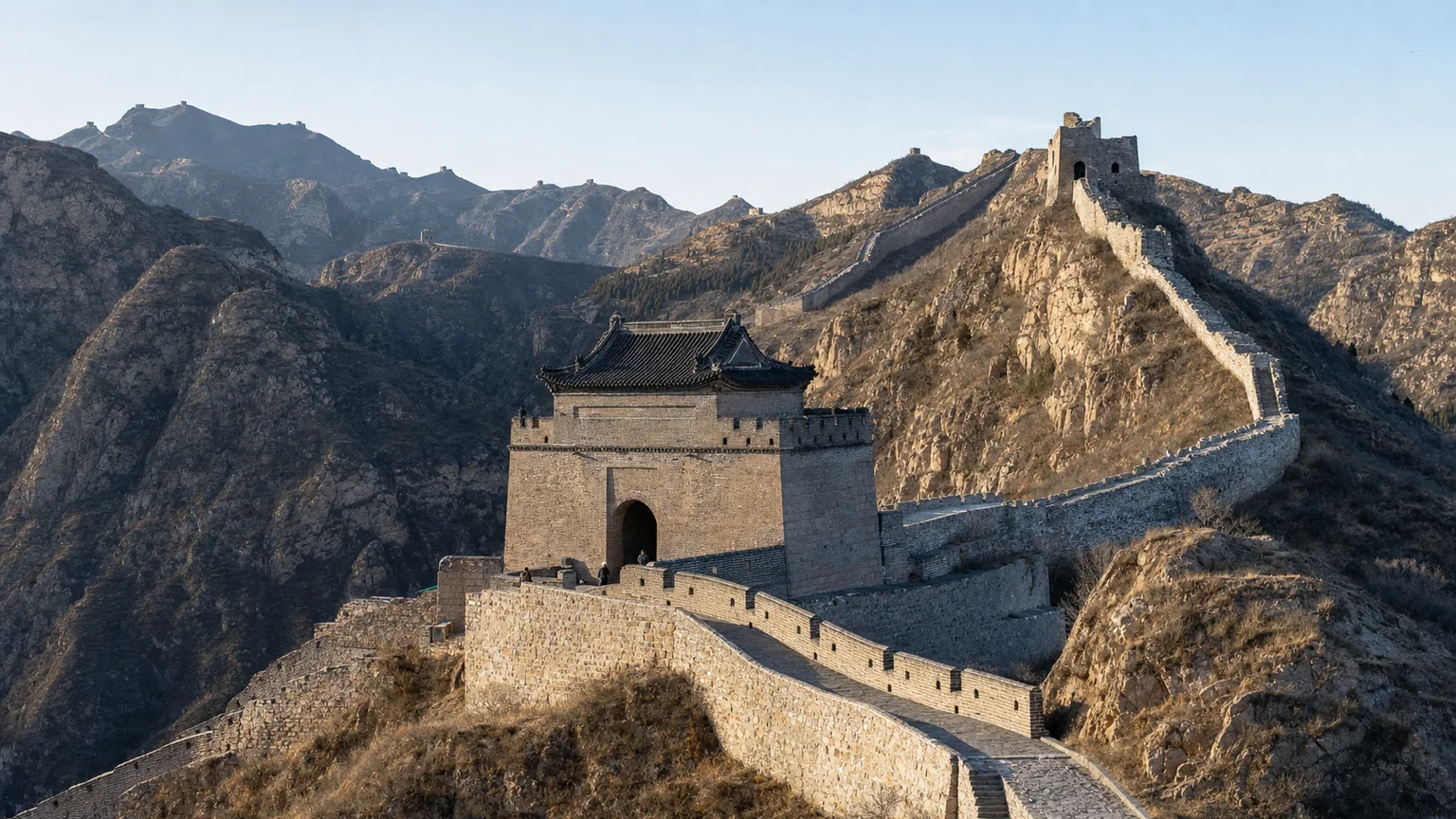
5A View location, maps and nearby scenic areasWalk through the restored gate street, then turn and climb until you can see the pass as a gap between ridges. From above, the tiled towers shrink and the mountains take over. That is the view that explains Yanmen Pass: not a picturesque gate placed on an empty wall, but a controlled crossing through a hard north–south barrier.
The masonry beneath you is not all one age. The route is ancient; the present pass city took its main form under the Ming; towers and walls were repaired many times; and the polished visitor complex includes substantial modern rebuilding. The terrain is the most continuous historical evidence. Trace the road below, the walls rising on both sides and the sightlines towards the next ridge before deciding what the architecture could do.
Best first sequence: read the pass from the lower gate and barbican, walk the central street slowly, then climb only one wall wing before choosing whether to continue higher. The short route explains the defences; the long ridge route explains the geography. Wall access and shuttle arrangements can change with weather and conservation.
Read the terrain before the gate towers
Yanmen Pass lies in the mountains of Dai County, around 20 kilometres north of the county town, within today’s Xinzhou, Shanxi. Its ridge is commonly described as roughly 1,800 metres above sea level, although elevations vary across the scenic area. The Yanmen Pass 5A profile gives the mapped location.
The name is often explained by a poetic local tradition: the peaks were so high and confined that migrating wild geese had to find a gap through them—hence “Wild Goose Gate.” It is a memorable image, not a measurable account of bird migration. The older geographic name Gouzhu and the alternative Xixing Pass, or Western Defile, also appear in historical sources. Those names warn against imagining one unchanged gate occupying exactly the same spot for two thousand years.
The Hengshan mountain system separates the Datong basin and northern steppe approaches from the valleys leading towards Daizhou and Taiyuan. Movement concentrates where gradients, water and road-building allow it. A force that held the crossing could delay troops, inspect travellers, signal along the ridge and protect supply routes. It could not seal an entire frontier by itself: attackers could seek other passes, defenders needed garrisons and food, and a wall without mobile forces was an obstacle rather than an absolute border.
Look beyond the crenellations. The most important “building” here is the funnel made by mountains.
A corridor older than the walls you see
An ancient Chinese text, the Lüshi Chunqiu, lists Gouzhu among the “Nine Passes under Heaven.” Modern publicity sometimes transforms that into the stronger slogan “first of the nine passes,” but the early text establishes importance, not a modern ranking table.
During the Warring States era, the state of Zhao developed northern defences and military routes across this broader region. Qin and Han governments later organised commanderies and frontier systems around Yanmen. Forts, signal stations and roads moved as political centres and military needs changed. References to “Yanmen” can mean a commandery, a mountain zone or a pass, so a battle in Yanmen territory did not necessarily occur inside today’s reconstructed gate.
That distinction matters with famous names. Generals such as Li Mu and Li Guang are associated with northern defence and the Yanmen region, but stories told at the scenic area may compress campaigns separated by centuries into a single stage. The corridor is genuinely old; the precise attribution of every platform or bend is rarely so simple.
It was also a road for diplomacy. Wang Zhaojun, a Han court woman sent in 33 BCE to marry the Xiongnu ruler Huhanye Chanyu, became a lasting symbol of political marriage and frontier peace. Local tradition says her northward journey crossed Yanmen. Her mission is historical; the exact route through this gate is not securely documented. The story remains useful because it restores something military narratives omit: borders were negotiated through kinship, gifts and movement as well as weapons.
How the Ming pass controlled movement
Local heritage records date the main construction of the present pass city to 1374, early in the Ming dynasty, under the official Lu Heng. Further repairs and wall building followed, including major work in the late Ming. Yanmen, Ningwu and Piantou became known together as the Outer Three Passes, protecting approaches across northern Shanxi.
The names of the restored principal gates express a defensive ideal. Tianxian Gate means “Heavenly Barrier”; Dili Gate invokes the advantage of terrain. Gate openings did not form a straight, generous avenue. Barbicans, turns, walls and overlooking positions slowed an arrival and exposed it to inspection or attack. On the ridges, watchtowers and beacon points extended observation beyond what anyone at street level could see.
Yet a fortification is a system, not a silhouette. Soldiers needed wells or carried water, grain, fodder, fuel, weapons, replacement clothing and communication. Pack animals and porters mattered as much as battlements. Smoke or fire signals could send alarm, but they required agreed codes and garrisons ready to respond. Gates also had to open: officials, envoys, merchants and local residents depended on movement through the corridor.
As you walk, identify function before admiring style. A narrow turn manages speed; a higher platform creates visibility; a courtyard can hold and examine entrants. Then check the stonework. Regular new blocks, clean parapets and fresh timber often belong to recent restoration, while worn paving, foundations, inscriptions and irregular fabric may preserve earlier phases. Age should be established by evidence, not colour alone.
Yang Ye: the history inside a family legend
The best-known warrior story at Yanmen centres on Yang Ye, a tenth-century commander. He first served the Northern Han kingdom, then entered Song service after its surrender. Song histories credit him with a striking victory over Liao forces in the Yanmen region in 980, helping earn a reputation later expressed as “Invincible Yang.”
The turn came during the Song’s 986 northern campaign. Conflicting commands and a deteriorating military situation left Yang Ye exposed. He was captured after fighting in the wider Daizhou frontier and died in captivity after refusing food, according to traditional historical accounts. His end turned professional military failure, loyalty and disputed responsibility into a powerful moral drama.
Later opera, storytelling and novels created the Yang Family Generals: generations of perfectly loyal sons, widows and women warriors defending the frontier. This tradition preserves a historical family core but greatly expands the record. Characters, battles and intimate speeches should not all be read as tenth-century fact. Their cultural afterlife is nevertheless real. Shrines, martial-arts traditions and family memory around Dai County continue to give the Yang story social meaning beyond the scenic area’s staged scenes.
At the pass, the most useful question is not “Did every legend happen on this stone?” Ask why a frontier society needed stories in which duty survived poor decisions by rulers and commanders. The legend remembers courage; history also asks who supplied the troops, who issued the orders and who absorbed defeat.
The people who made passage possible
Commanders dominate plaques, but ordinary bodies made Yanmen function. Builders quarried and fitted stone on exposed slopes. Soldiers stood watches through wind and snow. Grooms cared for horses; porters carried food and arrows; cooks and craftspeople kept a garrison usable. Families farmed nearby valleys and lived with requisition, trade opportunities and the danger of campaigns.
The same road that concentrated armies also concentrated goods. The balance changed with policy, but livestock, grain, cloth, tools and other commodities moved between northern pastoral economies and farming regions to the south. Licensed markets, tribute missions, private exchange and smuggling could coexist. Inns, guides and transport workers earned livelihoods from travellers who had no interest in conquest.
It is tempting to describe the wall as a permanent line between “Chinese farmers” and “northern nomads.” Historical identities and loyalties were more fluid. Dynasties on both sides ruled mixed populations; soldiers changed service; communities traded, married and adopted one another’s skills. The wall regulated a political frontier at particular moments. It was not a timeless ethnic boundary.
Pause on the street and listen past any recorded battle sounds or performance music. Hooves, carts, bargaining and shouted orders would once have mattered here as much as clashing weapons. A pass exists because people need to cross it.
Poetry, memory and battles retold
Tang poet Li He begins his “Song of the Governor of Yanmen” with an image often translated as: “Black clouds press the city, threatening to crush it; armour glitters in the sun like golden scales.” The verse turns weather, light and fear into one compressed battle scene. It has shaped how generations imagine a Chinese frontier fortress.
The poem should not be treated as a photograph of today’s pass or proof of one documented siege here. “Yanmen” also functioned as a literary frontier name. Its modern echo survives because the ridge can still produce the poem’s visual logic: cloud shadow fills the valley while sunlight catches a tower or wall.
Other memories accumulate more freely. Zhaojun’s route, the Yang family’s exploits and stories about geese are repeated because they make diplomacy, loyalty and landscape personal. Each deserves its label—documented event, regional association or local tradition—rather than being forced into one category called “history.”
The corridor gained military importance again in the twentieth century. In 1937, during the war against Japan, Eighth Route Army forces attacked Japanese transport and supply movements in the Yanmen area. Memorial narratives may group actions across a broad landscape; do not assume every modern marker identifies the exact footprint of an engagement. What continues across the centuries is not an unbroken wall but the strategic pressure exerted by the road.
Choose the route that fits your legs
A short visit of two to three hours can cover the restored gate town, barbican, central street, temples or interpretive halls that are open, and one moderate climb for an overview. This route gives the clearest relationship between road, gates and enclosing walls without committing to every ridge stair.
For a half-day visit, continue farther along an authorised wall wing towards higher watch points. The reward is spatial understanding: you can look back and see “one pass, two wall wings” stretched across the mountain. The cost is repeated climbing on exposed, sometimes uneven surfaces. Distance on a map understates effort when every metre includes steps and wind.
Do not assume all labelled attractions are ancient fabric. Some halls, statues, shops and performance settings belong to the modern visitor complex; they interpret history and support the local tourism economy. Decide whether a scheduled performance is worth time you could spend on the ridge. Performance times, access to towers and the operation of internal shuttles can change.
The lower area contains paved streets and courtyards, but cobbles, thresholds and gradients can still be difficult. The wall is generally unsuitable for wheelchairs and can challenge visitors with limited balance, knee problems or vertigo. Ask the official operator about the current step-free area, rest points and shuttle drop-off before purchasing tickets. Turning around is a route choice, not a failed visit.
Wind, stone and the photograph you can safely make
Yanmen is exposed mountain terrain. Strong wind can arrive even when Dai County feels calm. Winter brings severe cold and possible snow or ice; spring can be dusty; summer sun and ultraviolet exposure can be intense, with thunderstorms or sudden rain possible. Check a mountain forecast, carry water and a windproof layer, and wear shoes that grip polished or loose stone.
Leave the ridge when thunder approaches, and never climb onto parapets for a cleaner picture. Closed or unrestored wall segments may lack stable surfaces and safe exits. Children need close supervision on high stairs; hikers with heart or respiratory conditions should pace themselves at the pass’s elevation.
For the strongest photograph, climb far enough to place a gate tower below and one wall wing climbing out of the frame. People on the stairs provide scale. A moderate telephoto lens compresses gates and ridges; a wide lens shows the corridor but can make the walls look small. Side light often reveals masonry texture, but opening hours may not permit sunrise or sunset access, and cloud or haze cannot be promised.
Drones, tripods, commercial filming and photography around performances may require permission or be restricted. Check posted rules. The best image here is not the emptiest postcard view; it is the one that shows why this particular gap through the mountains had to be watched.
What restoration can and cannot return
War, weather, abandonment, stone reuse and twentieth-century destruction left the pass severely damaged. Modern conservation and tourism development rebuilt towers, repaired walls and created a legible visitor route. Yanmen was included in China’s nationally protected Great Wall heritage in 2001, but legal protection does not mean every visible structure predates that designation.
Restoration creates a genuine trade-off. Without repaired access, many visitors could not understand the pass as a connected defensive system and local communities would receive less tourism income. Heavy reconstruction can also smooth over uncertainty, making new gatehouses appear as untouched Ming survivals. Interpretive honesty matters: foundations, inscriptions, archival photographs, surviving masonry and reconstructed superstructures should not be blended into one vague word, “ancient.”
Walk back down and look again at the gates. They are useful, beautiful and partly renewed. Then look beyond them to the ridge and road, the older evidence that no rebuilding invented. Yanmen’s meaning does not rest on claiming that every brick witnessed every general. It lies in a mountain corridor repeatedly made into a border—and repeatedly reopened by soldiers, envoys, traders, families and travellers.
Use the LoreLens app on site to identify the gates, wall wings and ridge logic, then hear the documented history behind Yanmen’s most persistent legends.
Location profile
Where it is

Frequently asked questions
How long should I allow for Yanmen Pass?
Allow about two to three hours for the restored pass town and a short wall climb, or roughly half a day for higher ridge viewpoints. Shuttle operation, performances, closed wall sections and weather can change the route, so confirm current conditions with the official scenic-area channel.
Is Yanmen Pass the original ancient structure?
The mountain corridor has been strategic since antiquity, but the pass shifted and was rebuilt repeatedly. The present core follows a major Ming reconstruction begun in 1374, while many gate towers, streets and visitor facilities have also undergone substantial modern restoration. Look for different masonry and interpretive signs rather than assuming every visible stone is ancient.
Is Yanmen Pass difficult to walk?
The lower restored streets are manageable for many visitors, though paving, thresholds and gradients can be awkward. The wall and ridge routes involve sustained steps, steep or uneven surfaces and strong exposure to wind. Ask which accessible areas and internal transport are operating before arrival.
How do I reach Yanmen Pass without a car?
Yanmen Pass is about 20 kilometres north of Dai County, the most practical local base. Taxis, booked transfers and occasional tourist transport are commonly used, but public routes and return services can be limited or seasonal. Confirm both outbound and return arrangements with your accommodation or the official operator.