Sichuan · Leshan
Leshan Giant Buddha: Carved for a River, Not a View
A 71-metre Maitreya cut into soft red sandstone over roughly ninety years, aimed at a three-river confluence that wrecked boats. The hidden gutters in its hair are why it is still there. Its face is not the one the Tang carvers left.
5A View location, maps and nearby scenic areasThe Leshan Giant Buddha was not carved to be looked at. It was carved to look at something.
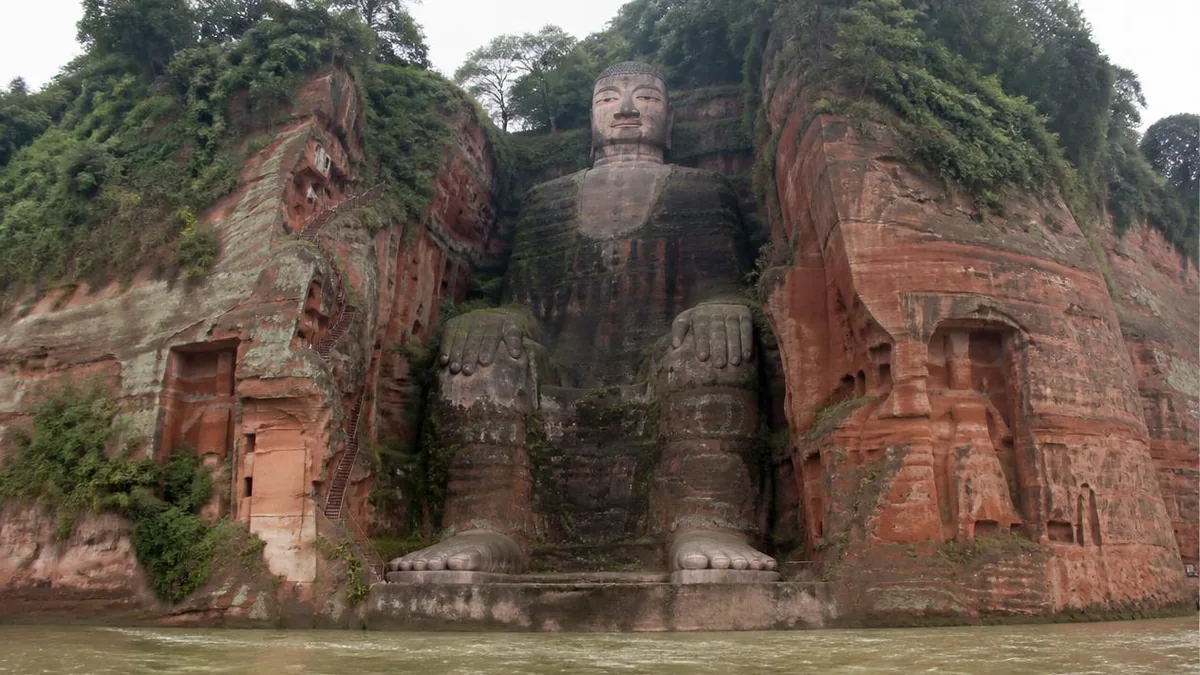
A 71-metre Maitreya, seated with both hands on his knees, cut into the cliff of Lingyun Hill directly above the place where three rivers collide. It has faced that confluence for twelve hundred years, and everything about it — why it exists, why it is still standing, and what has gone wrong with it — comes back to the water in front of it.
Three rivers and a killing ground
The Min, the Qingyi and the Dadu meet below the cliff. That junction was the problem: currents at a three-river confluence are unpredictable and violent in flood, and the river traffic had no way of avoiding the meeting point.
The cliff itself is Cretaceous red-bed sandstone, the soft, porous, iron-stained rock that produces Sichuan’s danxia landforms. That geology decides the story twice over. It is soft enough that a figure of this size could be cut with Tang-dynasty iron tools at all, which is why nothing on this scale exists in granite. And it is weak enough that the statue has spent every century since fighting water, roots and its own porosity.
The statue is a Maitreya, the Buddha of the future, seated upright with feet down rather than crossed. It faces the water, towards Mount Emei, and the two sites share a single World Heritage listing from 1996: separate gates, separate tickets, roughly thirty kilometres apart.
Haitong, and a sentence about his eyes
The founder was a monk named Haitong, described in Chinese sources as coming from Guizhou. His stated purpose was to reduce the force of the water by placing a Buddha above it, and he raised the money by begging for it.
The most-repeated episode is the eye. As the story goes, local officials tried to extract a share of the donations; Haitong replied that his own eyes could be had but the Buddha’s funds could not; when they pressed, he took out one eye and offered it on a plate, and the demands stopped. The phrase attributed to him is the part that survives verbatim.
Handle it carefully. The account appears in later writing about the site rather than in an eighth-century document, so it belongs to the tradition about Haitong, not to the record of him. What is documented is less cinematic: he started the work, and when he died it stopped.
Ninety years, three patrons, two stoppages
The Buddha was built in three funded pushes with long gaps between them, and you can still see the joins in the chronology.
After Haitong’s death the work stalled with the figure roughed out only from the shoulders up. In 739, Zhangchou Jianqiong, then military governor of Jiannan, put 200,000 cash of his own salary into restarting it. In 746 he was transferred to a ministry post in the capital and the work stopped again, this time with the carving reaching the knees and nothing below them cut.
The third and final push came in 785, when Wei Gao took up the western Sichuan command and contributed a reported 500,000 cash. The figure was completed in 803. Wei Gao then wrote the Record of the Great Maitreya Stone Image at Lingyun Temple in Jiazhou and had it carved into the cliff on the right-hand side of the niche, facing the river. That inscription is why the completion date is the firmest number in the whole sequence.
The start date is looser. Chinese scholarship notes that no surviving contemporary text fixes it precisely: the record says only “early Kaiyuan,” and 713 is the conventional reading. English-language accounts frequently give 722 instead, or a range of 712 to 804, without addressing the Chinese sources. Ninety years, three patrons, one firm end date and a soft beginning is the accurate summary.
The spoil went into the river
Here is the part that gets skipped, and it is more interesting than the legend.
Cutting a 71-metre seated figure out of a cliff face does not remove 71 metres of stone. It removes the entire volume of rock that used to occupy the space around the figure, and at Leshan that spoil went straight down into the confluence below. Accounts of the site state that the deposited rock changed the currents and made the passage safer for shipping.
Take that seriously as engineering and lightly as measurement. The mechanism is obviously real: tip thousands of tonnes of sandstone into a river junction and you change its bed and its hydraulics. What we could not find is a study quantifying the change, so the claim sits as well-attested tradition with a physically sound basis rather than as a measured result.
But it reframes the project. Haitong’s Buddha was religious infrastructure that also happened to be a nine-decade rock-fill operation at exactly the point where the river was dangerous. The prayer and the ballast were pointed at the same problem.
Read it as a drawing
The dimensions only mean something in relation to each other, so take them as a set. Total height 71 metres. Head 14.7 metres high and 10 metres wide, carrying 1,021 spiral curls. Ears 7 metres. Eyes and mouth 3.3 metres across. Nose 5.6 metres. Neck 3 metres. Shoulders 24 metres wide. The instep is around 8.5 to 9 metres wide and 11 metres long, and photographs of a dozen people standing on one foot are not exaggerated.
One figure in circulation is a slip worth flagging rather than repeating: the middle finger is given as 8.3 metres in most sources and as 24 metres in at least one Chinese description, which is the shoulder measurement misplaced.
Two details are not stone. The right ear and the nose are later repairs, built out on timber armatures and surfaced with render, not carved from the cliff. And the proportions are not improvised: the figure follows the canonical Buddhist rules of image proportion, which is why the head reads correctly from the river despite being enormous.
Flanking the niche are two carved guardian kings in armour with halberds, each about 16 metres tall and 6 metres wide. Most visitors never register them, because from the plank road they are behind you.
The gutters in the hair
This is the reason the statue exists in 2026, and it is invisible from every viewpoint.
Sandstone this porous fails by saturation. Water gets in, freezes and dissolves and feeds root systems, and the surface spalls. The Tang carvers built a drainage system into the figure to keep that from happening.
The head carries eighteen tiers of spiral curls, and three of those tiers — the fourth, the ninth and the eighteenth — are cut as horizontal drainage channels running across the head, disguised as hair. There is a channel on the left of the chest connected to another behind the right arm. Behind both ears, at the back where the head meets the cliff, are cavities that connect through from side to side. Two further openings sit at either end of the back of the chest, not linked to each other.
The arrangement collects rainwater and moves it off the body rather than through it, and it still works. When you look at the head from the platform, you are looking at plumbing that has drained a cliff for twelve centuries while pretending to be a hairstyle.
There is also a sealed cavity in the chest, closed with a stone that turned out to be a fragment of a Song-dynasty stele recording the rebuilding of a pavilion. What was inside was mundane — scrap iron, old lead sheet, brick — and both the contents and the stele fragment were lost during the Cultural Revolution, when local accounts also describe a proposal to blow the Buddha up, abandoned when residents obstructed it.
It used to be indoors
The Buddha you photograph is the ruin of a larger building, and almost nobody is told this.
When the figure was completed it was painted, inlaid and partly gilded, and it stood inside a multi-storey timber pavilion built against the cliff to keep sun and rain off it. Descriptions put it at thirteen storeys, comparable to the shelter over the Rongxian Giant Buddha. The shelter was lost in warfare; accounts place that at the end of the Yuan, though the attribution varies.
There was at least one more roof after that. By the early Northern Song the statue was already mossy and its pavilion had collapsed; a large repair under the Renzong reign rebuilt both the Buddha’s surface and a pavilion over it, and the stele fragment sealing the chest cavity comes from that campaign. After that the record on destruction and rebuilding effectively goes dark.
Rearrange the clock accordingly. The Buddha’s exposure to weather does not begin in 803. It begins when the last roof came off, which is why decay over the last few centuries has run far faster than the Tang builders planned for.
A century of well-meant damage
The modern record begins in 1914, when monks of Lingyun Temple were working on the statue as a French archaeological mission led by Victor Segalen arrived on 11 June. That is the first documented repair of the modern era, and photographs from around then show the state of it: curls still flat-topped, a large rectangular pit at the corner of the right eye, the nose and right ear simply gone, grass across the face and body.
In 1925 a man named Chen Hongfan paid for a repair. The method was to quarry local red sandstone into strips and build a face-mask over the head; the features could not be modelled, so the nose was painted on and the whole face coated red. Contemporary description of the result is blunt: a red-faced Guan Yu, without a nose. In the same year the warlord Yang Sen drove Chen out of Leshan, and Yang’s artillery used the Buddha as a target from the opposite riverbank, punching a hole through the left eye. A lay Buddhist paid to patch the eye in 1927. A larger campaign around 1930 knocked the sandstone mask off and rebuilt the nose over a timber tripod.
The state stepped in for a documented reason. In 1962, two photographs in a national picture magazine drew official attention: the Buddha was under vegetation with some 400 cubic metres of rubbish piled at its feet, and an investigation established that in 1958 a vegetable plot, a makeshift kitchen and two septic pits had been built at the right foot. Reported to Beijing, this produced a full repair.
The cumulative verdict comes from Tang Changshou, a Leshan scholar who worked on the restorations: the face today is not the Tang face. The proportions are off, the nose reads as flattened, the mouth is wider, the earlobes are short, and the chest ornament differs visibly from earlier photographs. Every repair was a rescue. Every repair also moved the face.
What conservation looks like now
The current era of work is documented in detail, which makes it a useful counterweight to the improvisations above.
A World Bank-supported programme began with a first phase running roughly 24 March to 22 April 2001: cleaning, descaling, filling and re-surfacing from head to chest, work on the feet and the platform, and stabilisation of two unstable Tang niches. The chief engineer’s own assessment was mixed. Waterproofing on the head worked, and rain no longer seeped through the brow. Traditional materials replaced cement render at the collar and shoulders, and the new surfaces were deliberately aged to match the rock. But the hands were added to the scope mid-project, and because no scaffolding was erected at that height the work was done on ropes with limited supervision, leaving patches unfinished.
A second phase followed in 2002, concentrating on the feet: roughly 200 steel anchor piles over five metres long driven into the rock at the base, rapid-setting grout injected into the cracks, repair of the undercut rock below the waterline, and a sloping imitation-rock wall built up from the river bed to stop the current scouring the foundation directly. That wall doubles as structural support for an enlarged platform, which gained about 160 square metres. Cost reporting diverges: the second phase is given at around 180 million yuan with a US$2 million World Bank loan, while 250 million yuan appears for the programme as a whole, and the two have not been reconciled in the sources we could read. Completion was marked on 2 September 2002 and billed as the Buddha’s twelve-hundredth birthday.
The most recent intervention is the one people remember for the scaffolding. On 18 October 2018 the scenic area announced emergency survey and protection work on the cracked and damaged chest and abdomen, where weathering, seepage and bulging of the surface layer had become serious. Roughly 180 days later, in April 2019, the survey and repair ended and the Nine-Bend Plank Road and the foot platform reopened.
Two footnotes. A magnitude 5.0 earthquake near Leshan on 14 January 2015 caused no damage heritage authorities could find. And in June 2023, reporting on a 1.7 billion yuan sale of thirty years of operating rights drew a response from the management committee, which said the transfer had happened years earlier and complied with regulations.
Three ways to look at it, one of them modern
Start with what the three viewpoints actually give you, because they are not substitutes.
From the platform beside the head you get the face at close range and no sense of the body. The Nine-Bend Plank Road, cut into the cliff on the right-hand side and running from the head down to the feet, is the only route that takes you past the full height: steep, narrow, one-way, and the source of the longest queues here. Along it are two of the best-preserved of the several hundred niches around the Buddha, and a finely cut relief of the Western Paradise at the first switchback. From a boat on the river you get the whole figure in proportion with the guardian kings on either side, in twenty minutes, with no stairs. Around it sit Lingyun Temple, the Lingbao Pagoda, the Han-dynasty Mahao cliff tombs and Wuyou Temple.
Then there is the reclining Buddha, which needs an honest label. Seen from the water at the right angle, the skyline of the hills here is said to read as a giant Buddha lying on his back, with the Giant Buddha itself at the position of the heart. The resemblance is real enough once pointed out. But it is a modern reading, generally dated to the late 1980s and credited to a visitor photographing from the river. It is not attested in Tang or Song descriptions of the site, and there is no basis for treating it as anything the carvers intended. A good line of sight is not a design.
Which returns you to the water. Everything here points at it: the choice of cliff, the purpose Haitong gave the work, the spoil tipped into the confluence, the gutters cut into the hair, the anchor piles and the anti-scour wall holding the feet against the current in 2002. The Buddha has never been looking at the viewing platform. Stand at the feet, turn around, and look at what he has been looking at.
The LoreLens app can identify Buddhist iconography, cliff-carving techniques and conservation features while explaining the history behind them.
Location profile
Where it is

Frequently asked questions
When was the Leshan Giant Buddha built, and how long did it take?
The standard answer is that the monk Haitong began it in the first year of the Kaiyuan era, 713, and that it was finished in the nineteenth year of the Zhenyuan era, 803, about ninety years and three sponsors later. That is the date the site's own management committee uses, and it is anchored to a Tang stele text, the Record of the Great Maitreya Stone Image at Lingyun Temple in Jiazhou, written by Wei Gao and carved on the cliff beside the niche. Two honest caveats. First, Chinese scholarship notes that no contemporary document fixes the start precisely; the surviving wording says only early Kaiyuan, and 713 is the conventional reading of it. Second, English-language sources frequently give 722 or a range of 712 to 804 instead, without reconciling that against the Chinese record. The completion year, 803, is the firmest number in the sequence.
Did Haitong really gouge out his own eye?
The story is recorded, but not by anyone who was there. As it is told, officials demanded a cut of the donations raised for the carving; Haitong answered that his own eyes could be taken but the Buddha's funds could not, and when they persisted he removed one eye and presented it on a plate, after which the demands stopped. The line attributed to him is the memorable part and it circulates in that exact form. What is missing is a contemporary Tang source: the account appears in later writing about the site rather than in the eighth-century record, so it should be read as tradition about Haitong rather than as a documented event. The undisputed part is duller and more useful: he raised the money himself, work stopped when he died, and it needed two later officials to restart it.
Is it true that carving the Buddha actually calmed the river?
Partly, and the plausible half is the unglamorous one. The stated purpose was religious: a Maitreya facing the confluence of the Min, Qingyi and Dadu rivers, where the currents wrecked boats. But cutting a 71-metre figure out of a cliff produces an enormous volume of spoil, and that spoil went into the water directly below. Accounts of the site say the deposited rock altered the currents and made the passage safer, and the mechanism is entirely credible: dumping thousands of tonnes of sandstone into a confluence changes its bed and its flow. What we have not found is a hydrological study quantifying the effect, so the sensible position is that the engineering side-effect is well attested as a tradition and physically reasonable, but not measured. The faith and the fill were doing the same job.
What is the best way to see it, and how long does it take?
Three views, and they are not interchangeable. From the platform beside the head you get the scale of the face and nothing of the body. The Nine-Bend Plank Road down the right-hand cliff takes you past the full height to the feet: it is steep, narrow and one-way, and it generates the longest queues in the scenic area, sometimes measured in hours. From a sightseeing boat on the river you see the whole figure in proportion, framed by the cliff and the two guardian kings, in about twenty minutes and with no stairs, which is why many visitors do the boat first and then decide whether the plank road is worth the wait. The wider scenic area also holds Lingyun Temple, the Lingbao Pagoda, the Han-dynasty Mahao cliff tombs and Wuyou Temple. Queue lengths, boat schedules, plank-road access and ticketing all change: confirm at the gate on the day.
Sources and further reading
Background references for the history and place names in this guide. Opening hours, ticketing and access change often — always confirm with official local information before travelling.