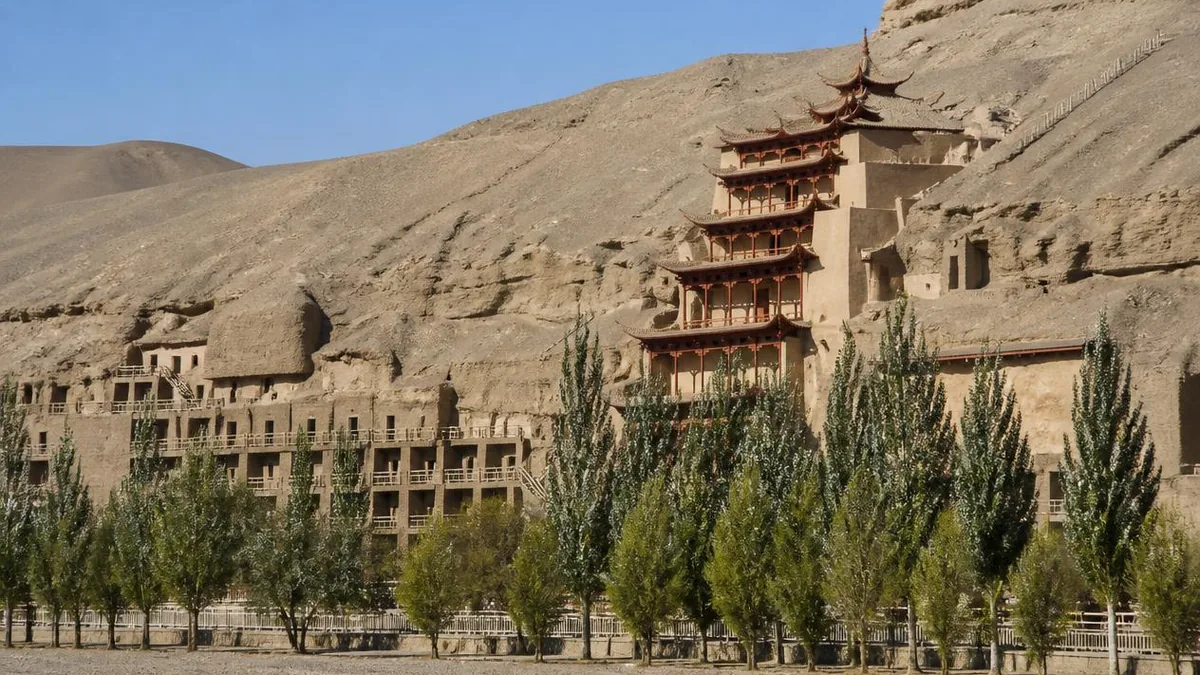
Gansu · Dunhuang
Mogao Caves: The Site That Never Applied for a Rating
China's most famous grottoes hold no A-grade tourism rating at all. That absence is not an oversight, and following it leads to the real subject: a heritage site engineered to resist the act of visiting it.
Search for the Mogao Caves and one question comes back more than any other: what grade of scenic area is it? The answer catches people out. It is not 5A. It is not 4A either. Dunhuang’s grottoes hold no A-grade tourism rating at all.
That is not a clerical gap, and it is the most useful thing to know before you go. Pull on it and you arrive at what this place actually is: a World Heritage site whose whole operating logic is aimed at limiting the number of human beings who stand inside it.
The rating it never applied for
China’s A-grade scenic area system opened on 8 May 2007 with a first batch of 66 sites, and had reached 359 by 27 December 2024. It is run by the culture and tourism ministry against a national standard, scored out of 1,000 points, with roughly 950 needed to qualify.
Two of the four great grottoes were in that opening batch, on the same day: Longmen and Yungang. Maijishan followed on 17 January 2011. Mogao appears nowhere on the list, at any grade.
The site people confuse it with is in the same city. Mingsha Shan and Crescent Lake, the dune-and-spring pairing just south of Dunhuang town, was rated 5A on 13 July 2015. Mogao is about 25 kilometres southeast of town, the opposite direction.
The exclusion is specific rather than institutional. The Dunhuang Academy, which runs Mogao, also administers Maijishan and Bingling Temple, the latter rated 5A on 29 December 2020, four years after the province transferred it to the Academy. The body that runs Mogao is not outside the rating system. Mogao is.
One caution: many articles say the Academy refused a 5A rating, often crediting former director Fan Jinshi personally, and that claim circulates without a primary document behind it. What is documented is the absence, the Academy’s remit, and a policy sentence written twenty years before the rating system existed.
Who actually runs the caves
The Dunhuang Academy began in 1944 as the National Research Institute on Dunhuang Art and was upgraded to Academy status in 1984. In 2016 the province transferred Maijishan, Bingling Temple and the North Grottoes Temple to it, producing the arrangement it now calls one academy, six sites, three of them World Heritage.
A correction is due, because the common shorthand is wrong in a specific way. The Academy is usually described as belonging to the national cultural heritage administration. Gansu’s provincial cultural relics bureau lists it among its own directly affiliated public institutions in its published 2024 departmental budget; the national administration’s relationship runs through key research bases and joint programmes rather than line management. The accurate sentence is narrower and more interesting: the Academy sits in the cultural-heritage system at provincial level, not in the tourism system. Its stated work policy is three words — protection, research, promotion — and receiving visitors is downstream of the first two.
Two listings carry the legal weight. In 1961 Mogao entered the first batch of Major Historical and Cultural Sites Protected at the National Level, entry 1-35. In December 1987 it was inscribed as World Heritage, meeting all six cultural criteria.
A sentence from 1987 that predates the rating system
On 24 November 1987 the State Council issued a notice on further strengthening cultural relics work. Its section on tourism names one site outright. In translation: rare treasures easily damaged, such as the Dunhuang murals, cannot be treated as ordinary tourism opening points; visitor numbers must be strictly controlled and effective protective measures adopted.
Two decades before the A-grade standard existed, national policy had already put this place in a different category from the one the rating measures. Read the standard’s weighting and the mismatch is plain: it rewards transport, parking, toilets, catering, signage, reception capacity — the machinery of moving more people comfortably. Mogao’s engineering problem is moving fewer.
So the internet’s framing has the causality backwards. This is less a story of a proud site turning down an honour than of a site that was never in that queue.
Sixty-two per cent
The physical reason is unglamorous and worth carrying into the caves with you.
Chinese conservation has a codified vocabulary for what goes wrong with wall paintings — the national standard GB/T 30237-2013 names more than two dozen conditions — and four dominate here: flaking of the paint layer, powdering, hollowing where plaster separates from rock, and the salt disruption of the ground layer that specialists call sujian. Behind most of them are soluble salts, chiefly sodium chloride and sodium sulfate, the latter identified as the main agent of salt disruption. Salts travel with water. When air moisture rises they go into solution; when it falls they recrystallise, and the growing crystals push the plaster apart from inside. Repeat that cycle often enough and the painting leaves the wall.
Hence the number the whole operation turns on: about 62 per cent relative humidity. Above it, salts in the ground layer begin to deliquesce. Xinhua reported in August 2026 that Academy director Guo Qinglin described recent rainfall leaving standing water in front of the cliff and raising humidity inside the caves, with openings postponed or suspended in response.
Visitors are a humidity source. Research associated with Fan Jinshi found that 40 people inside a cave for half an hour raised carbon dioxide by roughly seven and a half times, relative humidity by about ten points, and temperature by about four degrees. That is simply what forty warm, breathing bodies do to twenty cubic metres of still air. The Academy has run automated monitoring since 2007 and an integrated system since 2013, reading temperature, humidity, carbon dioxide and volatile organic compounds minute by minute alongside visitor counts, on a framework built through long collaboration with the Getty Conservation Institute.
Three thousand, six thousand, twelve thousand
The carrying-capacity work, run with the Getty Conservation Institute and the Australian Heritage Commission and described as taking roughly a decade, produced a figure: a safe daily reception of 3,000 people.
In 2014 the site opened a digital exhibition centre about 15 kilometres from the cliff, at a reported cost of 260 million yuan. It reorganised the visit into four steps — total volume control, online booking, digital display, physical caves — and cut time inside the caves from about two hours to 70 or 75 minutes. That shortened dwell time is what allowed the cap to double to 6,000, with groups held to about 25 people.
Then demand arrived. The site reported a little over 300,000 visitors for all of 2003, 810,000 in 2014, roughly 2 million in 2018 and more than 2.2 million in 2019. In 2024 it passed 1.5 million by 23 July and 1.77 million by 12 August, up 15.33 per cent year on year, with tickets sold out weeks ahead.
The pressure valve is the emergency visit, which adds 12,000 more per day, so on the heaviest days throughput can reach 18,000 — six times the figure the research produced. This is not hidden: emergency mode is openly described as a balance struck between conservation and demand, not as a revised safe limit.
For contrast, Mingsha Shan and Crescent Lake, the 5A site down the road, has reported 30,000 visitors in a single day at peak. Same tourists, different physics. Sand has no paint layer.
How to get in, and why this section will age fastest
From the Academy’s own opening announcement dated 30 March 2026:
- Seasons. Peak 1 April to 30 November, 08:00 to 18:00, ticket checking stopping at 16:10. Quiet season 1 December to 31 March, 09:00 to 17:00, stopping at 15:10.
- Regular visit. 6,000 tickets a day; a digital film in exhibition hall one, then eight actual caves.
- Emergency visit. 12,000 tickets a day; four actual caves, no film; activated in the busy season as needed.
- Special caves. Opened in limited numbers according to each cave’s own capacity, arranged after that day’s regular or emergency visit.
- Booking. Timed and name-registered. Ticket, ID and person must match. Arrive at the exhibition centre 30 minutes before your slot. Official channels only; the Academy states plainly that no third party is authorised to sell its tickets.
- Refunds. Full refund on unused reservations if the caves close for heavy rain or sandstorm.
Prices are where published guidance is least trustworthy. Figures widely quoted in travel media put a full regular ticket near 238 yuan including two films and the shuttle, an emergency ticket near 100, and special caves at 150 to 200 yuan each. Those come from secondary reporting, not from the announcement, which lists no prices at all, and they have changed repeatedly.
The announcement ends with the line that should govern everything above: terms will be adjusted as conservation work requires, and the latest notice from the Mogao Caves Opening Management Committee prevails. Treat any rule you read anywhere, this article included, as needing same-day confirmation.
You do not choose your caves
The 2026 announcement lists 62 generally open caves and 14 special ones. A regular ticket shows you eight of the 62, decided on the day and shaped by what is closed for monitoring, conservation or humidity. The pool moves too: the 2025 announcement listed 60. There is no fixed itinerary to plan around, and the group ahead of you saw a different set.
There is a second trap, and it catches people the moment they open a book. At least eight parties numbered these caves. Stein numbered 18 representative ones in 1907. Pelliot’s team in 1908 sliced the cliff into vertical sections and reached 183 numbers, mixing digits with upper- and lower-case letters — 118a, 120A, 136F — a scheme later blamed for most errors in concordance tables. Zhang Daqian, copying murals between 1941 and 1943, brushed a zigzag sequence of 309 numbers onto the walls, and those were what scholars cited until the institute published its own. Chang Shuhong’s scheme appeared in 1951 with 469 numbers, grew past 493 as sand clearance revealed more, gained a full renumbering of the northern zone in 1995, and was tidied again in 2003.
So one cave has several names. Cave 464 in current numbering is Zhang Daqian’s 308 and Pelliot’s 181; an older paper’s number will not match the label at the door. The totals disagree too. 735 is the figure usually printed, while the Dunhuang municipal account of the 2003 concordance gives 767, split 519 south and 248 north. The stable number is the one that matters: 492 caves retain paintings or sculpture. Mural area is given as about 45,000 square metres officially and 46,000 in English sources, painted sculptures as more than 3,000 officially and 2,415 on Chinese Wikipedia — different counting scopes, and none of them a round certainty.
Among the landmarks in the general pool, Cave 96 is the one you see from the car park: a red timber facade of nine storeys, about 45 metres tall, sheltering a seated Maitreya of 35.5 metres modelled against the cliff, built in 695 under Wu Zetian’s Zhou and already called the North Great Image in the Tang. The nine storeys are recent — local people rebuilt the facade up from five between 1928 and 1935. Cave 130 holds the South Great Image, 26 metres, from the High Tang.
Cave 17 was built for a dead monk, not for books
The Library Cave opens off the north wall of the passage into Cave 16. It is tiny: about three metres floor to ceiling, 7.65 square metres, under 20 cubic metres of air.
It was cut between 851 and 862 as a memorial chapel for Hongbian, the senior monk who headed the Buddhist establishment of the Hexi region and had funded Cave 16; his appointment stele of 851 is set into the west wall. His portrait statue sits on a low platform, and it has its own itinerary, because it was not in the cave when the manuscripts were found. It stood in Cave 362, and was moved back in 1965 on the decision of Chang Shuhong.
The chamber was sealed in the early eleventh century, holding material from the fourth to the eleventh. Totals vary: the Academy’s pages say more than 50,000 items, other accounts 60,000, some over 70,000. The date of discovery wobbles too. The year 1900 is agreed; the day is not, with 22 June and 25 June both in print alongside the twenty-sixth day of the fifth lunar month, and the Academy’s own introduction allowing a variant reading of the preceding year.
Why it was sealed remains unresolved, and the two oldest hypotheses belong to the two men who emptied it. Pelliot argued hasty concealment ahead of the Tangut attack of 1035, noting that the cave contains nothing in Tangut script, which was created in 1036. Stein read the contents as sacred waste — fragments, broken scroll ends, wrappers, damaged banners gathered from Dunhuang’s monasteries and walled up because such things could not simply be discarded.
Later proposals include a library reorganisation and a deposit of offerings. Rong Xinjiang has argued that the Karakhanid destruction of Buddhist Khotan prompted the Sanjie Temple to seal the material deliberately: the contents were sorted rather than dumped and the doorway was disguised with painting, neither of which reads like panic. Shi Pingting proposed in 1990 that the deposit relates to the monk Daozhen’s long project of repairing sutras at that same temple. There is no consensus.
Who took what, and the numbers that disagree
Stein came in 1907, Pelliot in 1908, the Otani expedition in 1911 and 1912, Oldenburg in 1914; Langdon Warner removed sections of painting with adhesive cloth in the 1920s. Material from the cave now sits in London, Paris, St Petersburg, Tokyo, Beijing and elsewhere.
The quantities and sums are exactly the kind of detail that hardens into false precision. One Chinese Wikipedia article has Stein paying 200 taels of silver for 24 crates of manuscripts and five of other art, then 500 taels in 1914 for 570 items, with Pelliot at 600 taels for more than 10,000 pieces; another has Stein paying 40 horseshoe ingots for some 7,000 scrolls plus 6,000-odd fragments, and Pelliot 500 taels for just over 6,000. English-language accounts convert the two purchases to £130 and £90. These cannot all be right. Give a range and a source, or give nothing.
The Qing state moved in 1910. More than 9,000 scrolls were counted at departure; roughly 8,000 arrived in Beijing three months later, and 8,757 entered the Metropolitan Library, now the National Library of China. A large part of the loss happened inside the country, on the road.
Wang Yuanlu, the Daoist caretaker who lived from 1851 to 1931, is where the argument concentrates, and the assessments genuinely diverge. Yu Qiuyu’s widely read essay made him the emblem of a national wound; historians note that it gets basic things wrong, including crediting him alone with a discovery his assistant made. Against that reading: Stein wrote that he put every donation he raised into restoring the temple and spent none on himself; he reported the find upward, to the county magistrate, the circuit intendant and the provincial treasurer, and was told to reseal it where it lay; Hu Shi observed that he had no idea what he was holding, having sold scrolls to neighbours as medicinal charms. Also true: before the 1910 removal he set bundles aside to sell later, and did.
Both halves stand. He was the only person on site who did anything at all, and what he did included selling.
Digital Dunhuang, and the line everyone quotes backwards
Digitisation was proposed in the 1990s and has run in step with the caps ever since. In 2016 the Academy published 30 caves online at high resolution, viewable worldwide. On 8 December 2022 it launched an open materials library holding more than 6,500 high-resolution files from its six grotto sites and the Library Cave documents, released for download and reuse with rights recorded on a blockchain.
Set that beside the visitor cap and it stops looking like a marketing project. It is the other half of the same policy: the more the physical caves are rationed, the more the substitute has to carry — and in resolution terms the substitute already beats what you see by torchlight in eight minutes. The dispersal has its own version of the same fix. A single manuscript can have one half in London and the other in Paris; the International Dunhuang Project’s digitisation is a reunification that cannot happen physically.
Which brings us to the most quoted sentence in the field. Dunhuang is the heartbreak of our nation’s scholarship. It sits near the front of Chen Yinke’s 1930 preface to Chen Yuan’s catalogue of the manuscripts that stayed in Beijing, and it is almost always quoted as his verdict. It is not. He introduces it with two characters meaning “some say”, and the rest of the preface argues against it: the 8,000-odd scrolls left in China are not dregs, new materials generate new questions, and Dunhuang studies is, in his phrase, the new current in world scholarship today. The famous lament is the position he set up in order to refuse it.
That is close to the argument the cliff makes now. There are more than 700 openings in it. Sixty-two are open this year. You will see eight, for a few minutes each, in the dark, with the door shut behind you to keep the outside air out.
The missing rating is neither modesty nor neglect. It is a site declining to be scored on how many people it can move.
The LoreLens app can identify grotto architecture, Buddhist iconography and mural styles on the spot, and explain the history behind what you are looking at.
Location profile
Where it is
Frequently asked questions
Are the Mogao Caves a 5A scenic area?
No, and they are not 4A or 3A either. The caves appear nowhere on the national A-grade list at any level. The system began on 8 May 2007 with 66 sites and stood at 359 as of 27 December 2024; Longmen and Yungang were both in that first batch, Maijishan followed on 17 January 2011. The site most often confused with Mogao is Mingsha Shan and Crescent Lake, in the same city, rated 5A on 13 July 2015. Two things are worth separating. The documented facts are the absence from the list, the caves' governance by a research institution in the cultural-heritage system, and a State Council notice of 24 November 1987 stating that easily damaged treasures such as the Dunhuang murals cannot be treated as ordinary tourism opening points. The undocumented part is the popular claim that the Dunhuang Academy formally refused a rating, often credited to former director Fan Jinshi; that story circulates without a primary source, and the Academy also administers two sites that are rated 5A, so a blanket institutional refusal does not fit the record.
What is the difference between the regular ticket and the emergency ticket?
Per the Dunhuang Academy's own 2026 opening announcement, dated 30 March 2026: the regular visit is capped at 6,000 tickets a day and covers a digital film at the exhibition centre plus eight actual caves; the emergency visit is capped at 12,000 a day, covers four actual caves, and includes no film. Emergency mode is switched on during the busy season as demand requires. Special caves are opened separately and in limited numbers according to each cave's own capacity, arranged after your regular or emergency visit that day. Prices are the least reliable thing you will read anywhere, including here: the Academy's announcement lists none, the figures circulating in travel media have changed more than once, and quiet-season arrangements differ again. Booking is timed and name-registered through official channels only, ticket and ID must match the person, and the announcement itself states that terms will be adjusted as conservation requires.
Can I see the Library Cave and the nine-storey Buddha?
Probably, but nothing is promised. The 2026 announcement lists 62 generally open caves, and a regular ticket shows you eight of them, chosen on the day and constrained by which caves are closed for monitoring, conservation or humidity. Caves 16, 17, 96, 130, 148, 249 and 428 are all in that general pool, so the Library Cave and the 35.5-metre Maitreya behind the nine-storey facade are reachable in principle. The pool itself moves: the 2025 announcement listed 60 general caves against 2026's 62. Fourteen caves are designated special and need a separate same-day arrangement at extra cost: 9, 45, 57, 156, 158, 159, 217, 220, 254, 275, 320, 321, 322 and 420. If one specific cave is the reason for your trip, accept that you may not get it.
Why are visitor numbers capped, and when should I go?
Because humidity destroys wall paintings and visitors are a humidity source. Soluble salts in the plaster, chiefly sodium chloride and sodium sulfate, dissolve when air moisture rises and recrystallise when it falls, forcing the ground layer apart; the working threshold used at Mogao is about 62 per cent relative humidity. Research associated with Fan Jinshi found that 40 people in a cave for half an hour raised carbon dioxide roughly sevenfold, relative humidity by about ten points and temperature by about four degrees. A carrying-capacity study run with the Getty Conservation Institute and the Australian Heritage Commission put the safe daily figure at 3,000; the 2014 digital exhibition centre cut in-cave time from about two hours to 70 to 75 minutes and allowed the cap to double to 6,000. On timing, the peak season runs 1 April to 30 November with last entry at 16:10, and the quiet season 1 December to 31 March with last entry at 15:10. Midsummer sells out weeks ahead and pushes the site into emergency mode; late autumn and winter mean fewer people and a calmer visit.
Sources and further reading
Background references for the history and place names in this guide. Opening hours, ticketing and access change often — always confirm with official local information before travelling.