Gansu · Jiayuguan
Jiayuguan: One Ticket, Three Places, a Fifteen-Kilometre Line
The 5A listing called the Jiayuguan Heritage Area is not a gate. It is a fort, a wall hung down a mountainside and a beacon tower on a river cliff, strung across the narrowest point of the Hexi Corridor, and every famous claim about the place belongs to a different piece of it.
5A View location, maps and nearby scenic areasAlmost everyone arrives at Jiayuguan expecting a gate.
What the 5A listing actually covers is three separate places, strung out over roughly fifteen kilometres across the narrowest neck of the Hexi Corridor: the fort itself, a wall hung down a mountainside to the north, and a single beacon tower on a river cliff to the south. Visitors who budget two hours for “the pass” and then discover two more sites at opposite ends of a shuttle route lose an afternoon to it.
That structure is not an administrative accident. It is the argument of the place. Jiayuguan was never a door. It was a line, and the line was assembled over a hundred and sixty-eight years.
The ticket is for three places, not one
The Jiayuguan Heritage Area is administered as one 5A scenic area, entered in the first national batch in 2007, and it comprises the fort, the Overhanging Great Wall on the northern flank, and the First Beacon Tower on the southern flank.
The geometry matters more than the paperwork. The fort stands several kilometres southwest of the modern city. From it, the wall line runs roughly seven to eight kilometres north to the Overhanging Great Wall and roughly seven to seven and a half kilometres south to the beacon tower on the Taolai River. Published distances vary slightly with which gate you measure from, but the end-to-end span is about fifteen kilometres.
In practice the ticket bought at the fort has in recent years admitted holders to the other two, while each outlier can also be entered separately on a cheaper ticket. Shuttle services run between them, with a return loop and a full-circuit fare. Every one of those arrangements—prices, validity, shuttle frequency, whether summer reservation is compulsory—has moved year to year. Confirm at the gate.
What “western terminus” actually measures
The phrase attached to Jiayuguan everywhere is the western end of the Ming Great Wall, and it is defensible. It is also narrower than it sounds.
In April 2009 China’s cultural-heritage administration and its mapping administration jointly announced the first precise measurement of the Ming wall: 8,851.8 kilometres, running through ten provincial-level regions and 156 counties. The total broke down into 6,259.6 kilometres of built wall, 359.7 kilometres of trench and 2,232.5 kilometres of natural barrier counted as defensive line. The same survey moved the eastern terminus from Shanhaiguan, where popular accounts had long placed it, to Hushan near Dandong on the Yalu.
The western end it confirmed was Jiayuguan. But the Han dynasty had walled several hundred kilometres further west, running along the Shule River drainage toward Yumen Pass and Yangguan in the Dunhuang area, and a 2012 survey covering all dynasties reported a combined 21,196.18 kilometres. Whether the westernmost Han beacon lines out toward Lop Nur count as wall at all is itself argued, since some scholars hold that those towers were never joined by a continuous rampart.
So the honest sentence is: Jiayuguan is where the Ming stopped, not where China stopped.
The corridor was gated long before the fort
This is the part that separates the age of the fort from the age of the pass, and it is worth carrying north with you to the Overhanging Great Wall, because that site stands at the mouth of the gorge in question.
Shiguan Gorge, also called Heishan Gorge, cuts east to west through the eroded hills north of the fort, roughly ten kilometres long, a hundred-odd metres wide, narrowing at points to around thirty metres between cliff walls, with a stream in it. It is the natural way west out of Jiuquan, and it has water.
The historical geographer Li Bingcheng has argued across a series of papers from the 1990s and 2000s that this gorge held both the earliest and the latest incarnation of Yumen Pass: an initial Western Han pass here, lasting about a decade before the pass was moved west toward Dunhuang around 102 to 101 BCE, and then a return of the name to this gorge in the Five Dynasties and early Song, lasting perhaps 130 years until the Western Xia took the corridor in 1036. On his reckoning Yumen Pass as an institution ran something over 1,140 years, and the Ming fort six and a half kilometres from the gorge mouth is a continuation of the same gate by a different name.
Treat that as a live scholarly position, not a caption. Li Zhengyu and others have contested the location of the Tang-period pass and the chronology of its moves, and the arguments turn on survey evidence and route reconstruction that has not converged. What is not in dispute is the simpler point: people had been putting a gate somewhere in this eight-kilometre band for a very long time before 1372.
One hundred and sixty-eight years, in instalments
The founding date on every signboard is 1372, the fifth year of the Hongwu reign, when the general Feng Sheng is said to have chosen the site while pacifying the corridor. What was built then was modest: an earth enclosure given in early accounts as about 220 zhang around and a little over two zhang high, which survives as the rammed-earth core of the inner city. A fort with no towers.
One caveat belongs here. Research on the sources has noted that the explicit link between Feng Sheng’s campaign and the founding of Jiayuguan traces to Pingfan Shimo, written by Xu Jin after his retirement in 1506, and that no clear Ming-period statement of a 1372 founding has been identified earlier than that. The date is standard; its documentary chain is thinner than its ubiquity suggests.
The rest arrived in instalments. In 1495, on the instruction of the grand coordinator Xu Jin, the Suzhou defence commissioner Li Duancheng added the brick-faced outer enclosure and raised a tower over the gate—a gate tower built more than a century after the gate. In 1506 and 1507 Li Duancheng built the two inner towers, Guanghua and Rouyuan, to the same pattern, along with offices and stores. In 1539, after the minister Zhai Luan inspected the corridor’s defences, a major programme added enemy towers and corner towers to the fort and, crucially, ran wing walls and beacon towers north and south. Work finished around 1540.
Hence the figure repeated locally: 168 years from first earth to complete system.
How the inner city is assembled
The fort rewards being read as a machine rather than admired as a silhouette.
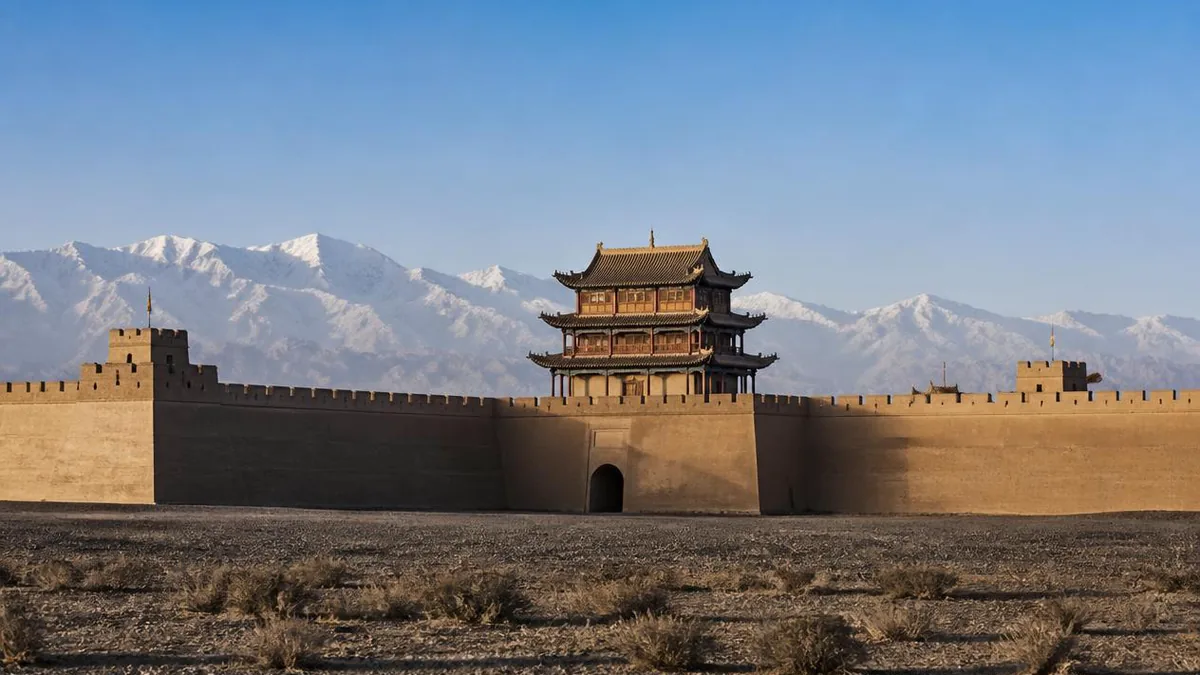
The surviving core is the inner city: about 640 metres around, some 25,000 square metres in area, walls about 10.7 metres high, rammed earth with brick facing on the west side where an attacker would come from. Two gates pierce it, Guanghua to the east and Rouyuan to the west, each backed by its own barbican courtyard. Counts of the towers on and around the inner wall—arrow towers, enemy towers, corner towers, pavilions, gate towers—commonly reach fourteen.
Outside that is the outer enclosure, a brick-faced wall described as forming a raised profile with archery towers at its north and south ends, and beyond that an outer wall line and a ditch. Three tall three-storey, three-eaved hip-and-gable pavilions stand on a single axis: the Jiayuguan Gate Tower, Rouyuan and Guanghua, each about 17 metres high, the lowest storey in brick and timber and the upper two in mortise-and-tenon timber.
The name over the western inner gate, Rouyuan, means to treat the distant with conciliation, which is a fair summary of what a frontier gate is for when it is working.
And the tower you will photograph most is a reconstruction. The Jiayuguan Gate Tower, first raised around 1495, was destroyed in fighting in 1931; the structure standing today was rebuilt to the old pattern in 1987.
Two legends, told as legends
Both of Jiayuguan’s famous stories are traditions. They are worth telling, and worth flagging.
The city-fixing brick sits on the rear ledge of the western barbican gate tower. According to tradition a craftsman named Yi Kaizhan, expert in reckoning, calculated the exact brick requirement for the works; the supervising officer, disbelieving, staked the craftsman’s head and the workforce’s wages on the count; one brick was left over at completion; and Yi announced that it had been placed by an immortal and that removing it would bring the tower down. Nobody has dared move it since.
The versions disagree on nearly everything. The reign period is given as Hongwu in some tellings and Zhengde in others; the supervising officer is anonymous in some and named in others; the brick total is 99,999 in one line of accounts and 999,999 in another. Chinese commentators have added the practical objection that a real masonry job loses roughly five percent of its bricks to firing, transport and laying, so finishing exactly one brick over is not a miracle but an impossibility.
The second is the swallows’ cry. According to tradition a pair nested inside the Rouyuan gate; the male was shut out at nightfall and died against the wall, and the female mourned until she died, after which a stone struck against the masonry answers with a swallow’s call. Wives of departing officers struck the wall for a safe return, and the custom spread to whole families. Visitors struck the wall so often that it was damaged, so today you strike a stone instead. The acoustic explanation offered locally is an echo returned by the tightly laid, upward-tapering brick corner.
The Overhanging Great Wall and the gorge it plugs
Seven or eight kilometres north, on the northern slope of Heishan at the mouth of Shiguan Gorge, a wall climbs a ridge at roughly forty-five degrees. It looks hung rather than built, which is where the name comes from, and the local nickname is the Badaling of the West.
It was part of the 1539 programme, supervised by the Suzhou defence official Li Han and completed in 1540, and it never stood alone: a second stretch, the Broken Wall, runs east to west on the southern side of the same gorge. Together they close the gap. The original construction was stone slabs layered with earth—remnants of the old wall are recorded at about four metres wide at the base, two at the top, and anywhere from half a metre to six metres high, with stone courses of ten to fifteen centimetres and earth courses of ten to twelve.
What you climb is a reconstruction, and openly so. In 1987 the municipal government funded the rebuilding of 750 metres, of which 231 metres hang on a ridge described as 150 metres high and pitched at forty-five degrees. Crenellations and parapets were added, a beacon platform at each end, and a stepped ramp so that visitors can get up it—something over four hundred steps.
Figures for the original length differ. One account gives 1.5 kilometres for the gorge-side wall; another counts 7.5 kilometres from a corner platform at the fort north to the mountainside, of which about 750 metres lay on the slope. The two are probably measuring different things.
The First Beacon, on a cliff above the Taolai
South of the fort the wing wall runs out to its last tower, and stops because the ground stops.
The First Beacon Tower of the Great Wall, also called the Taolai River Tower, stands on the north bank of the Taolai on a cliff generally given as close to 56 metres high. Older reprinted texts say nearly 80 metres; the 56-metre figure is the current mainstream and official one, and the discrepancy is worth knowing rather than repeating. The tower itself is rammed earth, surviving to about 10 metres, roughly square at the base at about 14 metres across with an interior around six metres, and its earth courses are ten to twenty centimetres thick.
It was built in the same 1539 programme under Li Han, and it worked. Ming Jiayuguan is recorded as commanding thirty-nine beacon towers across its inner, frontier and outer zones, and this was the principal one south of the fort, relaying signals from the passes of the Qilian range. It was equipped with an enclosure, post horses, post camels and stacked fuel.
The rhetorical pairing you will hear is with Laolongtou at Shanhaiguan, where the eastern wall runs into the Bohai Sea: head and tail of the same dragon. The site today covers a little over three square kilometres and includes a suspension bridge over the gorge and a zip line, which is a strange afterlife for a signal station but does get you looking at the cliff.
Why here: a narrows, a spring, and later a steelworks
The siting logic is legible on the ground, and it is the reason the line is only fifteen kilometres long.
Here the Hexi Corridor pinches between the eroded Heishan hills to the north and the Qilian range to the south, and the wall only has to cross the gap. Local accounts add a second reason that a garrison cares about more than a strategist does: the Jiuyan Springs beside the fort, which gave the post its water. A pass without water is a camp you cannot hold.
The rest of the fort’s modern status came in the twentieth century. It was placed in the first national batch of protected cultural relics in 1961, and it was inscribed with the rest of the Great Wall on the World Heritage list in 1987. The prefecture-level city that now carries the name is younger than either: it grew around the Jiuquan iron and steel works established in the late 1950s, and is commonly noted as one of the few Chinese cities at its administrative level governed without counties beneath it. You are visiting a Ming frontier inside an industrial town.
Sequence the line, not the gate
The single most useful piece of planning advice here is an ordering.
Take the Great Wall museum at the fort first, then the fort, then one wing, then the other. The museum makes the earthwork legible; walking the fort first and reading about it afterwards inverts the sense. If you are driving on toward Dunhuang the same day, put the First Beacon Tower last, since it sits on the way out. Allow the better part of a day for all three, and more if you want the evening programme at the fort, which runs seasonally.
And hold the three claims apart as you go. The fort is 1372 in its earth and 1495 to 1507 in its towers and 1987 in its most photographed silhouette. The wings are 1539. The gate in this corridor is older than all of it, possibly by a millennium and a half, and stands at the mouth of a gorge that most visitors drive past on the way to the wall that hangs above it.
One ticket. Three places. One line, built by four centuries that never met.
The LoreLens app can identify rammed-earth fortification, beacon-tower construction and Ming wall forms while explaining the frontier history around them.
Location profile
Where it is

Frequently asked questions
Does one ticket really cover all three sites, and how far apart are they?
That has been the arrangement in recent years: the ticket bought for the fort has admitted holders to the Overhanging Great Wall and the First Beacon Tower as well, while each of the two outlying sites can also be entered on its own cheaper ticket if you skip the fort. Distances are the thing to plan around. The fort sits several kilometres southwest of the modern city; the Overhanging Great Wall is roughly seven to eight kilometres north of it, and the First Beacon Tower roughly seven to seven and a half kilometres south, with published figures varying by a few hundred metres depending on which gate is measured from. That means about fifteen kilometres end to end, and shuttle buses rather than walking. Prices, validity periods, shuttle routes and whether advance booking is required all change between high and low season, and reservation rules tighten in summer, so confirm at the gate or on the official channel on the day.
Is Jiayuguan the western end of the Great Wall?
It is the western end of the Ming Great Wall, which is not the same statement. The 2009 joint survey by China's cultural-heritage and mapping authorities put the Ming wall at 8,851.8 kilometres running from Hushan in Liaoning in the east to Jiayuguan in the west, and that survey is also what corrected the older textbook claim that the Ming wall began at Shanhaiguan. Earlier dynasties built much further west. The Han wall continues past Jiayuguan along the Shule River drainage to Yumen Pass and Yangguan near Dunhuang, several hundred kilometres beyond, and a 2012 follow-up survey covering all periods gave a combined length of 21,196.18 kilometres. So Jiayuguan is a genuine terminus of a genuine wall; it is just not the westernmost wall China ever built.
How much of the fort is actually Ming?
Most of the earthwork is, and one of the three great gate pavilions is not. The rammed-earth inner city is the oldest surviving element, and the two inner towers, Guanghua and Rouyuan, are attributed to construction in 1506 and 1507 under the Suzhou defence commissioner Li Duancheng. The outermost tower, the Jiayuguan Gate Tower itself, is the one most photographed and the one to be careful about: it is generally recorded as first built around 1495, destroyed in fighting in 1931, and rebuilt to the old pattern in 1987. Knowing which silhouette is which changes how the skyline reads. The wing walls running north and south, along with the Overhanging Great Wall and the First Beacon Tower, all date from the 1539 programme, well over a century and a half after the first earth fort.
Is the story of the last brick true?
It is told as tradition, and it should be repeated that way. In the usual version a craftsman named Yi Kaizhan calculates the brick requirement for the whole works exactly, the supervising officer threatens him with execution over a single brick's error, and one brick is left over at completion, whereupon Yi declares it a city-fixing brick placed by an immortal that must never be moved. The versions do not agree with one another: the reign period is given variously, the supervising officer is named in some tellings and not others, and the brick count differs by a factor of ten between accounts. Chinese commentators have also pointed out the practical objection, that breakage in firing, transport and laying runs at something like five percent in real masonry, so a whole fort finishing one brick over is an arithmetic impossibility rather than a miracle. Enjoy it as folklore. The brick on the ledge is worth seeing either way.
Sources and further reading
Background references for the history and place names in this guide. Opening hours, ticketing and access change often — always confirm with official local information before travelling.