Jiangsu · Taizhou
Qinhu: The Day After Qingming
Every year, the day after the tomb-sweeping festival, boats from two hundred villages converge on one lake in central Jiangsu to make offerings to soldiers who died eight hundred years ago and whose names nobody knows. The boats are ordinary cargo boats, dressed for one day and stripped again afterwards.
5A View location, maps and nearby scenic areasQingming, the tomb-sweeping festival, is when Chinese families go to their own graves. They pull the weeds, they burn paper, they bow, they eat something, they go home. It is the most domestic of the calendar festivals — a day of private obligation, repeated across a few hundred million households.
At Qinhu, in the Jiangyan district of Taizhou, the important day is the one after.
On that day the villagers of some two hundred settlements pole their boats out onto the water and converge, from every direction, on the town of Qintong. What they have come to do is make offerings to soldiers who died in this marsh eight hundred years ago, whose bodies the local people buried, and whose names nobody ever knew.
No document I can find explains the choice of the second day rather than the first. The logic does not need much explaining. Qingming belongs to your own dead. The day after is left over, and it can be given to the dead who have nobody.
The boats are not festival boats
Start here, because it is the fact that makes the rest of it make sense.
The Qintong boat gathering is not a regatta with a fleet in a boathouse. The boats are the boats these villages use the rest of the year — production, transport, hauling, getting about a landscape where the water is the road. About ten days before Qingming they are picked, washed, reinforced, decked out and converted into ritual craft. On the day they carry gods, offerings, opera troupes and racing crews. Then they are stripped, the fittings come off, and they go back to work.
The fleet exists for roughly twenty-four hours a year and is otherwise cargo.
This is also why the festival survived. A tradition that requires purpose-built equipment dies when the equipment rots. A tradition that requires people to borrow their own working boats for a day only dies when the people stop having boats.
Nine steps
The national intangible cultural heritage listing sets out the sequence in nine stages, and the whole cycle runs close to two months.
Choosing the boats. Ten days before Qingming the gathering head raises a flagpole in the village — one pole per boat, with green shoots and a pennant lashed to the top. The boats wanted are new and light. Selection is an honour, and boat owners hold that a boat that has been in the gathering will run fast and do good business afterwards, so craft that are away working are brought home on purpose to be looked over.
Trying the water, locally practising hands and feet. The polers are men over eighteen, plus a few volunteers in their seventies who insist. Every afternoon they take the boats out to get the feel of the water and drill the unified call — poles going down and coming up as one, which is the only way a pole boat reaches full speed.
Dressing the boats. Scrubbed, decorated, gunwales strengthened, gangplanks laid so the polers have something level to stand on. The offering boats and flower boats get whatever their crews have thought up.
The sacrifice, which the listing identifies as the core of the entire event.
Going to the gathering, which it identifies as the main body: the two hundred villages converging by water.
The race, which it identifies as the climax.
Then sending the first pole, also called sending the red; the drinking; and the night opera. The old custom in the Qintong villages was that any village which had sent boats three years running owed the district an opera.
Nine steps, a set of taboos, and a sequence that the sources describe as essentially unchanged for centuries. It is billed as the only completely surviving water-borne temple fair in China, and given what happened to comparable rites elsewhere in the twentieth century, that claim is easier to believe than most.
Down, down, down
The sacrifice finishes before dawn. Then the boats move into the race water.
The male hands wear headcloths and white wrappings on their legs; the women wear red and green. Pole boats race in pairs. The two boats line up, the gong goes three times, and the crews shout the word for down — three times, in unison — and the poles come down together. The stock description in the Chinese sources is that raised, the poles are a phalanx of spears; driven, they are a python going into the water.
Between heats the performing starts, on the prows and the upper decks: regional opera, comic sketches, stilt-walking, the lake-boat dance, the river-mussel dance, dragon and lion dancing, flower-basket routines. The largest offering boats have three levels and run three different acts at once.
The whole thing draws several hundred boats and something on the order of ten thousand boatmen. The local boast is that for boat gatherings, Qintong is the one that counts, and there is a Guinness certificate on the wall.
Six kinds of boat
The sources vary between five types and six, which is a sign of a living practice rather than a curated one. The full set:
- Offering boats — the ritual centre. They carry the deities and the offerings to the dead. Everything else in the fleet is arranged around them.
- Pole boats — the main type and the workhorse. They push the offering boats along, lead and escort the sacred cargo, travel to the gathering, and do the racing.
- Oar boats, the little skiffs — ten people in a small one, twenty-two in a large, one paddle each. The crews are mostly women and older men. Historically they did not compete at all; then they raced as an afterpiece once the pole boats had finished; now they have their own event.
- Flower boats — performance platforms, developed out of the old lake-boat dance.
- Dragon boats — for dancing the dragon lantern on the water. Not dragon boats in the southern racing sense.
- Abduction boats — three small skiffs working together to stage a comedy about a young couple fighting for the right to choose each other.
That last one is worth pausing on. In among the funeral rites for anonymous soldiers, somebody long ago decided there should also be a farce about marriage freedom performed by three boats in formation. It has stayed in the programme.
The dead nobody claimed
The dominant origin story is Southern Song and it is specific.
After the fall of the north, militia leaders in this marsh country — the names that recur are Zhang Rong and Jia Hu — fought Jin forces around Qinhu, under or alongside Yue Fei, the general who is China’s standard emblem of loyal resistance and who was executed by his own court in 1142. The engagements here are recorded as Song victories. They were also expensive. Many of the dead on the Song side were local militia and unidentifiable.
Local people buried them. The following spring, on the day after Qingming, they took boats out to where the graves were and made offerings. Then they did it again the next year, and the year after that, and at some point it stopped being an act of memory and became an institution.
The festival still carries the general’s surname on its banners, and flags reading serve the country with perfect loyalty — the four characters that tradition says were tattooed on Yue Fei’s back.
Five other explanations
The Yue Fei version is the most widespread. It is not the only one, and the honest position is that the sources disagree.
- The temple fair theory: that this was originally a festival for the Perfected Warrior, a Daoist deity, and the martial framing came later.
- The righteous burial theory: the same rite for anonymous dead, without the Jin wars attached — dead of plague, flood or famine rather than battle.
- The ancestor-search theory: that after his enthronement the founder of the Ming came looking for his family’s graves in this district by fast boat, and the boats have been going out ever since.
- The Zhang sacrifice theory: offerings to a specific local figure surnamed Zhang.
- The pirate theory: that a Ming officer named Hou Bida fought Japanese pirates in these channels, that villagers poled out to help him, and that each man’s pole served as both propulsion and weapon.
That last one has a detail the others lack — the pole as a dual-purpose object — and anyone who has watched a poling crew work will see why it circulates.
The five alternatives are not evidence that the Song story is false. They are evidence of what happens to an origin over eight hundred years in a place with no early written record of it. What survives unambiguously is the shape of the thing: boats, the day after Qingming, offerings to dead people who cannot be named.
Dormant
The received chronology runs: originated in the Song, developed through the Ming and Qing, at its height from the Republican period into the early years of the People’s Republic — and then dormant, from the Great Leap Forward through the Cultural Revolution, and revived after Reform and Opening.
That gap is roughly twenty years. It is stated flatly in the Chinese sources without further comment, and it is the most fragile point in the whole history: an eight-hundred-year practice that came within one generation of not being handed on. The people who restarted it in the late 1970s and 1980s had learned it as young men before it stopped.
It is now spread across six towns of Jiangyan district and draws from more than two hundred villages. In June 2008 it was inscribed on the national list of intangible cultural heritage, in the second batch, under the heading of the Qingming festival. In 2002 it had already been named one of China’s ten great folk festivals, and in 2012 the province designated a cultural-ecological protection experiment zone for Jiangyan’s Qingming customs, announced at the festival’s own opening ceremony.
The town the boats go to
Qintong itself deserves a stop, and it starts with its own name.
The town was Qinhong under the Tang and Qintong under the Song, both written with the plain character qin. The version with the water radical — the one used today — appears to have been invented by a single Ming official. Chen Yingfang, a hydraulic engineer of some standing who rose to be vice-minister of the imperial stud, retired here and drew a Map of the Waterworks of Taizhou, and on that map he labelled the town with a qin he had given three dots of water. The spelling caught on and has been standard for over four centuries.
There is a footnote to this that is almost too neat. The character he chose is read zhen everywhere else in China. Here, and only here, as this town’s name, it is read qin — the sound of the older character it replaced. The town let a bureaucrat change its spelling and refused to change its pronunciation.
It sits where three counties meet, and the local expression for that is that a dog barking in Qintong is heard in three counties at once. Neolithic stone axes have come out of the ground here along with the milu bone. The place was coastal once.
From the middle of the Qing it prospered — farming, fishing, and brick — sitting on the junction of two rivers that carried the grain and salt traffic. By the Republican period it had electric light, a power station, a flour mill and a cotton mill, and Shanghai newspapers printed the Qintong grain prices, which earned it the nickname Little Shanghai. Some 60,000 square metres of old building survive, 20,000 of it Ming and Qing, with ninety-nine lanes, seventy-two old wells and thirty-six old bridges — the largest and most complete old town in central Jiangsu. The lanes are famously convoluted and in places wide enough for one person.
The brick is worth a paragraph of its own. Qintong fired grey brick from dredged river silt from the Qin and Han onward, in a colour the locals call arrowhead-green, dense enough to ring like a gong when struck and fine enough to carve — which made it the material of choice for door lintels and screen walls well beyond the district. Shanghai’s City God Temple, Nanjing’s Jiming Temple and the Jinshan Temple at Zhenjiang are all recorded as having used it. There is now a brick and tile museum of 1,750 square metres in one of the villages, with the kiln work reconstructed.
Two buildings in the old town are the ones people come for.
The first is a courtyard containing a camellia planted in the Song dynasty — over eight hundred years old, and by the assessment of Chinese and international specialists the largest-trunked, tallest and oldest artificially cultivated camellia found in China, of a prized variety, and the only tree of its kind north of the Yangtze. It carries ten thousand blossoms at once. It was already one of the eight classic views of Qintong under the Qianlong emperor. And it flowers around Qingming — which means that on the day the boats come in, the eight-hundred-year-old tree in the middle of town is in full bloom. Nobody planned that. It has simply been true every year for a very long time.
The second is the Academicians’ Residence, a Qianlong-era house of about a thousand square metres. Its owner’s descendants include Li Chenglin, who took first place in the imperial examination in 1840, and — five generations later — three brothers, Li Deren, Li Deyi and Li Dequn, all three of whom were elected to China’s national academies. One house, one Qing top scorer, three modern academicians.
The old town is separately rated 4A and covers 0.54 km². It is on the national list of historic and cultural towns.
The second wetland park in China
The water it all happens on has its own credentials.
Qinhu sits in the Lixiahe depression, one of the three great low-lying basins in China, in the country between the Yangtze and the Huai. It was the second national wetland park approved in China and the first in Jiangsu.
The figures, as usual, depend on which document:
- Planned scenic area: 26 km², of which about 7 km² is open to visitors
- Lakes and rivers: around 37% of the scenic area
- The wetland park proper: 806.9 hectares planned, 588.6 hectares of wetland, a wetland rate of 72.9%
- Three wetland classes (lake, river, marsh) and three types (permanent freshwater lake, permanent river, herbaceous marsh), zoned into conservation, restoration and rational-use areas
The lake itself is natural, and is usually called Magpie Lake — 1.4 kilometres east to west, 1.5 north to south, about 2.1 km², a shape the local description compares to a jade pendant. Nine rivers come into it from all sides, which produces a formation the locals call the nine dragons facing the throne. The name is for the magpies that nest here, magpies being auspicious birds in China; there is also a story about a dragon flinging the lake into existence with its tail to repay a magpie spirit who saved its life.
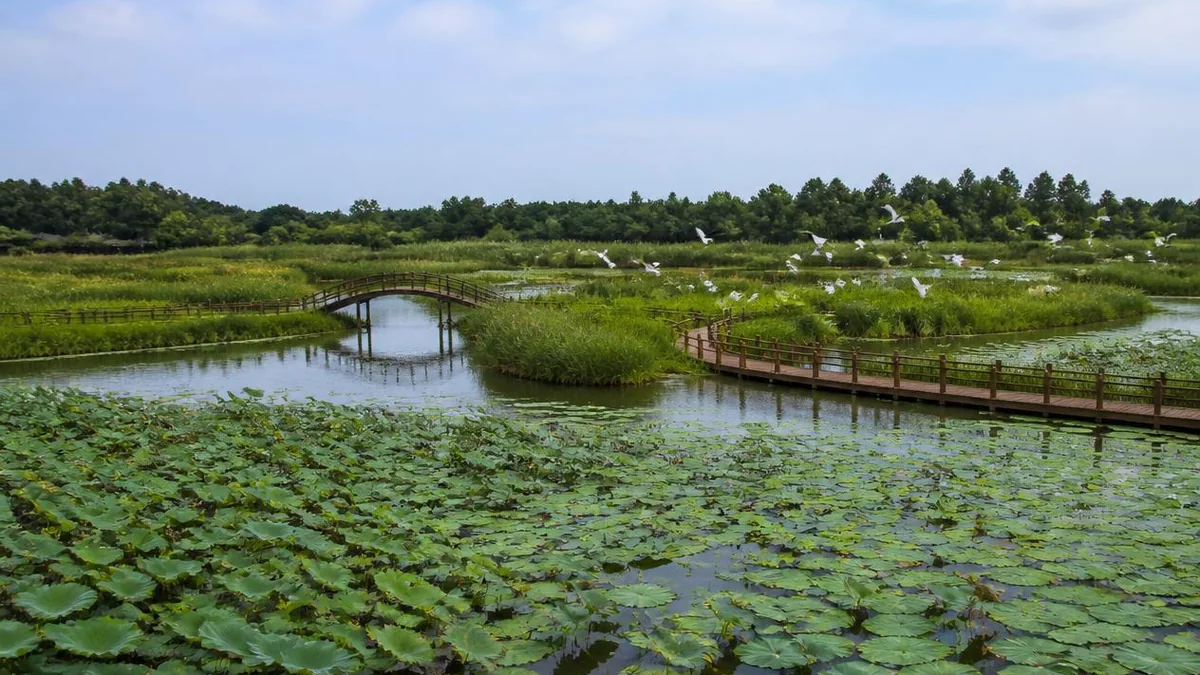
Magpie Lake splits the site cleanly. East is the wetland ecology zone — islands, boardwalks, a wetland science museum of nearly 8,000 m², bird enclosures, a milu enclosure. West is the car park, an aquarium, and an 80-metre pagoda over the water at the old Shousheng Temple, billed as the tallest three-faced Medicine Buddha pagoda in the world, which is a specific enough category to be safe.
The wildlife counts, again with variation: 153 wetland plant species and 97 wild animal species by one account, 392 animals and 251 plants by another; 21 mammals; 97 bird species including seven under national first-class protection — white stork, black stork, red-crowned crane among them. The site is described as having been named to the UN environment programme’s Global 500 roll of honour.
Milu, again
There is one national first-class protected mammal here, and it is the same animal that carries the coast two hundred kilometres northeast of here: the milu, or Père David’s deer, the species that went extinct in China and survives because a French missionary noticed it in an imperial park in 1865 and an English duke bought up the European zoo stock in 1898.
Qinhu has a claim on it that Dafeng does not. Large quantities of milu fossil bone have come out of the ground around the lake and around Qintong town, which is documentary evidence — in the archaeological sense — that this specific marsh was milu habitat long before anyone thought to write the animal down. Qinhu bills itself as the milu’s homeland, and the reintroduced herd here is one of the more approachable in the country. When they cross the water together it is the thing most visitors photograph.
The two sites make a pair worth doing in sequence. Dafeng is where the population problem was solved, at scale, with eight and a half thousand animals and the genetics to worry about. Qinhu is where you can see what the landscape they were built for actually looks like — a shallow, reedy, nine-river freshwater marsh, which is what the whole of this part of Jiangsu was before it was drained.
Four dates for one rating
Qinhu became a 5A scenic area in 2012 — Taizhou’s first — and the sources cannot agree on when.
- One gives the national announcement as gazette number four of 2012, reported in May
- One has the plaque awarded at a ceremony in Beijing on 27 April
- One gives 31 March
- The scenic area’s own website says 5 April, and its own chronology elsewhere says March
Four or five dates, at least two of them published by the site itself. This is not unusual for Chinese scenic-area records, where the assessment date, the announcement date, the gazette date and the plaque ceremony are four separate events that get reported interchangeably as the date. It is mentioned here because the alternative — quietly picking one and stating it as fact — is what most write-ups do.
The earlier ladder is cleaner: provincial scenic area in 2001, opened to visitors on 1 October 2003, national water conservancy scenic area and national wetland park in 2005, the first national wetland science-education base in 2008, national forest tourism demonstration area in 2011.
Weir crab
Autumn is when this place is at its most popular and it has nothing to do with boats.
The eight delicacies of Qinhu are weir crab, softshell turtle, icefish, freshwater shrimp, waterfowl, snails and shellfish, a mixed dish called the four happinesses, and water vegetables. The crab leads the list, and the method is the point: fishers set bamboo weirs across the channels the crabs travel, and the only crabs taken are the ones strong enough to climb the barrier. The gear does the grading. Local partisans will tell you the autumn weir crab here stands comparison with Yangcheng Lake’s, which in Jiangsu is roughly the strongest claim a person can make about a crab.
The local seasonal formula is: spring for the boats, summer for the lotus, autumn for the eight delicacies, winter for the migratory birds. It is marketing, and it is also accurate.
Visiting
The gate is built out of five pole boats stacked on top of each other, which tells you what the place thinks it is about.
Outside festival time this is a half-day to a full day: a boat across Magpie Lake, the eastern wetland on boardwalks, the milu enclosure, the science museum if you have children with you, the pagoda from a distance. It is not a wilderness. There is an aquarium and a farm-experience park and a commercial street, and the site is engineered for throughput in the way 5A sites are.
For the gathering, you need to be in Jiangyan on the day after Qingming, and you need to accept that you will be one of a very large number of people. The thing to watch for is not the racing. It is the hour before dawn, when the offerings are made, before any of it becomes a spectator event.
Two facts to hold at once.
The first is that this is a heavily developed tourist wetland with an aquarium and a car park, whose principal festival is now a branded municipal event with a stage, sponsors and a press pack, and which was dormant for twenty years within living memory.
The second is that on one specific morning each spring, several hundred boats that spend the rest of the year hauling things come out onto this lake so that somebody can make an offering to men who died here in the twelfth century and whose names were never recorded — and that this has happened, with a gap, for about eight hundred years, because the people who lived here decided that dead strangers were their responsibility.
The LoreLens app can identify the boat types, the shrine buildings and the wetland species at Qinhu, and explain what the nine stages of the gathering are for, in your own language, offline.
Location profile
Where it is

Frequently asked questions
When is the boat gathering?
The day after Qingming, which in the Gregorian calendar means 5 or 6 April most years. The preparation cycle runs close to two months before it — boats are chosen about ten days ahead, and the crews practise every afternoon. If you want to see the gathering itself you need to be in Jiangyan on that specific day; there is no second chance in the year.
What is actually being commemorated?
The most widely told version is that militia under the Southern Song general Yue Fei fought Jin forces around this lake, that the Song losses were heavy, that local people buried the dead they could not identify, and that they went out by boat the following spring to make offerings. Five or six other origin stories circulate. The rite itself is unambiguous whichever story you accept: it is for the dead nobody claims.
Are the racing boats specially built?
No, and this is the most interesting thing about the festival. They are ordinary working boats — cargo, transport, everyday village craft — chosen ten days in advance, washed, reinforced, fitted with gangplanks and decoration, used for one day, then stripped and put back to work. The fleet exists for about twenty-four hours a year.
Is it worth visiting outside the festival?
Yes, but for different reasons. Qinhu was the second national wetland park approved in China and the first in Jiangsu, and outside the festival it is a quiet boat-and-boardwalk wetland with a large approachable milu herd, a bird list of around ninety-seven species, lotus in summer, migratory birds in winter, and one of the better regional freshwater cuisines in the province in autumn.
What are the eight delicacies?
Weir crab, softshell turtle, icefish, freshwater shrimp, waterfowl, snails and shellfish, a mixed dish known as the four happinesses, and water vegetables. The crab comes first. Local fishers set bamboo weirs across the channels, and only crabs strong enough to climb the barrier get taken, which means the catch method does the grading.