Jiangsu · Yancheng
Dafeng Milu Park: Twelve Deer and Their Descendants
Every Père David's deer alive on earth descends from a handful of animals that survived in an English duke's park after the species vanished from China. On the Yancheng coast, 8,502 of them are back, and more than three thousand of those are wild.
5A View location, maps and nearby scenic areasEvery Père David’s deer on earth — the herds in Chinese reserves, the animals in European wildlife parks, the pair in a zoo in some city that has never seen a Chinese wetland — descends from a small group of deer that were living in an English duke’s park a little over a century ago, when there were none left anywhere else.
The standard figure is twelve. Eighteen animals were gathered at Woburn Abbey in Bedfordshire; twelve of them bred. Counts vary between about eleven and eighteen depending on which animals are credited, and geneticists working on the species usually treat the effective founder number as smaller still, because a founder that produces one calf and dies contributes very little compared with one that breeds for ten years. Whichever number you prefer, the arithmetic is the same in outline: an entire species, several thousand animals today, passed through a bottleneck you could count on your fingers.
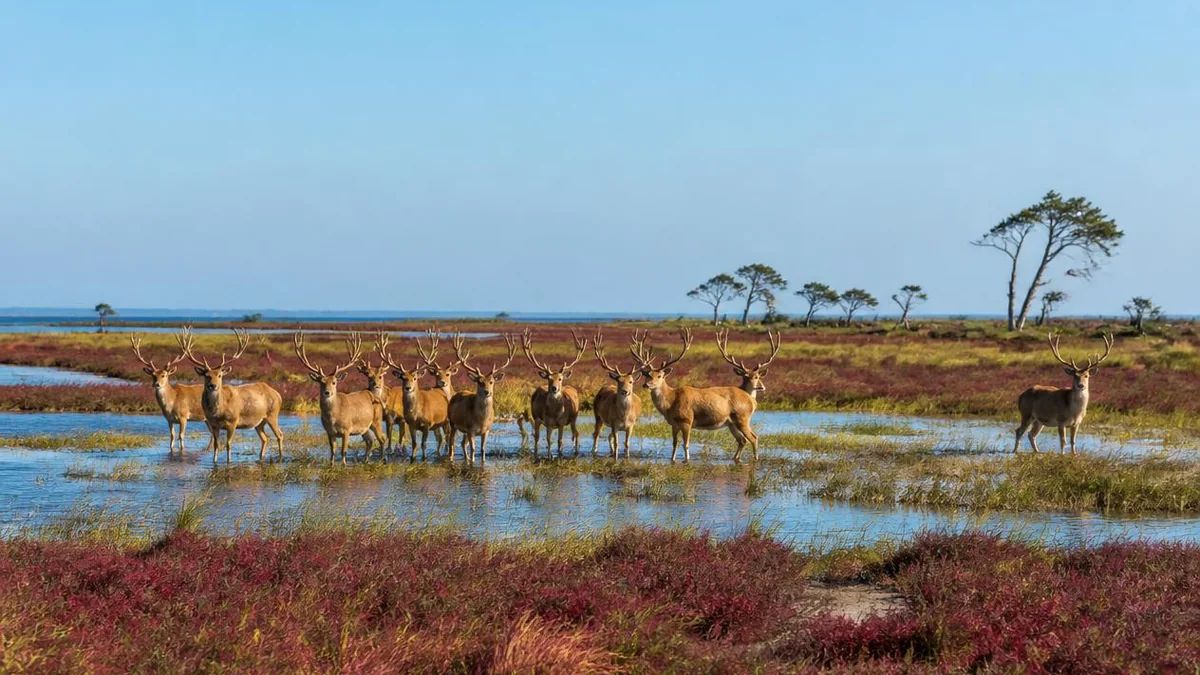
8,502 of them now live on the coast of Jiangsu, in the tidal country east of Yancheng. 3,673 of those are wild.
The four-unlikes
Milu (麋鹿, pronounced roughly “mee-loo”) is a large deer of flat wet ground — river deltas, reed marsh, the seasonally flooded plains of eastern China, which is where it evolved and the only kind of country it was ever native to. It stands about 1.2 metres at the shoulder, weighs up to 200 kilograms, has splayed hooves that spread on soft mud, and swims well enough to spend a good part of the day standing in water.
Chinese has called it 四不像, sibuxiang, the four-unlikes, for centuries: antlers like a deer, face like a horse, tail like a donkey, hooves like an ox. It is a folk description rather than a taxonomic one, but it is unusually accurate — the animal genuinely does look assembled. The antlers are the giveaway to anyone who knows deer: the main tines fork backwards rather than forwards, which no other deer’s do, and the tail is far too long for a deer, hanging almost to the hock.
And here is the fact that reframes everything that follows: the milu had not been a wild animal for a very long time before it went extinct.
The wild population was already collapsing by the end of the Han, around the third century, as the wet plains it needed were drained and ploughed. The sequence after that is imperfectly documented, but the outcome is not: under the Yuan the surviving animals were rounded up and taken to the imperial park at Nanhaizi, south of Beijing, and there they stayed. Two hundred-odd of them were still there in the Qing. So for something on the order of six or seven centuries — possibly longer — the entire species lived inside one wall, as the property of a succession of dynasties.
That is worth pausing on, because it means the wildness that conservationists set out to restore in the 1990s was not something the milu had lost in living memory. It was something no milu had experienced since roughly the fall of the Han.
Deer parks and the throne
Before it was a conservation story the milu was a political animal, and knowing that changes how the Nanhaizi wall reads.
Enclosing deer for a ruler’s pleasure is one of the oldest recorded Chinese institutions. The Spring and Autumn Annals note the building of a deer park in the eighteenth year of Duke Cheng of Lu — 573 BC — and the name and the arrangement persisted, through dynasty after dynasty, all the way to the Qing. The imperial park at Nanhaizi where the last milu lived was not an eccentricity. It was the final instance of a practice roughly two and a half thousand years old.
And the animal turns up at the centre of one of the foundational conversations in Chinese political thought. In the Mencius, King Hui of Liang stands beside his pond with his geese and his milu and asks the philosopher whether a worthy man also takes pleasure in such things. Mencius answers that only a worthy man can: an unworthy one may own all of it and enjoy none of it. He then quotes the Book of Songs on King Wen’s park, where the people rejoiced at the building of it and took pleasure in their king’s having deer and fish — the point being that a park is legitimate when the people are glad of it and a private indulgence when they are not. Two and a half millennia of Chinese argument about the duties of rulers runs through a scene in which the props are these deer.
The deer also stands, more bluntly, for power itself. When the Records of the Grand Historian has an adviser say that Qin lost its deer and the whole world gave chase, the commentator Zhang Yan glosses it plainly: the deer here means the throne. That metaphor is still in everyday Chinese — zhulu zhongyuan, chasing the deer in the central plains, for a contest over supremacy, and lu si shui shou, in whose hand the deer dies, for an outcome still undecided.
There is a folk-literary afterlife too, and a dispute inside it. In the Ming novel Investiture of the Gods, the strategist Jiang Ziya rides a beast called the sibuxiang — the four-unlikes — bestowed on him by the Primordial Lord of Heaven, and popular tradition has long identified that mount as a milu, which is why Chinese children often meet this deer first as a piece of mythology. Purists object that the novel’s creature is a sibuxiang of a different character, meaning a qilin rather than a deer, and they have a point; matters are not helped by Zhu Xi, who in his commentary on the Songs describes the qilin as having the body of a river deer, the tail of an ox and the hooves of a horse, which is itself a four-unlikes description. The confusion is old, unresolved and probably unresolvable.
Two smaller things the classical sources noticed and modern zoology confirms. The milu is the only deer that casts its antlers in winter rather than spring, which Chinese naturalists explained through the waxing and waning of yin and yang. And some agricultural historians have argued that farmers on the eastern plains sowed rice into mud the deer had trampled before they thought of using oxen to do the same job — a suggestion rather than a settled finding, but a pleasing one: that the animal in this marsh may have taught the technique that eventually destroyed its habitat.
Two skins to Paris
In 1865 a French Lazarist missionary named Armand David — a serious naturalist who collected for the Paris museum throughout his years in China and has a panda, a mole and a laughingthrush named after him as well — looked over the wall of the Nanyuan park and saw an animal he did not recognise. He obtained two skins. They reached Paris, where Alphonse Milne-Edwards described the animal as a species new to science and gave it the name it still carries, Elaphurus davidianus.
What followed was the ordinary business of nineteenth-century zoology: European legations and collectors acquired live animals, and a scatter of milu ended up in zoos and private parks in France, Germany, Belgium and England. In China, meanwhile, the single surviving herd came apart. The accounts agree on the outcome and differ on the sequence — a flood that breached the park wall in 1894, the foreign armies that reached Beijing in 1900, hunger and hunting in the years around both. By the early twentieth century there was no milu in China at all, and there would not be one for eighty-odd years.
The 11th Duke of Bedford bought up what was left. From 1898 he acquired eighteen animals from the zoos at Paris, Berlin, Cologne and Antwerp and gathered them at Woburn Abbey in Bedfordshire, at considerable expense, and it worked: by the outbreak of the Second World War the Woburn herd numbered 255, all of it descended from that founding handful. From 1944 the family began deliberately dispersing animals to zoos and parks around the world — 268 of them over the following decades — on the sound principle that a single herd in a single park is a single accident away from nothing.
They went everywhere. For more than half a century they did not go to China. Britain gave China four pairs, two in 1956 and two in 1973, and those went to Beijing Zoo; they were an exhibit, not a population.
The Martinair flight
The return took two attempts and two different English aristocrats.
On 17 July 1985 a Chinese reintroduction group signed an agreement with the Marquess of Tavistock, the Duke of Bedford’s heir; on 24 August 1985 twenty deer flew to Beijing and were released into the Nanyuan wetland, where the species had made its last stand. That was the symbolic return — the animal back on the exact ground it had disappeared from.
The second attempt was the one that mattered biologically. In August 1986, under a project run jointly by the IUCN, the World Wildlife Fund and China’s Ministry of Forestry, thirty-nine milu — thirteen males and twenty-six females — were selected from seven zoos belonging to the Zoological Society of London and given to the Chinese government. On 13 August 1986 a red-and-white Martinair transport landed at Shanghai Hongqiao and the deer were driven north-east by truck, through the salt country, to the coast at Dafeng.
Dafeng was not chosen for its scenery. In the 1960s milu antlers and bone were excavated in the area, which established that this coast was historic milu habitat rather than a plausible-looking substitute — the reintroduction was going back to a real place rather than a convenient one. The tidal marsh here is also, in ecological terms, exactly what the animal is built for: brackish, flat, seasonally flooded, thick with reed and Spartina and salt-tolerant grasses.
Two years, ten years, then the gate
The programme was designed in three stages, and the design is worth attention because it is the part that is easiest to skip and most often skipped.
The first stage, roughly two years, was introduction and increase: get the animals through the transition, get them breeding, build numbers in managed enclosures. The second, allotted ten years, was behavioural reshaping — the recognition that a deer born in a Bedfordshire park does not know how to be a wild deer, and neither does its calf. Foraging on natural vegetation instead of provided feed, avoiding people, coping with tides and storms, sorting out a rut without keepers refereeing it: none of that is instinctive in the way it is convenient to assume.
Only on 5 November 1998, twelve years after the Martinair flight, did the reserve open the gate — the third stage, rewilding. Eight animals were chosen for physical condition and released into the core zone. One hind was fitted with a radio transmitter. The enclosures by then held more than three hundred deer and were crowded; the reserve’s total had reached 354, and the judgement was that the moment had come.
Before that day, every milu on earth lived inside a fence. Not most of them: all of them. There was not a single genuinely wild individual of this species anywhere on the planet.
The eight found shelter and winter forage on their own, and in March 1999 one of them dropped a calf in the open marsh. But the reserve does not date the success of the programme to either of those events, and it is right not to. The date it uses is 3 March 2003, when a female who had herself been born wild gave birth to a calf of her own — followed by three consecutive years in which every wild-born calf survived. That is the point at which the population was reproducing without reference to human beings across generations, which is what rewilding actually means and what almost every reintroduction project fails to achieve.
Four further release trials followed, up to 2016. The wild herds are now into their fifth wild-born generation.
There is a companion story from the same year that deserves telling beside it. In the summer of 1998 the great Yangtze flood broke the fences of the milu reserve at Shishou in Hubei. Some of the escaped deer stayed in the surrounding wetland; a small group swam the Yangtze and settled at East Dongting Lake, which surprised everyone involved — the water had been assumed too deep and too wide for a deer to cross, and it turned out that milu, an animal built for standing in water, swim extremely well. That accidental population has grown to around 150 head in under thirty years.
So in one year, two Chinese milu populations became wild: one on 5 November by careful design after twelve years of preparation, and one in high summer because a river knocked down a fence.
Then the numbers did what recovering populations do when the habitat holds and nobody shoots them.
Thirty-nine deer, thirty-nine years
- 1986: 39
- 2000: 468
- 2013: 2,027, of which 205 wild
- 2019: 5,016
- 2023: 7,840, of which 3,356 wild
- 2024: 8,216, of which more than 3,500 wild
- 2025: 8,502, of which 3,673 wild
Thirty-nine deer arrived in 1986. Thirty-nine years later there are 8,502 — a coincidence of arithmetic, but a useful one for holding the scale of the thing in your head.
The wild herds here hold more than sixty per cent of the world’s wild milu. The reserve claims three world records — the largest milu reserve, the largest wild milu population and the largest milu gene bank — and the first two are straightforwardly true. What the numbers actually closed was a gap of about a century during which there was no fully wild milu herd anywhere on the planet: the species existed, in parks, as a managed object. The IUCN’s 2012 guidelines on species reintroduction rank China’s milu programme among the fifteen most successful of the 138 reintroduction projects it assessed worldwide — a judgement from the body that writes the rules rather than from the people running the project.
What twelve deer cost
Here is the part the visitor centre is quieter about, and it is not a scandal — it is simply the bill.
A population rebuilt from a dozen founders carries almost none of the genetic variation its ancestors had. Milu have measurably low diversity: the species shows very little variation at the immune-system loci that let a population respond to disease, which is precisely the variation you would most want a wild herd to have. Numbers are not the same as security. Eight thousand animals that are all close relatives are, in the specific sense that matters for an epidemic, less safe than eight hundred that are not.
This is why the phrase gene bank keeps appearing in the reserve’s own literature, and why animals are moved between Dafeng, the Beijing Milu Park and the Shishou reserve on the Yangtze rather than each population being left to itself. It is management against an inherited constraint that no amount of successful breeding can undo. You cannot make lost alleles come back.
So the fair summary of the Dafeng programme is not that the milu is saved. It is that the milu is numerous again, in the right kind of country, doing the right things, with a permanent structural weakness at the bottom of it that dates to a decision taken in an English park before anyone involved knew what a gene was.
The other 283 species
The reserve is not only about one animal, and the wider site is arguably more important than its mascot.
It covers 78,000 hectares in three zones — a core area of 2,668 hectares, a buffer of 2,220 and an experimental zone of 73,112 — of tidal flat, reed marsh, seasonal pool and reclaimed grassland. The bird list runs to 283 species. Nine of them hold China’s first-class protection: red-crowned crane, hooded crane, oriental stork, black-faced spoonbill, Saunders’s gull, Nordmann’s greenshank, cinereous vulture and others. Forty-five hold second-class. Nordmann’s greenshank in particular is one of the rarest shorebirds in the world, and the Yellow Sea coast is not one of its stops but effectively the stop — a bird with nowhere else to go.
Alongside the birds: 12 mammal species, 27 reptiles and amphibians, 156 fish, 599 insects, 499 plants.
The recognitions accumulated in the order such things do. The reserve joined UNESCO’s Man and the Biosphere network in September 1995, became a national science-popularisation base in December 1999, and in 2001 was designated a wetland of international importance and a permanent protected site under United Nations programmes. In February 2021 it was named in the fifth batch of national forestry and grassland science bases. And in July 2019 this coastline was inscribed on the World Heritage list as the first phase of the Migratory Bird Sanctuaries along the Coast of the Yellow Sea and Bohai Gulf of China — a listing that protects the mudflat, which is the thing under actual threat. Milu are charismatic and can be bred. Intertidal mud, once it is reclaimed for aquaculture or industry, does not come back, and the birds that need it have no substitute.
Ratings, and a sociologist’s handwriting
The tourism side climbed the Chinese grading ladder step by step: AA in October 2001, AAA in April 2005, AAAA in 2007, and 5A in October 2015. It is, as far as anyone can determine, the only 5A scenic area in the world built around the combination of wetland ecology and the conservation of a single species — which is less a boast than a description of an unusual institutional animal, a nature reserve and a top-rated tourist attraction occupying the same fence line.
That combination is a real tension and worth naming. A 5A rating is awarded partly on visitor facilities, throughput and signage. A reserve’s job is to keep people away from things. The compromise here is the standard one — managed enclosures where the deer are visible and the wild zone where they are not — and it works well enough that most visitors leave believing they have seen wild milu, which they have not quite.
One small detail at the entrance repays noticing. The characters over the gate, 「中华麋鹿园」, were written by Fei Xiaotong — the anthropologist and sociologist whose fieldwork in the Yangtze delta villages in the 1930s essentially founded the study of rural China, and who spent his later decades arguing for the development of exactly this region. It is his handwriting on a deer park, which tells you something about how completely the milu’s return was understood in China as a national story rather than a zoological one.
Visiting
The park sits east of Dafeng town, itself a district of Yancheng, reachable by road from Yancheng or Nantong and by rail to Yancheng and then bus or taxi. Half a day is enough for the visitor areas; a full day if you want the outer boardwalks and observation points, which is where the birds are.
Late September into October is the rut. The stags are vocal, antlered up, and behaving in ways that make the four-unlikes description look conservative, and it is far and away the most interesting time to be here. It is also when the animals least want an audience, and the keepers’ instructions about distance are not decoration.
Two things to hold at once, standing at the fence.
The first is that this is one of the most complete conservation successes on record. A species that was extinct in its own country for the better part of a century is back on its original coast in the thousands, breeding without help, in habitat that has been given the strongest legal protection an international body can confer. Very little in conservation works this well.
The second is that the reason it could work at all is that a nineteenth-century French priest looked over a wall, and an English duke with money bought up the leftovers of a collapse he had nothing to do with, and neither of them was trying to save anything. The milu survives because of the collecting habits of the people whose empires were dismantling the country the milu came from. The 8,502 deer on this coast are the descendants of an accident — and they are also, now, simply deer in a marsh, doing what they did here for a hundred thousand years before any of it happened.
The LoreLens app can identify what you are looking at across the reserve — the deer, the shorebirds on the flats, the marker stones — and tell you the part of the story that is not on the sign, in your own language, without a connection.
Location profile
Where it is

Frequently asked questions
What is a milu, and why is it called Père David's deer in English?
Milu is the Chinese name for Elaphurus davidianus, a large wetland deer native to the eastern Chinese plains and found nowhere else. Chinese tradition calls it sibuxiang, the four-unlikes: antlers like a deer, face like a horse, tail like a donkey, hooves like an ox. The English name commemorates Armand David, the French missionary-naturalist who sent the first specimens to Paris in 1865, where Alphonse Milne-Edwards described the animal as new to science. So an animal that is Chinese in every respect carries a French priest's name in most of the world's languages.
Is it true that all of them descend from a dozen animals?
Effectively, yes. After the species was lost in China around the turn of the twentieth century, the surviving stock was a scatter of animals in European parks and zoos, which the 11th Duke of Bedford gathered at Woburn Abbey — eighteen head, of which the standard account says twelve bred. Sources differ on the exact founder count, and geneticists usually treat the effective number as smaller still, because a founder that breeds once contributes far less than a founder that breeds for a decade. Either way, the whole world population today passes through that needle.
How many deer are there now, and can you see wild ones?
As of 2025 the reserve reports 8,502 milu, of which 3,673 live wild — more than sixty per cent of the world's wild milu. You will reliably see deer in the managed enclosures, which is what most visitors mean by seeing them. The genuinely wild herds are out in the experimental zone across tens of thousands of hectares of tidal marsh, and seeing those is a matter of luck, patience and a long lens.
What else lives in the reserve?
283 recorded bird species, including nine with China's first-class protection — red-crowned crane, hooded crane, oriental stork, black-faced spoonbill, Saunders's gull, Nordmann's greenshank and cinereous vulture among them — plus 45 with second-class protection. Also 12 mammal species, 27 reptiles and amphibians, 156 fish, 599 insects and 499 plants. In July 2019 this coast was inscribed on the World Heritage list as part of the Migratory Bird Sanctuaries along the Coast of the Yellow Sea and Bohai Gulf of China.
How long does a visit take, and when should you come?
Half a day covers the visitor areas comfortably; a full day if you want the boardwalks and the outer observation points. Spring and autumn are best for birds. Late September into October is the rut, when the stags are at their loudest and most visible, and it is the single most rewarding time to be here — though it is also when the animals are least interested in being looked at, and the keepers will tell you to keep your distance and mean it.