Jiangsu · Changzhou
Yancheng: Three Walls, Three Moats and No Owner
The only surviving triple-ringed earthwork city of the Spring and Autumn period anywhere in the world sits in suburban Changzhou. Ninety years of archaeology have not established whose it was.
5A View location, maps and nearby scenic areasThere is a moment on the path around Yancheng when you realise what you are looking at, and it is not a dramatic moment. You are walking on a low grassy bank about three metres high, with water on both sides, in the suburbs of a manufacturing city. Beyond that water there is another bank. Beyond that, another moat, and another bank.
That is the whole thing, and it is the only one in the world.
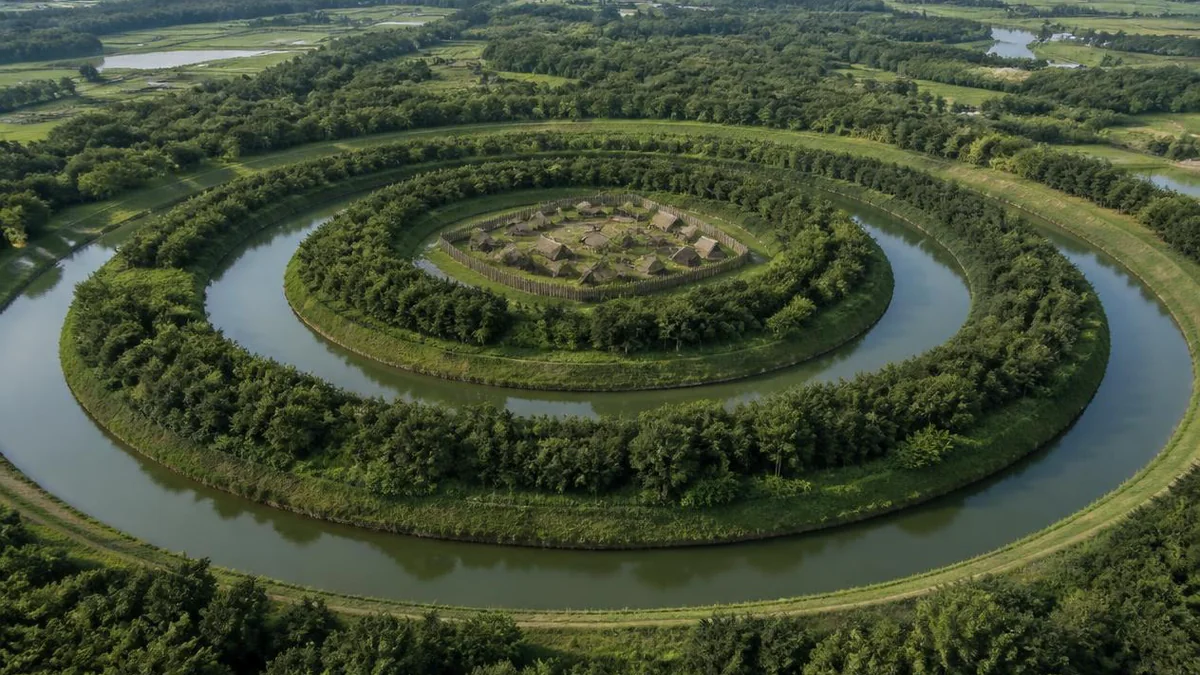
Almost every ancient walled city in China has one wall and one moat. A handful have two walls, or two moats, or two of one and one of the other. Yancheng has three of each, nested — an inner palace enclosure with its own ring of water, an inner city with its own ring of water, and an outer city, irregularly round, with its own ring of water outside that. The archaeologists who dug here describe the form as existing nowhere else among China’s ancient city sites, and the researcher who led part of the 1986 season went further: the only well-preserved Spring and Autumn military installation anywhere in the world with three moats and three walls.
And the plainest fact about it is this. Ninety years after Chinese archaeologists first surveyed it, nobody can say whose city it was.
What the shape is
The site sits at Hutang in Changzhou’s Wujin district, with Lake Tai to its southeast and Lake Ge to its southwest — flat, wet country where earth is the only building material to hand and water is never far below the surface.
It measures 850 metres east to west and 750 north to south, about 650,000 square metres in all. All three walls are piled earth, standing around three metres today. The innermost enclosure, the palace city, sits slightly north of centre, nearly square, with a circumference of about 500 metres. The inner city around it is also roughly square, about 1,500 metres round. The outer city is not square at all but an irregular circle, close to 2,500 metres in circumference.
Each wall has its own moat immediately outside it, and the moats were dug to make the walls — the earth came out of the ditch and went up into the bank, which is why the two are always paired and why the whole structure could be built by people with baskets and no stone.
The mounds in and around the site were long assumed to be more fortification. Excavation showed they are burials, of the earth-mound type that was standard in southern Jiangsu through the Western Zhou and Spring and Autumn periods. The pattern is informative: inside the walls, one mound holds one tomb, which suggests people of rank buried individually; outside the walls, one mound holds many, which suggests family plots of ordinary people. The living arrangement and the dead one match.
Dating has been contested in a low-key way that visitors rarely notice. The excavation literature puts construction in the late Western Zhou, main occupation from the late Western Zhou into the early Spring and Autumn, and effective abandonment by the middle Spring and Autumn — call it 2,700 to 2,800 years ago. You will also read that it was built in the late Spring and Autumn, and the scenic area’s own website says the site is over 2,500 years old. The earlier figures are the archaeological ones, and the site’s signage has not entirely caught up with its own excavation reports.
The boats
The most spectacular things to come out of Yancheng came out of the water.
In the early summer of 1958, villagers digging mud from the inner moat for fertiliser found a boat. Over the following years three more emerged from the same ring of water: four dugout canoes, each hollowed from a single trunk — not by carpentry as we would understand it, but by controlled burning followed by adzing out the charred wood, which is exactly the technique the earliest Chinese texts describe when they speak of hollowing wood to make a boat.
The largest is eleven metres long, ninety centimetres across and forty-five deep, cut from one length of nanmu. It is known locally as the first boat under heaven, and it now lives in the National Museum of China in Beijing. A 4.2-metre canoe went to the Nanjing Museum. Two more stayed here in the site museum. One of them, 7.45 metres long, has been carbon-dated to over 2,800 years.
Standing in front of an eleven-metre log with the inside burned out of it does something that a wall of piled earth does not. Somebody chose that tree, felled it without metal saws, lit fires along its length in controlled patches, and scraped out the char, repeatedly, for as long as it took — in order to move across a moat that they had also dug by hand, around a city they had also raised by hand.
The three-wheeled basin
The bronzes number more than twenty, in the forms you would expect of the Wu and Yue traditions — zun, pan, yi, gui, ding, bells, swords — alongside over a thousand jades, and thousands of ceramic pieces in geometric stamped hard pottery and early celadon.
One object stands apart. The bronze three-wheeled basin, found at Yancheng in 1957, is 15.8 centimetres tall and sits on three wheels so that it can be pulled along, with the front axle decorated by a pair of animal heads. It is now in the National Museum of China, and it is regularly cited as one of the most distinctively regional bronzes of the Wu-Yue world — the kind of object that could not have been made in the Zhou heartland, because nobody there was thinking about putting wheels under a ritual vessel.
Whoever lived here was not a marginal population improvising in a swamp. They were people with bronze, with jade in quantity, with a ceramic tradition of their own, and with enough surplus labour to move six rings of earth and water.
Whose city was it
Here the record simply stops being able to help, and the honest thing is to lay out the competing cases rather than pick one.
The Yan refugee theory is the oldest and gives the site its name. In the 1930s the archaeologists Wei Juxian and Chen Zhiliang published notes on visiting an “Yan city” some twenty li south of Changzhou. They connected it to the ancient state of Yan, a late Shang polity located east of the old city of Qufu in Shandong, whose ruler is said to have joined Wu Geng’s revolt against the Zhou in the reign of King Cheng and been destroyed for it. The tradition holds that the surviving Yan people fled south with their lord, cut ditches for defence and piled earth for walls, and kept calling themselves Yan; because the character for Yan was interchangeable in antiquity with a homophone written with the water radical, the place became Yancheng. There is a documentary hook for it: the Yuejue Shu records that the southern city of Piling county was anciently the land of the lord of Yan.
The Ji Zha theory is later in date and southern in sympathy. Ji Zha, the famously scrupulous Wu prince who repeatedly refused the throne, is said to have been so disgusted by Helü’s assassination of King Liao that he resolved never to enter Wu again, and built a city with moats on his own fief at Yanling to mark a permanent withdrawal — the name in this reading meaning to linger, to stay away.
Both stories explain the name. Neither explains the archaeology. The Ji Zha version is chronologically awkward, because the site’s main occupation is centuries earlier than the events it invokes. The Yan version depends on a migration for which the physical evidence here is inference rather than proof. The plain summary given by China’s own reporting on the site is that scholarly and archaeological opinion on the origin of Yancheng and the identity of its owner remains various and unsettled.
The man the second theory names
The Ji Zha theory does not survive the dating, but Ji Zha survives everything else, and he is the reason Changzhou has a recorded history at all.
Ji Zha (roughly 576–484 BC) was the fourth son of King Shoumeng of Wu and, by every account that reaches us, the most admired man of his generation in the south. In 547 BC King Yuji enfeoffed him at Yanling, which is Changzhou — and that act is the point at which the city enters the historical record with both a firm date and a firm name. Everything before it here is archaeology; everything after is history. He is styled the Lord of Yanling ever since.
He is famous for refusing things. His father wanted to pass the throne to him over his three elder brothers; Ji Zha put forward the eldest, Zhufan, and withdrew to the countryside. When Zhufan died the second brother offered it again, and he refused again. When the third brother died, envoys came to fetch him and he ran rather than accept. And when Helü had King Liao assassinated and offered the throne to Ji Zha as the legitimate alternative, he refused a fourth time, went back to his fief, farmed, and — the tradition holds — never set foot in the Wu capital again. Asked to justify himself, he cited the example of Zichang of Cao, who had held to principle, and said that when there is a rightful heir, who would dare contest him. When the people of Wu insisted anyway, he abandoned his household and property and went to work the land.
Two stories carried his name for the next two and a half thousand years.
The first is the music. Sent as envoy to the state of Lu, he was invited to hear the full Zhou ritual repertoire, and after each piece he delivered a judgement on the state whose music it was. From the airs of Zhou’s southern domains he read a country with solid foundations and a diligent, uncomplaining people. From the airs of Zheng he concluded that Zheng’s people had reached the limit of endurance, and that this was the music of a state about to fall. When the Shao dance was performed he stopped: virtue has reached its limit here; the viewing is finished; if there is other music, I dare not watch it. The Chinese phrase for the summit beyond which one need see no more comes from that sentence.
The second is the sword. The Records of the Grand Historian tells it in five lines. On his first embassy north, Ji Zha passed the lord of Xu, who admired his sword and did not say so aloud. Ji Zha understood, but he was travelling to the great states and needed the sword, so he did not offer it. On the return journey the lord of Xu was dead. Ji Zha untied the sword, hung it on a tree at the tomb, and left. To his attendant, who thought this a waste, he said: I had already promised it in my heart — shall his death make me betray my own heart? The people of Xu made a song of it. Du Fu was still alluding to it in the eighth century.
Confucius, who was about thirty years younger, thought highly enough of him to attend the funeral of Ji Zha’s eldest son and to observe that Ji Zha was the man of Wu who understood ritual. Later tradition pairs them: Ji in the south, Confucius in the north.
Ji Zha is buried at Shanghu, in what is now Shengang in Jiangyin. In front of the tomb stood a stone bearing ten archaic seal characters attributed to Confucius himself, a lament for the tomb of the gentleman of Yanling of Wu — and the character is junzi, gentleman, not jizi, which is how it is often misquoted, including in the first version of this sentence I wrote. The stele was destroyed in the fighting at the start of the war with Japan; what survives is a rubbing, 2.26 metres by 0.93.
None of which he can have had anything to do with these walls. He was enfeoffed here in 547 BC, by which time Yancheng had most likely been empty for a century or more. But the theory that names him is not really a dating claim. It is a claim about what kind of place this was — and a city built by a man to demonstrate that he had permanently withdrawn from power is a considerably better story than a fortress, which may be exactly why it stuck.
The argument about scale
One sub-argument is worth following, because it shows how these disputes actually work.
Supporters of the royal-city reading point out that Yancheng’s dimensions match a famous line in the Mencius about a city of three li with an outer wall of seven — the classical formula for a capital. If the measurements fit the formula, the argument runs, this was a king’s seat.
The rebuttal is twofold and, to my reading, stronger. First, the passage in Mencius is not a specification for city planning at all; it is an argument about statecraft, using a city as an illustration, and reading it as a building code mistakes a metaphor for a manual. Second, the numbers do not actually support grandeur: more than ten Eastern Zhou cities are known to have exceeded ten square kilometres, and Yancheng is under one. Whatever it was, it was not a capital by the standards of its own era.
Which leaves the military reading — a fortress, probably of Wu, holding a wet frontier with three rings of water because water was the cheapest and most effective defence available in that landscape. That interpretation fits the size, fits the location between two lakes, and fits the swords among the bronzes. It also leaves the name unexplained, which is where we came in.
How it ended
The end appears to have been sudden.
One excavated tomb chamber is Western Zhou in date, which establishes that people were living here before the Spring and Autumn period began. Then, on the evidence of the objects recovered from the moats, the occupation stops. Archaeologists have suggested that the defeated Yan people — if that is who they were — lived here only briefly and left in the middle Spring and Autumn period because of some abrupt reversal.
There is a candidate for the reversal. In 1981 the Zhenjiang Museum excavated tomb chambers at Damao Hill and Sixiang Hill in Wujin, and the results have been read as evidence that the state of Yan was destroyed by the neighbouring state of Yi in the later part of the middle Spring and Autumn period.
So the sequence, as best it can be assembled: a population arrives in this wet country, possibly from a very long way north, builds the most elaborate earth-and-water defence anyone in the region has attempted, uses it for something like two centuries, and is then eliminated by a neighbour — after which nobody moves back in, and the rings of earth and water sit in the paddy fields for the next two and a half thousand years, keeping their shape because nothing was ever built on top of them.
That last part is the reason the site matters. Yancheng survives not because it was protected but because it was abandoned early and never wanted again.
The stories the villages kept
Where the documents fail, the villages did what villages do.
Local tradition around Yancheng preserves a set of tales — that the moats were dug by two turtles; that the king of Yan beheaded his own daughter; that Yue Fei, the Southern Song general, quartered troops inside the old walls. The site park points out a stone turtle, the foundations attributed to the lord of Yan’s hall, a thatched hut ascribed to Sun Wu — the author of the Art of War, a Wu commander in reality — and a platform where Yue Fei is said to have reviewed his men.
None of this is history in the sense that the canoes are history. All of it is now formally recognised: the Yancheng legend cycle is inscribed on Jiangsu’s provincial list of intangible cultural heritage. That is the correct way round, in my view. The stories are protected as stories, and the earthwork is protected as an earthwork, and no one is asked to confuse them.
Yue Fei is the most revealing of the three. He lived some seventeen centuries after the walls were built. A community that has lost the name of the people who dug its moats will fill the gap with the most famous soldier it can think of, because an anonymous fortification is intolerable and a fortification belonging to Yue Fei is not.
The park on top
The Spring and Autumn Yancheng tourism district was designated a national 5A scenic area in the winter of 2016–17; the tourism authority’s confirmation is reported as December 2016 and the plaque as February 2017, which is the usual gap between approval and ceremony. The site itself had been a national protected monument since 1988, and in 2009 the district won a gold award under a United Nations environmental sustainability programme.
The district bundles five things: the archaeological site park, the Yancheng Spring and Autumn theme park, a safari park, a traditional-style shopping street, and the Baolin Chan temple. Even the total area is inconsistently reported — 7.6 square kilometres in the fuller descriptions, 3.2 on the operator’s own homepage, with correspondingly different lists of components. That is the sort of discrepancy that tells you the tourism product has been reorganised more than once.
The marketing line is genuinely good: for the Ming and Qing, go to Beijing; for the Sui and Tang, go to Xi’an; for the Spring and Autumn, come to Yancheng. It is also a claim the ruins cannot quite carry on their own, since a bank of earth communicates less to a first-time visitor than a palace does, and the theme park exists to fill that gap with chariot shows and costumed performance.
This is Changzhou’s second answer to the same problem its dinosaur park answers. There, a city with no fossils imported a collection and built an industry around it. Here, a city with a genuinely world-unique monument found that the monument was three grass banks and a lot of water, and built the entertainment beside it. One case is invention; the other is amplification. Both are the same municipal instinct.
Visiting
Do the ruins first and slowly, and walk the full circuit rather than cutting across. The point of Yancheng is not any single object in it — the best objects are in Beijing and Nanjing — but the experience of crossing three lines of water in sequence and understanding, physically, what an attacker would have had to do three times over.
The site park is in Wujin district south of central Changzhou, reachable by city bus and metro connection; the theme park and safari park are ticketed separately from the ruins, and the ruins are the quiet part of the complex. Spring and autumn are best, both for the walking and because the moats are at their most legible when the vegetation is low.
Two facts to hold together as you go round. This is the only city of its kind anywhere — three walls, three moats, intact, from a period when most of the world’s cities have vanished entirely.
And we do not know a single name of anyone who lived in it.
The LoreLens app can tell you which of the three rings you are standing on and which of the competing theories claims it — including the ones the signage leaves out.
Location profile
Where it is

Frequently asked questions
What makes Yancheng unique?
Its plan. Almost every ancient Chinese walled city has one wall and one moat; a few have two of each. Yancheng has three concentric earth walls each with its own moat — an inner palace enclosure, an inner city and an irregularly round outer city. Archaeologists who have worked on it describe it as the only intact three-wall, three-moat Spring and Autumn site known anywhere.
Who built it?
Nobody knows, and the honest answer is that the question is open. The two long-standing theories are that it was built by refugees of the Shang-era state of Yan fleeing south from Shandong after a failed revolt, or that it was raised by the Wu prince Ji Zha as a gesture of permanent withdrawal from Wu politics. Neither has been proved. The site was declared a national protected monument in 1988 with its owner still unidentified.
What was found there?
Four dugout canoes from the inner moat — the largest 11 metres long, hollowed from a single log by burning and adzing, and one carbon-dated to over 2,800 years — plus more than twenty bronzes, over a thousand jades, ceramics and early celadons, and the famous bronze three-wheeled basin now in the National Museum of China. The mounds in and around the site turned out to be Western Zhou and Spring and Autumn burials.
Is the site the same thing as the theme park?
No, though they share a ticket gate area and a 5A designation. The Spring and Autumn Yancheng tourism district bundles the archaeological site park with a Spring and Autumn theme park, a safari park, a shopping street and a Buddhist temple. The ruins themselves are quiet, largely unbuilt, and free of rides.
How old is it, exactly?
Sources disagree, and the disagreement is worth knowing. Excavation reports place its construction in the late Western Zhou with main occupation into the early Spring and Autumn period and abandonment around the middle of that period — roughly 2,700 to 2,800 years ago. The scenic area's own website says over 2,500 years. The earlier figure is the archaeological one.