Jiangsu · Changzhou
Tianmu Lake: The Reservoir That Became a Lake
Jiangsu's most photographed stretch of water is a flood-control dam, dug by hand during a famine, on top of a village called Shanya Bridge. The bamboo sea, the hot spring and the most famous soup in Changzhou are all downstream of that decision.
5A View location, maps and nearby scenic areasThe most photographed water in Changzhou is not a lake, and almost nothing you come here to enjoy was built for you.
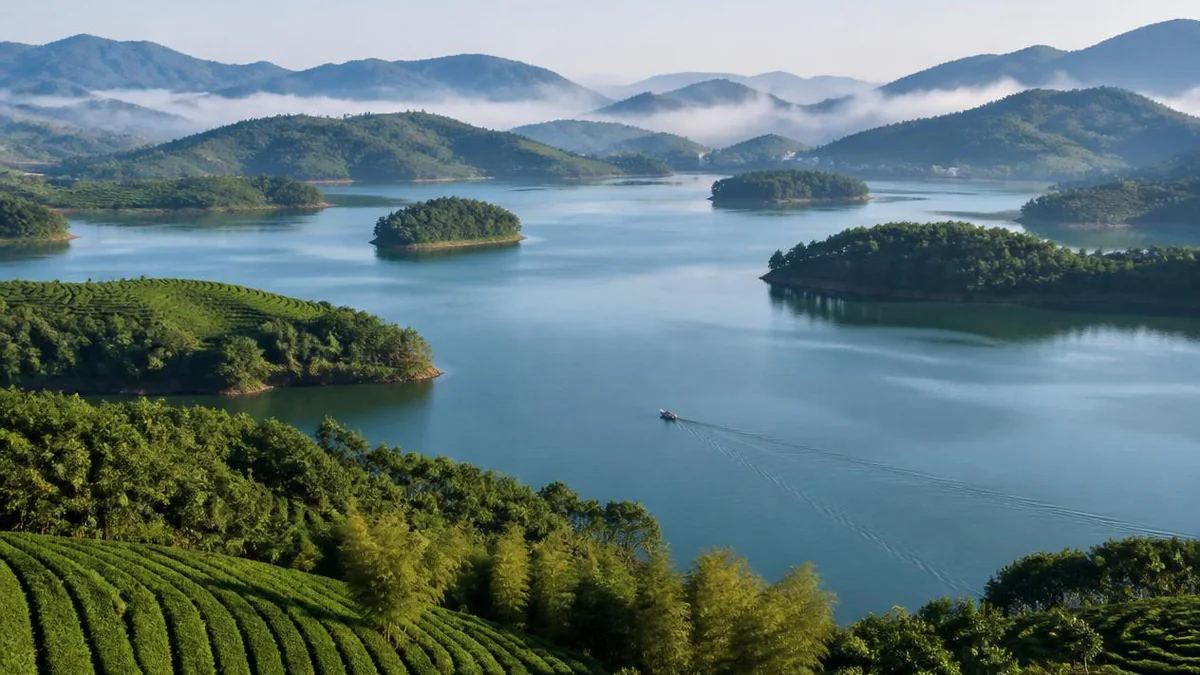
Tianmu Lake is Shahe Reservoir. It lies eight kilometres south of Liyang, it holds back a river that used to destroy the villages along it, and it was given its present name in 1992 because a reservoir is a harder thing to sell than a lake. The name is not invented out of nothing — these hills are an outlying spur of the Tianmu range, and the lake took the range’s name. But the shape of the water, that long narrow north-south body that photographs so well from the hills, is the shape of a drowned river valley behind a dam.
Which makes this one of the more honest 5A areas in the country, if you know what you are looking at.
The river that had to be stopped
The Shahe rises in the north of Guangde county in Anhui, in two mountain gullies. By the time it crosses into Liyang it has gathered eight tributaries carrying the water of forty-eight ravines, and it arrives wide and fast. In flood season it arrived as a disaster.
Twice in four years the mountains south of Liyang produced a catastrophe. Flash floods in 1954 and again in 1957 destroyed dozens of villages along the Shahe and tens of thousands of mu of farmland. After the second one, the county sent a survey team into the southern hills to work out where the water was coming from and what could be done about it.
The plan they came back with was a main dam thrown between Mozi Hill and Diaoyutai Hill — the hill now called Taigong Hill, the one with the fishing terrace on it — plus two auxiliary dams closing the other gaps in the ring of hills. Dam the gaps, and the valley fills. That is the lake.
Nineteen fifty-eight
The county Party committee issued the mobilisation order in early September 1958, and the provincial water resources department gave formal approval on the 7th. The first men onto the site were more than 1,700 labourers from four communes: Daibu, Chating, Chengnan — and Shanya, which is now under the water.
They closed the main dam on 5 July 1959, on schedule.
What happened in between is the part the promotional material does not mention. In February 1959 the great famine of the three hard years reached the water-conservancy sites of Liyang. Some provincial and prefectural leaders questioned whether the Shahe project should continue at all, and preparations were made to shut it down. The provincial Party standing committee discussed it and decided to keep Shahe going — by cutting back the scale of the neighbouring Daxi reservoir project instead. So this dam was built by hungry men, and it was finished because another dam was made smaller.
The main works were essentially complete in 1961. Supporting works continued from 1962 and were not basically finished until 1973.
And Shanya Bridge village went under. Shanya commune relocated its seat to Pingqiao and was renamed Pingqiao commune. That is the whole of the record that surfaces easily — no resettlement totals, no list of households. Anyone who wants those numbers will have to go to the Liyang county gazetteer or the local water-conservancy annals, and it is worth saying plainly that they exist and are not in front of the visitor.
What the numbers say
The catchment is 148.5 square kilometres. Total storage capacity is given as 109 million cubic metres, though you will also see 49 million quoted — that is normal operating capacity, a different measure, and the two should not be set against each other as if one were wrong.
The lake sits at an elevation of about 21 metres and normally holds a level of 20 to 21, swinging between 16 and 22 depending on rainfall. Its recorded high was 21.98 metres, on 1 July 1999. It is narrow east to west and long north to south; the southern end runs 4 to 5 metres deep and the northern end 10 to 14.
The resort’s planned area is 10.67 square kilometres, not counting 7.25 square kilometres of water, inside a 300-square-kilometre ecological protection zone holding both the Shahe and Daxi reservoirs. Jiangsu named it one of its first ecological tourism demonstration areas.
Water quality overall runs Grade II to III. Dissolved oxygen is genuinely good — 39.9% of readings at Grade I, 35.8% at II, 20.8% at III, and only 3.4% worse than III. The weak indicators are nutrients: 17.5% of total phosphorus readings and 15.6% of total nitrogen readings fall below Grade III. That is a working drinking-water reservoir in a farmed catchment, and the figures read like one.
The soup
Now the best story on the lake, which is about waste.
Shahe Reservoir produced silver carp in quantity. The reservoir’s staff ate the fish and threw the heads away, because a fish head is mostly bone. The old Party secretary, Xu Yugen, thought this was wasteful, picked the heads back out, and boiled them.
In April 1975 a man named Zhu Shuncai, born in Liyang in August 1952, was demobilised from the army and posted to the reservoir canteen as a cook. He had previously been the man responsible for opening and closing the sluices on three of the channels, and being young and willing he had often helped out in the canteen anyway. He took Xu’s improvised soup and spent years working it out properly.
The method, as he describes it: an eight-jin wild grey silver carp from the lake. Render pork fat and fry the head in it first, to bring up the richness. The instant the oil begins to bubble, add Tianmu Lake water — not any water. High heat until the liquid and the fat emulsify and the broth turns milky white, then transfer to a sand casserole and simmer gently for three or four hours. Because the lake bed is sand and gravel rather than silt, the broth carries none of the earthy taste that fish-head soup usually has to be argued out of. Fresh without muddiness, rich without heaviness, and white as milk.
In 1982 the ambassadors of seventy-five countries visited Shahe Reservoir with their spouses and were given Zhu’s fish head. In 1985, when Deng Xiaoping was in Nanjing, the Tianmu Lake Hotel sent Zhu there with the lake’s fish and the lake’s water to cook it on site. Deng said it was the best dish of the evening, and asked Zhuo Lin to take the message back to the kitchen. Yang Shangkun and Jiang Zemin later ate it too.
Zhu Shuncai worked in kitchens for forty-seven years, became a master chef of Jiangsu province, and rose to deputy general manager of the hotel. He was still on the road promoting the dish in March 2024, in Hanyin county in Shaanxi. The dish is now routinely described as the one that made a city — and it began with a man who could not stand seeing food thrown out.
A bamboo sea eighteen kilometres away
The 5A rating covers three sites, and the second is not on the lake at all.
Nanshan Bamboo Sea sits in the far southeast corner of Liyang, bordering Yixing to the east and looking across the hills at Guangde in Anhui to the south — the meeting point of Jiangsu, Zhejiang and Anhui. Locals have always called the southern hills Nanshan, and the hills are under continuous bamboo, so the name is simply descriptive. It covers more than three square kilometres and is 18 kilometres from the lakeside garden.
Its history is short and instructive. In September 2000 the township government of Hengjian set up a tourism development company and began building around the Taoshu ravine reservoir. In March 2004 the Tianmu Lake tourism company signed with them to form a joint venture, put in nearly 70 million yuan, and reopened the site the following year. Climb to the First Peak of Wu and Yue at 508 metres and you can see the whole bamboo canopy and, on a clear day, three provinces at once.
The third site is Yushui hot spring, at Lijiayuan village in Daibu town, 18 kilometres from the lake and 30 from Liyang city. It is a calcium bicarbonate spring — uncommon in eastern China, and drinkable as well as bathable, with claimed benefit for nervous, musculoskeletal and dermatological complaints. It was voted one of China’s ten great hot springs in March 2011, and its selling point is the open-air pools set into 35,000 mu of bamboo.
So a single 5A designation reaches across nearly twenty kilometres and three separately developed businesses. That is normal for the category, and it is worth knowing before you plan a day here.
What is actually up there
The bamboo sea is organised around two themes — bamboo, and longevity — and it repays knowing the layout before you arrive, because the site is Y-shaped and everything transfers at Shouxing Square, the Square of the Star of Longevity.
There are 35,000 mu of bamboo. Within it: a quiet lake with boating, a Bamboo Culture Museum, a stretch of old official road, a longevity culture area with the figure of the Nanshan Old Man carved into the hillside, a bamboo carving gallery, the peak, a village, and — unexpectedly — pandas.
The panda house runs to over a thousand square metres and holds two sisters, Huali and Xing’an, both born in 2013 at Bifengxia in Ya’an, Sichuan. Xing’an was adopted for life by Mercedes-Benz China at birth. You cannot walk to them; access is by ground funicular from Shouxing Square, and the pandas tend to sleep somewhere between half past ten and two, which is worth planning around rather than discovering.
The peak is the reason to come. It is signed Wu Yue Di Yi Feng, the First Peak of Wu and Yue, and the middle character is written wrong on purpose. The expected character for first in an ordinal sense carries a bamboo radical on top; the sign uses the bare form without it, the one that ordinarily means younger brother. The explanation offered locally is that the mountain does not need a bamboo radical printed on its sign, because the bamboo covering every slope of it is the annotation. Whether or not that was the original intention, it is now the standing explanation, and it is a better joke than most mountains manage.
At 508 metres the summit sits exactly on the meeting point of Jiangsu, Zhejiang and Anhui, so you can stand with one foot in three provinces. There is a large bell there for pilgrims and tourists to strike; the local phrase is that this is where the cock’s crow is heard in three provinces and the bell is heard in all six directions. You strike it three times, for fortune, rank and long life. You reach the summit either on foot in about an hour, or by cable car over the top of the canopy, which is the better view.
Jiming Village — Cock-Crow Village — sits on the same three-province seam and is named for the same reason. It has a Qing ancestral hall and Ming dwellings, and because of where it is, its architecture is a composite of all three provinces: the white walls, dark tiles and horse-head gables of the Anhui school, the bridges and running water of Jiangnan, and something of the compressed-scale garden aesthetic of the Zhejiang merchant house. Lion dances run four times a day. Neither the village, the bamboo culture park nor the panda house needs a separate ticket.
And there is the tea. Tianmu Lake white tea is not a white tea in the processing sense at all — it is a green tea made from a white-leaf cultivar, and it began when a Liyang grower brought Anji white tea cuttings across from Zhejiang in the 1990s. The first plantations were right here beside the bamboo sea before spreading across the county. It was made a special-supply tea for the Great Hall of the People on 28 April 2008, named one of the ten famous teas of the 2010 Shanghai Expo, granted geographical-indication protection on 16 April 2010, and in 2015 made a national demonstration model for agricultural geographical indications — the only product in Jiangsu to hold that title.
The chemistry explains the taste. Amino acids run 5 to 6%, roughly double an ordinary green tea; polyphenols run 12 to 15%, giving a phenol-to-amino ratio of 2.6, about half the normal figure. High amino acids and low polyphenols is precisely the combination that produces a liquor tasting fresh and sweet rather than astringent. Only the spring flush is picked, after the bushes have spent an autumn and winter accumulating reserves, and the leaf comes off jade-white with emerald veins. It is processed by the local flat-leaf method and drinks with a chestnut aroma and a pale goose-yellow liquor.
Liyang sums its own produce up as three whites and three blacks. The whites are white celery, white tea, and fish head soup.
The layer underneath
There was, of course, something here before 1958.
Wu Yuan Hill is named for Wu Zixu, whose given name was Yun — a man of Chu in the Spring and Autumn period who fled to the state of Wu after his father and brother were killed, and spent the rest of his life engineering Chu’s destruction. There is a reading terrace attributed to Cai Yong, the great Eastern Han writer and calligrapher, father of the poet Cai Wenji. There is a Taibai Tower, for Li Bai. There is Bao’en Chan Temple, and the site of the Tang monastery of Longxing. And there is a stone arch dam locally advertised as the first in the world, a claim best left where it is found.
These survive as points on a map with plaques on them. The reservoir is the dominant fact of this landscape now, and it is only sixty-five years old.
Nor is it finished being useful. Jiangsu’s first pumped-storage station sits on the east side of the lake’s middle reach, using Tianmu Lake as its lower reservoir: begun 18 September 1998, commissioned 12 January 2003, 603 million yuan, two 50-megawatt units. A much larger Liyang pumped-storage station broke ground on 13 December 2008, with its lower reservoir at Wucun next door to Shahe — and its upper reservoir up on Wu Yuan Hill, in the Longtan forest farm. The hill named for a Spring and Autumn exile now has a reservoir on top of it.
The scorched-tail zither
Cai Yong deserves more than a plaque, because the most famous object associated with this district is an instrument he is said to have made out of someone’s firewood.
Cai Yong (132–192) was the outstanding literary man of the late Eastern Han — writer, calligrapher, musician, and the father of the poet Cai Wenji. He was also, for twelve years, a fugitive. Having offended the court he fled south into the old lands of Wu, and the tradition places his years of hiding around Guanshan in what is now Tianmu Lake town and Huangshan over in Nandu.
The Book of the Later Han tells the story in a few lines. A man of Wu was burning a paulownia log for cooking fuel. Cai Yong, hearing the sound the fire made as it took the wood, recognised that this was fine timber; he asked for the log and cut it into a zither, and it did indeed have a beautiful voice — but the tail of it was scorched, and so people of the time called it the Jiaowei, the Scorched-Tail.
It is one of the four celebrated qin of Chinese history. It is said to have still been in someone’s hands in the Ming, after which it disappears. Its shape survived it: the Jiaowei form, also called the Cai Yong form, was first set down in the Ming compendium Taiyin Daquan Ji under the qin forms of successive ages, and a dozen or more later handbooks record it. Readers of Jin Yong will have met it too — it is the zither He Zudao plays on Shaoshi Mountain in The Heaven Sword and Dragon Saber.
Liyang has staked a formal claim to it. The China National Folk Instrument Society examined the textual record and did fieldwork around the Guanshan reading terrace, and on 26 September 2009 named Liyang the home of the Scorched-Tail zither. In 2011 the legend itself was inscribed on Jiangsu’s provincial intangible heritage list.
The terrace where he is said to have read is at Shangnianqian village under Guanshan, a hillock about twenty metres high standing among paddy fields and ponds. It was once an island in a body of water called Huangshan Lake; by the Guangxu reign the lake had shrunk, and a reservoir built in the 1950s finished off whatever was left of the old prospect. The Kangxi-era Liyang County Gazetteer records it briefly: the reading-terrace hall stands forty li west of the county seat, on the terrace, northeast of Xuguan — and of it, today, only the Cai family hall survives. It was registered as an immovable cultural relic in the third national survey on 22 April 2008 and listed as a municipal protected site on 5 December 2012. There is a small memorial hall beside it now, with a seated figure of Cai Yong and a qin.
One correction is worth making, because the two stories are constantly merged. Cai Yong’s exile produced two legendary instruments, and only one of them belongs here. The other is the Keting flute: passing the Gaoqian Pavilion at Guiji — modern Shaoxing, in Zhejiang — he noticed that the sixteenth bamboo rafter in the eastern bay of the roof was of unusual quality, took it, and made a flute that came out, in Gan Bao’s phrase, clear and carrying. Keting became a standing byword in Chinese for a first-rate flute, and the instrument later belonged to Huan Yi, the flute sage of the Eastern Jin. That happened in Zhejiang, not in Liyang. The zither is Liyang’s; the flute is not.
Either way, the sequence is worth pausing on. A man on the run from the imperial court, hiding in the hills of somebody else’s kingdom, hears a stranger’s cooking fire and identifies from the noise of the flames that the wood is good enough to sing.
Becoming a 5A
The resort was rated 4A in the National Tourism Administration’s first batch, in January 2001. The bid for 5A opened in 2008 and took five years, during which the resort put roughly 800 million yuan into upgrading: the second phase of the bamboo sea, the hot spring, Nanshan Xiaozhai, a new visitor centre, over 100,000 square metres of open park and ecological car parks, and more than thirty kilometres of tourist roads.
The expert review sat on 5 August 2013 and scored it highly. On 11 October 2013 the tourism administration handed out certificates in Beijing to ten new 5A areas, Tianmu Lake among them, taking the national total from 161 to 171. It made Changzhou the fourth city in Jiangsu with two or more. In 2015 the resort was approved as one of the country’s first national-level tourism resorts.
You will find sources online giving 2011. They are wrong.
Visiting
Treat it as two or three separate trips, not one.
The lakeside garden is the half-day option and the one with the views over the water. The bamboo sea is a full day, best in the shoulder seasons — bamboo in summer heat is pleasant and in autumn is extraordinary — and the 508-metre peak is worth the climb for the three-province view. The hot spring is an overnight. There is public transport between them but the distances are real; a car makes the three-site structure workable and the alternative is committing to one.
Eat the fish head. Not as a curiosity — it is a genuinely great soup, and it is the only dish in this article whose recipe specifies which reservoir the water has to come from.
And when you are photographing the long silver body of water from up in the hills, it is worth holding both facts at once. This is one of the loveliest views in southern Jiangsu. It is also a flood-control structure, thrown up between two hills by seventeen hundred men working through the worst famine in modern Chinese history, over a village whose name survives only as the reason a commune had to move its office.
The water they were fighting is the water they now boil the soup in.
The LoreLens app can explain what you are looking at from the dam and the peak, and tell you which of the hills around the lake carry names older than the reservoir.
Location profile
Where it is

Frequently asked questions
Is Tianmu Lake a natural lake?
No. It is Shahe Reservoir, a flood-control dam completed in 1961 across a river that had repeatedly destroyed villages downstream. It was renamed Tianmu Lake in 1992 to suit the developing tourist trade. The name itself comes from the surrounding hills, which are an outlying spur of the Tianmu range.
When did it become a 5A scenic area?
In October 2013 — the certificates were handed out in Beijing on 11 October, in a batch of ten that took the national total from 161 to 171. The bid had begun in 2008 and took five years, and around 800 million yuan was spent on the resort during it. The 5A area combines three parts: the lakeside garden area, the Nanshan Bamboo Sea and the Yushui hot spring. Some online sources give 2011, which does not match the tourism administration's own announcement.
What is the fish head soup, and why is it famous?
Tianmu Lake casserole fish head — originally Shahe simmered fish head. Reservoir staff used to discard the bony heads of the silver carp the water produced in quantity, until the old Party secretary Xu Yugen thought it wasteful and started making soup from them. From April 1975 a demobilised soldier named Zhu Shuncai, posted to the reservoir canteen, refined it into the dish now served across the region. In 1985 Deng Xiaoping, tasting it in Nanjing, called it the best dish of the evening.
How is Nanshan Bamboo Sea related to the lake?
Administratively, not geographically. It is 18 kilometres from the lakeside garden, in the far southeast of Liyang where Jiangsu, Zhejiang and Anhui meet, and it was developed separately from 2000 by the township government of Hengjian. In 2004 the Tianmu Lake tourism company bought in, invested nearly 70 million yuan, and the two were folded into a single brand — which is why one 5A rating now covers sites nearly twenty kilometres apart.
Is the water clean enough to swim or drink?
The lake supplies drinking water and its overall quality sits in Grade II to III on the Chinese scale, with dissolved oxygen strong — about 40% of readings at Grade I. The weaker indicators are total phosphorus and total nitrogen, where roughly 17.5% and 15.6% of readings respectively fall below Grade III. Swimming is not the point here; the designated water recreation is in the separate Water World area.