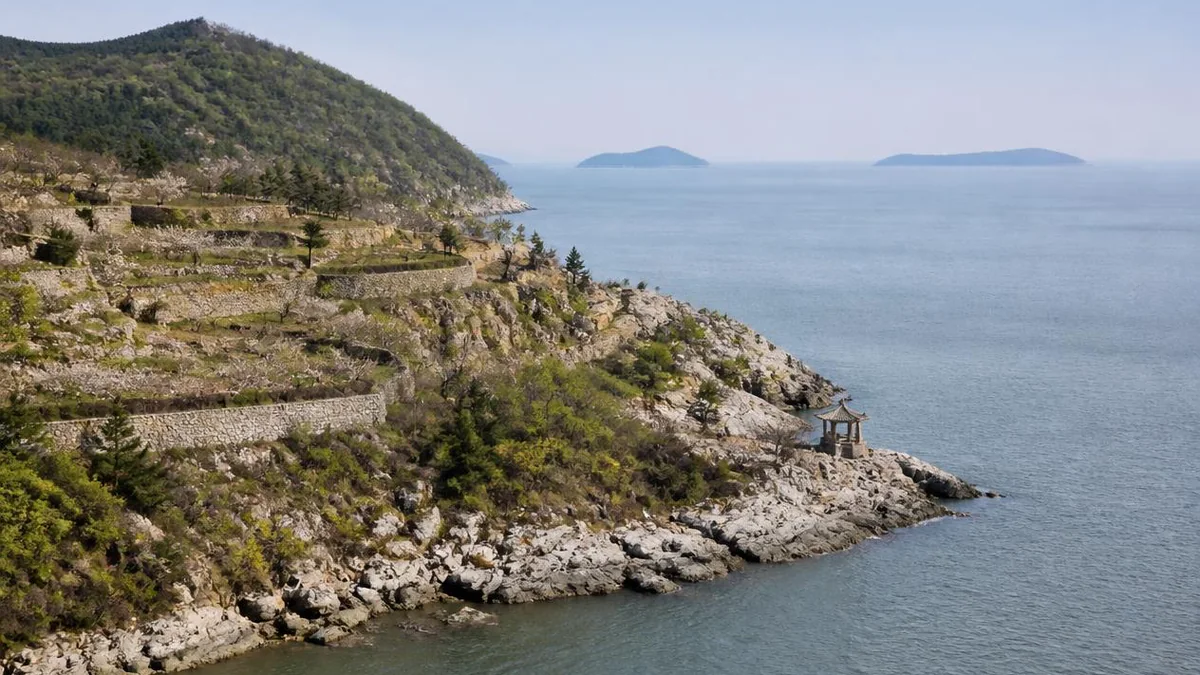
Jiangsu · Suzhou
Wuzhong Lake Tai: A 5A Rating Stretched Across Three Mountains, Seven Sights and Ten Thousand Years
This is not one place. It is 21.5 square kilometres of Suzhou's lakeshore holding a hall of Southern Song clay arhats, a Ming prime minister's village, a Republican merchant's 3,854 carvings, an island with ten-thousand-year-old stone tools, and the hill where tradition says Sun Tzu wrote the Art of War.
5A View location, maps and nearby scenic areasThere is a particular kind of Chinese tourist designation that is not a place at all. It is a container.
Wuzhong Lake Tai — formally the Suzhou Taihu Tourism Area — is 21.5 square kilometres of shoreline, hill and island on the eastern rim of Lake Tai, southwest of Suzhou. It became a 5A area on 12 April 2013, announced at the opening of the 16th China Suzhou International Tourism Festival. And what it contains is not a single attraction with a single ticket and a single story, but three separate scenic areas, an hour or more apart by road, whose contents range from ten-thousand-year-old stone tools to an agritourism village that did not exist in its current form until 2004.
The official phrasing is three scenic areas, seven sights. The three areas: Dongshan, the peninsula that pushes out into the lake; Qionglong Hill, inland to the west of the city; and Wangshan, a valley of tea terraces and bamboo close to Suzhou’s southern suburbs. The seven sights: Qiyuan, the Carved Building, Zijin’an, Luxiang village, Sanshan Island, Qionglong Hill and Wangshan. Earlier promotional material sometimes stretched it to eight by adding Taihu Park.
Take the container seriously and it is one of the more interesting 5A areas in the country, because the things inside it are genuinely first-rate and have almost nothing to do with each other.
First, what is not in it
This matters before you plan anything, because the wider region is full of famous places that are not inside this designation.
Guangfu — the pagoda, the Situ Temple with its ancient cypresses, and Xiangxue Hai, the sea of fragrant snow where the plum blossom crowds go in February — is a separate scenic area. Shigong Hill and Linwu Cave, both on West Hill across the water, belong to the Xishan and Jinting area. All of these sit inside the much larger Suzhou Taihu National Tourism Resort, which is administratively described as three hills and one blessed place, covering the townships of Jinting, Dongshan, Guangfu and Xiangshan. But the resort is not the 5A area.
The distinction is invisible on the ground and constantly blurred in marketing. It is worth holding onto anyway, because a day trip that assumes Linwu Cave is a stop on the 5A circuit will end up driving a long way around a lake.
Sixteen arhats, and a saying about two halls and a half
The single most important object inside this 5A area is not a view. It is a room.
Zijin’an sits in a fold of hills at Xiwuwu, on the Dongshan peninsula. It is a small temple — founding traditions put it in either the Southern Dynasties or the Tang, and the surviving buildings, including the main hall, the Jingyin Hall and the Listening-to-Pines Hall, are Ming and Qing. There are more than fifty statues inside: a triad of Buddhas, a Guanyin, twenty deva kings, four heavenly kings.
And sixteen arhats, each roughly 1.13 metres high, seated in niches along the side walls.
There is a saying in the trade: the whole world holds two halls of arhats and a half. The half is at Baosheng Temple in Luzhi; one hall is at Lingyan Temple near Jinan in Shandong; and one hall is here. A more recent local variant runs two halls and a half, and Wuzhong holds a hall and a half — which is a boast, but a defensible one, since Luzhi is also in Suzhou.
What makes them worth the detour is that they are not pious. They are dramatic, almost comic. One arhat is rendered in unmistakable drunkenness. Another sits with his hands thrown open in a gesture of frank admiration. A third has turned his head away in visible contempt, one leg cocked, refusing to look at whatever the others are looking at — which, if you follow their eyes, is a dragon carved on the pillar above. The tiger-taming arhat is decrepit and elderly, and the tiger under his foot is docile anyway.
A stele in the temple’s own Jingyin Hall, quoted by later gazetteers, says the arhat figures are strange and dazzling, made by a master’s hand, and that none anywhere else are so alive that you would expect them to answer if called.
Who made them, and when
Here the record splits, and the split is not resolvable.
Local tradition, recorded in the Taihu Beikao compiled by Jin Youli in the Qianlong reign and repeated in the Tongzhi-era Suzhou Prefecture Gazetteer, says the arhats were modelled and painted by Lei Chao — a Southern Song sculptor, working with his wife. That is the attribution on the signage and in most writing about the temple.
A competing view assigns them to Qiu Mituo, a late Ming sculptor. And there is a documented reason for the confusion: eight seated arhats in the niches on the hall’s north wall were added later, by Qiu Mituo at the end of the Ming, and they are conspicuously inferior — sitting upright and formal, gaze blank, without the fine mobile expressions of the earlier group. So the hall contains work from two hands and two eras, and the question is only which group is which.
One more discrepancy: the old gazetteers describe eighteen arhats. There are sixteen. The iconographic basis for a set of sixteen is the Record of the Abiding of the Dharma, translated by Xuanzang in the Tang; the eighteen-arhat convention is later and became the popular norm, which is very likely how the gazetteer compilers came to write down a number they had not counted.
The hall also carries a reputation for three optical treasures — the wise eyes, the floral canopy and the sutra canopy. The first is real and testable: move through a 180-degree arc in front of the Buddha and the gaze appears to follow you the whole way.
The statues came very close to destruction during the Cultural Revolution. By local account a monk shielded them behind portraits of Mao, and villagers and local cadres between them arranged for the temple to be requisitioned as a warehouse for confiscated old property — which is what saved it. Zijin’an was listed as a provincially protected relic in 1951 and nationally protected in the sixth batch on 25 May 2006. It reopened in 2025 after eighteen months of conservation, the painted surfaces cleaned back to something like their intended colour.
A village that produced a prime minister and then would not stop
Ten minutes away, Luxiang is the village Zijin’an’s neighbours came from.
Its most famous son is Wang Ao (1450–1524), who did something in three consecutive examinations that almost nobody manages. In 1474 he placed first in the provincial examination — jieyuan. In 1475 he placed first in the metropolitan examination — huiyuan. In 1476 he placed third in the palace examination — tanhua. He went on to become Minister of Revenue and a Grand Secretary of the Wenyuan Chamber.
His family built three memorial arches in the village to mark the three results, and all three still stand on Zishi Street, arranged in a T-shape that is said to be unique in Jiangnan. His student Tang Yin — the painter Westerners usually meet as Tang Bohu — wrote of him that he was first in the realm for prose, and without equal as the prime minister in the hills. The village’s name comes from Wang Ao’s mother, whose surname was Lu.
What is more striking than Wang Ao is what happened afterwards. Luxiang’s scholarly reputation compounded. After him the village produced a zhuangyuan — a first-place palace graduate — eleven jinshi, and forty-six provincial graduates. In the modern era it has produced five members of the Chinese Academy of Sciences and more than 160 professors. It is locally called both the village of the examinations and the village of professors.
The physical village survives in unusually good condition: more than thirty Ming and Qing buildings, about 36% of the total floor area of the historic quarter, including the restored Huilao Hall and Suigao Hall, the latter the house of Wang Ao’s younger brother Wang Quan. Jiangsu promotes it as the first ancient village of Lake Tai.
3,854 carvings, and a contractor who saw an opportunity
Also on the Dongshan peninsula, and about as far from a Ming scholar’s village in spirit as you can get, is the Carved Building — formally Chunzai Lou.
In 1922, a man named Jin Xizhi, then forty-one, came home from Shanghai and bought land in his native Dongshan to build a house for his mother. Sources disagree on how he had made his money — a securities and futures broker in one account, the cotton yarn king of Republican Shanghai in another. Either way he had a great deal of it.
He hired 250 craftsmen of the Xiangshan school, the Suzhou building tradition that had supplied imperial carpenters for centuries. Construction took three years. It consumed 170,000 silver dollars — reckoned at the time as the equivalent of 3,741 taels of gold. The result covers more than 5,000 square metres of ground with 2,242 square metres of building: a screen wall, a carved brick gatehouse, a front building, a rear building, outbuildings, a garden.
And 3,854 individual carvings. The count breaks down as 2,708 in wood, 611 in gilt, 289 in brick, 160 in moulded clay and 86 in stone. The local phrase is that there is nowhere not carved, nowhere not cut, and the building’s nickname is the first building of Jiangnan.
The name Chunzai Lou — spring abides — is explained two ways. The building faces east, and the conventional couplet runs the household that faces the sun has spring always. The other explanation traces it to the Qing poet Yu Yue’s line the blossom falls, yet spring remains.
There is a good story attached, recorded locally. Jin hired his Xiangshan craftsmen in 1922, in the depression that followed the First World War, when the building trade in particular had collapsed. The foreman, seeing his position, colluded with a member of Jin’s own family to inflate the scale and specification of the work behind Jin’s back. When Jin came back from Shanghai and discovered that the carved brick gatehouse alone had cost 3,500 silver dollars, he was furious — but the work was done. The whole 170,000 was spent, and the house took three years.
The building was listed as nationally protected in the sixth batch in 2006. It has since appeared as a location in more than a hundred film and television productions.
A six-hundred-year-old house inside it
Tucked into the same compound is something older and quieter than any of the carving.
Jin Xizhi’s grandfather, Jin Yechuan, bought the Shi Zhuangyuan Mansion in the late Qing, and it became the Jin family’s old house. It is a Ming building, close to six hundred years old now: main hall facing east, three bays wide, seven purlins deep. It was the home of Shi Pan, who in the fourth year of the Zhengtong reign — 1439 — became the first zhuangyuan, first-place palace graduate, that Suzhou Prefecture had produced since the examination system began. He is the earlier of the two zhuangyuan in Dongshan’s local tally of two first-places and a third, the third being Wang Ao.
The building now displays examination history: papers, official robes, the apparatus of a system that ran for over a thousand years. It is an odd and rather good juxtaposition — a Ming scholar’s austere hall inside a Republican broker’s monument to spending money.
The garden built to commemorate meeting an emperor
Qiyuan, also called the Xi Family Garden, sits on the lakeshore about 30 kilometres southwest of Suzhou, 70 mu of ground with the hill behind it and open water in front. Of all Suzhou’s gardens it is the only one built against a hillside and along a lake.
It was built in 1933 by Xi Qisun, a Dongshan merchant who had made his money in Shanghai, and it was built for a specific reason: to commemorate the fact that his own ancestor had stood on this shore and received the Kangxi emperor. The ancestor, Xi Qiyu, was a major official-merchant, and in the thirty-eighth year of the Kangxi reign — 1699 — the Xi family met the emperor at this jetty, from which the imperial barge continued south. Xi Qisun raised the money from Shanghai’s industrial and commercial community, had the garden modelled on Liyuan at Wuxi, spent three years and 100,000 silver dollars, and produced something rare in the region: a lake-and-hill garden rather than a courtyard one.
The garden advertises three treasures: the imperial jetty, set out into the water; the old Liu Yi well, named for the Tang tale of the scholar who carried a letter to the dragon king’s daughter; and an ancient bayberry tree that tradition says Kangxi planted himself. That last claim is the sort a garden makes about itself, and should be held lightly.
The main building, Jinghu Lou, is a two-storey four-sided hall with a double-eaved hip-and-gable roof and a colonnade below. Inside it is a hall named Chenxing Tang — the imperial visit — hung with a painting of Kangxi’s progress to Dongshan, showing the Xi family receiving him at the jetty. The imperial stele pavilion, the stone jetty and the old arch carry inscriptions attributed respectively to the Qianlong emperor, the Grand Secretary Liu Yong, and the Nationalist elder statesman Yu Youren. Qiyuan is a municipally protected relic.
Ten thousand years, on an island
Sanshan Island lies out in the lake, and it holds the oldest thing in this 5A area by an order of magnitude.
The site was found in the mid-1980s, and by the end of that year excavation had produced a large quantity of chipped stone tools from the late Palaeolithic. Fissures in the island’s limestone then yielded mammal fossils covering six orders and twenty species — tiger, deer, rhinoceros, bear, water buffalo among them. The material dates to roughly ten thousand years ago, and the composition of the stone tool assemblage indicates an economy that depended mainly on fishing, with hunting secondary. The find was named Sanshan Culture, and it is the earliest evidence of human life anywhere in the Yangtze Delta.
Pollen analysis from the site describes a landscape nothing like today’s: broad valleys and low hills instead of the flat Taihu plain, fast rivers, and a vegetation of conifer forest and grassland, meaning a climate drier and colder than the present.
The discovery year is disputed. Chinese Wikipedia dates the find to 1985 with excavation later that year. Baidu Baike gives a fuller and different chronology: ancient mammal fossils, neolithic material and a limestone cave found between 9 and 11 April 1984; the Palaeolithic site itself identified on 20 September 1984 and named Sanshan Culture then; county-level protection from Wu County on 25 March 1986; provincial protection from the Jiangsu government on 19 April 1995. The provincial listing date is consistent across sources; the discovery date is not.
The island has two further claims to make. In March 1995 it became the first location inside China with internationally confirmed evidence of a meteorite impact crater. And on 19 January 2004 it was approved as a national geopark in the third batch.
Suzhou’s highest point, and the hut where the Art of War was written
Qionglong Hill is the third of the three areas, and the only one that is a mountain in any real sense. Its main peak, Ruomao Feng, reaches 341.7 metres — the highest point in Suzhou, and the highest on the eastern shore of Lake Tai. The scenic area covers about 10.5 square kilometres, and includes Suzhou’s longest mountain road at 6.5 kilometres and its only provincial-level nature reserve.
What the hill is marketed on, though, is Sun Wu — Sun Tzu — and the Art of War. Tradition holds that he lived in seclusion halfway up this hill and completed the treatise here. The original thatched hut is long gone; what stands on the spot now is a brick-built reconstruction, the Sun Wu Cottage, furnished with old furniture and the household objects of an ancient scholar. The reconstruction is honest about being a reconstruction, but the underlying attribution rests on later tradition rather than contemporary record, and should be read that way.
Suzhou has nonetheless built substantially on it. The Sun Wu Culture Park, in the Cangwu and Maopengwu valleys, runs to 36.7 hectares and is organised around three halls — the Hall of the Martial Sage for lineage, the Hall of Knowing War for method, the Hall of Washing Weapons for cultural transmission. The hill is promoted as the world’s first mountain of wisdom, and hosts a Sun Tzu Art of War culture festival with an international symposium and ancestral rites performed by claimed descendants of Sun Wu.
There is more on the hill than Sun Tzu. At the summit sits the Daoist Shangzhen Guan, whose founding is placed in the Yuanshi period of the Han emperor Ping; tradition says the Three True Lords of Mao refined elixirs here in the early Han and left a Maojun Hall, of which a broken stele survives. What you see today is a recent and substantial rebuild, its halls stepping west to east down the slope. The Qianlong emperor is recorded as having come here to pray six times.
And a short walk from the Sun Wu hut is the reading rock of Zhu Maichen, a Western Han official who according to tradition studied here while cutting firewood for a living. The rock is a natural slab roughly 2.5 metres long, 1.3 high and 1.5 wide, inscribed the place where Lord Zhu, Grand Administrator of Kuaiji under the Han, read. Zhu Maichen is the origin of one of the most-used idioms in the language: spilled water cannot be gathered up. His wife left him during his poverty; when he rose, she asked to return, and he poured water on the ground and invited her to collect it.
The Southern Song general Han Shizhong, who fought the Jin, is also recorded as having retired here to practise Chan.
The newest layer
Wangshan is the odd one out, and interesting precisely because it is.
It is a valley in Yuexi subdistrict, about 6.1 square kilometres, with forest cover above 80%, tea terraces, bamboo and a scatter of temples including Qianyuan Si and Baohua Si. Behind it rises Qizi Hill at 294.6 metres. Eight named sights are listed, among them Jiulong Tan, Aidai Ridge and the Qianjiawu hamlet.
But its history as a destination is twenty years old, not four hundred. Wangshan village was named one of Suzhou’s first new socialist countryside villages in 2004. From 2005 it developed Qianjiawu as an agritourism cluster. In 2006 it invested more than 20 million yuan in an eight-kilometre three-tier road network. By 2011 the village had more than forty farmstay operations, 70% of them concentrated in Qianjiawu, and was receiving over 1.1 million visitors a year. It now also carries a cultural and creative street and a children’s park.
So the 5A designation covers, in one administrative unit, a ten-thousand-year-old fishing camp and a twenty-year-old rural tourism project. Both are real. Neither explains the other.
What to actually do with it
Treat it as three trips, not one.
Dongshan is the day with the most in it: Zijin’an for the arhats, Luxiang for the village and the three arches, the Carved Building for the carving and the Ming zhuangyuan hall inside it, Qiyuan for the lake and the jetty. Sanshan Island needs a boat and effectively its own day. Qionglong Hill is a half-day of climbing with a sightseeing shuttle running Shangzhen Guan to Wanghu Garden to the Sun Wu Cottage to Ningbang Temple. Wangshan is a lunch and a walk.
Tickets are sold both individually and in combinations, and the combinations move: a Dongshan pass covering Qiyuan, Zijin’an, the Carved Building, Luxiang and the Sanshan Island wetland park, and a wider three-area pass covering Dongshan, Wangshan and Qionglong Hill. Confirm current prices on arrival rather than from any article, including this one. Zijin’an has been closed for restoration more than once; check before you drive out to it.
And the thing worth holding in mind on the drive between them: a 5A rating is not a claim that these places belong together. It is a claim that each of them is worth the trip. On this particular shoreline, that happens to be true — of a hall of clay figures where one of them is drunk, of a village that turned one man’s three first places into four centuries of scholarship, of a broker who spent a fortune in gold on 3,854 carvings for his mother, and of an island where someone was fishing this lake before any of the rest of it existed.
The LoreLens app can identify the individual arhats at Zijin’an and read the carved inscriptions in the Carved Building and at Qiyuan.
Location profile
Where it is

Frequently asked questions
What is actually inside the Wuzhong Lake Tai 5A area?
Officially, three scenic areas and seven sights, totalling 21.5 square kilometres. The three areas are Dongshan (East Hill), Qionglong Hill and Wangshan. The seven sights are Qiyuan garden, the Carved Building, Zijin'an temple, Luxiang ancient village, Sanshan Island, Qionglong Hill and Wangshan. Some older promotional material added Taihu Park to make eight. The designation was awarded on 12 April 2013, at the opening of the 16th China Suzhou International Tourism Festival, under the name Suzhou Taihu Tourism Area.
Are Guangfu, Shigong Hill and Linwu Cave part of the 5A area?
No, and this trips up a lot of itineraries. Guangfu — with its pagoda, the Situ Temple and the plum blossoms at Xiangxue Hai — belongs to the separate Guangfu scenic area. Shigong Hill and Linwu Cave are on West Hill, in the Xishan and Jinting area. All of them sit inside the wider Suzhou Taihu National Tourism Resort, which covers four townships, but they are not inside this particular 5A designation. If a guide tells you the 5A ticket includes Linwu Cave, it does not.
Why is Zijin'an worth a detour?
For sixteen painted clay arhats, each about 1.13 metres high, seated in niches down both side walls of the main hall. There is a trade saying that the whole country holds two halls of arhats and a half — the half at Baosheng Temple in Luzhi, one hall at Lingyan Temple near Jinan, and one hall here. A later variant adds that Wuzhong alone holds a hall and a half. The figures are unusually theatrical: one is visibly drunk, one throws up his hands in admiration, and one has turned his head away in contempt. Zijin'an reopened in 2025 after eighteen months of conservation work.
Did Sun Tzu really write the Art of War on Qionglong Hill?
Tradition places him halfway up the hill, and a brick-built thatched hut called the Sun Wu Cottage has been reconstructed on the spot where the original is said to have stood. The original hut is long gone, so what you are visiting is a commemorative reconstruction rather than a surviving building, and the attribution rests on later tradition rather than contemporary evidence. Suzhou has built substantially on it: there is now a 36.7-hectare Sun Wu Culture Park, and the hill is marketed as the world's first mountain of wisdom.
How old is the human presence on Sanshan Island?
About ten thousand years, at the very end of the Palaeolithic. Excavation produced a large quantity of chipped stone tools, and fissures in the island's limestone yielded mammal fossils covering six orders and twenty species, including tiger, deer, rhinoceros, bear and water buffalo. The stone tool assemblage suggests an economy based mainly on fishing with hunting secondary. It is the earliest evidence of human life in the Yangtze Delta, and it was named Sanshan Culture. Sources disagree on the discovery year, giving either 1984 or 1985.