Jiangsu · Suzhou
Tongli: The Garden a Disgraced Official Built, and Named After His Own Mistake
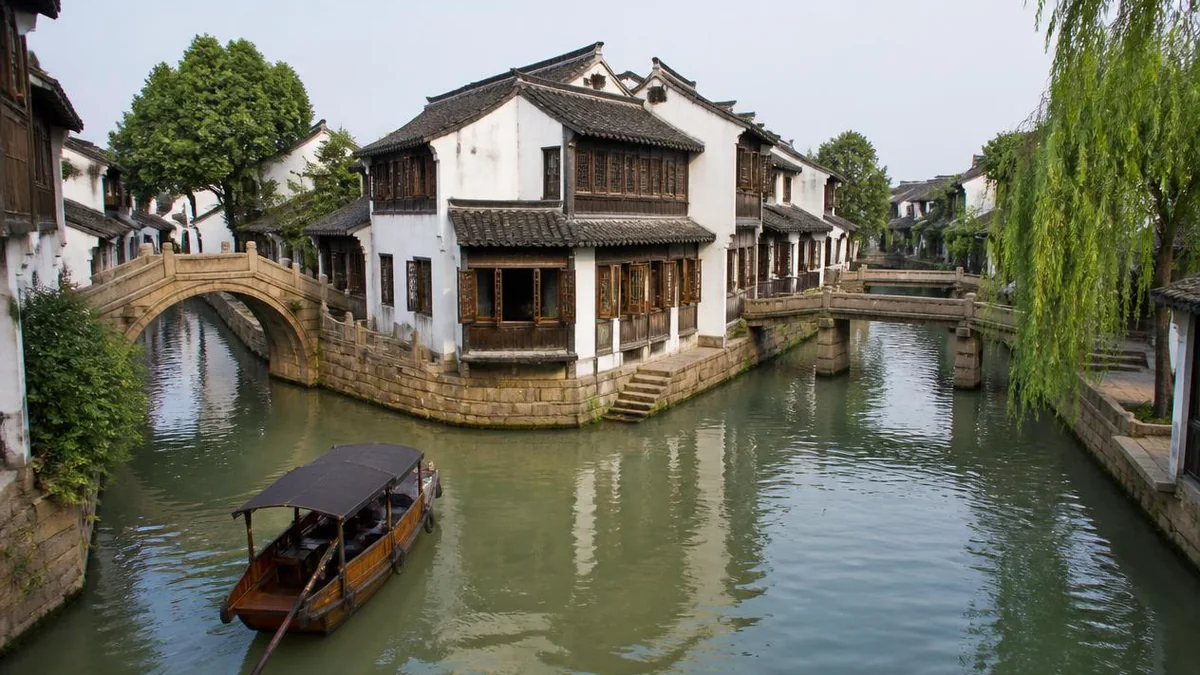
Fifteen waterways cut this Suzhou town into seven islands joined by forty-nine bridges. On one of them stands a World Heritage garden that a sacked provincial commissioner spent a hundred thousand taels of silver on, gave a name meaning to reflect on one's faults, and died the year after finishing.
5A View location, maps and nearby scenic areasSome water towns in the Yangtze delta are a single canal with houses on it. Tongli, in Suzhou’s Wujiang district near the shore of Lake Tai, is something more unusual: fifteen waterways cut it into seven islands, and forty-nine old bridges join them back together.
The result is a town you cannot walk through in a straight line. Every route is a decision about which bridge to take, and the town’s most famous single object is a garden built by a man whose career had just ended.
It used to be called Rich Earth
The old name of this place was Futu — rich earth — and the name was changed.
Tradition holds that it was changed because it was too conspicuous: a settlement advertising its wealth in its own name invites the attention of tax collectors. The town became Tongli by stages, and the story of the substitution is one of those etymologies that is repeated everywhere locally and is difficult to verify. Treat it as what the town says about itself, which is interesting in a different way: this is a place whose founding legend is about not looking rich.
There was something here long before either name. Archaeological material from the site belongs to the Songze culture, roughly six thousand years old. The town as an administrative town dates from the Song, which gives it the round thousand years that Chinese heritage listings like.
One garden, two halls, three bridges
Tongli has an official self-description, and unusually for a Chinese tourist town it is a good one: one garden, two halls, three bridges, plus the Pearl Pagoda.
That is a real itinerary, in ascending order of how long each takes. The three bridges are ten minutes. The two halls are an hour. The garden is as long as you want to give it, and it is the reason Tongli is on a World Heritage list.
The man who was sacked
Ren Lansheng was from Tongli, and he had done well: military-civil commissioner for a circuit covering the Feng-Ying-Liu-Si region of Anhui — a serious appointment carrying both military and administrative authority.
In the eleventh year of Guangxu, 1885, he was impeached and dismissed.
He came home. He hired the painter Yuan Long as designer, and spent — the figure is consistently reported and it is remarkable — one hundred thousand taels of silver building a private residence and garden. It was finished in 1887.
He died the following year.
A man loses his post, spends two years and a fortune building the most refined thing in his home town, and then does not get to live in it. That is the story sitting underneath every photograph of Tuisi Garden, and it is worth carrying around the garden with you.
The name is a confession, or an argument
What he called it is the interesting part.
The Zuo Zhuan, the vast Warring States chronicle that is one of the foundational texts of Chinese political thinking, contains a line about the duty of an official: advancing, he thinks of giving his full loyalty; retreating, he thinks of correcting his faults.
Ren Lansheng took the second half. Tuisi — in retreat, reflecting.
Read one way, this is a disgraced official’s public act of contrition, carved over his own front gate, in the classical idiom that every literate person of his time would recognise instantly. Read another way, it is a very sophisticated protest: the man quoting the classic on how officials ought to behave is implying something about the people who removed him.
Chinese literati culture had a well-developed grammar for saying difficult things by quotation, and gardens were one of its favourite media. This one is a two-year, hundred-thousand-tael sentence.
The garden is sideways
The layout is what garden specialists come for, and it is a solution to a problem.
Jiangnan residence-gardens are normally arranged in depth: you enter at the street and move backwards through a sequence of courtyards, halls and finally the garden, along a single axis. Tuisi Garden could not do that — the site would not allow the depth.
So it turned ninety degrees. The composition runs left to right: residence, then courtyard, then garden. You do not go deeper; you go across. The residence is divided into outer and inner parts, with the outer running three courtyards along its own axis — gate hall, tea hall, main hall — used for receiving guests, weddings and ancestral rites.
The whole thing occupies 5,674 square metres, which is small. Constraint is what makes it good: the horizontal plan is the only one of its kind among the Suzhou World Heritage gardens, and it exists because a sacked official had a difficult plot of land.
World Heritage, with an asterisk on the date
Tuisi Garden became a provincially protected site in 1982. In November 2000 it was inscribed as part of the Classical Gardens of Suzhou, in the extension that also brought in Canglang Pavilion, the Lion Grove Garden, the Garden of Cultivation and the Couple’s Garden Retreat. In June 2001 it became a nationally protected site.
You will see the World Heritage year given as 2001 — the People’s Daily Overseas Edition has printed it that way, and Chinese tourist material follows. The extension was approved in November 2000. If a sign disagrees, the sign is rounding.
The son turned the garden into a girls’ school
This is the best thing about Tongli and almost nobody tells you.
Ren Lansheng died in 1888. The garden passed to his son, Ren Chuanxin. In 1906, aged nineteen, Ren Chuanxin spent heavily from the family fortune, recruited teachers, and founded a girls’ school inside Tuisi Garden.
Understand the date. In 1906 the imperial examination system had just been abolished, the Qing dynasty had six years left, and formal education for girls in China barely existed. Ren Chuanxin’s school — Lize Girls’ School — is counted among the openings of that door in modern China, and he did it in a private garden in a small water town, at nineteen, by spending down what his disgraced father had built.
The garden became a campus. Classes met in the thatched hall, the music room, the dry boat and the osmanthus hall. The pavilion called sitting in spring, watching the moon became the girls’ dormitory. Around 1916 the school moved into a purpose-built block on land east of the garden — the surviving six-pillar gate is a Chinese-Western hybrid, and at the time it was the only building of its kind in Tongli.
Then, in 1980, staff and students tidying the grounds dug up a stone. It is a memorial stele to the national humiliation of the ninth of May — the date in 1915 when Yuan Shikai’s government accepted Japan’s Twenty-One Demands — erected by the school’s own teachers and pupils, signed collectively. Somebody had buried it, presumably to save it. In 1992 the town built a pavilion over it.
A garden named after one man’s fault, converted by his son into a school for girls, whose pupils erected a monument to a national disgrace, which was buried and then found sixty-five years later in the flowerbeds. All within one walled compound.
And then it was a sex museum
The Lize building has one more chapter, and it is genuinely strange.
Liu Dalin was a sociologist at Shanghai University who spent his career trying to establish sexology as a legitimate academic field in China. In 1995 he borrowed 300,000 yuan and opened a museum of ancient Chinese sexual culture in Xujing, a remote township in Shanghai’s Qingpu district. Nobody came. In 1999 he moved it near the Nanjing Road pedestrian street; by 2001 he could not afford the rent and moved to a cheaper address on Wuding Road.
In 2003 Tongli made him an offer: three million yuan for renovation, and the Lize Girls’ School premises rent-free for ten years, with ticket revenue split evenly with the town. The museum reopened here in April 2004 — sources give the 18th and the 19th — with over 4,000 objects, 3,800 square metres of indoor exhibition and a 5,200-square-metre garden. It was renamed the Chinese Sexual Culture Museum, after the great sociologist Fei Xiaotong wrote an inscription for it calling it the first exhibition of its kind in five thousand years.
It closed in 2015, when the building was taken over and converted into a boutique hotel, which is what it is today. Liu Dalin died in Shanghai in December 2022, aged 90.
So the building’s full sequence is: pioneering girls’ school, 1906. Primary school, after the war. Museum of Chinese sexual culture, 2004 to 2015. Hotel, 2015 onward. If you stay there — and you can — that is what you are sleeping in.
Two halls from the Republic
Across a canal from each other, near the three bridges, stand the two houses that make up the rest of Tongli’s core, and both are much younger than visitors assume.
Chongben Hall was built in 1912 — the first year of the Republic — when a local man, Qian Youqin, bought part of the Gu family’s old west residence and rebuilt it. It faces south onto the water. It runs five courtyards deep on a single axis — gate hall, main hall, front chamber, rear chamber, kitchen — on a plot of less than one mu, which is roughly a sixth of an acre. The compression is the achievement. Inside are more than a hundred wood carvings, and the brick gateway carries four characters about honouring virtue and remembering one’s roots.
It now houses the museum of Jiangnan water-town wedding customs, which is why you may find a bridal procession in it.
Jiayin Hall, opposite, was built in 1922 by Liu Bingnan. It is the showier of the two. Above the ridge of the main hall sit the three star-gods of fortune, longevity and rank. Locals call the main hall the gauze-cap hall for the shape of its roof frame. The five-purlin beams carry the eight steeds, the beam ends carry peonies in cold wind, and the undersides carry rebuses for getting what you wish and passing the examinations.
Both houses are early-twentieth-century merchant work, made when the classical vocabulary was still fully alive and there was money in the delta to spend on it. They are not survivals from the Ming. They are the last generation of the tradition, and they are better carved than most of what preceded them.
Peace, fortune, celebration
At a junction where three canals meet, three small bridges stand in a triangle: Taiping, Jili and Changqing — Peace, Good Fortune, Lasting Celebration. Taiping and Changqing are flat beam bridges; Jili is the arch. Together they form a natural circular walk, because crossing all three brings you back where you started.
Which is exactly what people do. Walking the three bridges is a local rite for securing safety, luck and happiness, and wedding parties still do it — which is why the wedding-customs museum is thirty metres away, at the northern end of Changqing Bridge.
It is the cheapest and best thing in Tongli. It costs nothing, takes ten minutes, and is the only piece of the town that is still primarily used by the people who live here rather than looked at by people who don’t.
The pagoda that is a ballad
The complex called the Pearl Pagoda is, architecturally, the former residence of Chen Wangdao, a Tongli man who served as an investigating censor in Nanjing during the Jiajing and Wanli reigns of the Ming. It has four parts: the censor’s residence, the Chen family’s rear garden, the family memorial arch and the ancestral hall. Its formal name refers to that official post.
The name everyone uses, though, comes from a story. The Pearl Pagoda is one of the standard pieces in the repertoire of Suzhou pingtan — the sung-and-spoken storytelling tradition of this region, performed by one or two people with a pipa and a sanxian, which was for centuries the dominant popular entertainment of the delta. The ballad concerns a poor scholar, a proud aunt, a humiliation and a reversal of fortune, and local tradition identifies this house as its setting.
So the building is a Ming censor’s residence, and the name over the door is a piece of musical theatre. Tongli is comfortable with that. So is China generally: the number of Chinese monuments that are visited for something that happened in a story rather than something that happened is very large, and pretending otherwise makes the country harder to understand rather than easier.
The revolutionary on Sanyuan Street
Tongli’s other significant native has a house on the canal at 15 Sanyuan Street, and it is a Qing residence of 1,364 square metres and 42 rooms, including a hundred-foot tower, a family shrine, and a hall called Haoge — singing aloud.
Chen Qubing was born in 1874. He was given a different name at birth and changed it himself after reading the Han general’s line — while the Xiongnu are still undestroyed, what use have I for a home? — taking the general’s own name, which means expelling the sickness. It is an adolescent gesture that he then spent his life justifying.
He joined Sun Yat-sen’s Revolutionary Alliance, and in 1909 he was one of the founders — with Liu Yazi and Gao Xu — of the Southern Society, the literary association that was the cultural wing of the republican revolution. Its name comes from a classical phrase about performing the music of the south and thereby not forgetting where one is from; its members wrote classical poetry in the service of overthrowing a dynasty, which is a combination that only makes sense in that exact decade. From 1923 he was professor of Chinese at National Southeast University.
He died at home in Tongli in 1933, and his Southern Society colleagues buried him at Tiger Hill in Suzhou.
The house was listed by the county in 1980, raised to provincial protection in 1995, and opened to visitors on 18 April 2002; the Haoge Hall was restored and opened in October 2013. Inside is a memorial museum in three parts — a century of the Southern Society, Tongli and the Southern Society, and Chen’s own life — with a hundred-odd photographs and more than fifty objects and manuscripts.
Siben Bridge, and the paperwork
The oldest thing standing in Tongli is not on the standard route. Siben Bridge dates from the Southern Song, which makes it seven or eight centuries older than the two famous halls and five older than the garden.
The town’s official history is a slow accumulation of listings: a scenic spot within the Lake Tai national scenic area in 1980; provincial cultural relic protection in 1982; promoted to a provincially protected town in 1992 — that is, the whole settlement rather than individual buildings; and 5A in 2010.
That 1992 upgrade is the one that saved it. Protecting individual monuments in a water town does very little, because what makes a water town is the relationship between the water, the bridges, the lanes and the walls. Tongli got the whole fabric listed eighteen years before the tourist rating arrived, which is why it still reads as a town.
Ren Lansheng’s problem
The best moment in Tongli is in the garden, and it is not a view.
It is the recognition that the man who built this had been publicly disgraced, had two years to live, had a hundred thousand taels of silver, and chose to spend them building something beautiful with a name that admits fault. He could have built a monument. He built an apology — or an argument dressed as one — and then he died and left it to a town that has been showing it to visitors ever since.
Everything else in Tongli is the ordinary miracle of a delta town: water in the right places, bridges where they are needed, two rich families competing at woodcarving in the 1910s, a ballad that gave a house a better name than its owner’s title. It is a very good place to spend a day walking in circles across three small bridges.
But the garden is one man’s last statement, and it is still legible. That is rarer than the architecture.
The LoreLens app can read the carved inscriptions in Tuisi Garden and the two Tongli halls, and explain what the rebuses in the woodwork mean.
Location profile
Where it is

Frequently asked questions
What does the name Tuisi Garden mean?
It comes from a line in the Zuo Zhuan, the great Warring States historical chronicle: in advance, think of rendering full loyalty; in retreat, think of correcting one's faults. The garden's name takes the second half. Its builder, Ren Lansheng, had just been impeached and dismissed from a senior military-civil post, and he came home to Tongli and built a garden whose name is a public acknowledgement that he had something to reflect on. Whether it reads as genuine contrition or as an elegant way of protesting his innocence is left for the visitor to decide, which is very likely the point.
Is Tuisi Garden actually a World Heritage Site?
Yes, as part of the Classical Gardens of Suzhou. It was added in November 2000, in the extension that also brought in Canglang Pavilion, the Lion Grove Garden, the Garden of Cultivation and the Couple's Garden Retreat. It became a nationally protected site in June 2001, and had been provincially protected since 1982. You will occasionally see 2001 given as the World Heritage year — the People's Daily Overseas Edition has printed it that way — but the extension was approved in November 2000, and that is the date to use.
What is the one garden, two halls, three bridges formula?
It is how Tongli describes its own core sights, and it is a genuinely useful itinerary. The garden is Tuisi Garden. The two halls are Chongben Hall, built in 1912, and Jiayin Hall, built in 1922 — both merchant houses from the early Republic, facing each other across a canal, and both extraordinarily carved. The three bridges are Taiping, Jili and Changqing, which meet in a triangle at a junction of three canals. Add the Pearl Pagoda complex and you have seen what people come for.
Why do people walk the three bridges in a particular order?
Because of what their names mean: Peace, Good Fortune and Lasting Celebration. Crossing all three is a local rite meant to secure safety, luck and happiness, and it is still done by wedding parties — the town's wedding-customs museum is in one of the halls beside them. Two of the three, Taiping and Changqing, are flat beam bridges; Jili is the arched one. They stand in the formation of the character for three items stacked, at a point where three waterways meet.
How old is Tongli really?
The town as a town dates from the Song, giving it over a thousand years, and it was formally rated a 5A scenic area in 2010. Human occupation of the site goes back much further: finds here belong to the Songze culture, of roughly six thousand years ago. The oldest structure still in use is Siben Bridge, from the Southern Song.