Jiangsu · Changzhou
China Dinosaurs Park: The Province With Zero Dinosaurs
Jiangsu has never yielded a single dinosaur fossil. Changzhou built a 5A theme park around one anyway — and the specimen at its centre is the one that settled where birds came from.
5A View location, maps and nearby scenic areasThere is a fact about this place that nobody who works here tries to hide, and it is the most interesting thing about it.
Jiangsu province has never produced a dinosaur fossil. Not one bone, not one tooth, not one footprint. Before 1996 the city of Changzhou had no connection to dinosaurs of any kind — no dig site, no local legend, no museum, nothing but an old and unrelated nickname, Dragon City, which refers to emperors rather than reptiles. When Xinhua Daily ran a feature on the park in June 2025, it opened by asking how many dinosaur fossils the city that owns China Dinosaurs Park has actually dug up. The answer it gave was zero.
And yet the museum at the centre of this park holds one of the most consequential fossils found anywhere in the twentieth century — a small feathered animal from Liaoning that forced palaeontologists to change their minds about where birds come from.
Both of those things are true at once, and the second one is only here because of a decision made in a meeting room in 1996.
What the dragon in Dragon City actually was
Since the nickname is the only pre-1996 thread connecting this city to anything draconic, it is worth following, because it turns out to be a genuine piece of history with a genuine dispute attached.
After the collapse of the Western Jin, northern families fled south in large numbers. Among them was the Xiao clan of Lanling in Shandong, who resettled around Wujin, where the court established a displaced commandery called Southern Lanling to house them. Two of their descendants founded dynasties: Xiao Daocheng established the Southern Qi in 479, and Xiao Yan the Liang in 502. Between them the two houses ruled the southern half of China for seventy-eight years, and the emperors they produced all came from this one relocated family.
The dragon enters through the Book of Changes. Its first hexagram speaks of six dragons driving the heavens, and Xiao Daocheng used that image deliberately to build his own legitimacy on the way to the throne; Xiao Yan then borrowed the same six-dragon formula to justify replacing Qi with Liang. Because the Xiao of Southern Lanling had produced that many emperors, the old town of Wujin — around Wanjiang, in what is now Menghe town in Changzhou’s Xinbei district, about fifty kilometres from the city centre — came to be called the City of Six Dragons. After the Tang, when Wujin’s county seat and the Changzhou prefectural seat came to occupy the same city, the name migrated with the administration, and the six eventually dropped off.
Three later moments fixed it in official use. In 1572 the prefect Shi Guanmin founded an academy on the site of the old Jinling county offices and named it the Longcheng Academy — Dragon City Academy — abbreviating the six away. In 1762 the Qianlong emperor, escorting his mother on a southern tour, burned incense at Changzhou’s Tianning Temple and wrote out a plaque reading Longcheng xiangjiao, which amounts to imperial confirmation of the nickname. And in the Guangxu reign the local gazetteer Wuyang Zhiyu recorded flatly that our prefecture was anciently called Dragon City, putting it into the official record.
There are competing folk explanations, all older-feeling and none documented: that six of the eight sons of the Dragon King of the Eastern Sea came down into the prefectural city after losing a contest, which is why Changzhou people once raced six differently coloured dragon boats on Baiyun Creek at the Dragon Boat Festival; that the old city wall was shaped like a tortoise, and a tortoise is dragon-kin; and that the Southern Tang calligrapher Xu Xuan’s seal-script rendering of the two characters for Changzhou looked like a golden bell covering six dragons.
Two things are contested rather than settled. The emperor count is usually given popularly as fifteen, while the provincial gazetteer’s own scholarly treatment says eighteen — the gap being a matter of whether posthumously elevated ancestors and the Later Liang are counted. More seriously, Changzhou does not have the claim to itself. Scholars in Zhenjiang argue that Danyang, which sits less than three kilometres from Wanjiang, is the real home of both founding emperors, and they have physical evidence to point at: twelve Southern Dynasties imperial tombs and eleven sites holding twenty-six pieces of tomb statuary, ten of them nationally protected. They also have the texts, since the Book of Qi and Book of Liang describe Southern Xuzhou — modern Zhenjiang — and the district of the Qi and Liang tombs as the ancestral home of the imperial house. The argument between the two cities has been sharp and is not resolved.
So the pre-existing dragon in Dragon City was an imperial metaphor from a divination classic, attached to a refugee family from Shandong, over a claim a neighbouring city disputes. It had nothing whatever to do with reptiles, which makes what happened in 1996 a coincidence of vocabulary rather than a continuation of anything.
What a ministry did with its gift shelf
In 1996 Beijing hosted the 30th International Geological Congress. Delegations arrived from around the world, and as delegations do, they brought presents: mineral specimens, ancient plants, fossil animals. Several of the fossils were dinosaurs, and they were good ones. China’s Ministry of Geology and Mineral Resources ended up with a collection it had no adequate place to display.
The ministry’s idea was to build a new geological museum for them, provisionally called the China Dinosaur Hall — with one condition attached from the start, which was that it should not be in Beijing. The capital had museums. The point was to put this somewhere it would matter.
The rest happened in the way these things happen. Vice-Premier Zou Jiahua and the minister, Song Ruixiang, met a delegation of Changzhou officials. Song mentioned that the ministry had dinosaur fossils and nowhere to put them. Changzhou’s Party secretary, Yu Zhenxin, proposed that his city pay to build the hall and put them on show. Nantong had also made the shortlist; Yu led Changzhou’s bid personally, and Changzhou won. Five state-owned enterprises put up 60 million yuan as seed capital.
The agreement was signed on 1 February 1997. Construction began on 20 September 1997. The park opened, three years to the day later, on 20 September 2000, across about 600 mu, with a first phase costing around 300 million yuan. Crates of national-treasure-grade fossils arrived from elsewhere in China and were unpacked in a city that had never had any.
You can call that opportunism. Jiangsu’s own state media prefer a different framing — wu zhong sheng you, making something out of nothing, and they mean it as praise for a resource-creating rather than resource-exploiting model of tourism. Both readings survive contact with the facts. What is not arguable is that the museum built out of that transaction is a real museum: the China Dinosaur Hall is a formal branch of the Chinese Geological Museum in Beijing, and it holds more than fifty specimens of national-treasure grade.
The hall itself runs to over 20,000 square metres, with a dragon-head peak reaching 71 metres and a dome of 36. Inside are thirty-six mounted skeletons — Yangchuanosaurus, Mamenchisaurus, Shantungosaurus, Bactrosaurus, Tyrannosaurus. Three are singled out as the treasures of the collection, and they come from Liaoning, Shandong and Yunnan respectively. None of them, obviously, comes from here.
The twelfth of August, 1996
The most important of the three arrived by the least institutional route imaginable.
On 12 August 1996 a farmer from western Liaoning named Li Yinfang walked into the Chinese Geological Museum in Beijing carrying a slab of rock roughly 70 by 50 centimetres. Its director, the palaeontologist Ji Qiang, looked at what was on it and bought the slab for 6,000 yuan.
What was on it was a small animal, about 68 centimetres long, lying on its side in fine lake shale, and running along its neck, back and tail was a dark fringe of fibrous structures. Ji and his colleague Ji Shu’an described it and gave it a name: Sinosauropteryx prima, which translates roughly as the first Chinese dragon-bird. They published in Chinese, in the journal Chinese Geology.
Publishing in Chinese had a consequence they cannot have intended. The paper existed, the priority was established — and almost nobody outside China read it.
Split down the middle
Here is the part of the story that reads like fiction and is documented fact.
Before selling, the farmer had split the slab along its bedding plane, the way fossil shale naturally parts, producing two halves: a positive and a negative, each carrying an impression of the same single animal. He did not sell them to the same person. The negative went to Ji Qiang in Beijing. The positive went to Chen Pei-ji of the Nanjing Institute of Geology and Palaeontology.
One animal. Two owners. Two institutions. Two interpretations.
On 17 October 1996 the New York Times reported from the 56th annual meeting of the Society of Vertebrate Paleontology, where Chen Pei-ji had shown the positive half to an audience of specialists. The reaction was a sensation. Photographs of the slab went around the world’s palaeontology departments within days.
So the fossil became famous internationally through the half that went to Nanjing, while the naming and the first publication belonged to the half that went to Beijing — and the two men who held the halves disagreed about what the animal was.
Feathers, or bristles
The disagreement was specific and it was worth having.
Ji Qiang’s case was that the fibrous structures were not random filaments but grew in clusters from single roots — branching, in other words, in the way feathers branch. Reptiles do not wear feathers. If this animal had them, it was on the bird side of the line, and since everything else about it looked like a small predatory dinosaur, that was itself the proof that birds had come from dinosaurs. His 1997 paper on a second specimen went as far as the argument allowed: the short, primitive feathers meant the animal should without doubt be assigned to the birds.
Chen Pei-ji’s case was that this was a small theropod dinosaur, full stop, and that the structures along its back were keratinous bristles — the sort of thing a modern lizard carries as a dorsal ridge — or simply fibrous connective tissue that had fossilised in place. Impressive, but not feathers, and not evidence of anything about birds.
The eventual resolution went against the name. The animal has short forelimbs and a long tail; it belongs among the compsognathids; it is, anatomically, a dinosaur and not a bird. The Chinese name — dragon-bird — is misleading, and specialists including the Chinese Academy of Sciences academician Xu Xing have said plainly that they do not accept it. But zoological nomenclature runs on priority, not on accuracy, and a validly published name stands even when it turns out to describe the animal wrongly. The Chinese idiom for this is jiang cuo jiu cuo — carry the error forward. So the first feathered dinosaur ever found is permanently called a bird.
The prima survived the correction rather well. It was meant as the earliest known bird in China. It reads now as the first confirmed feathered dinosaur, which is a larger claim and a true one. A minority of researchers still argue the filaments are fossilised collagen rather than feathers; the argument has not fully closed, and the honest version of this story says so.
New Haven, February 1999
What the Liaoning fossils did was settle an argument that had been running since 1868.
Thomas Henry Huxley, Darwin’s most combative defender, had looked at Archaeopteryx and at the small dinosaurs then known and proposed that birds were descended from dinosaurs. The idea went out of fashion for most of a century. It was revived in the 1970s by John Ostrom at Yale, on anatomical grounds, and remained a strongly held hypothesis rather than a settled fact — because the one thing missing was a dinosaur with feathers.
In February 1999 Yale hosted a symposium in Ostrom’s honour. More than five hundred scientists attended, and the theropod origin of birds was accepted with something close to unanimity. Huxley’s hypothesis became the textbook answer. The Liaoning specimens, Sinosauropteryx first among them, are the reason the meeting went the way it did.
Ji Qiang kept pushing the logic further than most were willing to follow. In 2015 he proposed that if birds are dinosaurs, the class Aves should be abolished and folded into a class Dinosauria — a tidy conclusion which the field has not adopted. In 2025 he was awarded the Future Science Prize in life science.
His connection to Changzhou is direct rather than nominal. He personally escorted a fossil bird to the museum here in December 2002, and on 10 April 2011 he became the park museum’s honorary curator.
What colour it was
The fossil’s scientific life did not stop in 1999. In 2017 a team led by Fiann Smithwick at Bristol, working with the palaeo-artist Robert Nicholls and the biologists Innes Cuthill and Jakob Vinther, published in Current Biology a reconstruction of what Sinosauropteryx actually looked like.
The method depends on melanosomes — the pigment-bearing organelles inside a feather, which survive fossilisation and whose distribution can be mapped. By comparing the pigmented plumage across three of the best-preserved specimens, the team could say with reasonable confidence where the animal was dark and where it was pale.
It had a banded tail. It was countershaded, dark along the back and light underneath. And it wore a dark band across its eyes — a bandit mask, the pattern a badger, a raccoon, a red panda or a shrike wears.
Then they did something cleverer. Countershading is not decorative; it cancels the self-shadowing that gives away a solid body, and the optimal position of the dark-to-light transition depends on how the light arrives, which depends on the habitat. So they built a three-dimensional model of the animal’s torso, lit it in different simulated environments, and worked out which transition line each environment would call for. The line on the actual fossil matched the prediction for an animal living in the open, with little vegetation overhead.
That is a real result about a place, not just an animal. The Jehol biota has generally been reconstructed as closed forest. If its most famous small predator was camouflaged for open ground, the landscape must have been more varied than the standard picture allows. A fossil first argued over as evidence about birds turned out, twenty years later, to be evidence about weather and vegetation.
Nothing in the display case tells you any of this, and the animal in it was in fact ginger-brown with a striped tail and a mask across its face.
Where the fossil actually came from
The holotype is Early Cretaceous, from Sihetun in Beipiao, western Liaoning, out of a two-to-seven-metre bed of ash-bearing lake shale low in the Yixian Formation. It was the first dinosaur recovered from the Jehol Group, the fossil beds that have since produced feathered dinosaurs, early mammals, early flowers and early birds in numbers that have reorganised several fields at once.
That matters for reading this museum honestly. The Jehol beds are what made Chinese palaeontology globally central over the following two decades, and none of them are in Jiangsu. Changzhou did not find this fossil. Changzhou made a bid, wrote a cheque, built a hall, and now displays it — which is a real contribution to public science and is a different kind of contribution from digging.
The other two treasures tell the same story with less drama. The giant Shantungosaurus from Shandong is a duck-billed dinosaur, one of the largest known, and the mount here stands about ten metres tall — so tall that it is on long-term loan from the Chinese Geological Museum in Beijing, which lacked the ceiling height to show it. Beijing owns it; Changzhou has the room. Lufengosaurus huenei comes from the Lufeng basin in Yunnan, and has its own place in the history of the science: it was the first dinosaur ever excavated, prepared and mounted entirely by Chinese scientists, in the 1930s and 1940s, under Yang Zhongjian. Nationally, it is the specimen that marks the point at which Chinese palaeontology stopped being something foreigners did in China.
What grew around it
The park did not stay a museum with a car park.
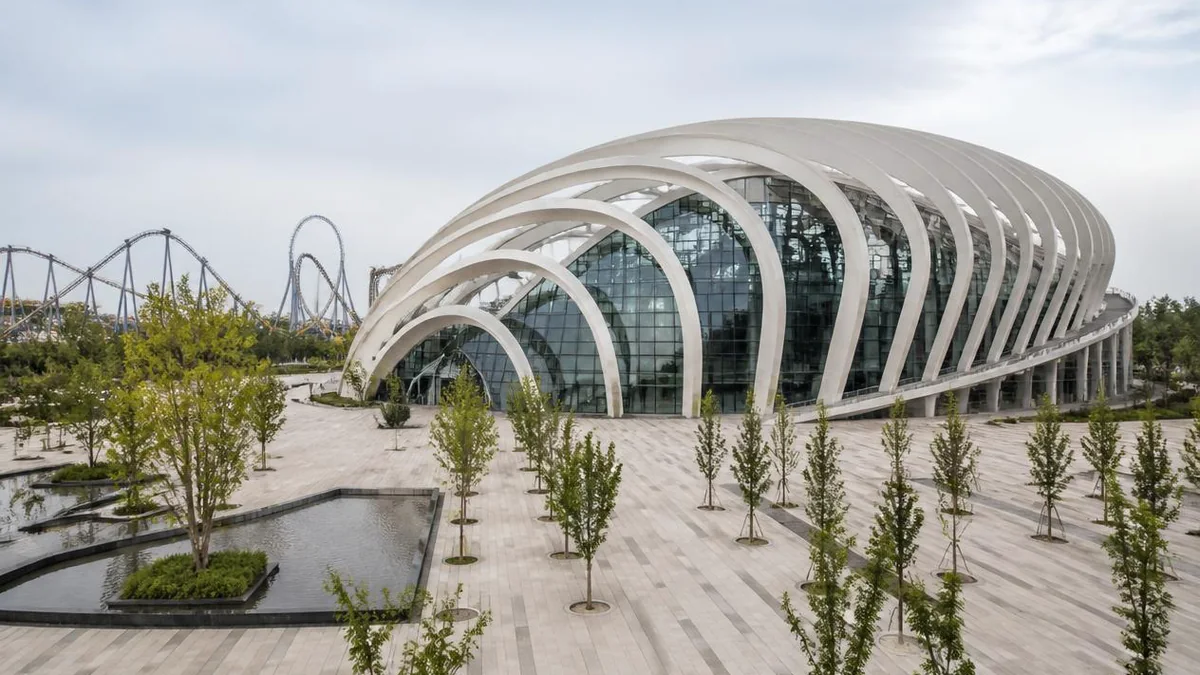
The 5A designation belongs to the Global Dinosaur City leisure and tourism district — over 4,800 mu at 60 Hehai East Road in Changzhou’s Xinbei district — which bundles China Dinosaurs Park with Dino Water Town, the Dinosaur Valley hot spring, the Dinosaur City Grand Theatre and a golf club. The plaque was presented at Yangzhou on 18 April 2010 (some local reporting says the 19th), making this Changzhou’s first 5A scenic area and the first cultural-creative theme attraction in Jiangsu to reach that grade. In October 2021 the district was named in the first national batch of night-time culture and tourism consumption clusters.
Visitor numbers run above three and a half million a year, with cumulative attendance past fifty million. In 2012 the second International Dinosaur Festival brought in more than twenty specimens from western Liaoning, including a pair of Psittacosaurus excavated that January — the borrowing has never stopped, because it cannot.
The park also drafted China’s first national standard for theme parks, the Theme Park Service Specification, which is a genuinely unusual thing for an attraction to have done and says something about how seriously the operation takes itself as an industry rather than a ride.
The standing criticism, made most sharply by the business press, is that the model has never travelled. Attempts to franchise the formula elsewhere have gone poorly enough that 36Kr summarised the company as one that cannot get out of Changzhou. Whether that is a failure depends on what you thought was being built. As a national brand it has stalled. As an answer to the question of what a mid-sized Yangtze delta manufacturing city does about tourism when it has no mountain, no famous lake, no imperial ruin and no fossils, it has worked for twenty-six years.
Visiting
Allow a full day, and do the museum first, before the queues form on the rides — the fossil halls are the part of the site that rewards slowness, and they are the part most visitors rush. The Sinosauropteryx is small, unglamorous and easy to walk past. It is a dark smear of an animal on a grey slab, and you have to stand close to see the fringe along its spine at all.
Dino Water Town, the hot spring and the theatre are separate components with separate tickets and separate opening seasons; check before you plan around any of them. The park is in Xinbei district north of the city centre, on Changzhou’s metro network, and Changzhou sits on the Beijing–Shanghai high-speed line, which puts it a little over an hour from Shanghai and about forty minutes from Nanjing.
Two things are worth holding together as you go round. The first is that this whole place — 4,800 mu of it, five million visitors a year, a national standard, a city’s tourism identity — rests on a ministry having been given some presents in 1996 and deciding not to keep them in Beijing.
The second is that the small animal in the glass case, bought off a farmer for six thousand yuan, is why the sentence birds are dinosaurs is in the textbooks. The province it sits in has never produced a fossil. The fossil it holds changed the answer to one of the oldest questions in the science.
The LoreLens app can identify what you are looking at in the fossil halls from a photograph and tell you where the specimen was actually dug up — which, in this museum, is never here.
Location profile
Where it is

Frequently asked questions
Have any dinosaur fossils ever been found in Jiangsu?
No. Not one. Jiangsu province has never produced a dinosaur fossil, and Changzhou had no dinosaur connection of any kind before 1996 beyond an old nickname, Dragon City. Every specimen in the museum was brought in from somewhere else — Liaoning, Shandong, Yunnan, Sichuan.
What is the most important thing in the museum?
The Sinosauropteryx holotype, bought from a Liaoning farmer for 6,000 yuan in August 1996. It was the first dinosaur found with preserved feather-like structures, and the argument over what those structures were helped settle the question of whether birds descend from dinosaurs. Two other star specimens — a giant Shantungosaurus from Shandong and a Lufengosaurus huenei from Yunnan — sit alongside it.
Is China Dinosaurs Park the 5A scenic area, or is it part of something larger?
It is part of something larger. The 5A designation, granted in April 2010, covers the Global Dinosaur City leisure and tourism district of over 4,800 mu, which bundles the park itself with Dino Water Town, the Dinosaur Valley hot spring, the Dinosaur City Grand Theatre and a golf club. The park is the anchor, not the whole.
Is this a museum or a theme park?
Both, deliberately. The China Dinosaur Hall is a branch of the Chinese Geological Museum in Beijing and holds more than fifty specimens of national-treasure grade. The rides, water park and shows were built around it. The park later drafted China's first national standard for theme parks.
How long should I allow, and is it good for children?
A full day, and yes — it is built for families, with the museum best done early before the queues build. Adults who came for the fossils should know that the collection occupies a fraction of a very large entertainment complex, and that the museum rewards a slow visit far more than the rest of the site does.