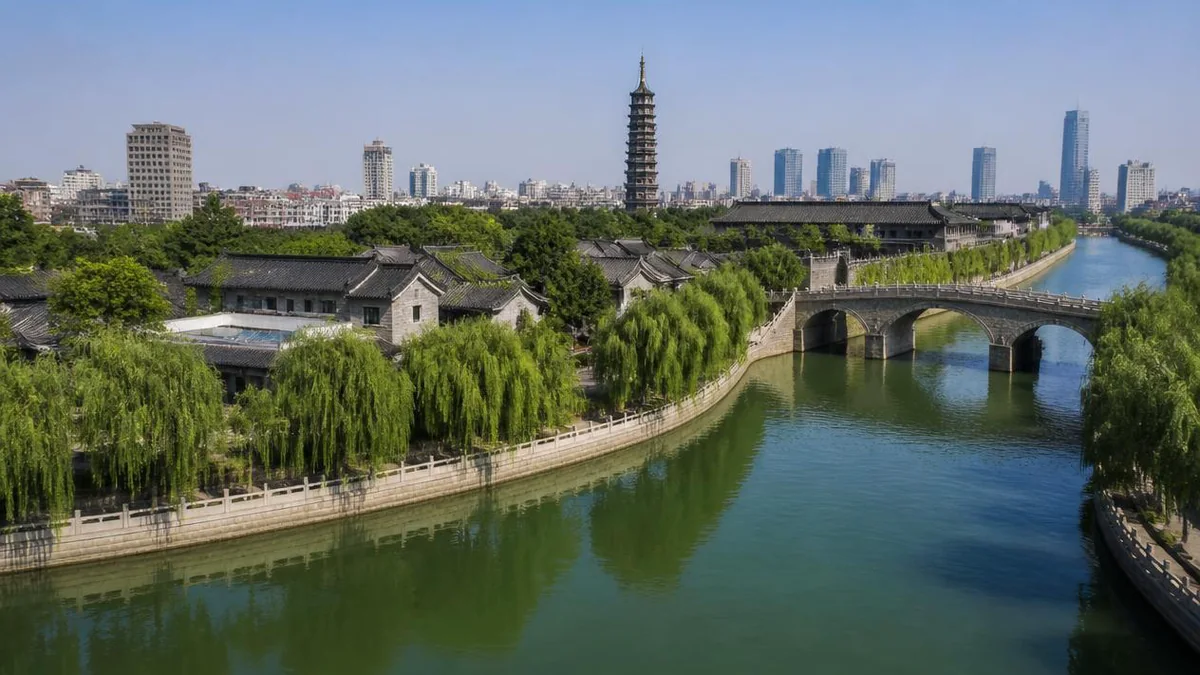
Jiangsu · Nantong
Haohe: The Moat Around China's First Modern City
Ten kilometres of tenth-century water still ring the old town of Nantong. Inside and along it stands almost everything one man built between 1895 and 1926 — the first public museum founded by Chinese, the first mills, the first public parks — which is why a group of scholars decided this was where modern China began.
5A View location, maps and nearby scenic areasThere is a stele under the Guangxiao Pagoda in Nantong with a sentence on it that settles the order of things: there was no city, there was first the pagoda; our forebears built the city up to the pagoda.
It is not a boast. The pagoda went up in 864, in the Xiantong years of the Tang. The city wall and the moat that defended it were dug in 958, under the Later Zhou. Ninety-four years separate them, and the moat, when it came, was routed around a religious building that was already old.
The walls are long gone, taken down as walls were taken down across China in the twentieth century. The water stayed.
Ten kilometres of water, and a disagreement about it
The Haohe (濠河, roughly “how-huh”) runs about ten kilometres around the old town, in the shape of an upended gourd — wide and rounded at the south, pinched, then swelling again to the north. At its broadest it is 215 metres across; at its narrowest, ten. The water surface is usually given as 1,040 mu, though 1,080 also circulates, and nobody seems to know which count came first.
The length is worth a note, because you will see two numbers. The official figure is ten kilometres. Popular material often prefers “thirty li”, which sounds classical and works out at fifteen kilometres, and appears to be a literary flourish that has hardened into a fact through repetition. Ten is the number the scenic area itself uses.
What makes the Haohe unusual is not its size but its completeness. Most Chinese cities filled their moats in, or culverted them, or left disconnected ponds. This one survives as a continuous ring of navigable water, one of only four largely intact ancient city moats left in the country, and the city has spent thirty years treating it as its central asset rather than a drainage problem. Locals call it the emerald necklace. Admission is free, which for a 5A-rated scenic area is close to unheard of — the rating covers a public waterway that people fish in and walk their dogs around.
The pagoda built to fix the exam results
The other pagoda on the water has a stranger origin.
Tongzhou — Nantong’s old name — was not producing enough successful examination candidates. The diagnosis, in the local reasoning of the time, was geomantic: the southeast of the prefecture lay too low, which was depressing the district’s literary fortunes. The remedy was to raise the southeast. So in 1618, in the forty-sixth year of the Wanli reign, the Wenfeng Pagoda was built on the moat’s southeastern bank, expressly, as the phrase went, to supplement the configuration of the landscape and assist the flourishing of the literary spirit. A bridge went up nearby and was named for the three first places in the imperial examinations.
The pagoda is 39 metres tall, five storeys, six-sided, a timber-framed brick-and-wood pavilion type with white walls and red columns, a small chamber on each level, one door and two windows to each face, and a gallery running round the outside. Dragon heads, beasts and immortals ride the flying eaves with bronze bells hung beneath them. From the third storey a central mast rises to meet the finial, which is a further ten metres of iron with seven rings threaded on it. It was overhauled in 1820 and twice after 1949, listed by the city in 1983 and by the province in 2011. Its courtyard now holds a gallery of some two hundred works by the Nantong painter Wang Geyi.
There is a local rhyme about the three pagodas of Tongzhou — this one, the Guangxiao in town, and the Zhiyun on Wolf Hill: Tongzhou has three pagodas, cornered four, six and eight; two rise from level ground, one is driven into the clouds. Six for the Wenfeng, eight for the Guangxiao, four for the one on the hill.
Hold on to the exam pagoda. It becomes funnier in about three hundred years.
The man who won
In 1894, at the age of forty-one, a man from a farming family in this prefecture took first place in the palace examination — the summit of the imperial system, the thing the pagoda had been built in the hope of producing. His name was Zhang Jian (张謇, “jahng jyen”).
It was a spectacularly bad year to have won. The examination results came in the same year as the war with Japan, and the war went catastrophically. The peace treaty signed at Shimonoseki in April 1895 opened Chinese treaty ports to foreign-owned manufacturing, which meant that foreign mills could now spin Chinese cotton inside China. Zhang Jian, who had spent his life climbing to the top of the empire’s scholarly ladder, drew the conclusion that the ladder was leaning against the wrong wall, and got off it.
In the eighth lunar month of 1895, Zhang Zhidong, the Viceroy of Liangjiang, commissioned him to set up a cotton mill. He would spend the remaining thirty-one years of his life doing that and everything that followed from it, almost all of it within a few kilometres of this moat.
The city that built a pagoda to improve its examination results produced the best examination result in the empire, and the man who achieved it walked away from the system that awarded it to build factories instead. Nantong’s two great monuments — a Ming pagoda for literary fortune and an industrial estate — are the two halves of that decision.
The great virtue of heaven and earth
The mill took forty-four months to get running, and the story of the money is the most instructive part.
In the spring of 1896 Zhang Jian settled on 68 mu of ground at Tangjiazha, northwest of the city on a creek off the Yangtze. In October 1897 he printed share certificates at 100 taels each. In January 1898 construction began, and the spinning machinery — which had been sitting on the Shanghai waterfront — was finally shipped up. On the fourteenth day of the fourth lunar month of 1899, corresponding to 23 May, the engines turned over and the mill began to spin. Some Nantong records date the ceremonial engine-start to 8 May instead; the discrepancy has never been resolved and both dates appear in official material.
He named it Dasheng, from the Book of Changes: the great virtue of heaven and earth is generation.
Now the arithmetic. Total capital raised over those forty-four months came to 445,100 taels. Of that, 250,000 was not money at all but 20,400 spindles that Zhang Zhidong had bought abroad for a mill in Hubei that never happened, transferred in at book value as a government stake. Another 41,900 was local public funds. Which leaves 153,200 taels genuinely subscribed by private investors — about a third of the total, raised over nearly four years of what by all accounts was relentless, humiliating solicitation. The founding document of Chinese private industry in this city was two-thirds government machinery and public money, and everyone involved knew it.
Then it worked. Dasheng returned a profit for twenty-one consecutive years. It grew into four mills with 160,360 spindles and 1,342 looms — 7.39 per cent of all spindles and 9.8 per cent of all looms in Chinese-owned mills nationally, making it the largest textile group in the country. Zhang Jian’s wider network eventually comprised sixty-nine enterprises and institutions: a shipping company, a bank, flour and oil mills, land-reclamation and salt companies out on the coast where the deer reserves are now.
It did not end triumphantly. Over-extension and the post-war cotton slump caught up with him, and in 1925 a consortium of Shanghai banks took over the Dasheng mills. He died the following year.
The clock still rings
Three kilometres northwest of the moat, at Tangzha, the mill is still there. Not the site, not a museum of the site: the mill.
The clock tower was built in 1915 as the works gatehouse — 22.8 metres, five storeys, with a mechanical clock installed to ring the shifts. It still keeps time and still rings them. On the fifth floor stands a figure of Kuixing, the god of examinations, presented by a British merchant as the mill’s yarn trademark — so the brand mark of Zhang Jian’s cotton was the deity the Wenfeng Pagoda had been built to petition. He does not appear to have commented on this.
Around it: the blowing-room shed of December 1898, a saw-tooth brick-and-timber structure of 500 square metres designed by an Englishman named Thoms and built by a Shanghai contractor, which makes it the oldest surviving modern industrial building in Nantong. The office block of 1900, where Zhang Jian worked and slept upstairs, now the mill’s history room; in the hall downstairs hangs a couplet by his examination patron Weng Tonghe — the mechanism of it moves between heaven and earth; the clothing it makes covers all our southeast. Also warehouses, the library and dormitory of the textile college, the works canal, the wharf.
The whole complex was listed nationally in 2006 as an extension of the Nantong Museum, then in 2013 split off and merged with the site of the Third Dasheng Mill into a single protected unit under its own name.
And the company that runs it makes a claim I have not seen anywhere else in China: in more than 129 years, three things have not changed — the name of the works, the business it is in, and the ground it stands on. In 2022 it commissioned what was billed as the country’s first smart spinning plant of the current five-year plan, running at under ten workers per ten thousand spindles. The bronze walkway at the Millennium Monument in Beijing, which inscribes the major events of Chinese civilisation, includes the line 1899: Zhang Jian founds the Dasheng Cotton Mill at Nantong. It is one of the few entries on that pavement you can go and hear.
Fourteenth of January, 1905
In 1903 Zhang Jian spent close to seventy days in Japan, keeping a diary of it, and went to an industrial exposition. He came home convinced that China needed institutions for public instruction as much as it needed factories, and petitioned the Qing court to establish an exposition hall. The court declined.
So he built one himself. The Nantong Museum opened on 14 January 1905, on the south bank of the moat, and it is the first public museum in China founded by Chinese on their own initiative. He donated his family’s entire collection to start it.
Two qualifications, because the claim is often stated too loosely. There were museums on Chinese soil before 1905 — but they were foreign-run, mission and learned-society collections in the treaty ports, founded by and largely for foreigners. And the first government museum was later, not earlier: a preparatory office at the Imperial Academy in Beijing in 1912, seven years after Nantong. The cleanest verdict came from the writer Zheng Zhenduo in 1956, who put it that setting aside a handful of foreign-run coastal institutions, the earliest public museum in China had to be reckoned the one Zhang Jian and his colleagues founded here.
The original site was 35 mu, organised in four departments — natural products, history, art, and education — with the large specimens displayed outdoors and gardens planted with trees and stocked with live animals. That is why it is a yuan, a garden-museum, rather than a guan, a hall: it was conceived as grounds you walk through, not a building you enter. The south gallery went up in 1906. The site is now 75,982 square metres with about 6,700 of new building, and it holds first-batch national grade-one museum status.
The stable
In 1914 Zhang Jian built himself a house in the museum grounds, on the moat’s southern bank, and called it the Hao’nan Villa. The architect was Sun Zhixia, a Nantong man and one of the first generation of Chinese architects to work in Western idioms, and the house is studied as an early instance of Chinese architects absorbing European forms rather than importing them wholesale. He died in it in 1926.
Twelve years later, in 1938, Nantong fell to the Japanese army, which took the villa as a headquarters and used the museum grounds as a stable. The collections — the family holdings he had given away, and thirty-three years of accessions — were essentially destroyed.
Everything in the museum today postdates that. The building was made a national protected monument in 1988. It is worth knowing, walking through it, that the institution is the thing that survived, and the objects are not.
Five parks
The other consequence of that 1903 trip to Japan was the parks.
Chinese cities had gardens: private, walled, entered by invitation, the whole aesthetic tradition that Suzhou is famous for. What they did not have was the public park — municipal ground, open to anyone, provided by the city as a matter of course. Zhang Jian planned five for Nantong and building began in 1917. It is a small-sounding change and a genuine hinge in Chinese urban history: the point at which recreational green space stopped being a possession and became a service.
The list of what else he put up in and around this water reads like an inventory of a country’s missing institutions, supplied one at a time by one man’s companies: the first normal school for training teachers, the first textile college, the first agricultural meteorological station, the first privately built highway, the first commercial street laid out on modern lines, a theatre, a library, a home for the aged, a training institute for women workers, an asylum, a school for the blind and deaf. More than 370 schools in total, and twenty-odd enterprises to pay for them, which was always the architecture of the thing: the mills existed to fund the schools.
China’s first modern city
In 2002 the architect and planner Wu Liangyong — the dean of Chinese urban planning — proposed that Nantong should be understood as China’s first modern city. More than 140 scholars worked on the proposition and the book came out in 2006, covering the thirty years from 1895 to 1926.
The claim needs stating precisely, because in its loose form it is obviously false. Shanghai, Tianjin, Wuhan and Guangzhou were all more modern than Nantong in 1910 by any measure of industry, population or built form. The specific argument is about agency: those cities were modernised through treaty ports, foreign concessions and foreign capital, on plans drawn in other countries for other people’s purposes. Nantong was the first Chinese city comprehensively planned, financed, constructed and administered by Chinese, to Chinese designs, as a coherent scheme — an industrial district at Tangzha, a port at Tiansheng, the old walled city as the civic and educational centre, and the whole thing joined by roads its promoter paid for.
Whether that makes it first is a definitional question that the 140 scholars cannot settle by weight of numbers, and the thesis is plainly also a piece of city branding — it arrived in 2002, Nantong applied for National Historical and Cultural City status in 2004, and got it four years later, helped considerably by the fact that Tangzha survives as a complete industrial company town of the period rather than a few listed buildings. That is how these things work, and noting it does not make the underlying observation wrong. Something was attempted here between 1895 and 1926 that was not attempted anywhere else in China, and enough of it is still standing to walk around in an afternoon.
Named and shamed
The Haohe collected the usual honours in the usual order: a provincial scenic area in 1993, part of Jiangsu’s first batch of historical and cultural protection districts in 1995, a provincially designated model scenic area in 1998, a Jiangsu human-settlements award in 2002, a China Human Settlements Model Award in 2005, and 5A in 2012.
Then, after the National Day holiday in 2015, the National Tourism Administration issued the scenic area a severe warning and named it publicly, for safety hazards and failures of hygiene and management, with six months to put things right. Being publicly disciplined is not rare for a Chinese 5A site; the interesting part is what Nantong did next. It passed its re-inspection with a high score in August 2016, and then legislated — enacting the Regulations on the Administration of the Haohe Scenic Area, the city’s first local statute governing a scenic area, which moved the moat from being something managed at administrative discretion to something managed under law.
It is a small, unglamorous, wholly real improvement, and it happened because somebody in Beijing embarrassed them in public.
A gazetteer for a moat
Two further things happened that are more characteristic of this city than any of the ratings.
The water quality was brought up from Class IV to Class III — a genuinely hard piece of work in a dense urban catchment, and the reason people are willing to be on and in the moat at all. And in 2021 Nantong published the Haohe Zhi, a full gazetteer of the moat: the first gazetteer ever compiled in China for a city moat.
Gazetteer compilation is a two-thousand-year-old Chinese practice, normally applied to counties, prefectures, mountains and temples. Turning that apparatus on a ring of municipal water is an unusual act of civic seriousness — a decision that this thing is a subject, with a history that deserves the same treatment as a prefecture’s. There is now also a night-boat programme, the Haohe Ye Hua, lit and narrated, following a renovation in 2019.
Visiting
The moat is free and continuous, so the sensible approach is a loop: walk the banks, take a boat for part of it, and stop at what is on the water. The Nantong Museum and Zhang Jian’s villa share a site on the south bank and want two hours. The Guangxiao Pagoda stands in the grounds of Tianning Temple to the northwest — octagonal, five storeys, about thirty metres, repaired in 1430 and again between 1457 and 1464, and the oldest thing in the city by nearly a century. The Wenfeng Pagoda is on the southeast bank where the geomancers wanted it. There are green belts on the east and west banks, a book garden, a civic square.
There is also a cluster of museums along the water that is, frankly, eccentric in a way worth an hour: the China Abacus Museum, the largest museum in the world on the subject of the abacus, and the China Auditing Museum, the first museum in the world devoted to auditing. Both exist because Nantong decided that if it was going to be the city that invented the Chinese public museum, it might as well keep going.
If you have half a day more, go to Tangzha. The clock tower rings the shifts at a working mill, and standing under it is the closest thing available to hearing 1915.
Two things to hold at once about this water.
The first is that the moat is the oldest thing here and had nothing to do with any of it. It was cut in 958 by a short-lived dynasty for the entirely conventional purpose of keeping enemies out of a walled town, and it has outlived the wall, the dynasty, the empire, and the industrial system that grew up along its banks. It is a piece of tenth-century military engineering that the twentieth century happened to find useful as a shape.
The second is that a man who reached the top of a thousand-year-old examination system in the year his country lost a war decided that the system was finished, and spent the rest of his life building the replacements one at a time — a mill, a museum, a normal school, a park, a home for the old — inside a ring of water that a general had dug a thousand years before he was born. He did not finish. The banks tell you how far he got.
The LoreLens app can identify the pagodas, the villas and the mill buildings along the Haohe and tell you who built them and why, in your own language, with no connection needed.
Location profile
Where it is

Frequently asked questions
What is the Haohe, exactly?
The moat of Nantong's old city, dug in 958 when the walls were built under the Later Zhou. It is about ten kilometres round, between 10 and 215 metres wide, and shaped like an upended gourd. The walls are gone — the moat is what survived, and it is one of only four largely intact ancient city moats left in China. Locals call it the emerald necklace. Admission to the scenic area is free.
Who was Zhang Jian and why is he everywhere here?
Zhang Jian (1853–1926) took first place in the imperial palace examination in 1894, the highest scholarly rank in the empire, and then left officialdom to build factories. Between 1895 and his death he founded the Dasheng cotton mills and twenty-odd other enterprises, more than 370 schools, China's first Chinese-founded public museum, a theatre, a library, an old-age home and five public parks — nearly all of it in and around this one city. Mao Zedong later said that on the subject of light industry, one must not forget Zhang Jian.
Is the Nantong Museum really China's first museum?
It is the first public museum founded by Chinese people on their own initiative, opened on 14 January 1905. There were earlier museums on Chinese soil, but they were foreign-run — mission and society collections in the treaty ports. The first government museum office came seven years later, in Beijing in 1912. The writer Zheng Zhenduo put it plainly in 1956: setting aside a few foreign-run coastal institutions, the earliest public museum in China has to be reckoned the one Zhang Jian and his colleagues founded at Nantong.
What does 'China's first modern city' mean?
It is a thesis, not an official title. The architect and planner Wu Liangyong proposed it in 2002, and more than 140 scholars worked on it over four years before the book appeared in 2006. The argument is that unlike the treaty ports, foreign concessions and occupied cities, Nantong was the first Chinese city comprehensively planned, financed, built and run by Chinese to Chinese designs — the whole thing done between 1895 and 1926 by one man's network of companies and schools.
How much time do you need, and what should you not miss?
A full day, mostly on foot and by boat. The essentials are the Nantong Museum with Zhang Jian's villa in its grounds, the Guangxiao Pagoda, the Wenfeng Pagoda, and — if you have half a day more — the Dasheng mill at Tangzha, three kilometres northwest, where the 1915 clock tower still rings the shifts in a factory that has not changed its name, its business or its address in more than a century.