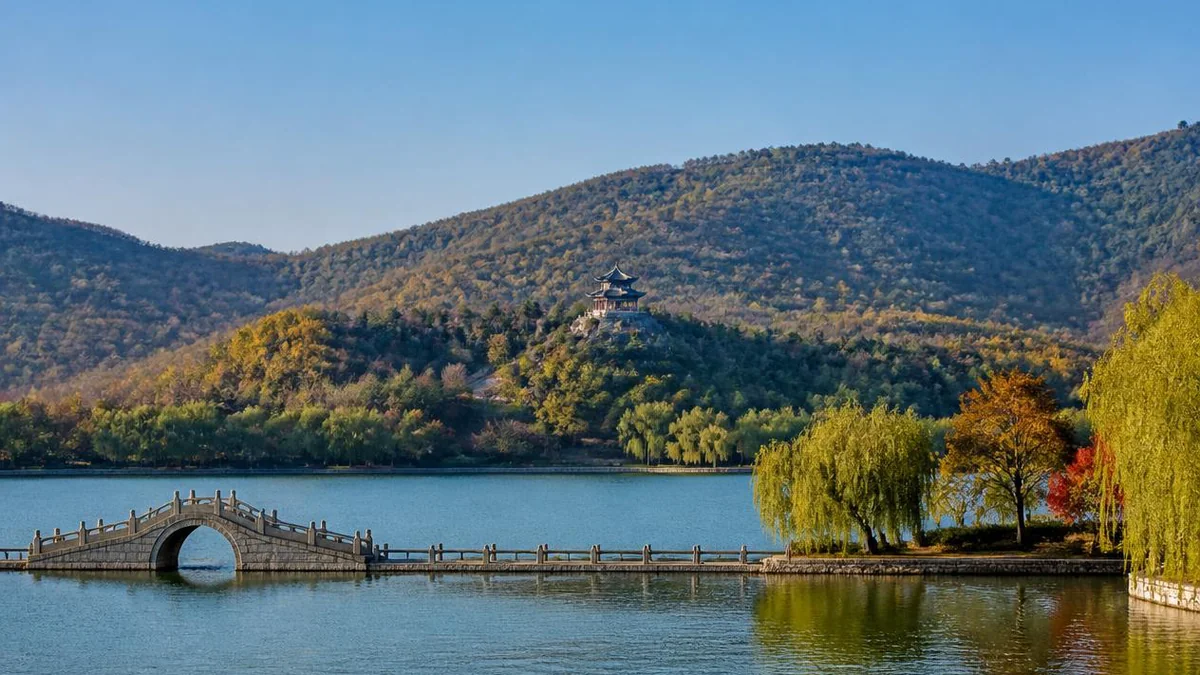
Jiangsu · Xuzhou
Yunlong Lake: Twenty Months of Su Shi
Xuzhou gave China two dynastic founders and was fought over for three thousand years. Its one 5A scenic area commemorates a poet who was posted here for twenty months, held off the Yellow River, wrote an essay about a hermit's pet cranes, and found the coal.
5A View location, maps and nearby scenic areasThe lake that Xuzhou is proudest of was called Stone Dog Lake for four hundred years, and nobody is certain why.
The respectable explanation is in the local gazetteer: rain running off the southern hills collected here and would not drain away, so at some point people carved a stone dog and set it on the bank to hold the water down. There is a folk version too, from the Wanli years of the Ming — a stonemason’s black dog was beaten to death and skinned by a landlord, and the grieving mason went up the mountain, quarried a block and cut it into the dog’s likeness, and the stone dog was said thereafter to drink the water in floods and spit it back in droughts. Tradition holds that the local people came to treat it as a deity.
And then there is the possibility that the whole thing is a misprint.
Su Shi, who was prefect of this city in the 1070s, refers in a poem to a place he calls Shigou Hu — Stone Ditch Lake. Gou meaning ditch and gou meaning dog are the same sound in Chinese. If that is the original name, then the stone dog, the flood-drinking, the mason and his murdered pet are all downstream of a homophone in the reception of a piece of eleventh-century verse, and Xuzhou spent four centuries explaining a typing error.
The lake has had other names — Erjia Chuan, Winnowing-Basket Hollow, and Lord Su’s Lake — and it got its present one, Yunlong Hu, Cloud Dragon Lake, only when a dredging project finished in February 1960. In 1967 it was briefly renamed Red Guard Lake. That did not stick either.
Twenty months
Su Shi (1037–1101), the poet, essayist, calligrapher, painter and serially demoted official whom most surveys of Chinese literature treat as the most complete talent the civilisation produced, arrived to govern Xuzhou — then called Pengcheng — in 1077. He was here for less than two years.
He arrived on the twenty-first day of the fourth lunar month of 1077. In the seventh month the Yellow River broke its banks upstream and the flood came down on the city. The local record of the water level below the Pengcheng gate is two zhang eight chi — call it eight or nine metres.
The account in the Song History, the official dynastic record, is unusually vivid for a document of that kind. Su Shi led his men out with baskets and spades and built a long dyke along the southeast, beginning at the Horse-Drilling Terrace — an earthwork raised a thousand years earlier by Xiang Yu, the warlord who lost China to the founder of the Han — and running it up against the city wall. He is recorded as having built a hut on top of the dyke and lived in it, and as having walked past his own house without going in. When officials pressed him to leave, the line attributed to him is that he would lead the men with his own body, and stand or fall with the city.
He went in person to the garrison and got the imperial troops — who did not answer to him — to work on the embankment. Accounts give forty-five days and nights of emergency work. The water stood around the city for more than fifty days, and on the fifteenth of the tenth month the river went back into its old channel and ran out to sea near Haizhou.
The city held. The court sent a formal commendation, which is worth noting because it is the only time in Su Shi’s entire official career that he was commended by an emperor for doing his job. Every other imperial notice he received went the other way.
This is why the lake’s oldest polite name is Lord Su’s Lake, and it is worth being clear about what is being commemorated. Not a poem. A civil engineering project executed under emergency conditions by a man who is remembered everywhere else in China for writing.
Earth conquers water
In the second month of 1078 the court, having praised him, also paid up: money was granted to build a proper flood wall around Xuzhou. Su Shi hired something over seven thousand four hundred labourers, reinforced the wall, piled up the embankments, and drove timber pilings in at four places where the current pressed hardest. At the weakest point of all — the east gate of the outer city — he put up a tower ten zhang high.
The dyke and the tower were both finished in the eighth month. He had the tower plastered with yellow earth and named it the Yellow Tower, on the five-phases principle that earth dams water. It was a flood monument that was also a piece of applied cosmology, built by a man who had just spent a season doing the engineering version of the same idea.
The opening party, on the Double Ninth — the ninth day of the ninth month — is one of the better-documented literary gatherings of the Northern Song. Su Shi invited thirty-odd notable men. His younger brother Su Zhe wrote the Rhapsody on the Yellow Tower, over a thousand characters long; the poets Qin Guan and Chen Shidao wrote pieces too; Su Shi collected the results as the Yellow Tower Anthology and wrote his brother’s rhapsody out in his own hand to be cut into stone. He also climbed the tower, drank, and produced Written at the Yellow Tower on the Ninth Day.
What happened to that stele is the part worth remembering.
Within a year of leaving Xuzhou, Su Shi was arrested and tried in the Crow Terrace poetry case, and his writings were banned. Under the amnesty at the start of Huizong’s reign the ban lifted and people took rubbings of the Yellow Tower stele day and night. Then Cai Jing became chancellor and ordered the printing blocks of Su Shi’s collected works burned — and the officer holding Xuzhou threw the Rhapsody on the Yellow Tower stele into the city moat, and renamed the building the Tower for Observing the Wind.
A monument to earth defeating water, dedicated with a thousand-character essay in the author’s brother’s words and the author’s own calligraphy, ended up at the bottom of a ditch because of a change of ministry in the capital.
The pavilion of the released cranes
In 1078 a recluse named Zhang Tianji — known locally as Zhang the Mountain Man — built a small pavilion on the first terrace of Yunlong Mountain. He kept two cranes. Each morning he let them go from the pavilion, and each evening they came back. That is the whole of it, and it is the reason the building is called the Crane-Releasing Pavilion.
Su Shi was a friend. In the autumn of 1078 he wrote the Record of the Crane-Releasing Pavilion, which does two things: it describes the mountain and the lake from up there, and it makes an argument about pleasure and power. A prince, Su Shi says, could not indulge a taste as clean and remote as a fondness for cranes without endangering his state; a man who has withdrawn to the hills could not be ruined by something as disastrous as wine. What destroys you depends entirely on what you are.
The essay was later selected for the Guwen Guanzhi, the anthology of classical prose that became the standard reader for Chinese students from the Qing onward. Which means that for the last three centuries, a very large proportion of literate Chinese people have encountered this specific pavilion on this specific hill as a set text, long before ever hearing of Xuzhou as a place.
The pavilion standing there now is a much-rebuilt descendant of the original — a brick-and-timber structure of 11.95 metres north to south and 4.95 deep, with a hip-and-gable roof, flying eaves, a platform in front and a gallery round the sides.
The tower they made a stable of
North of the Su Dyke and west of the mountain, in Yunlong Park — adjacent to the scenic area rather than inside it, and free to enter — stands a two-storey pavilion with double flying eaves called the Swallow Pavilion. It is a 1985 building, and it carries the strangest history of anything in Xuzhou.
The original was Tang. A military governor of the Wuning command built it inside his residence for a beloved concubine named Guan Panpan, and it was called the Swallow Pavilion because the upturned corners of its roof looked like a swallow in flight and because swallows came back to nest in it every spring. When he died, Panpan is recorded as having lived alone in the little tower for more than ten years and refusing to remarry. Bai Juyi — the most widely read poet of the Tang after Li Bai and Du Fu — wrote three poems about her, and so did his contemporary Zhang Zhongsu, and that is the only reason anybody knows her name.
There is a scholarly wrinkle. Bai Juyi’s preface calls the man “the late Minister of Xuzhou,” and later readers, Su Shi among them, took this to mean Zhang Jianfeng. The research consensus is that it was actually Zhang Jianfeng’s son, Zhang Yin. The most famous love story attached to this building is about a man whose identity was misremembered almost immediately.
In 1078 Su Shi spent a night at the pavilion, dreamed of Panpan, and wrote the lyric Yong Yu Le, whose central lines — the Swallow Pavilion stands empty; where is the lovely woman? Only the swallows, locked in the tower — are among the most quoted in the Chinese lyric corpus. Even here the circumstances are disputed: the Qing scholar Zheng Wenzhuo doubted the pavilion was in any state to be slept in and doubted Panpan needed to appear in a dream at all, preferring an alternative account in which Su Shi dreamed of climbing the pavilion and went looking for the site the next day.
Then the building’s actual history, which reads like a list of ways to lose a tower:
- 893: a defeated commander took his family up into it and burned it down with themselves inside.
- 1593: rebuilt, relocated to the northwest corner of the city.
- 1883: rebuilt on the southwest wall by the prefect; moved back to the northwest six years later.
- 1928: the city wall came down, and the pavilion with it. Nothing left.
- 1932: rebuilt in the southwest of the city.
- 1938: Xuzhou fell, the pavilion was hit from the air, and the Japanese army turned the site into a horse yard.
And then the part that is hard to read without stopping. In 1984 three Japanese civic groups — a Xuzhou friendship society, a card-game association and a club of Chinese classical literature enthusiasts — wrote to the city offering to help rebuild the Swallow Pavilion. It went up in 1985 on Zhichun Island in Yunlong Park, partly with Japanese donations, and in front of it stands a poetry stele erected jointly by both sides: on the Chinese side, Bai Juyi’s lines in the hand of the calligrapher Zhao Puchu; on the Japanese side, in the hand of Okazaki Kaheita, a waka written in reply to Bai Juyi’s poem by the Heian poet Ōe no Chisato.
A ninth-century Japanese poem answering a ninth-century Chinese poem about a tower, on a stone put up by the grandchildren of the army that used the ruins as a stable, forty-seven years later.
The tower’s literary afterlife ran on regardless of what happened to the building: a Yuan dynasty play, a Ming story collection, a chapter in Pu Songling’s Strange Tales, a line in Wen Tianxiang, and a passing allusion in Dream of the Red Chamber, where Lin Daiyu writes of the fading scent at the Swallow Pavilion. For most of the time this material was being written, there was no pavilion standing.
What one autumn produced
The rest of Su Shi’s Xuzhou output is scattered across the hillside and has generated an entire local topography.
There is the quatrain written at the pavilion while seeing off a friend — trying out spring clothes below Yunlong Mountain, sending off the last of the light before the Crane Pavilion; apricot blossom one colour, red for ten miles, and the young bridegroom goes, his horse like flight. There is Climbing Yunlong Mountain from the same year, with its line about walking up Yellow Thatch Ridge drunk, the whole ridge scattered with rocks like a flock of sheep — and Yellow Thatch Ridge and the big rocks are now, inevitably, marked scenic spots with signs on them.
There is the Kuaizai Pavilion, which was actually built by an earlier prefect, Li Bangzhi. Su Shi arrived, found it pleasantly breezy, decided it was the best place in the city to escape the heat, and gave it the name it still has. Somebody else built it and he named it, and it is his name on the sign.
Xuzhou now counts more than fifty Su Shi sites, and markets the lake and mountain together as the largest Su Shi cultural tourism area in China. There is a Su Shi memorial hall and a Lord Su Pagoda. All of it derives from a twenty-month posting nine hundred and fifty years ago.
The first poem about coal
In the twelfth lunar month of 1078 — which on the Western calendar falls in the opening weeks of 1079, a few weeks before he was transferred out — Su Shi solved a different local problem.
Xuzhou households were short of firewood, and the state ironworks nearby, which had been raised to the rank of Liguo Jian in 979 and was one of the four great iron-smelting bases in the empire, was short of charcoal. Su Shi had men sent out to prospect, and they found coal in the hills north of Baitu Town, in what was then Xiao county of Xuzhou prefecture and is now across the border in Anhui, on the edge of the Huaibei coalfield.
His preface to the resulting poem is almost a mining report: Pengcheng formerly had no coal. In the twelfth month of the first year of Yuanfeng men were first sent out and found it north of Baitu Town to the southwest of the prefecture. Used for smelting iron and making weapons, they are said to be sharper than usual. The poem itself has the line about the seam once opened running on without limit, ten thousand men rejoicing and a thousand standing to watch.
Coal is the first poem in Chinese literature on the subject, and its preface is the earliest surviving record of coal mining at Pengcheng. Xuzhou then spent the twentieth century as one of China’s coal cities, and has spent much of the twenty-first turning subsided mining ground back into water and reed beds.
So the ledger for those twenty months runs: a flood held off, a dyke, a tower, a poetry anthology, the most-read essay about a pavilion in the language, one of the most-quoted lyrics in the language, a hard line on the bandits around the ironworks, prayers for rain at a pool east of the city and for snow at two shrines, and the discovery of the mineral that would define the city’s next thousand years. Then, in the third month of 1079, a transfer order to Huzhou. The elders are recorded as coming out to see him off with wine and flowers, and he is recorded as having wept.
Sister lake
At the end of 1994 Yunlong Lake was formally twinned with West Lake in Hangzhou, and the local nickname is Little West Lake.
The comparison is not as unfavourable as the nickname suggests. Yunlong’s water area is usually given as 7.5 square kilometres against West Lake’s 6.39, so it is the larger of the two. It has hills on three sides — Yunlong to the east, Han and Tianqi to the west, Quanshan and Zhushan to the south — and the city on the fourth, which is a better setting by most measures than West Lake’s.
What it does not have is the fame, and the reason is straightforwardly historical: the country around West Lake was already prosperous and much-written-about in the tenth century, while Yunlong Lake as a designed landscape is essentially a twentieth-century creation on an old natural basin. A widely circulated Chinese internet exchange on the subject runs: both are 5A, so why is Yunlong not in West Lake’s league — to which the reply is, where is Yunlong Lake?
There is one coincidence in the twinning that nobody appears to have engineered. West Lake has a Crane-Releasing Pavilion too, on Gushan, built by the Song recluse Lin Bu. Two sister lakes, two hermits, two pavilions for letting cranes go.
How big it is
As with a lot of Chinese scenic areas, the size depends on which document you are holding.
- Planned scenic area: 44.7 km²
- Outer protection belt: 44.2 km², for a total controlled area of 88.9 km²
- Core scenic area: 15.1 km²
- Water: 7.5 km², with the water surface given separately as 6.5
- Original water 5.8 km² and land 5.6 km², with the water reaching 6.76 once the Little South Lake section is counted
These are not contradictions so much as different questions — planning boundary, protection zone, core, wetted area — answered in the same units without labels. The circumference figures are cleaner: taking the mid-lake causeway as the divider, the eastern lake is about 8.1 kilometres round, the western about seven, and the whole perimeter roughly twelve.
The mountain
Yunlong Mountain is the older attraction and in some ways the better one.
It has been accumulating buildings since the Northern Wei — Xinghua Temple, the Dashiyan grotto, cliff carvings of the Tang and Song. In 1993, during construction of a new main hall at Xinghua Temple, workers uncovered a set of Tang and Song cliff sculptures that had been buried: seven groups, seventy-one niches, thirty-eight inscriptions and 195 figures, carved into the rock face. The great stone Amitabha enshrined in the temple was begun under the Northern Wei and is therefore something over fifteen hundred years old — comfortably the oldest object in the scenic area, and older than every name attached to the place.
The visitor list is a decent index of the hill’s standing: Liu Bang, the peasant who founded the Han dynasty and came from this prefecture; Liu Yu, who founded the Song dynasty of the Southern courts and also came from here; the Qianlong emperor; Li Pan, the Xuzhou man who took first place in the imperial examination under the Qing; and the modern writer Yu Dafu.
The mountain was the centre of the provincial scenic area designated in 1984. The lake area became 4A in 2005 and 5A in August 2016 — Xuzhou’s first.
The city that made two dynasties
Which brings up the oddity at the centre of this place, and it is worth stating plainly.
Xuzhou is one of the most consequential pieces of ground in China. It sits where the North China plain narrows, at the junction of the routes between north and south, which is why it has been besieged, sacked and fought over more or less continuously for three thousand years, up to and including one of the largest battles of the twentieth century in its immediate vicinity. It produced Liu Bang, who founded the Han and shaped the Chinese state for two millennia. It produced Liu Yu. It was Xiang Yu’s capital. It has Han tombs, Han jade armour, and the finest collection of Han funerary stone reliefs in the country.
And its single 5A scenic area is about a poet who lived here for twenty months.
There is no scandal in that — the Han material is in museums a few kilometres away and is magnificent — but it is a real fact about how Chinese cities package themselves. Emperors are common; Xuzhou has two of its own and dozens more who passed through. What is scarce is a first-rank writer who left documentary traces you can stand next to. A city can commemorate a battle with a plaque. It cannot commemorate a battle with an essay in the Guwen Guanzhi that everybody has already read.
Visiting
A day covers lake and mountain. The full water circuit is around twelve kilometres, so the standard approach is to walk one half of the shore — the eastern side has the promenades, the western the quieter parks — and take a boat or a shared bike for the rest. The mountain rises from the northeastern shore and is a short, steep, thoroughly built-up climb with the pavilions strung along it.
Go up to the Crane-Releasing Pavilion. It is a small, unremarkable, repeatedly rebuilt structure with a good view, and it is one of the most-read buildings in the Chinese language.
Two things to hold at once, standing on the dyke side of the lake.
The first is that almost none of what you can see is old. The lake was dredged into its present shape in the 1950s, renamed in 1960, briefly renamed again for the Cultural Revolution, and landscaped into a modern civic waterfront over the last forty years. The pavilions have been rebuilt so many times that the question of originals does not really arise.
The second is that in 1077 a man who is now on the syllabus in every Chinese school stood somewhere near here in the rain, organising a dyke, and slept on it, and did not go home. That happened, and it is written down in the state’s own history, and the ground it happened on is still the southeastern edge of the same city. Everything else on this lake is decoration on that.
There is a third thing, and it is the one that gets left off the signage. The tourism is built on the essay and the lyric, because essays and lyrics are what a scenic area can sell. But the most consequential twenty months’ work any prefect ever did in Xuzhou was to send a few men into the hills to look for a black rock that burns. Nobody has built a pavilion for that.
The LoreLens app can identify the pavilions, carvings and stelae around Yunlong Lake and Yunlong Mountain and tell you which of them Su Shi actually touched, in your own language, offline.
Location profile
Where it is

Frequently asked questions
Why is Su Shi such a big deal in Xuzhou?
He was prefect here for under two years, from 1077 to 1079, and in that time the Yellow River burst its banks and nearly took the city. He organised the defence, built a long dyke along the southeast, and according to the official Song History he lived in a hut on top of it and passed his own front door without going in. He also built the Yellow Tower, hosted the literary gathering that produced the Yellow Tower Anthology, wrote the two best-known pieces of Chinese literature attached to any building in this city, and in his last weeks found the coalfield that Xuzhou lived off for the next thousand years. Xuzhou has more than fifty Su Shi sites today, and the lake and mountain together are billed as the largest Su Shi cultural area in China.
Is the lake really named after a stone dog?
That is the local name, Shigou Hu, and it stuck for over four hundred years. There are two explanations. One is that rainwater off the southern hills pooled here and would not drain, so a stone dog was carved and set on the bank to subdue it. The other is that Su Shi called the place Shigou Hu meaning Stone Ditch Lake, and the second character drifted into the identically pronounced word for dog in later retellings. If the second is right, the lake is named after a dog because of a slip in the transmission of a poem.
How does it compare with Hangzhou's West Lake?
They have been formally twinned as sister lakes since the end of 1994, and by surface area Yunlong is slightly the larger of the two — about 7.5 square kilometres against West Lake's 6.39. What West Lake has is nine hundred years of continuous fame. Both, as it happens, have a Crane-Releasing Pavilion built by a hermit and made famous by a writer, which is a coincidence neither city seems keen to explain.
What is on Yunlong Mountain?
The Crane-Releasing Pavilion of 1078, the Kuaizai Pavilion that Su Shi named, Xinghua Temple with its Tang and Song cliff carvings — seven groups, seventy-one niches, thirty-eight inscriptions and 195 figures, uncovered in 1993 during building work — and a great stone Amitabha begun under the Northern Wei, which makes it roughly fifteen hundred years old and the oldest thing on the hill by a wide margin.
How long do you need?
A day for the lake and the mountain together. The full circuit of the water is around twelve kilometres, split by the causeway into an eastern lake of about 8.1 kilometres' circumference and a western one of about seven, so most people walk one half and take a boat or a bike for the rest. The mountain is a short climb from the northeast shore.