Jiangsu · Huai'an
Zhou Enlai's Huai'an: The House He Wanted Pulled Down
For twenty years the premier of China sent instructions to Huai'an about the courtyard he was born in. Do not preserve it. Do not let visitors in. Do not repair it when it breaks. He also had his family's graves flattened. The site is now a 5A scenic area of just over three square kilometres.
5A View location, maps and nearby scenic areasThe former residence opened to the public on 5 March 1979, which was Zhou Enlai’s birthday. He had been dead three years. The plaque over the entrance was written by Deng Xiaoping.
Six years before it opened, in 1973, the man whose house it was had telephoned instructions to Huai’an through the head of the State Council duty office. There were three of them. Do not let people come to visit. Do not move out the families living in the building. And if it falls into disrepair, do not repair it.
He had been sending versions of that message since 1953.
Twelve
Zhou Enlai was born in this courtyard in Fuma Lane on 5 March 1898, in a city that had spent five hundred years as one of the administrative capitals of the Grand Canal and was, by the 1890s, in decline. He left in the spring of 1910, aged twelve, taken north by an uncle. He became premier of the People’s Republic in 1949 and held the office until his death on 8 January 1976, a span of twenty-seven years — the longest continuous tenure of any head of government in the modern history of the country.
He never went back to Huai’an. Not once, in sixty-six years.
This is not a case of a man forgetting where he came from. The documentary record shows something closer to the opposite: he thought about Huai’an constantly, asked after it in detail, and refused to go.
In 1960 the county party secretary, Liu Bingheng, was in Beijing and got in to see him. Zhou asked after the Dongyue Temple, the Sansi Bridge, the Wenqu canal and Fuma Lane — the specific furniture of a childhood, named one after another. Then he said: I would like to go back and have a look. I left Huai’an at twelve. This year makes fifty years exactly. And then, immediately: But there is a great deal to do.
In September 1961, at Lushan, a cousin’s son asked him directly when he was coming home. The reply is on the record: I cannot go back now. The moment I go back there will be trouble — all the relatives will come to me, and I cannot satisfy them. I will go back when everybody’s life has improved. Then I will go back.
Everybody’s life did not improve on that timetable, and he did not go.
Three mothers, and ten years old
The family Zhou was born into was not a prosperous one, and the reason is a small bureaucratic tragedy worth recording. His grandfather Zhou Qikui — the man whose grave was later flattened — came from Shaoxing in Zhejiang, worked as a clerk in the Shanyang county office, and late in life bought himself a magistracy. The incumbent refused to hand over the official seal. By the time Zhou Qikui was actually installed he was seriously ill, and he died shortly afterwards. He never made money out of any of it.
Zhou Enlai had, by his own account, two mothers, and a third woman who mattered as much as either.
At eight months old he was adopted out to his uncle Zhou Yigan, who was gravely ill, as a chongxi measure — the practice of arranging an auspicious event in a household to turn its luck. The uncle died anyway. So the boy had a birth mother and an adoptive mother, and he was explicit throughout his life about what he took from each.
His birth mother, Wan Dong’er, was the twelfth daughter of a county magistrate and was known in her own family as the Twelfth Girl. She was cheerful, practical and unusually competent — she had been running the Wan household before she married. Zhou’s summary: My birth mother was an open, cheerful person, and that part of my character comes from her. She died in 1907, when he was nine.
His adoptive mother, Chen, came from a scholarly family in Baoying. Her father had no son and had therefore made his daughter the object of the family’s entire educational effort, so she arrived in the marriage able to write poetry, do calligraphy and paint. Widowed early, she did not remarry and barely left the house. What she did instead was teach the child: characters and brushwork at three or four, classical poetry recitation at five, and a continuous supply of stories about historical figures who had stood up to something. Years later, as a schoolboy at Nankai, he wrote about clinging to her knees and listening all day without tiring. He also said, flatly, that without her he would never have become someone who loved learning — and, more revealingly: my adoptive mother stayed in her room all day and never went out. My quiet nature I inherited from her. She died in 1908, aged thirty. He was ten.
The third woman was his wet nurse, Jiang Jiang-shi, whom he called Mama Jiang all his life. She came from a farming family outside the east gate; her husband was a tailor who sometimes carried sedan chairs. She grew vegetables with the boy in the yard and took him home with her, which is how the son of an official family came to spend time in poor households. His own account of what that was for: My wet nurse took me to her own home beside the Grand Canal. From her I learned how working people live. She taught me selflessness.
Then the arithmetic of the household collapsed. His birth mother died in 1907; his father could not meet her family’s demand for an expensive funeral, and her coffin sat unburied in a temple for more than twenty years. His adoptive mother died the following year, and the ten-year-old — as her only heir — overrode the objections and insisted on a simple burial, then took her body back to Baoying himself. His father was away looking for work. An uncle was paralysed. He was the eldest male of his generation in the house.
His own description: I understood from childhood that life is hard. My father was often away. At ten or eleven I began running the household — the firewood, the rice, the oil, the salt, and dealing with people outside. It gave me a certain amount of training.
Two years later he left, and the sixty-six years began.
One practical note, because the sites are easily confused. He studied in five different places before he was twelve: the Zhou family school in Fuma Lane, two schools in Qingjiangpu, a relative’s house in Baoying, and the Gong family school by the Dongyue Temple. The memorial called his childhood reading room at the old Wan mansion is in Qingjiangpu, on the other side of the modern city from Fuma Lane, and is a separate visit from the 5A scenic area.
The street they widened
There is one exception, and it is the strangest fact in this article.
In 1959 he was flying north and the flight path passed over Huai’an. His secretary Wang Fulin recorded what happened. Zhou went to the window and looked down at the city for as long as it was visible. Then he made two observations. The Wenfeng Pagoda and the Li Canal looked exactly as he remembered them. But the streets near Zhenhuai Tower seemed to have got wider.
They had. In 1958 a rumour had gone round Huai’an that the premier was coming home, and the local government had widened South Gate Street in preparation. He was not coming. He noticed the widening from an aircraft, from several thousand metres up, forty-nine years after he had last walked on it.
That is the closest Zhou Enlai came to returning to Huai’an: a few minutes at a window, in which the thing he identified was the municipal work done for a visit that never happened.
Four instructions
The house is a modest one. Two adjoining courtyards, grey brick, grey tile, single-storey timber frame, in the vernacular townhouse style of northern Jiangsu — the eastern court fronting Fuma Wharf, the western on Ju Lane. Thirty-two rooms across 1,987.4 m². Nothing about it is architecturally remarkable, and that was rather Zhou’s point.
The record of his attempts to have it left alone, or removed, runs across four occasions and twenty years:
- 1953. Huai’an proposed a commemorative arch. He refused it, and sent word that the old house should be pulled down, with the reasoning: do not let an old house that nobody lives in take up space that belongs to living people.
- 1958. He criticised a deputy county head, Wang Ruxiang, over the treatment of the property. He allowed that Chairman Mao’s former residence carried real significance and could reasonably be preserved. His own, he said, did not, and should be demolished. It was not demolished.
- 1960. He criticised Liu Bingheng on the same subject. Deng Yingchao, his wife, asked that the rooms be put to use as a kindergarten or a library, and that under no circumstances should the place be developed as a former residence.
- 1973. The three instructions relayed by Wu Qingtong, head of the State Council duty office: no visitors, do not evict the residents, do not repair the building when it breaks.
Read in sequence, the escalation is legible. He begins by declining an honour, moves to ordering a demolition, and — when the demolition does not happen — falls back on the only mechanism left, which is to forbid the maintenance that would keep the building standing. He was, in effect, trying to arrange for his birthplace to fall down on its own.
It did not, because the county did not let it. Six years after he died the place was a national key protected site.
Seven graves
The house is the well-known half of this story. The graves are the other half, and they are harder.
Zhou raised the question of levelling the Zhou family graves at Huai’an in 1953 and again in 1958. The 1958 letter survives — written on 29 June to Wang Ruxiang. In it he says he no longer remembers exactly where the family plot is, and that if Huai’an is promoting grave-levelling and somebody identifies the site, then deep burial should simply be used, without consulting him further about it.
This was not a private eccentricity. Grave-levelling was national policy: burial mounds occupied arable land, obstructed mechanised ploughing, and were regarded as feudal practice. The premier was asking to be treated as an ordinary case under a policy he was responsible for administering.
The county would not do it. The refusal was made repeatedly, at standing-committee level, and the reasoning recorded is worth quoting in substance: the masses would not accept it, the party members would not accept it, and the county committee itself could not get its head round it. They would rather be criticised.
So he did it himself. Before Spring Festival 1965 he sent a nephew, Zhou Ercui, an army officer, quietly down to Huai’an with instructions and with money. Seven Zhou family graves — including that of his grandfather Zhou Qikui, the man who had brought the family to Huai’an in the first place — were deep-buried where they stood. The coffins were sunk more than a metre, deep enough not to obstruct a tractor. The mounds were taken off and the ground returned to cultivation. The villagers who did the digging were given one yuan each. The total cost, including compensation to the household whose crop was standing on the plot, came to seventy yuan, sent from his office.
He had done the same in Chongqing two months earlier — November 1958, sending State Council deputy secretary-general Tong Xiaopeng to level his father Zhou Shaogang’s grave, again at his own expense.
The site of the Huai’an graves is today a flat field. For decades it was somebody’s vegetable plot. The local government has since spent upwards of half a million yuan protecting and marking it — which is to say that Huai’an now maintains, as a heritage asset, a piece of ground whose only distinguishing feature is that Zhou Enlai went to considerable trouble and personal expense to make it indistinguishable.
The brother who was not allowed to go
One detail from the grave episode is worth separating out, because it shows how far the prohibition extended.
His younger brother Zhou Enshou knew the family in Huai’an and understood that the relatives would need persuading. He volunteered to go down and do it himself. Zhou Enlai’s first reaction was approval — good. Then, almost immediately, he reversed it: You cannot go back.
Zhou Enshou never went. He died in 1985, having never once returned to the city he was born in either.
The rule, in other words, was not about Zhou Enlai’s own conduct or his own reputation. It was a rule about the family, applied to the family, and it held for both brothers’ entire adult lives.
What the site is now
The Zhou Enlai Hometown Scenic Area was designated 5A on 8 October 2015, Huai’an’s first and still its only 5A. It covers 3.15 km² and takes in five components: the memorial hall, the former residence, the site of his childhood reading room, Fuma Lane, and Hexia old town. The official resource inventory runs to six classes, eighteen subclasses, eighty-three basic types and over a hundred individual items — a level of bureaucratic granularity that is itself informative about how these designations are made.
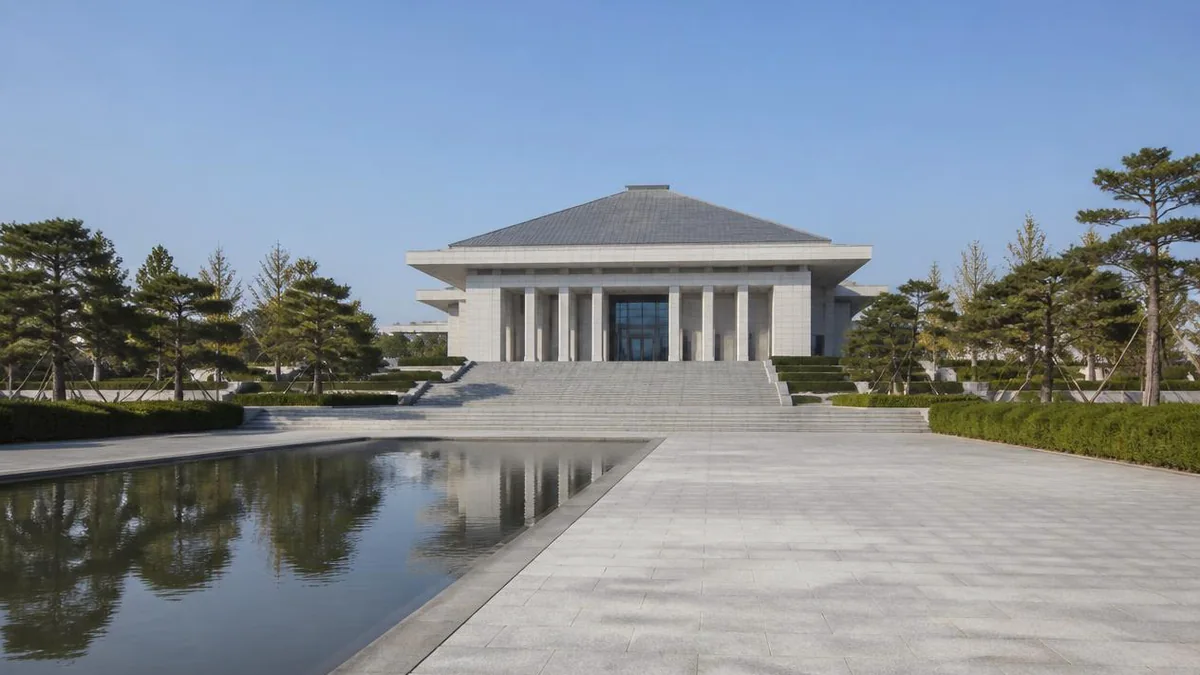
The memorial hall sits at Taohuayin, about two li from the house. It was approved by the Propaganda Department in March 1986 and opened on 6 January 1992, sixteen years and two days after his death. Deng Xiaoping wrote this plaque as well. The grounds cover 400,000 m², of which about 70% is water — a commemorative building group, an island, three artificial lakes and lakeside planting. The buildings themselves come to 21,166 m², with 7,880 m² of exhibition space. In May 2024 it was placed in the fifth batch of national first-grade museums.
Both places are free, with ID. The former residence reopened after refurbishment on 24 November 2023.
The contrast between the two sites is instructive. The house is small, plain and cramped, and gives an accurate impression of a middling official family in a declining canal town. The memorial hall is a large, water-centred, formally landscaped complex of the kind China builds for its most senior figures. One of them is the thing he was born in. The other is the answer to the question of what a country does when a man of that stature leaves instructions that he does not want to be commemorated.
Hexia
The part of the scenic area that most visitors remember is none of the above.
Hexia lies northwest of the old city, on the old course of the canal beside Xiao Lake. It formed in the late Spring and Autumn period — call it 2,500 years — and spent most of the Ming and Qing as a checkpoint on the grain transport route and an entrepôt for salt. Money of that kind, in that period, went into examination coaching, and Hexia’s return on the investment was extraordinary: sixty-seven jinshi, 123 juren, twelve Hanlin academicians, and — across the dynasties — all three of the top places in the palace examination. Locally it is called the hometown of jinshi.
It also produced Wu Cheng’en, whose former residence is here, and who wrote Journey to the West: the Monkey King, the pilgrim monk, the pig, the sand demon, and the single most adapted narrative in East Asia. If you have seen a Chinese film, a Japanese anime or a Hong Kong television serial involving a monkey with a staff, the ultimate source is a house in this neighbourhood.
Hexia is lanes, water, grey brick and a working population, and it is the section where the 5A designation feels least like an administrative decision and most like a place.
The canal capital
The city around all this is easy to underrate, because Huai’an today is a mid-sized prefecture with no obvious tourist identity. For roughly five hundred years it was one of the four great cities of the canal.
The reason was hydraulic. The Grand Canal met the Huai River here, at the junction called Qingkou, and the meeting was the most difficult piece of water management in the empire — which is why the Directorate of Grain Transport, the office responsible for moving the tax grain of the south to the capital in the north, sat in Huai’an. The ruins of its yamen are a park now. The prefectural yamen survives. So does Zhenhuai Tower, the building whose surrounding streets Zhou noticed from the air.
Two other men from here are worth naming. Han Xin, the greatest field commander of the Han founding — the man who won the empire for Liu Bang and was destroyed by him afterwards — was born in Huai’an, and the terrace where he is said to have fished as a poor young man is still pointed out. And Liang Hongyu, the Song general’s wife who beat the war drums at the battle of Huangtiandang, was from here too.
The hydraulic story runs the other way as well. Downstream of the city, in what is now Hongze district, stands the Hongze Lake Great Dyke — seventy kilometres of masonry that raised a lake above the surrounding countryside in order to keep the canal navigable, drowned the city of Sizhou in 1680, and was inscribed on the World Heritage List with the Grand Canal in 2014. That story, and the wetland at the far end of the same lake, are across the water in Suqian.
The one thing he did allow
There is a single exception to everything above, and it is not a building.
On the evening of 30 September 1949, the day before the founding of the People’s Republic was proclaimed, the new central government held its first state banquet in the Qinzheng Hall at Zhongnanhai. The cuisine it was built on was Huaiyang — the cooking of the lower Huai and the canal cities — and the dish usually named as the first of that first banquet is soft-pouch eel, ruandou changyu, which is a Huai’an dish. Huaiyang has been the base of the Chinese state banquet ever since.
The man who ran the arrangements for that banquet, and for the state’s protocol for the next twenty-seven years, was from Huai’an. The connection is drawn constantly in Chinese writing on the subject and is difficult to prove in the strict sense; what is not in dispute is that a cuisine from a declining canal prefecture became the official register of the Chinese state during the premiership of a man born in it.
Huaiyang cooking is worth understanding on its own terms, because its governing principle is the opposite of what “state banquet” implies. It uses cheap, ordinary, local ingredients and spends everything on technique. Pingqiao tofu, named for a town in Huai’an, is soft tofu cut into identical small diamonds with diced chicken and mushroom, freshened with crucian carp brains and finished with a film of clear oil that stops it steaming — so it looks cool and arrives scalding, which has caught out generations of visitors. Soft-pouch eel is the back meat of a thin green eel, flash-fried in seconds; in Huai’an the standard by which a cook is judged is how they do it. There is an all-eel banquet from the Xianfeng era running to 108 dishes, built on the principle that nothing is wasted: the front of the back is stir-fried, the rear of the back seared, the belly stewed, the blood and intestines steamed, the bones frosted.
In November 2021 UNESCO admitted Huai’an to its Creative Cities Network as a City of Gastronomy, the fifth in China after Chengdu, Shunde, Macau and Yangzhou — which means the two halves of the compound name Huaiyang are now both on the list. The application had taken five years. The city counts more than 1,300 surviving named dishes, and 298 of them are registered provincial intangible cultural heritage items, the largest number held by any prefecture-level city in the country.
So the ledger is this. He refused the arch, ordered the house demolished, banned the visitors, forbade the repairs, and had the graves flattened at his own expense. And he made his hometown’s cooking the official food of the People’s Republic, where it remains.
Visiting
The two Zhou sites plus Hexia is a comfortable day on foot and by taxi, and none of the three charges admission. Bring ID; you will need it at the gate.
Published opening hours contradict each other across sources, which is normal for free municipal sites — 08:00 to 17:30 and 08:30 to 17:00 both circulate, and one stale listing still quotes a fifteen-yuan ticket that no longer exists. Check on the day.
If you have a second day, the canal material is the reason to stay: the transport directorate ruins, the prefectural yamen, Zhenhuai Tower, Han Xin’s fishing terrace, Qingyan Garden. None of it is in the 5A designation and all of it is why the city exists.
And in the former residence, in the small plain courtyard with the well and the two ordinary trees, it is worth holding two facts at once. This is a carefully maintained national monument, refurbished as recently as 2023, visited by millions, with the calligraphy of Deng Xiaoping over the door. And the man it commemorates spent twenty years issuing instructions — four documented occasions, escalating from a declined arch to a demolition order to a ban on repairs — intended to ensure that nobody would ever stand where you are standing.
Huai’an disobeyed him. It is not obvious that Huai’an was wrong, and it is not obvious that he was. That is the interesting part, and no plaque on the site says a word about it.
The LoreLens app can identify what you are looking at in Fuma Lane or Hexia and tell you the story behind it, in five languages, from a photograph.
Location profile
Where it is

Frequently asked questions
Is the former residence free to enter?
Yes. Both the former residence and the memorial hall admit visitors free of charge on presentation of ID, and have done for years. Published opening hours disagree across sources — 08:00 to 17:30, 08:30 to 17:00, and one outdated listing still quoting a fifteen-yuan ticket — so check on the day rather than trusting a single page. The whole scenic area is walkable and the two main sites are about a kilometre apart.
Did Zhou Enlai really want the house destroyed?
The record is unusually well documented, and it is consistent across four separate occasions — 1953, 1958, 1960 and 1973. He refused a commemorative arch, said an empty old house should not occupy space belonging to living people, distinguished his own birthplace from Mao Zedong's as not warranting preservation, asked that the rooms be used as a kindergarten or a library instead, and finally sent three formal instructions through the State Council duty office: no visitors, do not evict the families living there, and do not repair the building when it falls into disrepair. The house is standing because Huai'an declined to comply.
What is the story about the graves?
He raised the question of levelling his family's graves in 1953 and again in 1958, and the county leadership repeatedly declined to do it. Before Spring Festival 1965 he sent a nephew, an army officer, quietly down to Huai'an with instructions and money. Seven Zhou family graves, including his grandfather's, were deep-buried where they stood, the coffins sunk more than a metre so as not to obstruct mechanised ploughing, the mounds removed and the ground returned to cultivation. The villagers who did the work were given a yuan each; the total, including compensation for the standing crop, came to seventy yuan, sent from his office.
How long does the scenic area take?
The two Zhou sites take two to three hours between them at a reasonable pace. Add Hexia old town on the same ticket-free footing and it becomes a full day; add the Grand Canal transport directorate ruins, the prefectural yamen and Zhenhuai Tower — all within the city and none of them part of the 5A designation — and it becomes two.
Is this worth going to if you are not interested in modern Chinese politics?
Huai'an is worth going to. It was one of the great canal cities, the seat of the official who moved the empire's grain, the birthplace of Han Xin and of the man who wrote Journey to the West, and Hexia produced sixty-seven successful candidates in the imperial examinations. The 5A designation covers the Zhou sites and Hexia together, and the old town is the part most visitors end up remembering.