Zhejiang · Huzhou
Nanxun: The Water Town That Ranked Its Millionaires as Elephants, Oxen and Dogs
Nineteenth-century Nanxun sorted its silk fortunes into a zoological league table — four elephants at the top, eight oxen below them, seventy-two dogs after that. The money came from one thread, spun in a village outside town, and it bought French etched glass, a garden that took three generations to finish, and a library built ten years after the region lost its greatest one.
5A View location, maps and nearby scenic areasThe town kept a league table of its own rich men, and the categories were animals.
A fortune above a certain line made you an elephant. Below that you were an ox. Below that, a dog — and a dog still meant a household with more silver than most Chinese counties saw in a year. The tally everyone in Nanxun still quotes is four elephants, eight oxen, seventy-two golden dogs. It was never an official register: it was gossip that hardened into local history, the way a nickname does.
What the elephants sold was thread.
Not silk cloth — Nanxun did not weave much. It sold raw reeled silk, the filament unwound from cocoons and made ready for someone else’s loom. For roughly seventy years, from the opening of Shanghai to the collapse of the silk trade in the 1930s, this canal town forty kilometres east of Huzhou was one of the wealthiest square miles in China per head.
That is the reason to come here rather than to one of the other water towns. Nanxun looks wrong. You walk a lane of whitewashed wall and grey tile that could be any Jiangnan town, and then a door opens onto a red-brick European ballroom with blue etched glass imported from France, and another onto a book tower, and another onto a garden that took three generations to finish.
One ticket, one town, two clusters
Chinese 5A ratings are frequently containers — one designation stretched over places an hour apart. Nanxun is the easier kind: a single continuous historic district, roughly 1.6 square kilometres of protected old town in Nanxun District, Huzhou, on Zhejiang’s border with Jiangsu. You could walk end to end in half an hour if you did not stop, which you will not manage.
The combined ticket is where the complication lives. It names a set of houses, gardens and halls, each with its own gate and staff, and they fall into two clusters at opposite corners:
- The southwest cluster, along the watercourse at the town’s edge: Xiaolianzhuang, the Liu family garden; the Jiayetang library immediately beside it; the Liu Ti House, universally called the Red House; and Qiushuli, a later Liu villa. This is the Liu family’s quarter, and you can do all of it without crossing a main road.
- The northeast cluster, along the old canal and the main street: the Zhang Shiming residence; the Zhang Jingjiang residence; the Guanghui Gong, the town’s Daoist temple; the Nanxun history museum in the Republican-era silk guild hall; and, on the north bank, Baijianlou.
Between them is a kilometre of ordinary lived-in town. Baijianlou is the exception to the ticketing arrangement: a residential street, not an exhibit, and nobody stops you walking down it.
The practical consequence: Nanxun is a full day, not the two hours the map suggests.
Xunxi, Nanlin, Nanxun
The name is a merger, and it is dated.
The settlement on this water was Xunxi — the Xun stream. A second cluster nearby went by Nanlin, the southern grove. In the twelfth year of the Chunyou reign of the Southern Song — 1252 — the two became a single market town, and the new name took a character from each. Chinese place names are often this literal and rarely this well documented.
The water that made the merger worth doing is the Ditang, the canal running east and west along the northern edge. It was cut long before the town existed, and its name records a repair: the channel was originally the Di embankment written with the character for reeds, and after a Tang-dynasty prefect of Huzhou named Yu Di rebuilt it, locals restruck the name with his character instead — a public works project renamed after the official who fixed it.
The Ditang connects to the Grand Canal, the north-south artery that has moved China’s grain, salt and tax revenue since the Sui dynasty and was inscribed as a UNESCO World Heritage Site in June 2014; the old Ditang course through Nanxun is counted among its components. This matters less as a badge than as an explanation. Everything Nanxun ever sold left by this water and reached Shanghai without a single overland transfer.
The thread that could hold eight copper coins
The silk was not made in Nanxun. It was made in a village just outside it, Qili in standard Chinese, pronounced closer to Jili locally — and the local pronunciation is the one that ended up on the export invoices. Jili silk was the premium grade of the whole Huzhou region.
Silk reeling in the delta is old, and the differences between one village’s output and another’s are small in description and enormous in price. Jili’s reputation rested on evenness: filament of consistent diameter, few slubs, a particular whiteness, and strength. The traditional formulation is that a single Jili filament would hold seven or eight strung copper cash where ordinary silk broke at three or four — a figure from the trade, not a laboratory. The commercial evidence is better than the anecdote: Jili silk carried a premium in Shanghai for decades, and premiums that last that long in a commodity trade usually indicate something real.
Two events turned the premium into fortunes.
The first was 1843, when Shanghai opened as a treaty port under the Treaty of Nanjing. Nanxun was suddenly about 130 kilometres of continuous inland water from the fastest-growing export market in Asia. Silk that had moved through the domestic system now went to European and American buyers, and the men who could aggregate it in volume — buying from thousands of peasant reeling households, grading, financing, shipping — took the margin.
The second was reputational. At the Great Exhibition in London in 1851, a Shanghai merchant named Xu Rongcun entered a consignment of Huzhou raw silk under his own house mark and it was awarded a prize. The story is told throughout this region, and Nanxun tells it as a Jili story specifically — but that last step is a local attribution rather than something the exhibition’s records settle.
Four elephants, eight oxen, seventy-two dogs
The animal ranking is the most quoted thing about Nanxun, and it is worth being precise about how imprecise it is.
The scheme graded households by wealth in silver taels. The version most often repeated puts an elephant at a million taels or more, an ox between half a million and a million, and a dog in the low hundreds of thousands; other versions move the lines. The number seventy-two is almost certainly not a count. Seventy-two is a conventional Chinese figure for a great many, in the same family as the seventy-two disciples of Confucius.
The four elephants are named and traceable, and their descendants built most of what you will pay to enter:
- Liu Yong (1825–1889), the largest of the four, who began as an apprentice in a silk shop and finished as the richest man in the town.
- Zhang Songxian, whose grandsons built the two most famous houses in the northeast cluster.
- Pang Yunzeng (1833–1889), whose son became the most important private collector of Chinese painting of his generation.
- Gu Fuchang, who worked the Shanghai end as a broker to the foreign firms.
You will also see a claim that the combined wealth of the elephants, oxen and dogs approached the Qing government’s annual revenue. It is repeated everywhere with no audited basis on either side. Take it as an expression of how the town was regarded, not as accounting.
A garden that took three generations
Xiaolianzhuang — the Little Lotus Villa — is the first thing most visitors see and the best introduction to how this money behaved.
Liu Yong began it in 1885. It was not finished until 1924, by which time he had been dead thirty-five years and his sons and grandsons had inherited the project. Nearly forty years on one garden is unusual even by Jiangnan standards, and it shows: the place is layered rather than unified, the honest signature of a long build.
The name is an act of deference. Zhao Mengfu (1254–1322) — the Yuan-dynasty painter and calligrapher whose running script is still copied by every Chinese child who takes calligraphy seriously — had a garden in Huzhou called the Lotus Villa. Liu Yong, a silk merchant with no scholarly lineage whatever, named his the little one. The social project of the Nanxun merchant class is contained in that single character.
What is inside:
- The lotus pond, which in July fills the southern half of the garden with flowers standing above head height from the walkways.
- The Liu family temple, with two memorial arches granted by imperial decree — proof that trade money had been converted into official recognition, which was the point of the exercise.
- A hall complex called the Cave of Pure Fragrance Poetry, containing a small architectural joke: two adjoining ceilings coffered in the shapes of the sheng and the dou, the standard grain measures of the Chinese market. A merchant family’s poetry pavilion, roofed with the tools of the trade.
- Dongsheng Ge, a Western-style building known locally as the young ladies’ tower — the earliest sign of what the next generation would build.
Liu Yong’s second son, Liu Jinzao (1862–1934), took the ambition further than a garden. He compiled a supplement to the Comprehensive Examination of Documents, one of the great Chinese institutional-history compendia, extending it through the late Qing across some 400 chapters. Historians of the period still use it. The family made its money grading cocoons and finished producing a standard scholarly source, in three generations.
The library built ten years too late
Directly beside the garden stands the reason a certain kind of visitor comes to Nanxun at all.
To understand Jiayetang you need one piece of context from thirty kilometres away. Lu Xinyuan (1834–1894), a Huzhou official and bibliophile, had assembled one of the outstanding private book collections in China, in a building he called the Bisong Lou — the Tower of Two Hundred Song Editions, named for its Song-dynasty printings, the most coveted objects in Chinese book collecting. In 1907 his son sold the collection entire to the Seikadō Bunko in Japan. It remains there. In Chinese cultural memory the sale is a wound that never closed: the largest export of Chinese rare books in the modern era, out of this prefecture.
Liu Chenggan (1881–1963), Liu Yong’s grandson, began collecting seriously a few years after that sale, with silk money and no scholarly training, at a scale nobody of his background had attempted. He bought whole libraries from families ruined by the 1911 revolution and its aftermath. Estimates of the peak run to hundreds of thousands of juan — the traditional unit, closer to a fascicle than a volume.
The building went up between 1920 and 1924 on an island site beside Xiaolianzhuang: a two-storey courtyard block with the stacks arranged around a square light well. The name came from above — a plaque inscribed with four characters meaning approximately reverently, an admirable enterprise, granted by Puyi, the last Qing emperor, who had abdicated in 1912 but was still living in the Forbidden City with a court and the power to bestow calligraphy.
Liu did not only collect. He printed, commissioning carved woodblocks and issuing texts that were rare, out of print, or suppressed under eighteenth-century Qing censorship. That programme survived best: the library still holds tens of thousands of his woodblocks, and a rack of them is a more direct encounter with how a Chinese book was manufactured than any display case.
Then it came apart. The Depression cut the family’s income, the war came, and Liu sold and lost material over two decades. In 1951 he donated the building and what remained to the Zhejiang Library, which administers the site to this day. What you visit is a working institution rather than a preserved house.
There is an unavoidable symmetry. The region’s greatest collection left for Japan in 1907; a decade later a man with no scholarly credentials but a great deal of silver started buying. He did not replace what was lost. He stopped the next thing from going.
The house with the French ballroom
Cross to the northeast cluster for the building that makes people take out their phones.
The Zhang Shiming residence, formally the Yide Tang, was built for Zhang Junheng (1871–1928), known by his style name Shiming, a grandson of the elephant Zhang Songxian. Construction ran from roughly 1899 to 1906. Local promotion calls it the first private residence of Jiangnan, a claim that cannot be adjudicated.
From the street it is a conventional Jiangnan merchant compound: successive courtyards on a north-south axis, grey brick, carved lintels, a hall for guests, a hall for the family, women’s quarters behind. Room counts run into the low hundreds. Work through it and the architectural vocabulary changes as you go deeper, which is the opposite of what you expect.
At the back is a European section. Red brick laid in a pattern nobody in this valley was using. A pedimented façade. Cast-iron balcony railings. Floor tiles and coloured window glass reported as French imports, the glass blue and acid-etched with grapevine motifs. And a ballroom, with a fireplace, in a Chinese merchant’s house in a canal town in 1906.
The detail that gets missed is that the house is not a pastiche. The Chinese sections are seriously good Chinese building — the brick carving on the gatehouses, the woodwork in the reception halls. The European section is not a veneer over that; it is a separate, complete, correctly detailed piece of work occupying the back of the plot. The owner did not want a fusion. He wanted both, done properly.
The lame man who paid for a revolution
A few minutes away is the house of a man from the same clan who spent his money differently.
Zhang Renjie (1877–1950), universally known as Zhang Jingjiang, was Zhang Shiming’s cousin. He walked with great difficulty from a young age, and in a society where officialdom required physical presentability that closed the conventional route. In 1902 he left for Paris as an attaché to the Chinese legation, and set up a trading company dealing in Chinese antiques, silk and tea for the European and American market. It made him extremely rich.
What he did with the money is why he appears in the standard histories. Meeting Sun Yat-sen (1866–1925) — the physician-turned-revolutionary honoured as a founder by both the People’s Republic and Taiwan — Zhang offered open-ended financial support, reportedly via a coded telegram system in which a single letter stood for a sum of money. He funded the movement through the years before the 1911 revolution that ended two thousand years of imperial rule, and after it.
He rose high in the Nationalist party in the 1920s and chaired the Zhejiang provincial government from 1927 to 1930. His most visible project in that role was the West Lake Exposition of 1929, a national industrial and cultural fair on the shore of West Lake that ran for months and drew millions. He fell out with Chiang Kai-shek over economic policy, withdrew from politics in the 1930s, and died in New York in 1950.
The residence is his family’s: a substantial but unostentatious merchant compound whose interest is entirely in who lived in it.
Red brick over a Chinese plan
Once you have seen the Zhang house you notice the pattern everywhere, and it is what distinguishes Nanxun from every other water town in the delta.
The Liu Ti House — the Chongde Tang, built for one of Liu Yong’s sons and known to everyone as the Red House — puts a European brick façade with arched windows and a pedimented entrance directly onto a Chinese courtyard plan. Qiushuli, Liu Chenggan’s own villa of the 1930s, does something similar in a later idiom. Dongsheng Ge, thirty years earlier, was the opening move.
The explanation is unglamorous and complete: these men lived in Shanghai. They worked in the International Settlement, watched the Bund go up, and came home to build. They were not making an argument about East and West. They were building what their peers built, and their peers were in Shanghai.
This is the substantive reason to choose Nanxun over Wuzhen or Xitang if you have one water town in your schedule. Wuzhen is the most controlled presentation of the idea, delivered as a single managed product. Xitang is the most lived-in. Nanxun is the one that shows you money arriving from outside and changing the buildings.
A hundred rooms and three stone bridges
Walk north to the Ditang for the town’s best stretch of ordinary architecture.
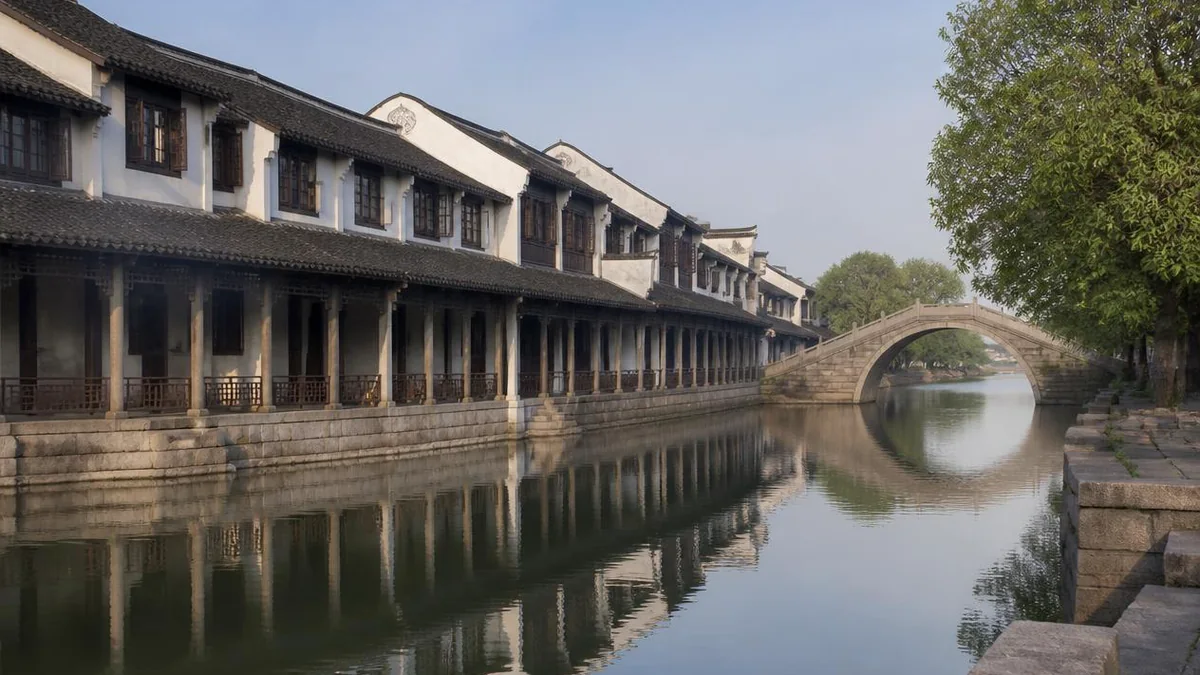
Baijianlou — the hundred rooms — is a continuous terrace of two-storey houses running several hundred metres along both banks of a narrow waterway: a covered walkway at ground level, arched openings between the bays, whitewashed gables stepping up and down against the sky, stone steps into the water every few doors.
Tradition attributes it to Dong Fen (1510–1595), a senior Ming official from this town. The story goes that when his granddaughter married, her dowry included a large retinue of servants, and Dong built a hundred rooms along the river to house them. It is the sort of origin story that explains a name too neatly, and should be held as tradition rather than record. The buildings are in any case mostly later — repaired, rebuilt and repaired again across four centuries, which is what happens to housing that never stops being housing.
That is Baijianlou’s real value. It is not an exhibit — people live in it, hang washing from it, park bicycles under the arcade. Go at seven in the morning, before the coaches, and it is the most convincing thing in the town.
The stone bridges are the other survival worth planning for. The Tongjin Bridge, a high single-arch span, sat at the heart of the silk trade — the wharf beside it was where reeling households brought their skeins to the buying houses. Guanghui Bridge and Hongji Bridge complete the set usually named with it. The arches are steep, the steps worn into hollows, and they stand that high because loaded boats had to pass beneath.
Collectors, a novelist, and a translator of Walden
For a town this size Nanxun’s cultural output is disproportionate. Three names are worth carrying.
Pang Yuanji (1864–1949), better known as Pang Laichen, was the son of the elephant Pang Yunzeng, and he spent the family’s silk money on Chinese painting with a seriousness no other collector of his generation matched. His holdings ran to thousands of works across the Song, Yuan, Ming and Qing; after 1949 much of the collection passed to major public museums. If you have looked at Chinese painting in a serious museum, you have probably looked at something that hung in a Nanxun house.
Dong Yue (1620–1686), a descendant of the Dong Fen associated with Baijianlou, wrote one of the strangest books in Chinese literature. The Xiyou Bu — Supplement to the Journey to the West — inserts itself into the famous sixteenth-century novel and traps the Monkey King inside a hallucination: he falls through mirrors into past and future, cannot find a way out, meets historical figures out of sequence, and at one point presides over a trial in hell. Written around the collapse of the Ming, it reads like a seventeenth-century surrealist novel. Dong Yue later took Buddhist vows.
Xu Chi (1914–1996) was born here and did two things a Western reader will recognise. In 1949 he published the first Chinese translation of Thoreau’s Walden, still read in China under his name. And in 1978, at the beginning of the reform era, he published a piece of literary reportage about the mathematician Chen Jingrun and the Goldbach conjecture — a portrait of a scientist working in obscurity through the Cultural Revolution, read by an enormous audience and credited with helping restore public standing to scientific work after a decade in which it had none.
How the old town got to be here
The twentieth century was not kind to the trade that built Nanxun. Chinese raw silk lost export ground to Japan from the 1920s, the Depression closed the American market, and the war finished the job. The merchant families dispersed, and their houses were divided into apartments, used as offices, schools and factories, and left standing largely because nobody had a reason to knock them down.
That neglect is why anything survives. Recovery came in stages:
- In 2001, Xiaolianzhuang, Jiayetang and the Zhang family residence complex were listed among the national key protected historic sites in the fifth national batch — the top tier of Chinese heritage protection, which brings both money and constraint.
- In 2003, conservation plans covering Nanxun together with Zhouzhuang, Tongli, Luzhi, Wuzhen and Xitang, drawn up by Ruan Yisan’s team at Tongji University, received a UNESCO Asia-Pacific heritage award. Ruan is the figure most responsible for any of these towns still standing.
- Also in 2003, Nanxun became a district of Huzhou city in its own right, changing the administrative weight behind it.
- In 2014 the Grand Canal inscription brought the Ditang course under World Heritage protection.
- The 5A rating, China’s top scenic-area grade, was awarded in 2015.
Nanxun’s development has been less aggressive than Wuzhen’s, and the difference is visible: no wholesale purchase of the housing stock, no relocation of residents out of the core. The town centre still has a wet market, schools and a normal amount of mess. Whether that survives the next decade of visitor growth is an open question everywhere in the delta, and Nanxun has no special immunity.
Going
Nanxun sits in the northeast corner of Zhejiang, hard against the Jiangsu border. Shanghai is about two hours by road, Hangzhou and Suzhou closer, Huzhou city the nearest rail hub. It works as a day trip and is better as an overnight, because the two best hours of the day are after the coaches leave and before they arrive.
A workable order: start in the southwest cluster early, when Xiaolianzhuang is quiet and the light is on the pond; Jiayetang next door; then the Red House. Walk the length of the town through the middle, which nobody ticketed and where people actually live. Take the Zhang Shiming residence in the middle of the day. Finish on Baijianlou at dusk.
Do not do it in two hours en route to somewhere else. The mistake visitors make is treating Nanxun as another photogenic canal — the canals are the least interesting thing in it. The interesting thing is a dated, documentable episode in which a village commodity, a treaty port and an accident of geography made a small town extraordinarily rich for seventy years, and the people who got rich spent it on gardens, books, paintings, a ballroom and a revolution.
Then the money went away, and the buildings stayed.
The LoreLens app can identify the merchant houses, carved gatehouses and stone arch bridges of Nanxun, and explain who paid for each of them, in your own language, offline.
Location profile
Where it is
Frequently asked questions
What does the Nanxun ticket actually cover?
A combined ticket for the old town, which is the whole of the 5A area rather than a set of far-flung sites. The houses named on it are Xiaolianzhuang garden, the Jiayetang library, the Zhang Shiming residence, the Liu Ti House known as the Red House, Qiushuli, the Zhang Jingjiang residence, the Nanxun history museum in the old silk guild hall, and the Guanghui Gong temple. Baijianlou, the riverside terrace, is a residential street you can walk into without a ticket. Combined tickets here change without notice, so confirm on arrival rather than from any article, including this one.
How is Nanxun different from Wuzhen and Xitang?
By money and by architecture. All three are Ming and Qing canal towns within an hour or two of each other, but Nanxun's merchants were raw-silk exporters working through Shanghai from the 1840s onward, and they came home and built with what they had seen there: red brick façades, a European ballroom with imported etched glass, cast-iron railings and Baroque pediments, none of which you will find in the other two. Nanxun is also less programmed than Wuzhen, whose west section was bought out and emptied of residents.
Is the story about the thread holding eight copper coins true?
It is the traditional way of describing Jili silk's tensile strength — a single filament said to bear seven or eight strung copper cash where ordinary silk broke at three or four — and it circulates in local writing rather than in any test report. Treat it as a trade boast that stuck. The commercial outcome is not in doubt: Jili reeled silk commanded premium prices in the Shanghai export market for decades, and the fortunes of the town were built on that premium.
What is left of the Jiayetang collection?
The building, the woodblocks and the institution, but not the peak collection. Liu Chenggan assembled it from around 1910 into the early 1930s, then lost and sold material through the Depression and the war, and in 1951 gave the building and what remained to the Zhejiang Library, which still administers it. Rare volumes are held in modern conditions rather than on the shelves you walk past. The most striking survival is the printing operation — tens of thousands of carved woodblocks from books Liu published himself.
When is the best time to go?
Late March to May, or October to November. June brings the plum rains, July and August are hot and humid on the Hangzhou-Jiaxing-Huzhou plain, and the site is mostly open water and walled courtyards with little shade. The hour after the day groups leave is the best of the day on the Baijianlou bank. Xiaolianzhuang's lotus pond peaks in July, precisely when the weather is worst — a trade-off with no clean answer.