Zhejiang · Ningbo
Tianyige: The House Rules That Kept a Library Alive for 400 Years
A retired Ming defence minister built a book tower in Ningbo in 1561 and left his sons a rule in eight characters: never divide the books, never let them leave the building. It held for two hundred years. Then an emperor asked to borrow some, and the borrowing never stopped.
5A View location, maps and nearby scenic areasThe rule was eight characters long, and it was not a suggestion.
Never divide the books between generations. The books do not leave the pavilion.
The man who left it had been a prefect, a provincial administrator, a censor and finally a vice-minister of war, and he had been beaten with the rod at the palace gate for standing up to a marquis. When he died in 1585 he split his estate into two piles and made his sons choose. One pile was ten thousand taels of silver. The other was a two-storey building beside a lake in Ningbo holding seventy thousand juan of books, and the obligation to keep every one of them exactly where it was, forever, along with everyone who came after.
The building is still there. So, in a much-interrupted way, is the collection. Tianyige is the oldest surviving private library in China, and its own literature goes further, calling it one of the three oldest family libraries in the world — a claim repeated everywhere and tested nowhere.
What makes it worth half a day is not the age. It is that Tianyige is a four-century controlled experiment in whether rules can keep paper alive, and the experiment has a readable result. The rules worked, until the one person who could not be refused broke them.
A building that is a sentence from the Book of Changes
Start with the name, because the name is the design brief.
Fan Qin (1506-1585) took it from Zheng Xuan’s commentary on the Yijing, the Book of Changes — the divination classic that underlies most Chinese numerology the way Euclid underlies Western geometry. The phrase is heaven one gives birth to water, earth six completes it. Heaven’s number is one, and it produces water.
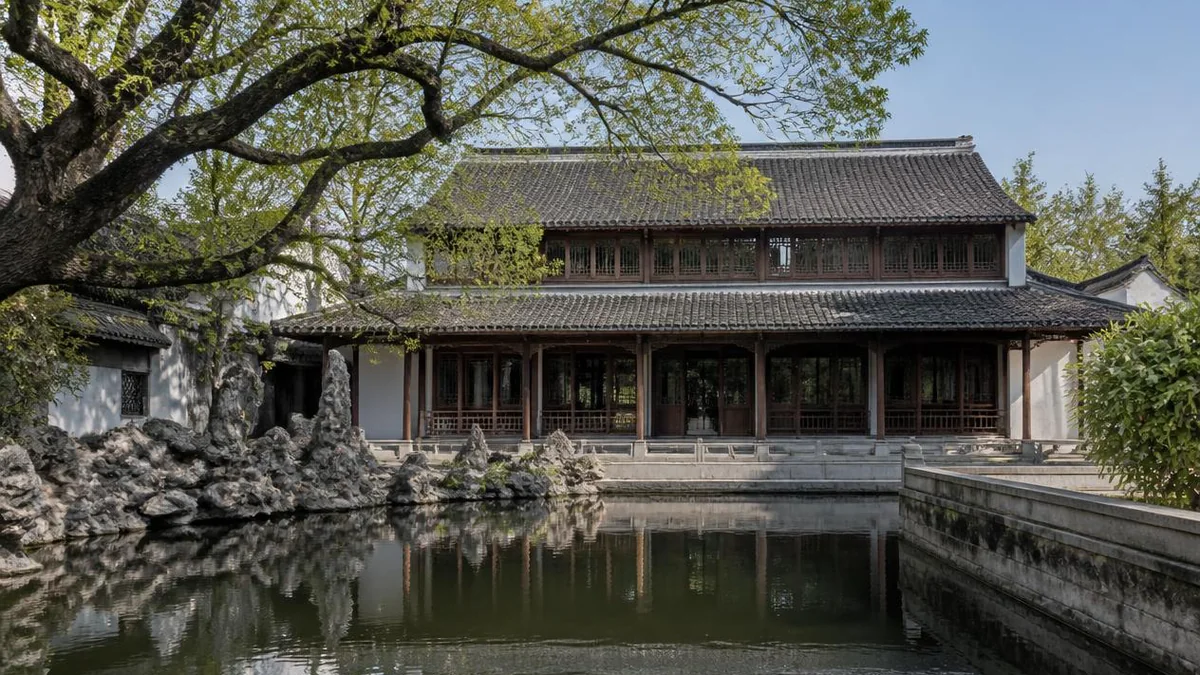
Fan Qin’s problem was fire. Every private library in China burned eventually. So he named the building Tianyi — Heaven One — to put water into its name, and then built the number into the fabric. Baoshu Lou, the pavilion, is a two-storey hall with a double-eaved flush gable roof, facing south. The upper floor is a single undivided room: one. The lower floor is five standard bays plus a stair bay: six. Heaven one above, earth six below. Sympathetic magic executed in carpentry.
The rest of the fire defence is not magic, and it is the part that worked:
- The family’s living quarters sit to the west, cut off by a fire lane and a fire wall, with a deliberate gap between the two.
- The doors of the two are offset, so nothing runs straight from the kitchens to the shelves.
- A water pool was dug in front, kept full against fire. Tradition holds it is fed from Moon Lake underground and never runs dry.
- Books were kept in camphor wood cabinets, whose smell repels bookworms and termites, and packed with yun, a bitter herb used as an insecticide. The Chinese phrase for scholarly refinement, shuxiang — the fragrance of books — is commonly said to come from that herb.
In 1665 Fan Qin’s great-grandson Fan Wenguang laid out the garden in front, piling rockery into named shapes. The set-piece is the nine lions and an elephant, and visitors still stand there trying to find the elephant. It is not obvious. Do not be embarrassed.
The man who built it
Fan Qin was born on 5 October 1506 in Yin county, now central Ningbo. He placed seventieth in the provincial examination of 1528 and became a jinshi — a metropolitan graduate, the qualification that opened the senior civil service — in 1532, at twenty-seven.
Then he spent thirty years being posted around the empire: prefect of Suizhou, a Ministry of Works section chief in the capital, prefect of Yuanzhou in Jiangxi from 1540, military circuit officer at Jiujiang, then administration commissioner or surveillance commissioner in Guangxi, Fujian, Yunnan, Shaanxi and Henan, then grand coordinator over the border country where Jiangxi, Fujian and Guangdong meet. In August 1560 he was promoted vice-minister of war. In October, two months later, he was impeached and went home.
Two collisions from that career are worth keeping. In 1539 he trimmed inflated construction prices on a major imperial building project and was denounced to the emperor by the Marquis of Wuding, who was supervising it; Fan Qin was arrested, beaten at the palace gate and made to buy his way back to his post. Later, as prefect of Yuanzhou, he refused Yan Shifan — son of Yan Song, the grand secretary who dominated the court for two decades and is the standard villain of mid-Ming politics — a government building he wanted for himself. The county gazetteer records Yan Song’s reaction as a shrug: this is the man who stood up to Guo of Wuding, so leave him alone, provoking him will only make his name.
That biography is also the collection’s secret advantage. A man who has served in eight provinces at senior rank can obtain documents no ordinary collector can buy: internal administrative compilations, official records, the printed output of government offices. Wherever he was posted he bought what was printed locally, and where he could not buy he hired copyists.
One loose end. Fan Qin died on 20 October 1585, which by his birth date makes him seventy-nine, or eighty by the Chinese count. The Yin County gazetteer says eighty-three. Somebody’s arithmetic is wrong and it is not recoverable.
What is actually on the shelves
Here is where most visitors are surprised. The treasure of Tianyige is not literature. It is paperwork.
Fan Qin collected what other collectors of his day thought beneath notice: local gazetteers, administrative handbooks, and above all examination rosters — the printed lists of who passed which imperial examination, in what order, with their family details. Serious Ming collectors chased Song editions of the classics. Fan Qin bought the current year’s civil service results.
Four centuries later the Song editions are in every major library and the examination rosters are almost nowhere, because nobody else kept them. The museum holds 271 Ming local gazetteers and 370 examination rosters, and puts its share of the surviving world total for that category at over eighty per cent. The signature holding is described as an unbroken run of jinshi pass lists from the dynasty’s first examination in 1371 to the fifty-second in 1583 — which, if you want to know who governed China during the Ming and where they came from, is the primary source.
One note on counting. Chinese book totals use two units: bu, a work or title, and juan, a fascicle. A single bu can run to hundreds of juan. They are not interchangeable, and older sources switch between them without warning.
Never divide the books, never let them leave
The estate division is told the same way everywhere: two piles, ten thousand taels on one side and the library on the other, and the elder son Fan Dachong giving up his claim on everything else to take the books.
The earliest account is by the Ningbo historian Quan Zuwang (1705-1755). It is worth noting that the county gazetteer, quoting him, adds a dry marginal comment: his account has one son take the books and the other cheerfully take the silver and leave, but it is not known which of them was Dachong. Even the founding scene has a loose thread.
What Fan Dachong did next mattered more than which pile he chose. He converted his father’s wish into an institution:
- The books belong to the descendants collectively, not to any individual or branch.
- The keys to the cabinets are distributed among the branches of the family. The locks cannot be opened unless every branch is present.
- No outsider enters. No member brings in a relative or friend privately. No member enters without reason.
- Nothing is lent to another surname, or to another branch.
The key rule is the clever one, because it relies on nobody’s virtue. It makes access require unanimity, and unanimity is expensive. If one branch is away, the cabinets stay shut. A collection that can only be opened by consensus is one that is very rarely opened, which is exactly what preserves it.
The penalties, recorded by the late-Qing bibliophile Miao Quansun, are not fines. They are exclusion from the ancestral sacrifices, the rite that defines you as a member of the family. Entering without reason: barred from three sacrifices. Bringing in an outsider, or opening a cabinet on your own authority: barred for a year. Taking a book out of the building: barred for three years.
In 1829, during an overhaul that replaced tiles and steps, repaired the rockery and dredged the pool, the family revised the code and cut it into stone — three prohibition steles, fifteen clauses.
The rule about women
The rule everyone repeats is that women of the family were forbidden to climb the stairs.
It appears in every account of Tianyige. The explanation usually offered is domestic and unsentimental: cooking was women’s work, cooking meant fire, and fire was the one thing that could end the library in an afternoon. Whether that is the historical reason or a later rationalisation I cannot establish. The clauses quoted from the surviving prohibition texts concern keys, outsiders and lending; I have not been able to trace the ban on women to a stele text, only to general descriptions of the clan code.
What the rule produced is the story most Chinese visitors arrive already knowing.
In the Jiaqing reign (1796-1820), the story goes, a young woman named Qian Xiuyun, niece of the Ningbo prefect’s wife, loved books, had heard about the Fan collection, and arranged through her uncle to be married into the family — to a scholar named Fan Bangzhu — specifically in order to read them. After the wedding she asked to go up. Her husband told her the clan rules forbade women on the upper floor. She asked instead that a book be brought down. Books do not leave the pavilion. She never got in, and died young, telling her husband she wished to be reborn as the yun herb, so as to lie among the books.
Treat this as literature, because that is what it is. The earliest version appears in the Chuncao Tang Ji, a Qing collection by Xie Kun, not in any family or official record. Museum researchers have said Qian Xiuyun and her husband were real, and that he belonged to a collateral branch of the Fans rather than the main line — a simpler explanation for his lack of access than his wife’s sex. The story’s modern fame is owed almost entirely to Yu Qiuyu, whose essay Tianyige in Wind and Rain, collected in A Bitter Journey Through Culture (1992), is one of the most widely read pieces of contemporary Chinese travel writing.
There is a rock in the 1665 rockery that resembles a girl tilting her head to look up. The local name is the beautiful woman looking in the mirror, and it is pointed out as Qian Xiuyun: a nineteenth-century story attached to a seventeenth-century stone, which is roughly how these things always work.
The first outsider
For its first century the pavilion was effectively sealed. Then a member of the family made an exception, and the exception made the library’s reputation.
Fan Guangxie had copies made of more than a hundred titles for local scholars to read, and then broke precedent by taking Huang Zongxi upstairs.
Huang Zongxi (1610-1695) is one of the two or three most important thinkers of the seventeenth century in China: a Ming loyalist who refused to serve the Qing, and author of Waiting for the Dawn, a critique of despotic monarchy so direct that reformers two hundred and fifty years later reprinted it as a manifesto. He read the entire collection, compiled a catalogue of it, and wrote his own Record of the Tianyige Collection, telling the Fan descendants not to treat what they held as smoke and cloud passing before the eyes but to guard it generation after generation as they would their own eyeballs.
He was the first person outside the family to get in. After him the door opened, narrowly, to a handful of eminent scholars over two centuries — Quan Zuwang among them, and later Ruan Yuan (1764-1849), the governor-general and classicist who wrote a preface to the Tianyige catalogue.
The date is not agreed. Chinese Wikipedia places the copying and Huang Zongxi’s ascent in 1676; other accounts, including material around the museum, give 1673. Both circulate freely, and nothing I can find reconciles them.
The emperor asks
In 1773 the Qianlong emperor (reigned 1735-1796) ordered the compilation of the Siku Quanshu, the Complete Library of the Four Treasuries — an imperial project to collect, copy and, where convenient, quietly censor the entire written inheritance of China. Private collections were instructed to send in their rare editions.
Fan Qin’s eighth-generation descendant Fan Maozhu submitted the Tianyige rarities. The number is among the most-cited figures about this library and it is not stable: most sources say 638 titles, while Chinese Wikipedia gives 641, following the bibliographer Luo Zhaoping’s corrected list of what was actually presented. Either way it was the second-largest private contribution in the empire, and by quality the first.
Roughly five-sevenths of it was recorded in the imperial catalogue and about one-sixth copied into the Siku Quanshu in full. And then — this is the part that matters — none of it came back. The collection dropped to 4,819 bu.
The rewards were considerable and entirely symbolic. In 1774 the emperor granted the family a set of the Gujin Tushu Jicheng, the great Qing encyclopaedia. In 1779 he sent sixteen engravings of the Victories in the Western Regions, cut after designs by Giuseppe Castiglione (1688-1766), the Milanese Jesuit who spent fifty years as a court painter in Beijing. In 1787, twelve more battle prints.
And he sent the Hangzhou textile commissioner Yin Zhu to Ningbo to measure the building.
Qianlong needed somewhere fireproof for seven manuscript sets of the Siku Quanshu, and had decided the safest book building in China was a private house in Ningbo. The order was that the new pavilions follow it — the system of the pavilion exactly as Mr Fan’s Tianyige. Seven were built, at Beijing, Shenyang, Chengde, Yangzhou, Zhenjiang and Hangzhou. Several were later destroyed. Wenlan Ge, at West Lake in Hangzhou, survives.
So the first serious breach of the books do not leave the pavilion came from the only quarter the family could not refuse, and the compensation was that the emperor of China copied their architecture seven times.
Then everybody else took some
After the emperor, the arithmetic runs one way.
1841. The Opium War reaches Ningbo and the prefectural city falls. British occupying troops carry off several dozen geographical works, among them the Comprehensive Gazetteer of the Great Ming.
1847. A count of what is left: 2,223 bu.
1861. The Taiping armies take Ningbo. In the disorder thieves strip books out and sell them; Fan Bangsui, a tenth-generation descendant, buys back what he can find.
1884. The diplomat and reformer Xue Fucheng (1838-1894) has a catalogue made: 2,152 bu, 17,382 juan of the original collection, plus the 8,462 juan of the encyclopaedia Qianlong sent.
1914. A professional thief named Xue Jiwei gets inside and works with accomplices outside, passing books out over a sustained period. The haul goes into the Shanghai second-hand trade. Zhang Yuanji of the Commercial Press bought a portion back at great expense for the Oriental Library — which was later bombed and burned in the fighting with Japan, so part of what was rescued in 1914 was destroyed anyway. The theft alone is reckoned to have cost around a thousand titles.
By 1940 the pavilion held 1,591 bu, 13,038 juan. Set that against seventy thousand juan in 1585. The family’s rules had held their side of the bargain for three and a half centuries — no branch divided the collection, no member walked off with it — and the collection had still lost more than eighty per cent of its bulk to an emperor, an army, a rebellion and a burglar.
The typhoon
On 18 September 1933 a typhoon brought down the east wall. The Fan descendants could not pay for repairs.
What happened next changed what Tianyige is. Local figures formed a Committee for the Restoration of Tianyige, including Fan descendants but led from outside the family — the Yin county magistrate Chen Baolin backed it, and the Ningbo collector Feng Mengzhuan and others raised the money. They repaired the pavilion, then did something more radical: they moved other things in.
- Zunjing Ge, the Classics-Revering Pavilion from the prefectural Confucian school, a Guangxu-era hall with a double-eaved gable-and-hip roof, was dismantled and re-erected inside the grounds.
- Some ninety stone stelae, Song through Qing, were set up in the rear courtyard as the Mingzhou Stele Forest. More arrived later.
- The Qianjin Studio opened to display over a thousand Han and Jin bricks collected by the Ningbo scholar Ma Lian (1893-1935), with city-wall bricks salvaged when Ningbo’s walls came down.
That is the moment a private family library became a public cultural site with a museum’s logic. The typhoon did what four centuries of scholarly petitioning had not.
The one time the books left, and why that saved them
In 1937 the war with Japan began. In 1939 the Fan collection did the one thing it had been forbidden to do for 370 years: it went out of the door.
The evacuation is documented to the day. A first batch of three crates left on 17 August 1937. A second batch of eight crates of pre-Ming editions left on 5 January 1939. On 12 April 1939 everything — the two batches already out plus what remained in the pavilion — was consolidated into 28 crates containing 9,080 volumes, sealed by the Yin county government and shipped inland to Longquan county in the mountains of southwestern Zhejiang, hidden in a village alongside the evacuated holdings of the Zhejiang Provincial Library.
The books came back to Hangzhou after the war and returned to the pavilion on 16 December 1946. From 1 to 3 March 1947 they went on public exhibition for the first time in the library’s history.
Read those two facts together. The rule the books do not leave the pavilion was written to keep the collection safe. The collection survived the occupation of Ningbo because in 1939 somebody broke that rule and put it on a boat.
Public property
On 9 June 1949 the Ningbo Military Control Commission took over Tianyige and made it a state institution. Two Fan descendants, Fan Yingxing and Fan Luqi, became salaried public employees — the family duty converted into a job description.
Then the collection began to grow again, from a direction the original rules could not have anticipated: Ningbo collectors started donating their own libraries into it. What had been a closed family holding of thirteen thousand juan in 1940 is now, by the museum’s figure, close to 300,000 juan, of which some 80,000 are rare editions. Tianyige is a National Key Ancient Books Protection Unit with a national restoration centre, and since late 2010 has digitised around 30,000 volumes.
For the record: national key protected relic, second batch, 1982; the Qin Family Ancestral Hall merged into the same listing in 2001; the municipal museum merged in during November 1994; and on 30 April 2020 the museum merged with the Baoguo Temple architecture museum to become the Tianyige Museum Academy, a National First-Grade Museum. Its site area is given as 26,000, 31,000 or 34,000 square metres depending on which document you read.
The lake the pavilion drinks from
The other half of the 5A designation is water.
Moon Lake is artificial. It was dug in the Tang dynasty as a reservoir and reshaped in the Song under the prefect Zeng Gong (1019-1083), one of the Eight Great Prose Masters of the Tang and Song — in a Western frame, something between a canonical essayist and a set text. The reshaping produced the ten islets: Zhuyu, Yuedao and Juhuazhou to the east; Huayu, Zhuzhou, Liuting and Fangcaozhou in the middle; Yanyu, Xueting and Furongzhou to the west. Even this list is unstable — the standard reference elsewhere substitutes Songdao for Zhuzhou.
So are the dimensions. Encyclopaedic sources give the lake as 1.03 km long and 0.22 km wide, with a 2.6 km shoreline and an area of 0.2 km², or twenty hectares. The scenic area’s own 5A publicity gives the water surface as about nine hectares. Those cannot both describe the same body of water, and no source I can find reconciles them.
What the lake is famous for is not scenery but scholarship. Its nickname is the Zou and Lu of eastern Zhejiang — Zou and Lu being the home districts of Mencius and Confucius, so the phrase means roughly our local Athens. From the Song onward this shoreline was where Ningbo’s intellectual life happened. Wang Anshi (1021-1086), the reformist chancellor who tried to rebuild the Song state’s finances and made permanent enemies doing it, served as magistrate of Yin county here early in his career. So did the Southern Song statesman Shi Hao, the four Chunxi-era masters of Ningbo learning, and later Wan Sitong (1638-1702) and Quan Zuwang, historians of the Zhejiang eastern school.
The Korean Legation site marks where the Song state received envoys, merchants and students from Goryeo; Ningbo was the designated port for that traffic. And the Lake Heart Temple, founded in the Zhiping reign (1064-1067), is where a Ming ghost story is set. The Peony Lantern, from the collection New Tales Under the Lamplight by Qu You (1347-1433), tells of a man who falls in love with a woman he meets by lantern light at Moon Lake in the last chaotic years of Yuan rule, and who turns out to be dead. The Japanese scholar Koyama Issei matched the story’s place names against the real topography of Ningbo. The tale travelled to Japan, was reworked there as Botan Dōrō, and is counted among the three great Japanese ghost stories. It has been staged as kabuki, told as rakugo and filmed repeatedly. It began on this pond.
The rest of the square kilometre
The 5A area holds more than fifty protected units and points, three of them nationally protected. What is worth your feet:
The Qin Family Ancestral Hall, south of the Tianyige gardens, begun in 1923 and finished in 1925, built by the Shanghai dye merchant Qin Jihan with more than 200,000 silver dollars put up by his father Qin Junan. There is a structural irony here: Qin was not of the senior line, so the clan elders would permit him only a branch hall — which is why he then spent a fortune making it the most elaborate building of its type in Ningbo. Zhang Jian, the 1894 top examination graduate turned industrialist, wrote its dedication. The showpiece is the opera stage: about six metres square, its coffered ceiling built from sixteen curved ribs converging on a mirror at the apex, and its rear columns replaced with a 15-centimetre cast-iron pipe so as not to block the audience’s view. The screen wall outside is 9.8 metres long and 6.8 metres high at the centre. The hall was Japanese army barracks in 1941, a knitting factory in 1951 and a pharmaceutical warehouse in 1958 before restoration in 1990-92.
Shuibei Ge, a book tower begun in 1864 for the scholar and gazetteer specialist Xu Shidong (1814-1873), moved into Tianyige’s south garden in 1996 and used since 1999 as the China Local Gazetteer Treasure Hall. Xu’s other library, Yanyu Lou, stood on the lake.
The Hundred Geese Pavilion, a Wanli-era tomb sacrificial pavilion carved with carp leaping the dragon gate, moved here from Zuguan Hill in 1959. Yintai Di, residence of the Qing communications vice-commissioner Tong Huai, now a museum of official domestic architecture. The water-level stele by Ping Bridge, a Southern Song gauge for the district’s irrigation system, under a Qing pavilion. The He Zhizhang shrine, Southern Song in origin, honouring the Tang poet (659-744) whose four lines about coming home old to a village that no longer recognises him are memorised by every Chinese schoolchild. And the Chen Clan Ancestral Hall, now the Mahjong Origin Exhibition.
Visiting
Give the museum compound two to three hours and the lake another one or two, in that order — the lake is better in late light.
Inside the compound the sequence that makes sense is: Dongming Caotang, Fan Qin’s earlier and smaller book room, rebuilt in 1980; Simadi, his residence, named for his ministry title and restored in 1996, holding a reproduction of his official robe and the family genealogy; then the pavilion with its pool and rockery; then Zunjing Ge, the stele forest and the brick studio behind. There are seven permanent exhibitions across the site. Ticketing, hours and which halls are open all change; confirm on arrival rather than from any article, including this one.
The thing to hold in your head while you stand in that courtyard is that the pavilion in front of you is a piece of applied risk management. Fan Qin could not stop his descendants being poor, or greedy, or careless, so he tried to design those possibilities out: split the keys so no individual can act alone, tie the punishment to the ancestors so breaking the rule costs you your identity, cut the whole thing into stone so nobody can claim they misremembered.
It nearly worked. What defeated it was not a weak grandson. It was an emperor with a bibliography project, a British landing party, a rebellion and one very patient thief — none of whom the rules had any purchase on at all. And when the books were finally, genuinely saved, in April 1939, it was by twenty-eight sealed crates going out of the door on a boat.
The LoreLens app can identify the buildings, the stelae in the Mingzhou Stele Forest and the carvings on the Qin hall’s opera stage, and explain what the Heaven One and Earth Six layout was for, in your own language, offline.
Location profile
Where it is

Frequently asked questions
What is actually inside the Tianyige and Moon Lake 5A area?
Roughly one square kilometre of central Ningbo, bounded by Zhenming Road to the east, Sanzhi Street to the south, the moat's west bank to the west and Zhongshan West Road to the north. It contains two halves rated together: the Tianyige museum compound built around the 1561 book tower, and Moon Lake with its islets, shrines, bridges and old residences. The management committee counts more than fifty protected heritage units and points inside the boundary. The 5A designation was announced on 29 October 2018.
Can you go inside the book tower and see the books?
Not in the way most visitors expect. Baoshu Lou is normally approached and photographed from the courtyard rather than climbed, and the collection has not lived in it for decades — the rare books are in modern conditioned stacks with a dedicated restoration department. What you see is the building, the pool in front of it, the 1665 rockery, and exhibition halls displaying selected volumes, rubbings and the history of Chinese private libraries. Around 30,000 volumes have been digitised since 2010 and can be read online.
Is the story of Qian Xiuyun true?
Partly, and nobody can separate the parts. The tale — a book-loving young woman of the Jiaqing era who married into the Fan family specifically to get into the library, was told women may not climb the stairs, and died of grief — first appears in a Qing literary collection, the Chuncao Tang Ji by Xie Kun, rather than in any family or official record. Museum researchers have said she and her husband were real people and that he belonged to a collateral branch, which is a simpler explanation for his lack of access. The dying wish to be reborn as the insect-repelling yun herb is the kind of detail literary sources supply.
When is the best time to go?
Late March to May, or October to November. Ningbo's plum rains arrive in June, July and August are hot and humid, and the late-summer typhoon season is a real factor here — a typhoon on 18 September 1933 knocked down the pavilion's east wall and set off the restoration that gave the site its stele forest. The compensation is that this is a largely roofed, courtyard-based site, so a wet day is survivable in a way a wet day on a mountain is not. Moon Lake next door is best at either end of the day.
Why is there a mahjong museum here?
Because the man usually credited with fixing the modern game was from Ningbo and his clan's ancestral hall is inside the compound. Chen Zhengyue (1817-1878), better known by his courtesy name Yumen, was a local official who reportedly found paper card games unwieldy, had the designs cut into bamboo tiles and settled the set at 136 pieces. Several mahjong terms are said to come from Ningbo dialect. Claims about who invented mahjong are contested everywhere they are made, and this one is a local attribution rather than a settled fact.