Zhejiang · Jiaxing
Xitang: A Town With a Roof Over Its River
The defining structure of this water town is a covered walkway along the riverbank, and its origin has no documentary record at all — only two folk stories, both hanging on the same pun. Behind it: 122 lanes, 27 bridges, a local god who gave away the emperor's grain, and villages making sixty billion buttons a year.
5A View location, maps and nearby scenic areasThe defining structure of Xitang is not a bridge, a garden or a temple. It is a roof.
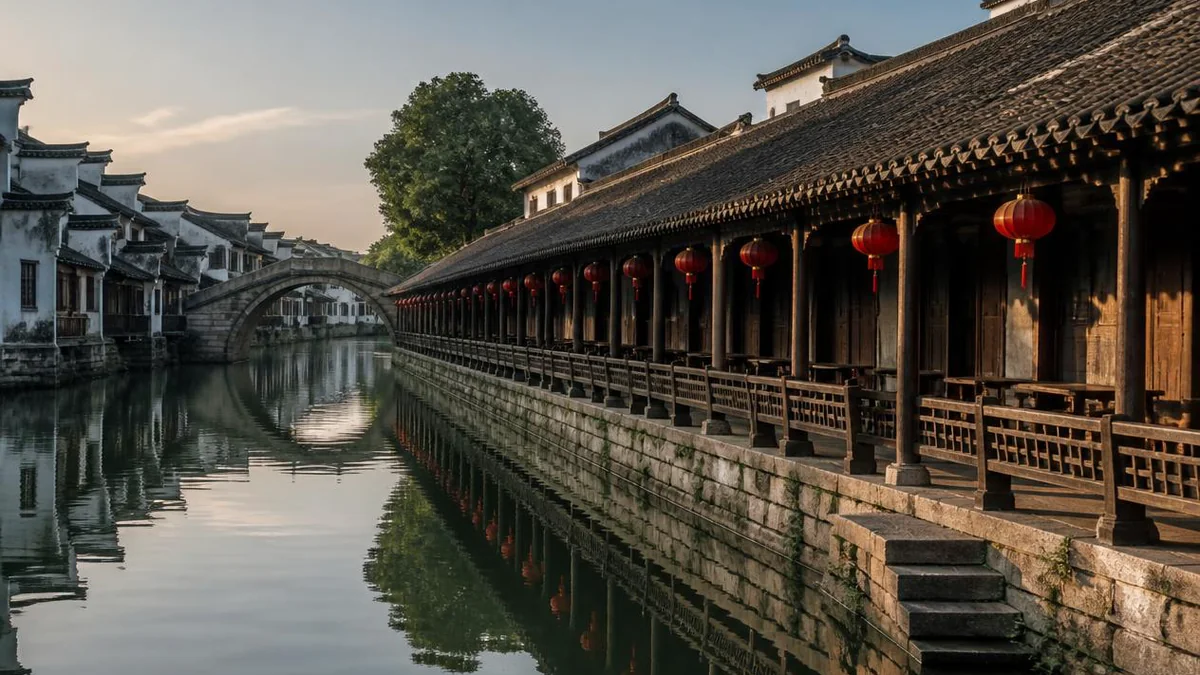
Along the riverfront of the old town runs a continuous covered walkway: timber posts on the water side, shopfronts on the other, black tiles pitched in a single slope so the rain falls straight into the channel. The Chinese word is langpeng, corridor shed; its tourist name is the Misty Rain Arcade, and if you arrive in a drizzle — this is the Yangtze delta, so you often will — you see immediately why somebody thought that worth naming.
What is odd is that nobody knows who built the first one. There is no documentary record of the arcade’s origin. What survives instead are two folk explanations, and both turn on the same pun.
The first: a young widow surnamed Hu kept a shop on the riverbank and was helped, quietly and for years, by a poor tofu seller called Wang the Second. Repairing her premises, she roofed the street in front of it. Her neighbours copied her, the roofs joined up, and the result was named langpeng — because lang, corridor, is also lang, one’s man. A shed built for him.
The second: a tobacconist sheltered a beggar from the rain, and the beggar left a couplet promising good fortune to a charitable house. The shop prospered, the owner built a permanent arcade, and again the neighbours copied.
Neither is history. The practical explanation is duller and almost certainly right: where the river is the road, goods change hands between boat and shopfront, and a covered strip keeps both merchandise and customer dry. But notice that when this town explains itself to itself, it does not reach for a general or an emperor. It reaches for a widow, a tofu seller and a beggar.
What the 5A designation actually covers
Xitang sits in Jiashan county, in the prefecture of Jiaxing, in the far northeast corner of Zhejiang, where the province meets Jiangsu and Shanghai. It is about 90 kilometres east to Shanghai, 110 west to Hangzhou, 85 north to Suzhou — inside the day-trip radius of three of China’s wealthiest cities, which governs how it feels on a Saturday.
It became a national 5A scenic area on 25 February 2017, announced by the then National Tourism Administration, the plaque handed over in Beijing two days later.
The designated area is 3.03 square kilometres, and the split matters: a core protection zone of 1.01 square kilometres — the old town — plus 2.02 square kilometres of surrounding modern town. Many Chinese 5A ratings are containers holding sites an hour apart by road. This one is a single continuous settlement, and the boundary is a ring drawn around a place where people live.
Inside the core: 250,000 square metres of surviving Ming, Qing and Republican-era building, 27 stone bridges, 122 lanes, and the arcade. Eight sites are provincially protected, twenty-two more at county level, and roughly 2,600 households still live there. The slogan is “the living thousand-year-old town”, which is marketing; the laundry strung over the water is not staged.
The corner where Wu met Yue
Xitang’s oldest label is Wu gen Yue jiao — the root of Wu, the corner of Yue.
In the Spring and Autumn period, roughly the eighth to fifth centuries BC, the lower Yangtze was contested between two states: Wu, centred on modern Suzhou, and Yue, on modern Shaoxing. Their rivalry is one of the foundational soap operas of Chinese history, and this flat, waterlogged country was the seam between them — which is not folklore, though nothing specific is documented as happening here in the sixth century BC.
Tradition attaches the waterworks to Wu Zixu (died 484 BC), the exiled nobleman who became Wu’s great strategist and is credited across the delta with more canal-digging than one man could plausibly have supervised. The story goes that he cut a channel down from the hills southwest of the present county town, and that channel and settlement took his name: Xutang, Xu’s embankment. The other old names are prosaic — Pingchuan, the flat plain, and Xietang, the slanting embankment, the name in official documents for centuries.
Local guides use a four-part formula, and it is a good compression: Spring and Autumn water, a Tang and Song town, Ming and Qing buildings, modern people. The water is ancient, the street plan medieval, the fabric four to six hundred years old. The laundry is from this morning.
The dates that are actually documented
Strip out the legend and the record is still precise, because Xitang spent five centuries being administratively fiddled with.
Villages are recorded here in the Kaiyuan era of the Tang (713–741); by the late Yuan the name Xietang covered the place. In 1447 the tax and excise office moved here from Taozhuang — the first hard evidence this was worth taxing. Documents of the Hongzhi reign (1488–1505) call it Xietang market; in the Zhengde reign (1506–1521) the name Xitang town appears for the first time.
Then a rupture. In 1556 Japanese pirate raiders — the wokou, a mixed Sino-Japanese raiding phenomenon that terrorised this coast for a generation — destroyed the market at Xigutan on the west side. The commercial centre shifted permanently east, which is why the busiest surviving street frontages are where they are.
The most interesting administrative fact is one Xitang lost. Jiashan county was created in 1430, carved out of Jiaxing because the district was too populous to govern as one, and Xietang was proposed for the county seat. The seat went to Weitang instead, and Xitang spent five centuries as a market rather than a capital — a large part of why so much survives, since county seats get rebuilt.
The arcade, measured
Everyone agrees the arcade is Xitang’s signature. Nobody agrees how long it is.
- 877 metres in one detailed account, which gives the Chaonandai section as 168 metres
- “over 1,000 metres” in the same account, for the North Gate, South Gate and Chaonandai strips taken together
- “more than 1,300 metres” in the official and promotional standard figure
- “close to 2,000 metres” in a fourth version
The spread is less sloppiness than four different questions answered with one number: continuous run, one named section, total of surviving stretches, or total including reconstruction. The signage says 1,300. The figure you walk is shorter.
The specification is consistent: two to two and a half metres wide, brick and timber, black tile, single-pitch roof draining riverward — the local term is yiluoshui, one fall of water — with backed benches on the river side in places. Chaonandai, the classic stretch, is named for facing south into the sun.
Much of what stands is restored rather than survived. Xitang commissioned its conservation plan from Tongji University in Shanghai in May 1996, under the principle of repairing the old as old; the thousand-metre Chaonandai restoration began that August, alongside dredging and rebuilt embankments. The first tourists arrived on 8 March 1997. Everything you see was chosen, about thirty years ago, by people deciding what a water town should look like.
Stone Skin Lane, and the family at the end of it
Of the 122 lanes, five run over a hundred metres and one is famous.
Shipi Nong, Stone Skin Lane, is a roofless alley wedged between two houses, built in the late Ming or early Qing. It is 68 metres long — 1.1 metres at its widest, 0.8 at its narrowest — with stepped gable walls rising six to ten metres on both sides. At midday you get a strip of sky and nothing else, which is why Xitang calls it its yixiantian, its one-line-of-sky.
The paving is the detail people repeat, and the sources contradict each other. One account has the lane surfaced with 216 slabs three centimetres thick; another puts the 216 on the walls and gives 168 for the ground; a third says 166. The slabs are thin enough that the town’s own explanation of the name is a skin of stone laid over the earth, with the drainage channel running beneath.
The lane exists because of the family on either side. Zhongfu Tang — the Hall of Planting Blessings — is the Wang family mansion, a Qing residence of seven consecutive courtyards running over 100 metres deep with something like seventy rooms, threaded by one internal passage. The name comes from a proverb: plant melons, get melons; plant blessings, get blessings. Local tradition attributes the hall’s plaque to Chen Bangyan, a Hanlin academician of the Kangxi reign — worth holding lightly, as plaque attributions in Jiangnan generally are. Across the lane is Zunwen Tang, whose showpiece is a beam carved with a hundred variant forms of the character for longevity.
Twenty-seven bridges, and the man who shaved his head to build one
Nine watercourses meet in the town and split it into eight blocks — a configuration the old formula calls nine dragons paying court to a pearl. Which means bridges, and Xitang’s are unusually well dated.
Anjing Bridge, Ming, originally the Middle Embankment bridge, is the knot of the old town: from its crown you can see three structurally different bridges at once — an arch, a flat slab and a dog-leg — which is genuinely rare.
Huanxiu Bridge, the Encircling Beauty, was built in 1581 as the town’s first high arch and rebuilt in 1997. Its couplet — boats pass through a ring of green jade, people walk across a rainbow — is lifted from the far older couplet on Hebei’s Zhaozhou bridge.
Wufu Bridge, the Five Blessings, is a single-span slab bridge 14 metres long with a 7.5-metre span, built in the Zhengde reign and repaired in 1901. The blessings are the classical set — long life, wealth, health, virtue, a good death — and tradition holds that crossing collects all five.
Songzi Laifeng, the Bringing Sons and Summoning Phoenixes bridge, was built in 1637; according to the story a bird landed during construction and the builders took the omen. Rebuilt in 1997 — one source says 1998 — it is a 10-metre-wide double corridor with a wall down the middle, so two streams of people cross without meeting.
The best story belongs to Wolong Bridge, the Reclining Dragon: a single-span stepped stone bridge 31.46 metres long, 5 wide, 5.5 high, replacing a wooden one that turned lethal in the rain. As the story is told, a bamboo craftsman surnamed Zhu watched a pregnant woman fall from it and drown, and resolved to fund a stone replacement. Having no money, he took the tonsure and the religious name Guangyuan, spent more than ten years begging, and raised over 3,000 taels of silver; the bridge was completed in 1716. The tale has the shape of a hagiography and should be read as one. The bridge and its date are not in doubt.
Two temples, neither of them quite Buddhist
Xitang’s principal deity is a civil servant who committed a capital crime.
The Huguo Suiliang Wang Temple — the Temple of the Grain-Escorting King Who Protects the State, universally the Seven Lord’s temple — commemorates a man remembered only as Jin, seventh of his siblings, an official escorting imperial grain along the Grand Canal in the Chongzhen reign, the last of the Ming. As the story goes, he passed through Xitang during a famine, gave away the entire cargo, and then — knowing that diverting imperial grain was a crime for which the town would answer — drowned himself in the channel at Yantawan. The court is said to have found in his favour and ennobled him posthumously with the title the temple carries.
Whatever the historical basis, the cult is real and narrow: the Seven Lord is worshipped in essentially two towns of Jiashan county and nowhere else. His temple faces south over the Yangxiujing channel, covers about 2,250 square metres in three halls, and was moved here from a site west of town in the early Qing. In front of his statue hang leaf-shaped incense sachets, called autumn leaves, sewn by local women.
The festival runs on and around the third day of the fourth lunar month, his birthday. The images of the Seven Lord and his wife leave the temple at eleven at night, process on a fixed route, and return the following afternoon, after which there are three days of opera. It goes out by water and by land at once: a boat convoy carrying the images, preceded by five flags in five colours standing for five-coloured clouds, and a land procession of dragon and lion dancing. It entered Jiaxing’s municipal intangible heritage list in June 2009 and Zhejiang’s provincial list in June 2012.
The second temple is stranger. Shengtang, the Sacred Hall, was founded in 1575 as a shrine to Pang Shangpeng, a serving imperial censor. In 1674 it was rebuilt and the image of Guan Yu — the third-century general deified as the god of war, loyalty and eventually commerce — installed in place of the censor’s. In 1711 it was renamed Jingjue Nunnery, a name nobody used — some sources put that renaming in 1668. The popular name is explained two ways: that Xitang honoured Confucius as the civil sage and Guan Yu as the martial one, or that the Qianlong emperor once visited, making it the hall the sage came to. Today four courtyards hold the civil and martial gods of wealth, Guanyin, and the gods of literature and of the three offices — Daoist, Buddhist and folk deities under one roof without anyone finding it awkward.
A garden, a photograph, and a rebuild
Xiyuan, the West Garden, is Xitang’s largest private garden and the site of a small but real episode in modern literary history.
In the winter of 1920 — one report dates it to 3 December — the poet Liu Yazi came here with Chen Qubing and spent an afternoon in this garden with local writers. They had a group photograph taken and titled it the Second Painting of the Elegant Gathering in the West Garden, in conscious imitation of the Northern Song painting of Su Shi, Mi Fu and Huang Tingjian at a garden party — the standard Chinese image of writers in company.
Liu and Chen were two of the founders of the Southern Society, a revolutionary literary association established on 13 November 1909 at a shrine on Tiger Hill in Suzhou, seventeen people present. It grew past a thousand members and served as the literary wing of the movement that overthrew the Qing two years later. Eighteen of its members were from Xitang, and this garden is where they met.
The honest caveat: the garden you walk into is a 1993 reconstruction, named Xiyuan in Liu Yazi’s memory, with a Southern Society exhibition room inside. What is old here is the story, not the stonework.
Two minutes’ walk away is a house that earns its place for the opposite reason: it is entirely ordinary. Ni Tianzeng (1937–1992), a deputy mayor of Shanghai remembered in China as an unusually incorruptible one, had his ancestral home here — a late Qing or early Republican house of 627.1 square metres, three courtyards surviving, opened as a memorial exhibition in April 1999 and now one of Zhejiang’s designated clean-government education sites. Foreign visitors walk through it in four minutes without registering what it is: a civic morality tale told in domestic architecture, in a town that specialises in domestic architecture.
Sixty billion buttons
The most unexpected building on the ticket is the China Button Museum, and it is not here on a whim.
The museum occupies the Xue house, built in 1926 — some sources say 1927 — a compact street-front, river-back shop-house of about 350 square metres. Six galleries cover ancient to contemporary buttons, the shell-button production process, buttons in use, and Chinese knotwork. The collection runs to something over a thousand types in more than thirty materials — jade, pearl, agate, shell, horn, bone, bamboo, leather, porcelain, enamel, plastic, glass. A craftsman cuts shell buttons on the ground floor and knots silk frog-fastenings upstairs. In the upper hall sits a Thai rosewood button 1.8 metres across and 420.2 kilograms, exactly as silly as it sounds.
The industry behind it is not silly. Dashun village, in Xitang township, built its first commune-run button factory in 1968, its first township enterprise in 1979, and was named China’s button capital in 1997. By 2010 buttons accounted for six billion yuan of output, 42.3 per cent of the township’s industrial production, and reported township figures run to more than 1,300 button firms producing some sixty billion buttons a year — around half of China’s demand.
So the picturesque core is ringed by an industrial cluster making an object almost nobody thinks about, at a scale almost nobody imagines. The museum is the one place in the scenic area where the town’s actual economy is on display.
Field songs, and the girl called Fifth
Jiashan’s other export is a musical form.
Jiashan tiange, the field songs, are the work songs of this rice country, sung in the paddies. Their lineage is traceable: the Ming writer Feng Menglong (1574–1646), who collected popular song as seriously as anyone in the imperial period, recorded the Wu-region songs from which they directly descend. They come in seven named tune types, three sung solo and four in group forms with lead, response and unison passages. Zhejiang listed them in May 2005, and they entered the second national batch of intangible cultural heritage in June 2008. The preservation problem is stated bluntly in Chinese sources: around fifty singers remain, most of them old.
The most famous piece is a narrative ballad, Wu Guniang, Fifth Daughter, organised around the twelve flowers of the twelve months. The story is said to be a real one from the Xianfeng reign: a landlord’s fifth daughter and a hired labourer named Xu Atian fell in love, her half-brother destroyed it, and it ended badly. It was sung in the fields for a century before anyone wrote it down, then adapted as a field-song play in 1953, as a Yue opera by the playwright Gu Xidong in 1954, and as a full musical in 2004 that won a Wenhua Award, China’s national theatre prize.
At the west entrance is a 3,000-square-metre Wu Guniang park with a statue, a water stage, and a pavilion roofed with a single tile — because in the story Xu Atian worked in a kiln and fired one tile to prove his love was one of a kind. It is modern and openly sentimental, and it is also the only monument in this region to a nineteenth-century farm labourer.
Tom Cruise, and ten thousand people in Ming dress
Two events shaped how Xitang is photographed.
In November 2005 the production of Mission: Impossible III took the town over. Crew were on site from the 22nd; filming ran on the 24th, 25th and 26th with the scenic area closed to visitors entirely, and a restaurant on Tangdong Street had been rented a month ahead to rebuild as a set. The sequence — a wire stunt, an explosion, and a long run over the roofs and across the bridges from Anjing to Yongning — put Xitang’s rooftops into a film that premiered at Tribeca on 26 April 2006. Locals still point out the run.
The second is home-grown. The Xitang Hanfu Culture Week began in 2013, initiated by the Taiwanese lyricist Vincent Fang — Fang Wenshan, who wrote most of Jay Chou’s hits — who came in person and later worked with Chou on a theme song for it. Hanfu is the revival movement around pre-Qing Han Chinese dress; it was then a small internet subculture, and Xitang gave it its first large-scale offline event and became its permanent host. The first edition drew under ten thousand people across a dozen activities; recent editions run more than forty activities and over a hundred thousand participants, usually from late October into early November.
If you have seen a photograph of Chinese visitors in flowing sleeves on a stone bridge in the last decade, there is a fair chance it was taken here in that week.
Eating
Jiashan’s cooking is delta cooking — freshwater, sweet-leaning, pork-heavy — and Xitang’s street food is cheap and specific.
The signature dish is lotus-leaf steamed pork: belly pork rolled in spiced toasted rice flour with bean-curd skin, wrapped in a fresh lotus leaf and steamed, so the leaf perfumes the fat.
The odd one is bazhen gao, the eight-treasure cake, a medicine as much as a snack: hawthorn, malt, lentil, coix seed, foxnut, yam, poria and lotus seed in rice flour, greyish-brown and mildly sweet, formulated for weak digestion. The Xitang version is credited to a local doctor of Chinese medicine, Zhong Daosheng, who in 1920 adapted a prescription from a Ming surgical manual.
Then foxnut cake from rival shops on Tangdong Street, and maiya tabing, a soft glutinous rice cake flavoured with cudweed.
To drink: Jiashan yellow wine, brewed here rather than in more famous Shaoxing, with water from Fenhu — the lake that was itself the Wu-Yue boundary. Semi-sweet, drunk warmed with ginger and sugar in winter, it dominates the Shanghai market. Crab from the same lake arrives in autumn.
Visiting
Xitang is small: a square kilometre of core, walkable in a morning, best planned around light and crowds rather than a list of sights.
The two good hours are early morning, before the coaches, when residents are washing vegetables at the water steps, and the hour after dark, when the lanterns come on along the arcade. Between them the town belongs to tour groups from Shanghai. The half-open format means the streets cannot be closed, and since 2023 the town has generally been free to enter outside ticketing hours — reported as before eight and after five, major public holidays excepted. The gate price has come down over the years, quoted at 95 yuan against an earlier 120, and the policy is revised annually, so check on the day rather than trusting any article, including this one.
Boats run from the Laifeng and Wolong jetties. A ticket buys the interiors; no ticket still buys the arcade, the bridges, the lanes and the food, which is most of what people come for.
And the thing to hold in mind while walking it: this is a town passed over for a county seat in 1430, sacked by pirates in 1556, rebuilt eastward, left as a market rather than a capital for five centuries, replanned in 1996, opened to its first paying visitor in March 1997 — and now carrying both a heritage economy and a button industry making sixty billion units a year. The arcade over the river is the oldest form of the same instinct: somebody worked out that with a roof between the boat and the shop, everybody stays dry and everybody keeps trading.
The LoreLens app can identify the bridges, hall names and carved details along Xitang’s arcade, and explain who the Seven Lord was and why his temple is here, in your own language, offline.
Location profile
Where it is

Frequently asked questions
What is inside the Xitang 5A area, and does one ticket cover it?
The designated area is 3.03 square kilometres: a core protection zone of 1.01 square kilometres — the old town of the photographs — plus 2.02 square kilometres of surrounding town. Unlike many Chinese 5A ratings this is not a set of sites an hour apart by road but one continuous settlement. The single ticket adds about eleven small interiors, among them Xiyuan garden, the Wang family hall, the button museum, the Seven Lord's temple, Shengtang and the Ni house. A few listed sights, such as the Wu Guniang park, sit off the walking circuit.
Do I have to buy a ticket at all?
Not always, and it is the most useful thing to know before going. Xitang is a half-open scenic area with roughly 2,600 households living inside it, so the streets cannot be sealed. Since a policy shift beginning in 2023 the town has generally been free to enter outside ticketing hours — reported as before 08:00 and after 17:00 — with major public holidays excepted, when ticketing runs late. The arrangement is revised roughly annually, and free entry buys the streets, arcade and bridges but not the ticketed interiors.
Is the story of the Seven Lord true?
It is a local legend, consistently told but without contemporary documentation. As passed down, a grain-transport official surnamed Jin, seventh of his siblings, gave away an imperial grain cargo during a late-Ming famine and then drowned himself so the town would not be punished for it. What is verifiable is the cult rather than the man: a temple of about 2,250 square metres, a deity worshipped in only two towns of Jiashan county, and a festival listed as municipal intangible heritage in June 2009 and provincial heritage in June 2012.
When should I go, and how long does it need?
The core is walkable in a morning and rewards a second day only if you want it empty. Early morning and the hour after dusk are when it stops being a queue, and weekdays are far quieter than weekends, since the town absorbs Shanghai's day-trippers from 90 kilometres away. Drizzle is not a problem and is arguably the point — the arcade exists so the riverfront can be walked in rain. Hanfu Culture Week, usually late October into early November, is the most photogenic week of the year and the worst one for quiet.
How is Xitang different from Wuzhen and Nanxun?
All three are Ming and Qing canal towns within an hour or two of each other. Wuzhen is the most thoroughly curated, run as a single controlled product, with the west section's residents relocated. Nanxun is the wealthiest-looking, built on nineteenth-century silk money and Western-influenced merchant mansions. Xitang is the messiest and most lived-in: roughly 2,600 resident households, a working button industry in the villages around it, and a covered riverside arcade neither of the others has at this scale.