Zhejiang · Jiaxing
South Lake: A Replica Boat, and Six Dates for One Afternoon
The most-visited object in Jiaxing is a wooden pleasure boat built in 1959, reconstructed from one woman's memory of a boat she hired for a single day in 1921. Nobody pretends otherwise. What cannot be settled is which day it was: the candidates run from 31 July to 5 August, and five years of research narrowed them only to two.
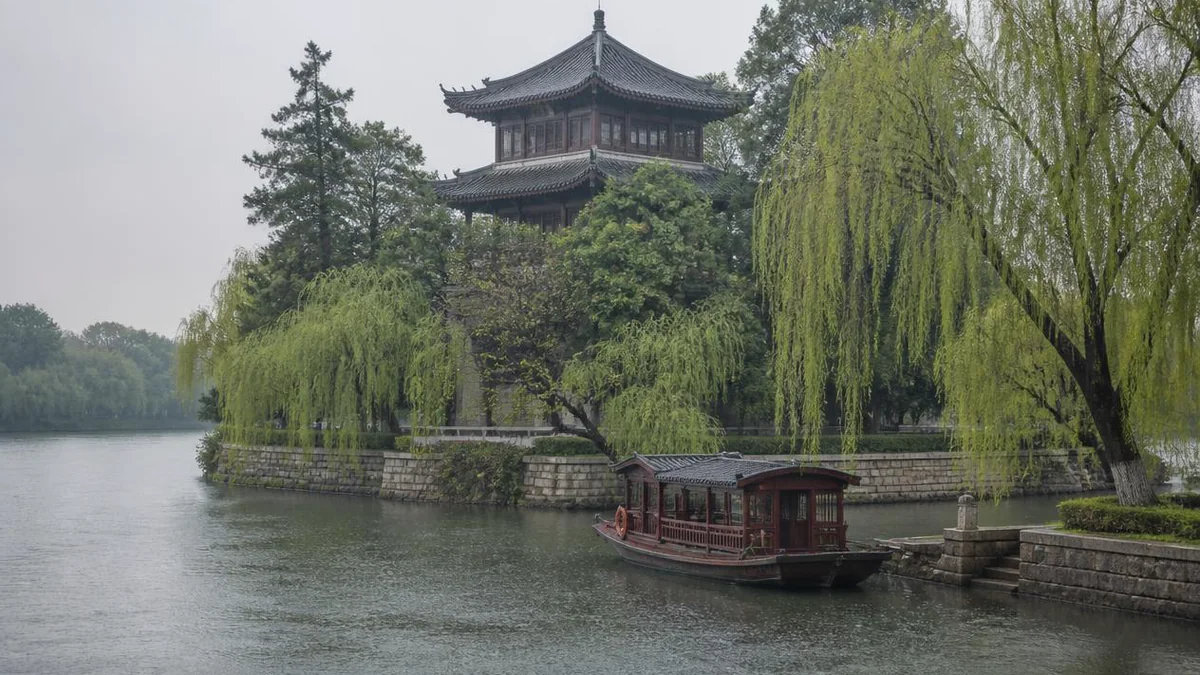
5A View location, maps and nearby scenic areasAsk a Chinese school group what they have come to Jiaxing to see and they will point at a boat: sixteen metres of wood moored off a small island in the middle of a lake, an awning over the bow, a tea set on the table amidships, a skiff tied astern. It was built in 1959.
That is not a debunking. It is on the label. The boat that matters to modern Chinese history was an ordinary hired pleasure craft that spent one afternoon in the summer of 1921 with eleven men in its middle cabin, then went back to work and was never identified again. What floats here is a reconstruction, made four decades later from the memory of the woman who arranged the hire.
The lake had already been a destination for a thousand years before any of that happened.
The lake, and its other name
South Lake — Nanhu — is named for the simplest reason available: it lies south of the old city of Jiaxing, in the flat canal country between Shanghai and Hangzhou. It is grouped with Hangzhou’s West Lake and Nanjing’s Xuanwu Lake as one of the three famous lakes of Jiangnan, a claim about reputation rather than size: this is a shallow sheet of a few square kilometres.
Its better name is Mandarin Duck Lake — Yuanyang Hu. A causeway once split the water into eastern and western halves, held to sit together like the mandarin ducks that nested here, the standard Chinese emblem of a devoted couple. The Southern Song compendium Fangyu Shenglan already records the alternative name.
The lake’s literary standing rests substantially on one man. Zhu Yizun (1629–1709), a Jiaxing native and major early-Qing scholar-poet, spent the winter of 1674 stranded on the canal outside what is now Beijing and wrote a hundred homesick quatrains about his home lake, thick with bridges, temples and dialect words. His cousin Tan Jicong (1624–1680) answered with matching poems, and others followed in each generation for three centuries, down to living Jiaxing writers — making this one of the more heavily versified small bodies of water in China, almost none of it known outside Zhejiang.
A tower rebuilt on an island made of mud
The building on the island is the Yanyu Lou, the Tower of Misty Rain, and it is the lake’s emblem.
Ming and Qing gazetteers trace it to around 940, when Qian Yuanliao — a prince of Wuyue, one of the small states that held the southeast between the Tang and the Song — built a viewing platform on the shore. The name is generally taken from a line by the Tang poet Du Mu (803–852) about the temples of the Southern Dynasties standing in the misty rain; the three characters are first securely attested later, in a Southern Song lyric by Wu Qian.
None of that survives, and the tower was not on an island to begin with. That part is Ming, and it is a by-product of drainage.
In 1548 the prefect of Jiaxing, Zhao Ying, conscripted labour to dredge the city moat. Rather than cart the spoil away, he had it dumped in the lake until it made ground. The island — about seventeen mu, call it a hectare — is silt out of a ditch. The following year the tower was rebuilt on top of it; sources split between 1548 and 1549, which is the gap between making the island and putting the building on it.
What happened to the tower is a compressed history of the region:
- 1646 — destroyed in the fighting after the Manchu conquest
- 1681 — rebuilt under the Kangxi emperor
- 1730 — restored by the governor-general Li Wei
- 1860 — destroyed again in the Taiping civil war
- 1918 — rebuilt, and this is what you climb today
So the standing tower is a hundred-odd years old, on a five-hundred-year-old artificial island, carrying a thousand-year-old name. The main hall runs to about 640 square metres and stands roughly twenty metres, and the plaque over the front eaves was written by Dong Biwu, for reasons that will become clear.
Qianlong’s eight ascents, and the copy in Chengde
The Qianlong emperor (reigned 1735–1796) made six imperial tours of the south, climbed this tower on eight occasions, and left more than twenty poems about it; two stele pavilions on the island house his inscriptions. Imperial attention also turned the building, which had faced north towards the city walls, to face south for the visits.
The larger consequence is 1,200 kilometres north. In 1780 Qianlong had a Yanyu Lou built on Green Lotus Island in the imperial summer retreat at Chengde, in Hebei — the walled park where the Qing court spent its summers and received Mongol and Tibetan envoys. It covers about 2,272 square metres and is not a measured copy: the stated intention was to take the idea rather than the dimensions, and the couplet on its ground-floor pillars names the source.
What went wrong in Shanghai
In July 1921 the Chinese Communist Party did not yet formally exist. There were small Marxist study circles in a handful of cities with, by the standard count, somewhat over fifty members between them, and thirteen delegates came to Shanghai to constitute them as a party. Two foreigners attended for the Communist International in Moscow: Maring — the Dutch organiser Hendricus Sneevliet — and a man known as Nikolsky.
They met from 23 July in a house in the French Concession — one of the enclaves administered by foreign powers with their own police, where Chinese government writ did not run, which is precisely why illegal political meetings were held in them.
On the evening of 30 July a stranger walked into the meeting room, apologised for the wrong address and left. The delegates read it correctly, broke up within minutes and scattered, leaving two men to improvise; concession police searched the house shortly after and found nothing. But the address was burned, and the congress still had a programme and a set of resolutions to adopt. They needed somewhere else, quickly, outside Shanghai.
The woman who picked the lake
The person who solved it was not a delegate.
Wang Huiwu was from Wuzhen in Tongxiang, inside Jiaxing prefecture — the canal town now visited as Wuzhen — and she was married to Li Da, one of the Shanghai delegates and an organiser of the congress. She was working as staff.
Venues were proposed and shot down. Hangzhou’s West Lake was too busy with sightseers, where a party of strange men would be noticed; her own home town of Wuzhen failed for the opposite reason, too few people for strangers to disappear into.
Her counter-proposal was Jiaxing, and her reasons were practical. She had been at school there. South Lake was close to the railway station, boats could be hired by the hour, and it was scenic enough that men on a boat read as tourists but not so famous that it drew West Lake’s crowds — and it was half Hangzhou’s rail distance from Shanghai.
At the Yuanhu Hotel on Zhangjia Lane — then the best hotel in Jiaxing, named for the lake’s mandarin-duck alias — she took two rooms in case the meeting ran overnight, and had the hotel’s accountant hire a boat: a mid-sized silk-net boat, the covered pleasure craft the region built at Wuxi, with a corridor down one side linking bow, middle, bedroom and stern cabins. She met the delegates at the station, brought them back to wash and eat, and on the way out asked the accountant for one more thing.
Two sets of mahjong tiles.
They went on the table in the front cabin. If anyone came alongside, what was visible was a gambling party. Wang Huiwu sat on the bow through the meeting, watching the water.
Six possible dates, and a five-year investigation
Here is what most accounts smooth over. Nobody knows what day this happened.
The delegates were operating illegally and kept no minutes; their recollections were collected decades later and do not agree. The first volume of the official History of the Chinese Communist Party, in its 2011 edition, declines to give a date: it says only that the delegates moved in batches to South Lake and held the final session on a boat, and appends a note listing 30 July, 31 July, 1 August, 2 August and 5 August as views current among historians. That note is not even complete — other researchers have argued for 3 August and 4 August.
The main candidates and their evidence:
- 31 July rests on the recollections of Dong Biwu, Liu Renjing, Bao Huiseng and Zhou Fohai. It has largely been abandoned.
- 1 August rests on Dong Biwu’s 1929 letter saying they finished the congress on a boat after skipping a day, and on Zhang Guotao’s account of adjourning and sending word to take the morning train. Shanghai ended on 30 July; skip a day and you get 1 August.
- 2 August rests on Wang Huiwu, who was not a delegate but made every arrangement personally.
- 5 August rests on a Comintern document — a letter from Smurgis, a Red International of Labour Unions representative at Chita, published in 1972 — saying the congress ran from 23 July to 5 August. The counter-argument is that Smurgis worked at second hand.
In February 2013 the Jiaxing municipal Party committee commissioned a dedicated study. The team worked five years and published in 2018, for 3 August.
Their method is the interesting part, because it is almost entirely circumstantial and almost entirely checkable. They argued that no decision taken in the scramble of 30 July could have reached all the delegates that night, and established that Chen Gongbo was still in Shanghai on 31 July, taking his leave before the evening express to Hangzhou.
Then the weather. On the afternoon of 1 August a violent squall hit South Lake between about five and six o’clock; the Shenbao newspaper reported on 3 August that pleasure boats had capsized and three people drowned. The Japanese historian Ishikawa Yoshihiro, in his study of the Party’s founding, notes that the storm report was first introduced into the debate by Fujita Masanori. Every delegate who described the day on the lake described calm water and pleasant scenery; nobody mentions a storm. So not 1 August — and, with Jiaxing station under emergency repair into 2 August, probably not then either. The further argument against 2 August is procedural: silk-net boats had to be booked a day ahead, so Wang Huiwu would have had to arrive on 1 August and walked straight into the squall. She never mentioned one.
That leaves 3 August, on a schedule reconstructed from the Shanghai–Hangzhou timetable: Wang Huiwu travelling on 2 August to take the rooms and hire the boat, the rest catching the 7.35am express on 3 August, arriving at 10.13, finishing around six in the evening.
It is an impressive piece of work and it did not close the question. The Party historian Xiao Sheng has pointed out that he interviewed Wang Huiwu twice in Beijing in 1983 and she would not move off 2 August. Four candidates are out; two remain; there is no direct documentary proof. The official history declines to pick, and so will this article.
Eleven men in the middle cabin
Not everyone came. Maring and Nikolsky stayed behind — two Europeans on a Jiaxing pleasure boat would have defeated the purpose — and Li Hanjun and Chen Gongbo, the two left to face the police search, also did not travel. That leaves eleven of the thirteen delegates on the water, plus Wang Huiwu on the bow.
Among them were Mao Zedong, then twenty-seven, representing Changsha; Dong Biwu for Wuhan, later one of the state’s most senior legal officials and briefly acting head of state; Chen Tanqiu; Wang Jinmei and Deng Enming from Jinan; He Shuheng; Zhang Guotao and Liu Renjing from Beijing; Li Da; Zhou Fohai; and Bao Huiseng.
The session adopted the Party’s first programme and first resolution and settled its leadership: by the standard account it elected a three-man central bureau — Chen Duxiu as secretary, Li Da for propaganda, Zhang Guotao for organisation. Chen Duxiu was not present; nor was Li Dazhao, the other man conventionally named as a founder. Even this is contested, some scholars arguing that what the congress chose was a provisional executive committee and that the bureau proper was formed later in Shanghai.
What is not in doubt is that a party of fifty-odd members constituted itself that afternoon on a rented boat, on a lake chosen because it was pretty but not too pretty, and that within twenty-eight years it governed the country.
The reconstruction has a paper trail
By the late 1950s Jiaxing wanted a memorial, and the memorial had a problem: there was no boat. Nobody had recorded its name, owner or registration; it had gone back to ordinary work in 1921 and vanished into the general population of Jiangnan pleasure craft. So they rebuilt it from testimony. The organising group canvassed old boat owners, fishermen and lake-goers, built a model and took it to Beijing.
Dong Biwu — who had been on the original — gave the most useful verdict in the exercise. The style, he said, was right, but it was too big, too new and too pretty. The instruction that came back was to make new work look old: this had been a perfectly ordinary hire boat, with a small boat trailing behind it.
Wang Huiwu was consulted in turn. Shown a model based on a double-corridor boat, she corrected it: the one she hired was a single-corridor silk-net boat, and she described the cabins in detail.
The build then involved Wuxi, where these boats came from. In March 1959 a delegation took the model there and went through the type with a local yard, at one point finding a silk-net boat converted into a cargo carrier and still working the wharf. Three craftsmen from what became the Wuxi Red Flag Shipyard — Xu Bugao, Wen Heshang and Wen Bingkui — came to Jiaxing to help. Fir came from Guangxi; carvers from Jiangsu.
Work started on 13 July 1959 and finished on 25 August. The result is sixteen metres by three, divided into bow, front cabin, middle cabin, bedroom cabin and stern, with a bed, stove and cupboard aft and a towed skiff astern. On 1 October 1959 it went into the water off the island, and the memorial museum opened that day inside the Yanyu Lou.
A dissenting Wuxi account says the boat was modelled on a specific commercial barge, the Pingxiang, on its operator’s advice. It does not change the substance: what floats at South Lake is a documented, twice-corrected reconstruction of a type, not a survival.
Eight coats of tung oil
A wooden boat kept permanently afloat in fresh water for sixty-seven years is not a preservation problem anyone would choose. The regime that has kept this one going is one light refit a year — essentially re-oiling, against rot and worm — and a major overhaul every two. A major overhaul means hauling the hull to a yard: of the boat’s thousand-odd components, upwards of five hundred and twenty come off to be worked on, from bottom planking to the bench by the stove, under a restore-as-found rule. The 2018 overhaul took forty-nine days. The oiling alone takes over fifty, because it is eight coats and each has to dry in the sun before the next.
Which raises the obvious question: after decades of replacing warped and split boards one at a time, how much of the 1959 boat is the 1959 boat? Nobody publishes a figure. The honest description is a continuously repaired reconstruction of a 1921 hire boat.
The only delegate who came back
Of the thirteen delegates, exactly one ever returned to South Lake.
On the morning of 5 April 1964 — Qingming, the tomb-sweeping festival, and raining — Dong Biwu, then seventy-eight, came to inspect the site. He climbed the Yanyu Lou, looked at the exhibition, then went aboard the memorial boat and delivered the verdict the museum had been waiting five years for: this boat, as he recalled it, had been built right.
That afternoon he wrote out a four-line poem in running script on a sheet of xuan paper, 120 by 65.5 centimetres, signed and dated. It opens with the revolution’s voice carried in a painted boat and closes with him returning at Qingming to look for old traces in the misty rain — the phrase that is also the tower’s name. Versions differ on one character in the last line. The original is held by the museum as a first-grade national treasure; in June 1985 the poem was cut into a stele 180 centimetres high, with a pavilion built for it east of the boat.
Three museums in fifty years
The memorial has moved twice and grown by roughly a factor of ten each time. The first, from 1 October 1959, was the Yanyu Lou itself: display cases in a 1918 garden tower on a Ming landfill island.
The second opened on 20 June 1991 on the east shore, paid for by public subscription: 3,800 square metres of ground, 1,980 of building, shaped in plan as the Party’s hammer-and-sickle emblem.
The third is on the south shore at Qiyi Square, and it is the one you visit. Approved in October 2005, ground broken in March 2007 at a ceremony conducted by the then provincial Party secretary, Xi Jinping, it opened for the Party’s ninetieth anniversary on 1 July 2011: 2.73 hectares of site, 19,633 square metres of floor area, 7,794 of it exhibition space. Fifty-six eave columns run around it, for China’s fifty-six officially recognised ethnic groups.
Descriptions of its shape do not agree, and both circulate in official sources: some say the plan is an I-shape formed by one main and two subsidiary blocks; others that from above it reads as the hammer-and-sickle emblem, at a height of nineteen metres (a figure that comes from encyclopaedia entries rather than the museum). They may be the same building seen from different angles, but they are not the same claim.
The rest of the 5A
The designation was awarded in 2011 and covers considerably more than the island.
Haogu Pagoda, on the west side, is a modern rebuild in Song style of one of old Jiaxing’s pagodas, named for the moat that curved past it: 63.36 metres in seven storeys, with a gilt-bronze finial, and the only pagoda in the city you can climb — 179 wooden steps to a view over the whole lake. Beside it stands the Shrine of Minister Wu, for Wu Zixu.
Lanxiu Garden, west of the lake, is 11,300 square metres organised as a park of inscribed stone: a 270-metre covered gallery carrying ninety-five carved stelae, with work associated with Wen Zhengming, Zhao Zhiqian, Wu Changshuo and Ren Bonian, including a stone-cut Guanyin after the Tang painter Wu Daozi and a Dong Qichang inscription of over 1,100 characters.
The lake’s second island, Little Yingzhou in the northeast corner, is a Kangxi-era spoil heap of about eight mu that fishermen used for drying nets. In the late Qing a society devoted to the reverent disposal of written paper built a shrine on it to Cang Jie, the legendary inventor of Chinese writing, traditionally shown with four eyes; rebuilt in 1924, it appears to be the only shrine of its kind in the country.
Two kilometres away, on a branch of the Grand Canal, the Yuehe quarter covers some 90,000 square metres of old waterfront: three parallel waterways and three streets, guild halls, a pawnshop, a soy sauce works and a zongzi museum.
Wu Zixu, zongzi, and a water caltrop with no horns
Most of China observes Duanwu, the fifth day of the fifth lunar month, in memory of the poet Qu Yuan. Jiaxing does not. Here the festival attaches to Wu Zixu, the exiled strategist who served the state of Wu and was, tradition holds, forced to suicide and thrown into the river; the local saying is that on the fifth of the fifth one welcomes Lord Wu, and Ming gazetteers record the practice continuously from there. Before the dragon boat racing the crews carry the dragon head ashore to be dotted with cinnabar.
Jiaxing’s Duanwu customs went onto the national intangible heritage list in 2011. The food is specific: the five yellows — cucumber, yellow croaker, eel, salted duck egg yolk and realgar wine — and above all zongzi, glutinous rice in bamboo leaf. Jiaxing’s are the pork ones, and Wufangzhai has made the city a national shorthand for the dish.
The lake’s other edible celebrity is the South Lake water caltrop, which has no horns. Ordinary caltrops carry two or four sharp spines; this one is round, green and shaped like a silver ingot, and the local formula is that it grows horns the moment it is planted anywhere else. The earliest written notice is a Qianlong-era Jiaxing miscellany, about 270 years of record; excavation of the Majiabang neolithic site southwest of the city in 1959 produced a carbonised round-cornered caltrop dated between 4090 and 2685 BC.
The legend is that Qianlong cut his mouth on one, said a hornless caltrop would be nicer, and got one. Selective cultivation is a duller explanation and a better one. The variety is now in trouble: sampling has found horns on over forty per cent of plants, and growing has largely moved off the lake.
Visiting
The lake shore is a public park and free, and so is the memorial museum. The one thing that costs money and time is the island, reachable only by the site’s own ferry from the Huijing Garden jetty, every twenty minutes or so. Combined tickets bundle the crossing with the museum, Lanxiu Garden and Haogu Pagoda; confirm prices at the gate rather than from any article, this one included. Half a day covers the essentials; a full day adds the pagoda climb, Lanxiu Garden and Yuehe with lunch.
Go in drizzle if you can arrange it. The tower is named for misty rain, Dong Biwu came back in it, and the lake was shaped by five centuries of taste to be looked at through weather.
And on the island, notice what you are standing on. The tower is 1918. The island is 1548 dredging spoil. The boat is 1959, rebuilt out of an old man’s memory and a woman’s correction, and re-oiled eight coats at a time ever since. The date of the afternoon it commemorates is still argued over by people who have read every surviving railway timetable.
Almost nothing here is original, and all of it is completely real.
The LoreLens app can identify the buildings on the island, the parts of the memorial boat and the inscriptions in Lanxiu Garden at South Lake, and explain who each figure was, in your own language, offline.
Location profile
Where it is

Frequently asked questions
What is actually inside the South Lake 5A area?
Three things that are not adjacent to one another: the lake with its two islands, the Revolutionary Memorial Hall on the south shore at Qiyi Square, and the Yuehe historic quarter two kilometres away on the Grand Canal. Published figures for the total give either 5.7 or 5.86 square kilometres depending on the document. Shore and memorial hall are free; the central island can only be reached by the site's own ferry, for a modest round-trip charge.
Is the Red Boat the boat the delegates actually used in 1921?
No, and the site does not claim it is. The original was an ordinary hired pleasure boat and was never traced. In 1958 and 1959 a model was built from the recollections of Wang Huiwu, who had hired it, checked in Beijing by Dong Biwu, who had been aboard, and reproduced full size with three Wuxi boatwrights. It was launched on 1 October 1959, and has been kept afloat since by one light refit a year and a major overhaul every two; the 2018 overhaul took forty-nine days.
What day did the congress actually close?
Unresolved. Official Party history published in 2011 lists 30 July, 31 July, 1 August, 2 August and 5 August as circulating candidates, and other scholars have argued for 3 and 4 August. A Jiaxing research team spent five years on it and published in 2018 for 3 August, eliminating four alternatives using railway timetables, delegate movements and a squall that hit the lake on 1 August. Two survive: 2 and 3 August. Wang Huiwu herself, interviewed in Beijing in 1983, insisted on 2 August.
When is the best time to go?
The tower on the island is named for misty rain, and a grey drizzling spring day shows the lake at its intended best — this is a landscape designed to be seen through weather, not sunshine. Dragon boat season around Duanwu, in late May or June, is when the town is liveliest and Yuehe is worth a separate half-day. Autumn is water caltrop season. Avoid the first days of July, when the anniversary of the Party's founding brings organised groups by the coachload and the ferry queue becomes the main experience.
Is the story about Qianlong and the hornless water caltrop true?
It is a legend, and worth telling as one. The story goes that the emperor cut his mouth on a caltrop here and remarked that a hornless one would be nicer, after which the crop obligingly lost its horns. The earliest documentary mention of the hornless caltrop is in the Qianlong-era miscellany Guhe Zaji, about 270 years of traceable history. The likelier explanation is generations of selective cultivation in one particular water and soil. The variety is now degenerating, with sampling finding horns on more than 40 per cent of plants, and growing has largely moved off the lake.