Zhejiang · Shaoxing
Lu Xun's Shaoxing and Shen Garden: One Ticket, Two Men, Eight Centuries Apart
A single 5A designation covers a writer's back garden and a poet's wall. They are twenty minutes apart and have nothing to do with each other — except that both are places where somebody wrote down, very precisely, a thing they could not fix.
5A View location, maps and nearby scenic areasIn 1131 the Song court was a government in flight. The north was gone, two emperors were prisoners in Jin hands, and the new emperor Gaozong was moving between towns in the Yangtze delta trying not to be captured. While sheltering in the prefecture then called Yuezhou he changed his reign title to two characters meaning roughly continue the ascendancy — Shaoxing — and then renamed the prefecture after the reign title.
So the city is named after a slogan: a piece of dynastic wishful thinking issued by an administration that had just lost half its territory.
That matters here, because both men this 5A designation is built around wrote down, with unusual precision, something they could not fix. One was a Southern Song poet who spent sixty years writing about a marriage that ended around 1147. The other was born in this city in 1881, spent his career describing a society he thought was eating its own people, and is by a wide margin the most consequential prose writer modern China has produced.
They are on one ticket, twenty minutes apart. There is no other connection, and this article is not going to invent one.
A reign title that turned into a city
Before it was Shaoxing, this was Kuaiji, and before that it was the capital of the state of Yue.
That is about two and a half thousand years of continuous consequence, which in Chinese terms puts it in a small category. King Goujian of Yue, who reigned in the fifth century BC and gives the language one of its most-used idioms — sleeping on brushwood and tasting gall, meaning to nurse a humiliation until you can avenge it — ruled from here. Wang Xizhi wrote his Preface to the Orchid Pavilion Gathering, the single most revered piece of calligraphy in Chinese history, in the hills southwest of the modern city in 353. Lu You was born here in 1125. Qiu Jin was executed here in 1907. Zhou Enlai’s ancestral home is here, and so is Cai Yuanpei’s.
Shaoxing calls itself a hometown of famous scholars, which is the sort of thing every Chinese city with a good gazetteer says, and which here happens to be defensible.
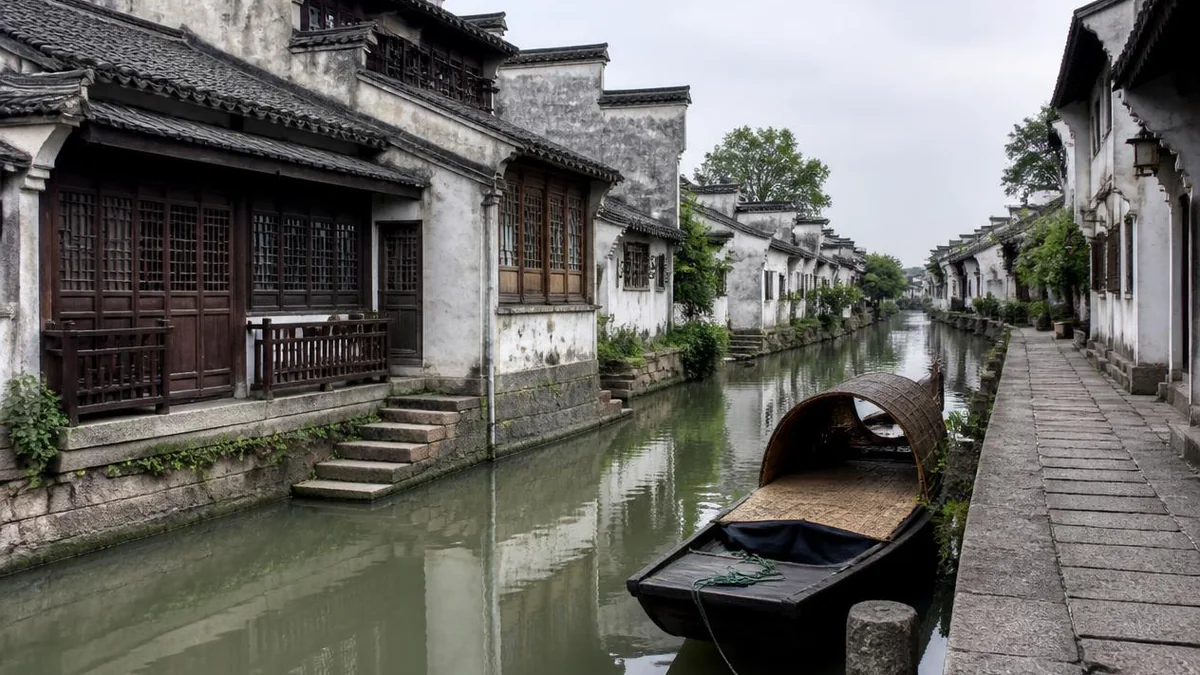
The physical city is water: a plain south of Hangzhou Bay, laced with canals, crossed by an extraordinary density of stone bridges, and fed by an artificial lake — Jian Lake, built under the Han — whose water is the reason the local rice wine is the local rice wine.
Zhou Shuren, and why Orwell is the useful comparison
The man the block is about was born Zhou Zhangshou on 25 September 1881, in a house on this street, and later took the name Zhou Shuren. Lu Xun was a pen name, used for the first time in 1918 on a story called A Madman’s Diary — the first modern short story written in vernacular Chinese rather than the classical literary language, and conventionally the starting gun of modern Chinese literature. Lu was his mother’s maiden surname.
For a reader with no Chinese background the most useful comparison is George Orwell — not because the lives match, but because the function does. Both are read as prose stylists and moral instruments at once. Both wrote short, quotable sentences that got detached from their contexts and turned into common property. Both are claimed by political tendencies they would have disliked, and both are taught to schoolchildren in a way that steadily sands the edges off them.
Lu Xun’s central charge, made most famously in A Madman’s Diary, is that a narrator reading old histories finds between the lines of every page, written over and over, two characters: eat people. He wrote about a peasant labourer who converts every humiliation into an imaginary victory (The True Story of Ah Q, serialised 1921–22), a widow destroyed by the moral machinery meant to protect her (The New Year’s Sacrifice, 1924), and a failed scholar drinking away the last of his dignity in a tavern in this town (Kong Yiji, 1919).
Then he stopped writing fiction almost entirely and spent his last decade on short polemical essays, thousands of them. He died in Shanghai on 19 October 1936, of tuberculosis, aged fifty-five. He is buried in a Shanghai park that now carries his name.
He left Shaoxing for school in 1898, at seventeen. Almost everything the Native Place block shows you happened before that date.
The garden whose name Lu Xun himself hedged
Behind the house where he was born there is a walled patch of ground with a well, a low mud wall, some trees and a vegetable bed. Its name is the Hundred-Plant Garden.
It is famous entirely because of one essay. From Hundred-Plant Garden to Three-Flavour Study, written in 1926 and collected in Dawn Blossoms Plucked at Dusk, opens with a sentence worth quoting because of one word in it: behind our house there was a large garden, said by tradition to be called the Hundred-Plant Garden. Even the name gets a hedge. He is writing about his own childhood back yard and he still will not vouch for what it was called.
What follows is a paragraph most Chinese adults can partly recite, and it is a list. Green vegetable beds, a smooth stone well-curb, a tall honey locust, purple mulberries. Cicadas in the leaves, fat wasps crouching on rape flowers, a skylark shooting out of the grass. At the foot of the mud wall, crickets playing their fiddles and ground beetles that puff a jet of smoke from the back when you press a finger on them. Fleeceflower root, which he dug for obsessively because tradition said a root shaped like a human being conferred immortality, and never found, though he tore up a good deal of the wall doing it. Raspberries, which he calls small coral beads strung into a ball.
He also records the garden’s horror story, told to him by the family servant: the beautiful-woman snake, a creature with a human head that calls a scholar by name from over the wall — which is why, the essay says, you should never answer a stranger who calls your name in a strange place.
Two things are worth holding while standing in it. This is the shared back garden of an extended family; it is not large or picturesque, and the essay’s power comes from the density of a child’s attention rather than from the site. And Lu Xun’s own point was that the garden was taken away from him. The second half of the essay is about being sent to school. It is a piece about the end of childhood, not a celebration of gardens.
Three flavours, and no agreement on which three
Across the street and a few doors down is the school he was sent to: the Three-Flavour Study, a room in the house of the Shou family, where he studied from about 1892 until 1898.
Physically it is one room: a dark hall, a desk for the teacher, a scatter of pupils’ desks, a wall plaque with three characters, and beneath it a painting of a deer lying under an old tree. Pupils bowed to the plaque and the deer at the start of the day, which the essay notes counted as bowing to Confucius, there being no Confucius tablet.
Two things about the room are contested, and it is worth knowing which.
The first is the name. In the traditional explanation associated with the Shou family, three flavours is a statement about reading: the classics taste like staple grain, the histories like a banquet dish, the philosophers like pickles and sauce. That is what the site tells you. Competing derivations trace the phrase back to Song-dynasty formulations about the flavours of different kinds of book, and no version is anchored to a document contemporary with the naming. Take it as the received explanation rather than an established fact.
The second is the desk. In the northeast corner is a small wooden desk with the character for early cut into the top right of it, and the story attached is that the boy Zhou Shuren arrived late one morning, was reprimanded, and carved it as a permanent instruction to himself. It is one of the most widely told anecdotes in Chinese primary education. Lu Xun does not tell it; it comes from later recollection rather than his own account.
What he does tell us is better. His teacher, Shou Jingwu — Chinese sources generally give his dates as 1849 to 1930 — he describes as the most upright, plain and learned man in the town. He also describes the class discovering that when the old man got carried away reading aloud, tipping his head back further and further, the pupils could quietly read illustrated novels under the desk or make paper armour for their fingernails. And he describes the small garden behind the study, where boys climbed the flowering plum, hunted ground beetles and fed flies to ants — the same catalogue of small cruelties and small pleasures as the Hundred-Plant Garden, relocated. That is the essay’s joke.
The pawnshop, the doctor, and the reason he left
The block is presented as a childhood. It was also, for about four years, a slow financial and medical catastrophe, and the two most important things that happened to Lu Xun in Shaoxing are not marked by any garden.
In 1893 his grandfather Zhou Fuqing — a jinshi, holder of the highest examination degree, and a serving official — was caught attempting to bribe an examiner on behalf of his son. He was arrested, sentenced to death, and the sentence commuted; he spent years in prison, and the family had to buy his survival annually. The Zhou household went from gentry comfort to something much narrower more or less overnight.
Then his father fell ill and died in 1896, when Lu Xun was fifteen.
His account of those years, in the preface to his first story collection and again in an essay called My Father’s Illness, is the coldest writing in his memoir work. For four years, he says, he went almost daily between the pawnshop and the medicine shop, handing goods up over a counter set higher than his head and carrying the money to the pharmacy. The prescriptions get itemised: a pair of crickets, and they had to be an original pair from the same burrow; aloe root beaten with sugarcane that had survived three frosts; reeds cut from the water. The last physician, having exhausted the pharmacopoeia, suggested the illness might be a matter of debts from a previous life.
Lu Xun went to Japan to study Western medicine and abandoned it. The account he gives is of a lantern slide shown in a Sendai lecture hall — a Chinese man about to be executed as a spy, watched by a crowd of Chinese onlookers with, as he puts it, perfectly healthy bodies and stupefied expressions. He concluded that the problem was not the bodies.
Both shops were on these streets. The trip he made every day between them is the origin of everything else.
Nine coppers, and a debt of nineteen
At the corner of the block is a tavern with a bronze figure outside it, a chalkboard on the wall, and a queue.
Xianheng Tavern takes its name from a phrase in the Book of Changes meaning roughly all things prosper. Chinese accounts give its founding as 1894, by a relative of the Zhou family, and record that it failed within a few years; the tavern standing here now is a 1981 rebuild, put up for the centenary of Lu Xun’s birth. The building is not the original and the business is not continuous, and none of that is hidden.
What makes it worth your time is that the story it is named after is a masterpiece of about two thousand characters, and the tavern is a diagram of it.
Kong Yiji, published in 1919, is narrated by a boy who works behind the bar, and its first paragraph is a piece of social architecture. Taverns in Lu Town, he says, are laid out unlike anywhere else: a big counter shaped like a carpenter’s square faces the street, the short-jacketed men — the labourers — stand at it and drink their warmed wine there, and only the ones in long gowns walk through to the inner room to sit down and order dishes.
Kong Yiji is the only customer who wears a long gown and stands at the counter. He is a scholar who never passed even the lowest examination, and the gown is filthy and unmended. He pays for two bowls of wine and a dish of aniseed beans with nine coppers, laid out one by one. He talks in classical tags nobody understands. He steals books, and when mocked for it insists that taking books cannot be called theft. When children crowd round for his beans he covers the dish with his hand and says, in bookish classical Chinese, many? not many at all — a line that has passed into the language.
Then he is caught stealing from a powerful household, has his legs broken, and comes back once more dragging himself on a mat to drink a bowl of wine sitting on the ground. The tavern keeps a chalk board of debts, and Kong Yiji owes nineteen coppers. The story ends with the narrator noting that the board was wiped after a couple of years and that he never saw him again — so Kong Yiji, he says, probably really did die, a hedge and a certainty jammed into one sentence.
The tavern displays the nineteen coppers and sells the aniseed beans. It is a themed restaurant built out of a story about a man dying of humiliation, and it is entirely aware of that.
What happened to Kong Yiji in 2023
Here is why the story is not a museum piece.
In early 2023, as youth unemployment in China rose sharply, a phrase spread across the Chinese internet: Kong Yiji literature. The reference was exact. Kong Yiji’s tragedy is that his education gave him a long gown and no way to earn a living, and that he could not take it off — could not go and stand at the counter with the short-jacketed men and do manual work, because the gown was the only thing he had.
Millions of Chinese graduates applied that to themselves. The gown became the degree. The phrase got picked up widely enough that state commentary responded to it, arguing that graduates should be willing to take off the long gown, which had the effect of confirming that everyone had understood the story identically.
A hundred and four years after publication, a short story written by a man who grew up on this street became the standard vocabulary for a national argument about graduate employment. Very little of what is preserved in the block is doing that kind of work.
Lu Town is not Shaoxing, and the last visit was 1919
Lu Xun’s fiction is set in a place called Lu Town. It is where Kong Yiji drinks, where the widow of The New Year’s Sacrifice is broken, and where the boys in Village Opera row out at night to watch an opera on a stage by the water. Readers have always identified it with Shaoxing, and the identification is basically right: the canals, the wine, the opera and the boats are all here.
It is also not a documentary. Lu Town is a composite with a fictional name built on his mother’s surname, and its job in the stories is to be a small town anywhere in this region where the old order still holds. Treating the block as its street plan gets the relationship backwards.
Shaoxing has since made the confusion physical. At a separate scenic area outside the city a full-scale Lu Town has been built, with the wine shop and the opera stage and the characters walking about. It is a different ticket and no part of this designation, and as literary tourism it is a strange object: a place built to look like a place that was invented to look like this place.
Lu Xun himself came back rarely. He taught at the prefectural middle school here between about 1910 and 1912, then left for the new Republic’s Ministry of Education. His last visit was December 1919, to sell the family compound and move his mother to Beijing.
That trip is the raw material of My Old Home, in which the narrator returns to a house already sold, finds the servant boy he played with as a child now a beaten-down adult who addresses him as master, and leaves for good. The compound really was sold, and the buyer demolished much of it; that the Hundred-Plant Garden survived at all is largely accident.
My Old Home ends with the line about hope being like a road — there was no road, and a road is what appears when enough people walk the same way. It is reproduced all over this block, generally without the considerably more doubtful sentence that precedes it.
The other half of the ticket
Now walk east, and change century.
Shen Garden — the Shen family’s garden — was a private Southern Song garden open at times to visitors, and would be a footnote in a local gazetteer except for what is supposed to have happened in it one spring day in the twelfth century.
Lu You (1125–1210) is one of the two or three most important poets of the Southern Song and the most prolific in the Chinese tradition: something on the order of nine thousand of his poems survive. He is read primarily as a patriot — his subject for sixty years is the failure to retake the north from the Jin, and his most quoted poem is a deathbed instruction to his sons to tell him at his grave when the north is recovered.
The other thing he is famous for is a marriage.
The received account runs like this. In his early twenties he married a young woman of the Tang family, a relative on his mother’s side. The marriage was happy; his mother disapproved and forced a divorce, probably around 1147. Both remarried, she to a member of the imperial clan. Some years later, walking in Shen Garden in spring, Lu You encountered her and her husband. She sent wine and food across to him. He wrote a poem on the garden wall and left. She is said to have died not long after.
The poem is Chai Tou Feng, written to a tune pattern of that name, and it is short. It opens on three images — red hands, yellow-sealed wine, spring colour over the whole city and willows by the palace wall — and ends each of its two stanzas with one word repeated three times: wrong, wrong, wrong, and then stop, stop, stop.
Those six syllables are the most quoted thing in the poem, and one technical fact about them complicates the emotion rather than cheapening it. The tune pattern requires a threefold repetition in that position; anyone writing to it has to put three identical syllables there. Lu You did not invent the gesture. He chose which word to spend it on.
What the earliest accounts actually say
This is where the site and the sources part company, and the honest position is not tidy.
What is not in doubt: Lu You wrote Chai Tou Feng, and Lu You wrote a series of poems, over decades, about a lost woman and about Shen Garden.
What is not in any surviving poem by Lu You: her name. He never gives it. Not once.
The name Tang Wan, the divorce, the mother’s intervention, the chance meeting and the writing on the wall all come from later prose accounts. The earliest are Southern Song — anecdote collections and remarks-on-poetry compiled decades after the events, by writers including Chen Hu, Liu Kezhuang and Zhou Mi — and they do not agree with each other. They differ on how the two were related: one line of transmission makes her the daughter of his mother’s brother, another a cousin of a less specific kind. The personal name everyone now uses is not securely attested in the early material at all.
Then there is the reply. A second Chai Tou Feng attributed to the woman, answering his and opening on the thinness of the world’s feeling and the malice of people’s, is printed in most popular editions, recited in the garden and carved on the wall beside his. Scholarly opinion, so far as there is a consensus, treats it as a later attribution rather than her work: it does not surface in the Song-era record alongside the story, and turns up in much later compilations.
None of which means the marriage did not happen. Something happened, and Lu You spent the rest of a very long life writing about it. But the version presented on site — named woman, dated meeting, matched pair of poems on a wall — assembled itself over several centuries, and it is worth walking the garden knowing which parts arrived when.
The garden needs the same treatment. Shen Garden decayed, was built over and mostly disappeared; what you walk through is a modern reconstruction and expansion on the historic site, laid out in distinct zones — an area presenting excavated remains, a garden of later date, and a southern section with a Lu You museum. The calligraphy of both poems is modern. In the evenings there is a staged performance with Yue opera and local ballad singing, which is well done, and is a show.
Forty years, and then fifty
The reason to take any of this seriously is not the wall. It is the arithmetic in the late poems, and these are securely dated.
In 1199, at about seventy-four, Lu You wrote a pair of poems on Shen Garden. In the first the slanting sun is on the city wall, a horn sounds, and Shen Garden is no longer the pond and terrace it was; the spring water under the bridge is green, and once reflected a startled swan going over. In the second he says the dream broke and the perfume faded forty years ago, that the willows are too old now to send out their floss, and that he is himself about to become earth on Mount Kuaiji — and still comes to look at the traces, and still weeps.
In 1209, at about eighty-four and the year before he died, he wrote that the flowers in the Shen family’s garden are like brocade, and half of them knew him in the old days.
Read in order, the story stops being a romance and becomes something else: a very old man walking to a garden in his own town, every so often for half a century, to look at a place. Whatever the anecdote collections got wrong, that behaviour is on the record in his own hand.
It is also why the pairing with Lu Xun, however administratively arbitrary, is not absurd. Both halves of this ticket are the same operation — a person converting an unfixable loss into precise, durable language, and the language outlasting everything else, including the buildings.
Yellow wine, aniseed beans and the three blacks
Shaoxing yellow wine is the local product with the widest reach: a fermented rice wine, amber to brown, drunk warmed, historically brewed with Jian Lake water and traditionally made in the cold months. It is the standard Chinese cooking wine and turns up in kitchens far outside China. The famous variety is daughter’s red, named for a custom in which jars are buried when a daughter is born and dug up for her wedding. Warmed wine in a shallow bowl is what Kong Yiji is drinking, and ordering it in the Xianheng tavern is the most on-the-nose thing you can do in Shaoxing, which is not a reason not to do it.
Aniseed beans are the accompaniment: broad beans simmered with fennel or star anise and salt, chewy and faintly medicinal, sold by the dish and by the bag all along the street. They are famous because of the story and they are also a good bar snack.
The local shorthand for the culture is the three blacks: black-awning boats, black felt hats and dried preserved vegetables. The boats are the distinctive one. A Shaoxing wupeng boat is small and low, roofed with a black-painted bamboo arch, and driven by a boatman in the stern who works the main oar with his foot while steering with a hand oar. It looks impossible; short canal rides are easy to arrange. The preserved vegetable turns up in the dish most worth ordering, pork belly steamed with dried mustard greens — dark, salty and very rich.
Stinky tofu is sold on every corner of the block. It smells exactly as advertised and is better than it smells.
Visiting, and what the ticket does not cover
The Lu Xun Native Place block is a pedestrian street of restored Qing houses, and a sensible order is the Zhou family’s ancestral compound at one end, then the memorial museum, the birthplace house, the Hundred-Plant Garden behind it, and the Three-Flavour Study across the road. Half a day is honest. Admission to the block has been free for many years, with visitors collecting timed tickets on presentation of identification and passports generally accepted — but booking rules for free sites in China change often and are worth checking on the day rather than trusting an article, including this one.
Shen Garden is a short taxi or bus ride east and is separately ticketed. An hour covers it by daylight; the evening performance is another ticket and another visit.
Go in late March to early May or October to early November, and avoid the national holiday weeks at the start of May and October.
It is worth being explicit about what the designation leaves out, because Shaoxing’s other landmarks are famous enough that people assume they are in. The Orchid Pavilion, where Wang Xizhi is said to have written his preface in 353, is a separate site southwest of the city. The tomb complex of Yu the Great, the legendary flood-tamer, is on Mount Kuaiji. Jian Lake is separate, and so is Keyan with its constructed Lu Town. And the crossroads where Qiu Jin was beheaded on 15 July 1907, at thirty-one, after a failed uprising, is a monument in the middle of a modern street a short walk from Lu Xun’s front door, and is not a ticketed site at all.
That last one deserves the walk. Lu Xun was twenty-six and in Japan when she was executed; the milieu was his, and his story Medicine — in which a family buys a steamed bun soaked in the blood of an executed revolutionary as a cure for their son’s tuberculosis, and the two graves end up side by side — is generally read against these events.
Stand at that crossroads, then walk back to the Hundred-Plant Garden. Six or seven minutes: the whole distance between a boy digging for a magic root in his back yard and the reason he stopped being interested in gardens.
The LoreLens app can identify the buildings, wall inscriptions and carved poems across the Lu Xun Native Place block and Shen Garden, and tell you which text each quotation comes from, in your own language, offline.
Location profile
Where it is

Frequently asked questions
What is actually included in this 5A area?
Two separate sites under one name. The first is the Lu Xun Native Place block — a street of restored Qing houses holding the Zhou family's ancestral compound, the house where Lu Xun was born, the Hundred-Plant Garden behind it, the Three-Flavour Study across the road, a memorial museum and the Xianheng tavern. The second is Shen Garden, a short ride east, associated with the Southern Song poet Lu You. They share a designation and are usually sold together; they share nothing else. Budget half a day for the first and an hour or two for the second.
Do I need to have read Lu Xun before I go?
Two short pieces will carry you through most of it, and both exist in English translation. 'From Hundred-Plant Garden to Three-Flavour Study' is a memoir essay of a few pages describing the two places you will physically stand in. 'Kong Yiji' is a short story of about two thousand characters set in a Shaoxing tavern, and the tavern in the block is named after it. If you read only one, read 'Kong Yiji' — the block quotes it constantly.
Is the Tang Wan story true?
Parts of it are documented and parts are not, and the site does not distinguish. Lu You certainly wrote poems about a woman he had lost and about Shen Garden, including two in 1199 and one in 1209, the year before he died. What he never does in any surviving poem is name her. The divorce, the chance meeting and the poem on the wall come from later prose accounts — the earliest Southern Song, but written decades after the fact — and those accounts disagree on how the couple were related. The reply poem attributed to Tang Wan is widely regarded by scholars as a later attribution.
When is the best time to visit?
Late March to early May, or October to early November. Shaoxing summers are hot and humid, and the Native Place block is a narrow street that funnels crowds. Avoid the first weeks of May and October outright — national holiday weeks, and this is one of the most visited literary sites in China. Shaoxing's yellow wine is traditionally brewed in the cold months, so a winter visit has its own logic.
Is there anything to do in Shaoxing beyond this 5A area?
A great deal, and none of it is on this ticket. The Orchid Pavilion, where Wang Xizhi is said to have written the most famous work of Chinese calligraphy in 353, is southwest of the city. The tomb complex of Yu the Great is on Mount Kuaiji. Qiu Jin, the revolutionary executed in 1907, was beheaded at a crossroads a short walk from Lu Xun's front door. And Yue opera, the second most widely performed opera form in China, originated in this prefecture.