Shanghai
Lu Xun Park: Three Histories on One Piece of Ground
A sports ground laid out beside a rifle range for the International Settlement, the site of a bombing in April 1932, and the grave of a writer moved here in 1956. Most visitors see one of the three.
Most parks accumulate history by accident. Lu Xun Park, in Hongkou District in northern Shanghai, accumulated three distinct histories that have almost nothing to do with each other, and carries all of them at once on about twenty-two hectares.
It began as a rifle range and sports ground built by a foreign municipal council on land outside its own jurisdiction. In April 1932 a bomb was thrown at a Japanese military ceremony here, killing two men and maiming several others. In 1956 the coffin of the writer Lu Xun was moved into its north-west corner, and thirty-two years after that the park took his name.
Almost everyone who visits sees one of these. The park does very little to connect them.
A rifle range with a park attached
In 1896 the Shanghai Municipal Council, the body that governed the International Settlement, bought roughly 237 mu — about 39 acres — of farmland at the far end of North Sichuan Road, beyond the settlement’s own boundary. A further two hundred mu or so followed in 1901. Part of the site became a shooting range for the Shanghai Volunteer Corps; the rest became the park.
The design is credited to two different people. Chinese-language sources name a British horticulturist rendered as Stooke; English-language sources name Donald MacGregor and date the redesign to 1905. Both agree the model was a sports park in Glasgow, and both agree the result was a sports facility rather than an ornamental garden.
The dates are steadier. Construction began in 1901, the name Hongkew Recreation Ground was settled in 1903, part of it opened in April 1906 and the whole was finished in 1909. It was expanded in 1917 and renamed Hongkew Park only in 1922 — so for its first sixteen years of operation the place was not called a park at all.
The jurisdictional oddity is worth holding on to. Like Jessfield Park to the west, this ground lay on Chinese territory outside the Settlement and was administered by the Council anyway. That arrangement produced everything in the next two sections.
Who was let in, and a sign worth being careful about
Council parks were reserved for the foreign community. Chinese residents were not admitted to Hongkew or to the Public Garden at the north end of the Bund, and the parks were opened to Chinese visitors for the first time in 1928; some accounts add that entry was initially by purchased ticket rather than free. Sun Yat-sen attacked the restriction, naming both gardens, in a speech in 1924. None of that is in dispute.
The famous sign is a different matter, and it is worth getting right rather than repeating.
The wording everyone knows — dogs and Chinese not admitted, in one line — is not what the surviving regulation boards say. Period photographs of the board at the Public Garden show a numbered list of about ten rules in which the reservation of the gardens for the foreign community and the exclusion of dogs and bicycles are separate clauses. The standard scholarly treatment, an article by Robert Bickers and Jeffrey Wasserstrom in The China Quarterly in 1995, traces how the two clauses fused into a single remembered sign and finds no documentary evidence for a board carrying the combined text.
Two conclusions follow, and both should be kept. The exclusion was real, it was written down, and it applied to this park. The single sign is a paraphrase that hardened into a memory — and the paraphrase was itself politically productive, which is why it appears on screen in Bruce Lee’s Fist of Fury rather than in any photograph. Neither half of that cancels the other.
The Far Eastern Games, and a park that was mostly for sport
For thirty years this was principally where foreigners in Shanghai played games. The inventory reads like a small municipal sports department: a nine-hole golf course, seventy-five grass tennis courts and eight hard courts, three football pitches, five bowling greens, plus hockey, baseball and athletics grounds.
The second and fifth Far Eastern Championship Games were held here, in 1915 and 1921. The 1915 edition mattered to the Beiyang government — Yuan Shikai had accepted Japan’s Twenty-One Demands shortly before, and Chinese spectators arrived wanting to beat Japan on a running track. The 1921 games were the first in the series to include women athletes, though their part was limited to group calisthenics.
One Council statistic gives the scale. In 1935 the total foreign population of the Settlement was about 38,000, and recorded participation in sport at this one park came to 86,103 visits in the year. Golf here required queuing.
From playing field to parade ground
The range next door changed what the park was used for. By the 1920s the Council had designated Hongkew as the drill ground for the Volunteer Corps infantry, and the Japanese Third Fleet, based in a district with a large Japanese resident population, held its Tenchōsetsu — the emperor’s birthday — review here in most years.
That is the sequence which put a military ceremony on a golf course. It is also, after 1932, what turned the park into a place foreign residents avoided: Chinese-language accounts describe a large Japanese review on 9 January 1933 conducted under heavy security, which set off rumours of an imminent attack and panic flight in the Zhabei district nearby. From 1937, after the fighting that opened the Battle of Shanghai, the park and the range were taken over outright as military ground and stayed that way until 1945.
29 April 1932
On 29 April 1932 the Japanese community and military in Shanghai held a combined event in Hongkou Park: the emperor’s birthday, and a review marking the end of the fighting that had begun that January. Yun Bong-gil, a Korean who had come to Shanghai in 1931 and was sworn into the Korean Patriotic Corps in Kim Ku’s office on 26 April, entered without an invitation and threw a bomb built into a water flask at the platform. He reached for a second device, disguised as a lunchbox, and was seized.
The casualties are recorded in detail. Shirakawa Yoshinori, commander of the Shanghai Expeditionary Army, died of his wounds on 26 May. Kawabata Teiji, head of the Japanese residents’ association, died early the following morning. Nomura Kichisaburō lost his right eye; Ueda Kenkichi lost a foot; the minister to China, Shigemitsu Mamoru, lost a leg and later signed the Japanese instrument of surrender walking on a prosthesis. The consul-general Murai Kuramatsu and the residents’ association secretary Tomono Mori were wounded, along with a number of guards.
Yun was tried by a Japanese military court on 25 May, taken to Japan that November, and shot at Kanazawa on 19 December 1932.
How the operation came about is told differently in different places. Korean accounts centre Kim Ku and the Korean Patriotic Corps, formed after the failed attempt on the emperor’s procession in Tokyo that January. Chinese accounts add a strand in which Nationalist figures — Chen Mingshu and the Shanghai gang figure Wang Yaqiao — approached the Provisional Government through An Chang-ho and supplied 40,000 yuan, having concluded that no Chinese could get into a ceremony from which Chinese were barred. Both versions are in print, and readers should know both exist rather than be handed one.
The consequence for the wider story belongs elsewhere: the Korean Provisional Government could no longer be sheltered in the French Concession and left Shanghai. What belongs to this park is the ground.
Meixuan, and how a memorial gets built
Nothing marked the spot for sixty years. The People’s Republic and the Republic of Korea normalised relations on 24 August 1992; in November 1992 Shanghai approved, with clearance from the Chinese foreign ministry, a two-storey Korean-style building in the park named Meixuan.
The name is Yun’s art name, Maeheon in Korean, written with the characters for plum and pavilion; his teacher Seong Ju-rok gave it to him in 1926, the plum taken from the teacher’s own art name. In 1994 the building was expanded into a garden — a plum garden, which makes the name a pun that only works on site — and in 2003 it opened as the Meixuan Yun Bong-gil Memorial. Korea’s Ministry of Patriots and Veterans Affairs replaced the displays from late 2014, and it reopened on 29 April 2015, eighty-three years to the day after the event.
So the sequence is: 1932, then silence, then a building in 1992, a garden in 1994, a museum in 2003 and a re-display in 2015. Memorial landscapes are usually read as though they grew out of the event. This one grew out of a diplomatic timetable, and the dates say so plainly.
The writer who lived up the road
Lu Xun moved to Shanghai from Guangzhou in 1927 and spent his last years in Hongkou. His final address was No. 9, Lane 132, Shanyin Road, then part of the Dalu Xincun terrace, a three-storey house that the Japanese bookseller Uchiyama Kanzō rented for him in April 1933 in the name of a shop employee. Lu Xun lived there from 11 April 1933 until his death on 19 October 1936. It is a short walk from the park and is a separate ticketed site.
Uchiyama is the connection Japanese readers usually come for. He arrived in Shanghai in 1913 selling eye medicine, opened the Uchiyama Bookstore on North Sichuan Road in 1917, moved it in 1929 to what is now No. 2048, and from 1930 stocked banned left-wing titles. He distributed Lu Xun’s books, handled his mail and meetings, and sheltered him on four occasions. When a 1934 magazine article accused him of being a Japanese agent, Lu Xun published a denial. On the funeral committee in 1936 his name was listed second, between Cai Yuanpei and Soong Ching-ling.
The friendship also touches the grave. Lu Xun was first buried at the International Cemetery in Hongqiao; during the war the plot was neglected and the stele damaged, and Uchiyama paid for the repair. In 1939 the ceramic portrait set into it was smashed. Uchiyama himself died in Beijing in 1959 and is buried in Shanghai.
The tomb came in 1956; the name came in 1988
Moving the grave was discussed from 1952 and decided by the State Council in January 1956, the twentieth year after Lu Xun’s death. A committee under the Shanghai mayor Chen Yi ran it; a design by Chen Zhi and Wang Dingzeng was selected in Beijing; construction ran from 19 July to 9 October 1956; the coffin was moved on 14 October and the site opened to the public on 25 October.
What you see is a rectangle of about 1,600 square metres built from more than two thousand blocks of Suzhou granite, on three terraces. A seated bronze of Lu Xun by the sculptor Xiao Chuanjiu stands on the middle terrace. The stele on the top terrace is 5.28 metres high and 10 metres wide and carries Mao Zedong’s gilded handwriting. Beside it grow cypresses moved from the original grave, planted there in 1946 by Zhou Enlai and by Lu Xun’s widow Xu Guangping. The tomb was listed in the first national batch of protected sites on 4 March 1961.
The original plot did not survive: in 1966 it was levelled along with the graves around it and used to dump industrial waste, and in 1973 museum staff recovered the two old steles from under the scrap.
The Shanghai Lu Xun Memorial Hall, in the park’s south-east corner, is older than the tomb. It opened on 7 January 1951 — described as the first museum in the People’s Republic devoted to a single person — initially in the Shanyin Road houses, with Zhou Enlai writing the name board. It moved into a new building in the park in 1956, was rebuilt and reopened on 1 August 1998, and dropped admission charges on 10 March 2008.
And the renaming came last. The park became Lu Xun Park on 19 October 1988, on the fifty-second anniversary of his death. The premise that the tomb and the name arrived together is a common one and it is wrong by thirty-two years.
Cherry trees, a bell, and a Hungarian poet
The fourth layer is the one nobody counts, and it is the reason the park is busy on an ordinary Tuesday.
In September 1984 a Japanese youth delegation of 3,017 people, from 220 organisations across all 47 prefectures, came to China; a thousand of them planted cherry trees here alongside young people from Shanghai. A China–Japan friendship bell inscribed by Wang Zhen was built to mark it, and some of the Yoshino stock is recorded as transplanted from Ueno Park in Tokyo. Fifty-two years after the bombing, a thousand Japanese teenagers planted trees on the same ground. Neither fact is displayed near the other.
There is also a bust of the Hungarian poet Sándor Petőfi, unveiled in 2007 by the then Hungarian prime minister Ferenc Gyurcsány before Expo 2010; Lu Xun translated Petőfi into Chinese, which is the entire reason it is there. The Zhu Qizhan Art Museum occupies the north-east corner.
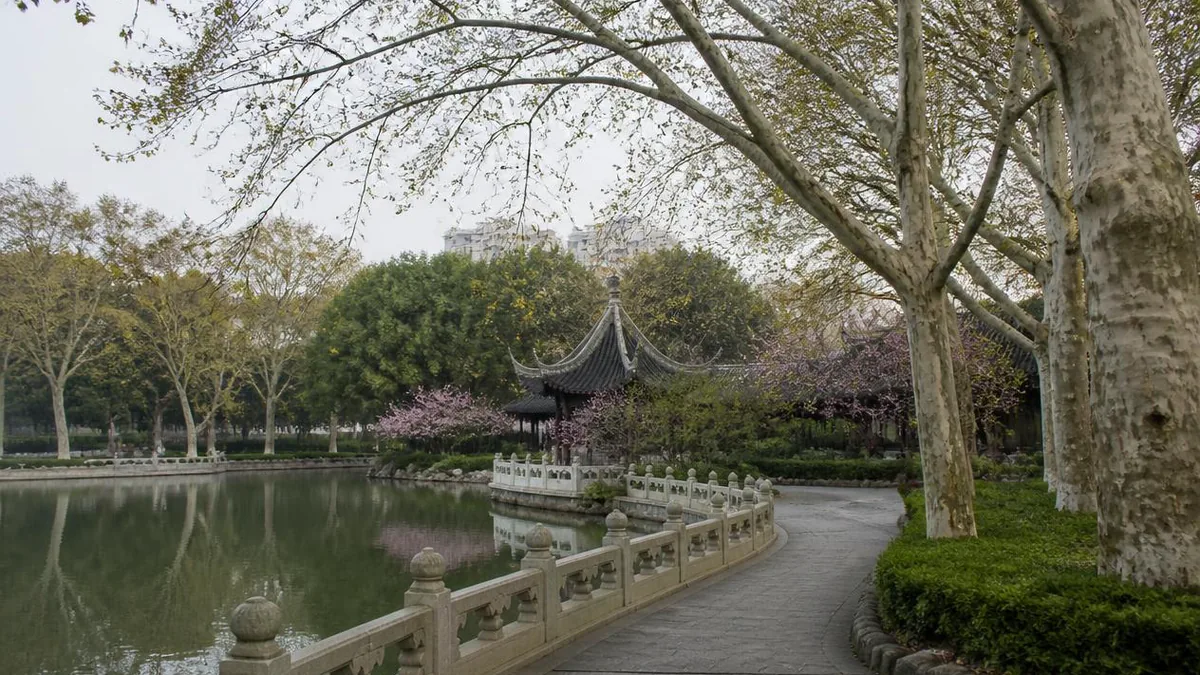
Even the lake and hill are younger than the tomb: they were dug and heaped in 1959 by volunteer labour organised across the district — a lake of about 16,000 square metres, three metres deep, and a hill 22 metres high.
Visiting: gates, hours and the things that change
The park is bounded by North Sichuan Road on one side and East Jiangwan Road on another, and you will see addresses on both — 2288 North Sichuan Road and 146 East Jiangwan Road are both real gates. The nearest metro is Hongkou Football Stadium, on Line 3 and Line 8; buses 21, 70 and 79 stop at Lu Xun Park. The stadium is directly behind the park, which is useful for orientation and unhelpful on match days.
A workable order: Memorial Hall first, in the south-east; then the tomb, in the north-west; then Meixuan. That way the writer’s biography is in your head before you stand at the grave, and the 1932 material comes last, which stops the park collapsing into a single story.
What to check on the day, every time: opening hours for the Memorial Hall and for Meixuan, whether either requires booking or ID, and whether Meixuan is charging. Free entry to a municipal park is stable; museum policy in Shanghai is not. The perimeter is also in flux — a project completed in October 2022 reopened the north-east corner without walls onto Dalian West Road and Ouyang Road, so the gate you remember may no longer be a gate.
The three histories here were assembled by different people for different reasons, decades apart, and the park has never tried to reconcile them. A municipal council built a golf course on land it did not govern. A ceremony held on that ground in 1932 killed two men and cost several others their limbs, and a memorial to it went up sixty years later when two governments recognised each other. A writer who walked here was moved in from another cemetery in 1956, and the park took his name in 1988.
Stand near the bell early in the morning and you will hear a choir practising. That is the fourth layer, and the only one that is not about anything.
The LoreLens app can identify memorial architecture, concession-era park structures and commemorative steles across Shanghai and explain what each one was built for.
Location profile
Where it is

Frequently asked questions
Is Lu Xun Park the same place as Hongkou Park?
Yes. The ground was bought by the Shanghai Municipal Council in 1896, opened in stages from 1906, and was called Hongkew Recreation Ground before being renamed Hongkew Park in 1922. It was briefly Zhongzheng Park after 1945, back to Hongkou Park in 1950, and was renamed Lu Xun Park on 19 October 1988 — the anniversary of Lu Xun's death. Two things confuse people. First, Lu Xun's tomb arrived in 1956, thirty-two years before the park took his name, so a 1960s or 1970s source calling it Hongkou Park is not out of date about the tomb. Second, there is another Lu Xun Park in Qingdao, on the sea; it is a different place with no grave in it.
Where in the park did the 1932 bombing happen, and is anything left of the spot?
The ceremony on 29 April 1932 was held on the park's open ground, on a raised platform put up for the occasion. Nothing of that platform survives, and the park has been dug out, planted, walled and re-landscaped repeatedly since — an artificial lake and hill were excavated in 1959, and a full year-long renovation ran from August 2013 to August 2014. The memorial garden known as Meixuan, in the park, is the place the event is commemorated, and Chinese and Korean accounts describe it as standing on or beside the ground where the platform stood. Treat it as a commemorative location rather than a preserved one.
Do I need a ticket for the park, the Lu Xun Memorial Hall and Meixuan?
They are three separate questions and only the last usually involves money. The park itself has been a free municipal park for many years, and since a 2022 project on its north-east side parts of it are no longer even fenced. The Shanghai Lu Xun Memorial Hall inside the park has been free of charge since 10 March 2008, though free museums in Shanghai often ask for ID or an advance booking. The Meixuan Yun Bong-gil memorial has commonly been reported as charging a small separate admission. Hours, booking rules and any charge all change; confirm at the gate or on the operator's own notice on the day you go.
When is the best time to go, and how long does it take?
Two answers, depending on which park you came for. For the cherry trees — many of them planted in September 1984 by a Japanese youth delegation, with some Yoshino stock recorded as transplanted from Ueno Park in Tokyo — the window is short and usually falls in late March or early April, varies by year, and is extremely crowded. For everything else, early morning on a weekday is the honest version of the place: tai chi, ballroom dancing and amateur choirs, before the tour groups. Ninety minutes covers the tomb, the Memorial Hall and Meixuan at a walk. Half a day is better if you also intend to see Lu Xun's former residence on Shanyin Road, which is outside the park and ticketed separately.
Sources and further reading
Background references for the history and place names in this guide. Opening hours, ticketing and access change often — always confirm with official local information before travelling.