Shanghai
The Korean Provisional Government Site: A State in a Lane House
A three-storey stone-gate house off Madang Road held a government-in-exile for six years. Shanghai was only the first address on a list that ran through nine cities and did not end until 1945.
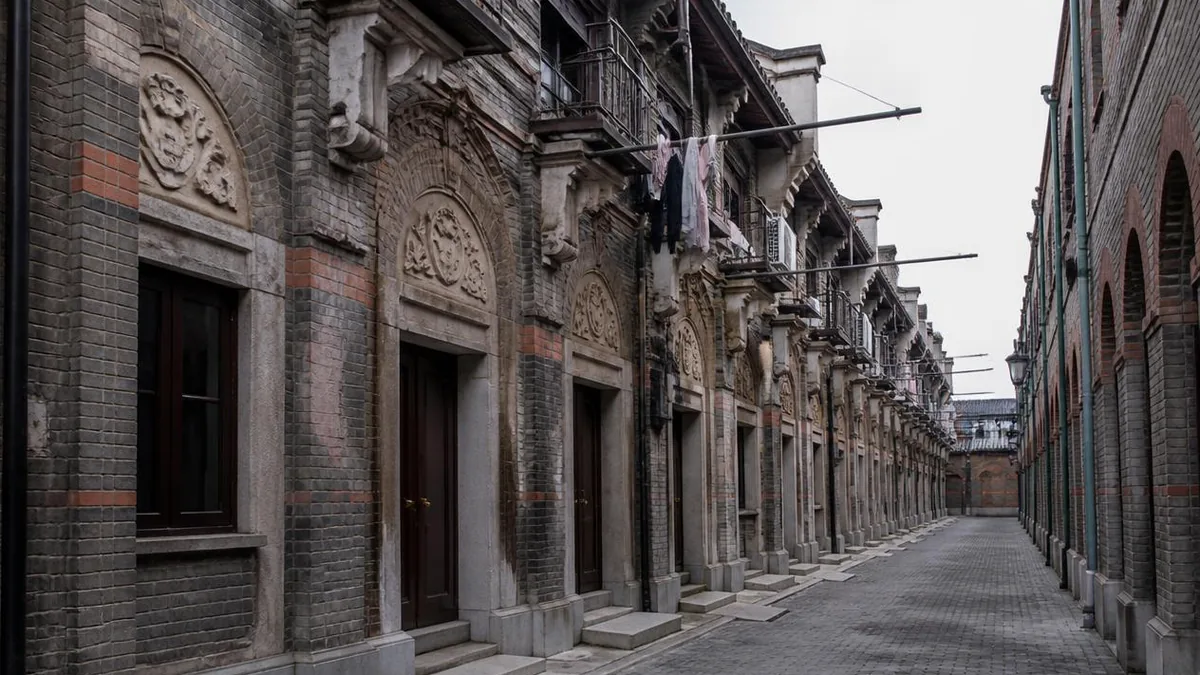
Number 4, Lane 306, Madang Road is not a monument. It is a terraced house in a lane, one door among several behind a shared stone gateway, in a district where thousands of houses look much the same. You walk past the entrance to the lane before you notice it.
Between 1926 and 1932 it held the offices of the Provisional Government of the Republic of Korea. That is the whole proposition of the place, and it is worth stating plainly before anything else: a government functioned out of a rented row house, and then it left, and then it kept moving for another thirteen years.
A house built for a family, used by a government
The building type is shikumen, literally stone gate, the hybrid that dominated Shanghai’s concessions from the late nineteenth century into the 1930s. A stone-framed doorway opens off a shared lane into a small forecourt; the house behind it is narrow, deep and vertical. It borrows the courtyard logic of Chinese domestic architecture and the density of a European terrace.
This one is three storeys. The historic address was No. 4, Puqingli, on a French Concession street then called Rue Brenier de Montmorand. That street was laid out in 1898 as Langshan Road, renamed in 1906 for a French consul-general in Shanghai, and renamed again in 1943, under the wartime Wang Jingwei administration, after Madang in Jiangxi. So the name on the envelope changed three times while the building stood still.
Published descriptions put the plot at roughly 191 square metres and the floor area at about 476 square metres; those numbers circulate widely without an official restatement, so take them as indicative. The layout presented to visitors is a meeting room, kitchen and washroom at ground level, Kim Ku’s combined office and bedroom on the second floor, and sleeping quarters on the third.
The stairs are the detail people remember. They are steep, narrow and enclosed, the standard shikumen staircase, and there is no way to reach the second floor except by climbing them the way everyone who worked here did.
April 1919, and two dates you will both see
The Provisional Government was formed in the months after the March First Movement of 1919, when independence demonstrations across Korea were suppressed and organisers left the peninsula.
On 10 April 1919, twenty-nine delegates met at the residence of Hyun Sun on Route Père Robert in the French Concession, now South Ruijin Road, and constituted a Provisional Legislative Assembly. On 11 April the same body adopted a ten-article Provisional Charter, rejected monarchy, settled on a republic and appointed a cabinet. On 13 April the government issued its Proclamation and its Declaration to the world.
Both 11 and 13 April appear as the founding date, and the discrepancy is not sloppiness—it is the difference between adopting a charter and announcing a government. Korean-language reference works generally lead with 11 April.
It was also not the only Korean provisional government that spring. A Korean National Council had formed at Vladivostok in March; a Hanseong government was proclaimed in Seoul on 23 April; several more existed on paper only. On 11 September 1919 seven of these bodies were merged by constitutional amendment into a single Provisional Government seated in Shanghai, with a president, a cabinet and a separation of powers written down.
One decision from that first month outlasted everything else. At a legislative session on 10 May 1919 the assembly fixed the state name as Daehan Minguk—the Republic of Korea. It is the name South Korea uses today, chosen in a borrowed house in a French concession by delegates with no territory.
Why the French Concession, and the addresses before this one
The choice of Shanghai was jurisdictional. The French Concession was administered by its own municipal council under French consular authority, which meant Japanese police could not simply operate inside it. That protection was never absolute and it was always political, but it was real enough to make the concession the base for Korean exile organising for over a decade.
The Madang Road house was not the first office. On 17 April 1919, with the tacit acquiescence of the French consulate and the concession council, the government hung its sign at 321 Avenue Joffre, now Central Huaihai Road. It later used premises on the street now called South Chongqing Road, and other addresses besides.
This matters for how you read the surviving house. It is not the founding site. It is the address the government occupied longest and the one that survived intact, which is why it, rather than any of the others, became the memorial.
1926, when the office and the residence became the same room
Kim Ku was elected head of the State Council on 14 December 1926, and the offices moved to where he was living—Puqingli No. 4. Korean-language sources date the occupancy from July 1926 to April 1932; Chinese-language sources tie the move to the December election and the departure to May 1932. The disagreement is a few months wide and nobody disputes the span.
The consequence is the thing worth noticing on site. By this point the Provisional Government had been through the resignation of its prime minister in 1921, the impeachment of its president in 1925, a general representatives’ conference in 1923 that failed to resolve anything, and a chronic shortage of money. Its head of state’s office and his bedroom were the same room on the second floor of a rented lane house.
Governments-in-exile are usually pictured in embassies. This one had a stove downstairs.
Four names, and what the record supports
Kim Ku (1876–1949) reached Shanghai in April 1919 and was appointed head of the government’s police bureau that autumn. He took the interior portfolio in 1923 and the leadership in December 1926, and remained the effective leader of the Provisional Government until 1945. He was shot dead in Seoul on 26 June 1949 by an army lieutenant, An Doo-hee.
Syngman Rhee (1875–1965) was appointed to the leadership in 1919 while living in the United States, arrived in Shanghai in December 1920, left in May 1921, and was impeached and removed in March 1925. He became the first president of the Republic of Korea in 1948. He never worked in this building.
Lee Bong-chang (1900–1932) threw a grenade at the imperial procession at the Sakuradamon in Tokyo on 8 January 1932. A guardsman was injured. He was convicted of high treason and executed on 10 October 1932. His written oath is dated the thirteenth day of the twelfth month of the thirteenth year of the Republic of Korea—the Provisional Government kept its own era count, beginning in 1919.
Yun Bong-gil (1908–1932) came to Shanghai in May 1931 and was sworn into the Korean Patriotic Corps in Kim Ku’s office on 26 April 1932. He was tried by a Japanese military court on 25 May 1932, taken to Japan that November, and shot at Kanazawa on 19 December 1932.
29 April 1932
The Japanese community in Shanghai held a ceremony in Hongkou Park on 29 April 1932, combining the emperor’s birthday with a military review marking the end of the Shanghai fighting that had begun that January. Yun Bong-gil entered without an invitation and threw a bomb built into a water flask at the platform.
The casualties are documented in detail. Shirakawa Yoshinori, commander of the Shanghai Expeditionary Army, died of his wounds on 26 May. Kawabata Teiji, head of the Japanese residents’ association, died the following morning. Nomura Kichisaburō lost an eye, Ueda Kenkichi lost a foot, and the minister to China, Shigemitsu Mamoru, lost a leg—thirteen years later he signed the Japanese instrument of surrender on the deck of the Missouri, on a wooden leg. The consul-general and the residents’ association secretary were also wounded.
Yun reached for a second device and was seized. Kim Ku subsequently published a statement claiming responsibility for both this action and the Tokyo attempt; a reward of 600,000 yuan was posted for him.
The direct consequence for this building is simple. The French Concession could no longer shelter the organisation, and the Provisional Government left Shanghai. The house on Puqingli was closed after roughly six years of use.
Two Korean sites in Shanghai, and they are not the same one
Visitors conflate them constantly, so it is worth separating.
The Madang Road house, in Huangpu District, is the office. The Yun Bong-gil memorial, in Hongkou District, is on the ground where the bombing happened. Hongkou Park was renamed Lu Xun Park in October 1988, after the writer who lived nearby and is buried in it; the park has been open since 1906 and was originally a British-designed sports ground, which is why the 1932 ceremony was held there in the first place.
Inside the park, a two-storey Korean-style building named Meixuan, after Yun’s art name, was approved in November 1992 and built in the following period; it was expanded into a garden in 1994 and opened as the Meixuan Yun Bong-gil Memorial in 2003, with its displays fully replaced and reopened on 29 April 2015. The two sites are about thirty minutes apart by metro. Go to both, but do not expect one to explain the other.
Nine cities in twenty-one years
This is the fact most visitors do not arrive with, and it changes the scale of the house.
After Shanghai the government moved to Hangzhou, then Zhenjiang, then Nanjing, then Changsha from December 1937, Guangzhou from July 1938, Liuzhou from November 1938, Qijiang from May 1939, and finally Chongqing from September 1940 until November 1945. A last address, the Seoul house called Gyeonggyojang, was used from December 1945 to 1948.
The early dates are genuinely contested. One reconstruction gives Hangzhou from May to October 1932 and Zhenjiang from October to November 1932; another, following Kim Ku’s own memoir, gives Hangzhou until November 1935 and Zhenjiang from November 1935 to November 1937. Jiaxing appears in many accounts but is a different kind of place: it is where Kim Ku personally hid after the bombing, not a seat of government.
In Chongqing the government established the Korean Liberation Army on 17 September 1940 and issued a declaration of war against the Axis on 9 December 1941. Its members flew from Chongqing to Shanghai on 5 November 1945 and returned to Korea later that month—as private individuals, the American military government having declined to recognise them in any other capacity.
Most of the surviving sites of that itinerary are in China, and they survive unevenly. Changsha’s is a house on Liansheng Street; Guangzhou’s is Baiyuan, on Xugu Yuan Road in the old Dongshan district; Liuzhou’s is the Lequnshe building, now a display hall; Chongqing’s is at Lianhuachi in Yuzhong District and is a municipal protected site. At Qijiang, most of the buildings were pulled down in 2002 and 2003, and the one remaining structure—the former residence of Yi Dong-nyeong—was demolished by mistake in 2011, leaving fragments of wall.
Shanghai is the beginning of that list, not the whole of it.
How the house survived to 1993
After 1932 the building stayed in private hands. Accounts credit a couple connected to the government, Gu Shouxi and Liu Longsheng, with looking after it, and relatives of theirs living there for decades afterwards. That ordinary continuity is the reason there is anything to visit.
It was listed as a district-level protected cultural relic in 1990—February in one account, 5 June in another—under Luwan District, which merged into Huangpu District in 2011. The People’s Republic of China and the Republic of Korea normalised relations on 24 August 1992, and the restored site opened to the public on 13 April 1993, the anniversary of the 1919 proclamation.
Since then the district has received seven serving South Korean presidents: Roh Tae-woo in September 1992, before the restored house opened; Kim Young-sam in March 1994; Kim Dae-jung in November 1998; Roh Moo-hyun in July 2003; Lee Myung-bak in April 2010; Park Geun-hye in September 2015; and Lee Jae-myung in January 2026. Moon Jae-in visited the Chongqing site instead, in December 2017.
The site is also read differently by the two Korean states. The preamble to South Korea’s 1987 constitution states that the Republic succeeds the legitimacy of the Provisional Government; North Korean references describe it as an unrecognised émigré body. Both positions are on the record. The house itself does not settle them.
Visiting, and one date that overrides everything
The site is closed from 1 August to 14 September 2026 for maintenance of ageing fittings, per notices from the management office and the South Korean Consulate-General in Shanghai. The reopening date is stated as to be announced. Check before you go.
When it is open, the municipal culture and tourism listing gives 09:00–11:30 and 13:30–17:00, with ticket sales ending at 11:00 and 16:30. The midday closure is the single most common wasted trip. Admission has been reported at 20 yuan, half for over-60s—treat prices and hours as subject to change and confirm on the day.
Three practical rules. Photography and video are not permitted inside; the exterior and the lane are fine, and the ban is consistently reported and consistently enforced. Groups need to book ahead—travel agencies have been asked for at least three days’ notice with an itinerary and the names of guides. And wear flat shoes, because of those stairs.
Allow 30 to 60 minutes. Interpretation is available in Korean, and the site is heavily visited by Korean travellers, so a weekday morning is calmer than a weekend. The address to give a driver is 4, Lane 306, Madang Road, Huangpu District; you will also see Lane 304, No. 302–304 and Lane 306 No. 1 on aggregator listings, all of them wrong. The nearest metro stations are Xintiandi and Madang Road, and the Xintiandi shopping district is two minutes’ walk away, which produces one of the sharper transitions in Shanghai.
Stand in the lane for a moment before you go in. What is in front of you is a rented house of a standard type, on a street that has had three names, in a foreign concession that no longer exists, occupied for six years by an institution that spent the following thirteen relocating. Nothing about it was meant to last, including the government. The address survived anyway, and that is the only reason the itinerary that started here can be walked at all.
The LoreLens app can identify shikumen architecture and concession-era buildings across Shanghai and explain the layers of history attached to them.
Location profile
Where it is

Frequently asked questions
Is the site open right now?
Not in August 2026. The management office and the South Korean Consulate-General in Shanghai both posted a notice that the site would close from 1 August to 14 September 2026 for maintenance of ageing indoor and outdoor fittings, with the reopening date to be announced separately. Some travel listings state 15 September as the reopening day, which is the day after the stated closure period, but the official notice does not commit to it. When the site is open, the Shanghai municipal culture and tourism platform gives hours of 09:00 to 11:30 and 13:30 to 17:00, with ticket sales stopping at 11:00 and 16:30 respectively; the midday break is real and catches visitors out. Admission has commonly been reported at 20 yuan with a concession for over-60s. Every one of those figures should be checked on the day.
Is this the same place as the Yun Bong-gil memorial?
No, and the two are on opposite sides of the city centre. The Madang Road house in Huangpu District is where the Provisional Government kept its offices from 1926 to 1932. The Yun Bong-gil memorial, called Meixuan after his art name, stands inside Lu Xun Park in Hongkou District, on the ground where the bombing of 29 April 1932 took place; that park was called Hongkou Park until it was renamed for Lu Xun in October 1988. The memorial building there was approved in November 1992, expanded into a garden in 1994, and opened as the Meixuan Yun Bong-gil Memorial in 2003, with a full re-display in April 2015. Visiting both in one day is easy; treating them as one site is a common mistake.
Did Kim Ku and Syngman Rhee both work in this building?
Kim Ku did; Syngman Rhee did not. Rhee was named to the leadership in absentia in 1919, reached Shanghai in December 1920, stayed until May 1921, and was impeached and removed by the Provisional Legislative Assembly in March 1925. The government only moved into the Madang Road house in 1926, so his Shanghai years were spent at earlier addresses. Kim Ku is the figure attached to this building: he arrived in Shanghai in April 1919, headed the police bureau and then the interior portfolio, was elected head of the State Council on 14 December 1926, and the offices moved to where he was living. Korean-language sources date the move to July 1926 and the departure to April 1932, while Chinese-language sources tie it to the December 1926 election and a May 1932 exit. All agree on 1926 to 1932.
Where did the government go after it left Shanghai?
Through most of central and southern China, over eight years. The sequence usually given is Hangzhou, Zhenjiang, Nanjing, Changsha, Guangzhou, Liuzhou and Qijiang, reaching Chongqing in September 1940 and staying until November 1945. The dates for the first two stops are genuinely disputed: one reading has Hangzhou from May to October 1932 and Zhenjiang from October to November 1932, another has Hangzhou until November 1935 and Zhenjiang from November 1935 to November 1937. Jiaxing appears in many accounts but belongs to a different category, being where Kim Ku personally sheltered rather than a seat of government. A final address in Seoul, the house known as Gyeonggyojang, was used from December 1945 until 1948.
Sources and further reading
Background references for the history and place names in this guide. Opening hours, ticketing and access change often — always confirm with official local information before travelling.