Zhejiang · Jinhua
Hengdian: The Town That Built Its Own Forbidden City Because Nobody Is Allowed to Film in the Real One
In 1996 a farming town in central Zhejiang put up a nineteenth-century Guangzhou in a few months because a director needed one and it no longer existed anywhere. Thirty years later the same town owns full-scale copies of the Qin imperial palace, the Forbidden City and a Song scroll painting, and roughly one Chinese costume drama in every two is shot inside them.
5A View location, maps and nearby scenic areasThe Last Emperor was shot inside the real Forbidden City. Bernardo Bertolucci got permission in 1986, moved his cameras through the actual courtyards where the actual boy emperor had lived, and released the film in 1987. It won nine Academy Awards, and it is essentially the last time a feature crew was given that kind of run of the place.
Which raises a practical question. Chinese television produces palace dramas continuously — dynastic intrigue is to Chinese prime time roughly what the police procedural is to American — and every one of them needs a throne hall, a gate tower, a courtyard where a concubine can be humiliated in the snow. If the building in Beijing is off limits, where is all of that being filmed?
The answer is a town of a few tens of thousands of people in the hills of central Zhejiang, four hours’ drive from Shanghai, with no imperial history whatsoever and no scenery to speak of. Hengdian, in the county-level city of Dongyang, under Jinhua prefecture, owns a copy. Also a copy of the Qin imperial palace, a copy of a nineteenth-century Guangzhou waterfront, a copy of Hong Kong before the war, a copy of the most famous scroll painting in Chinese art rendered as walkable streets, and — the most contentious of them — a copy of the summer palace that British and French troops burned in 1860.
None of it is heritage. All of it was built, on purpose, from nothing, inside living memory, by a company owned collectively by the town. That is the actual story here, and it is better than any of the dynasties on display.
The film that needed a city that had been demolished
It starts in 1996 with a director in trouble.
Xie Jin (1923–2008) was the most important Chinese filmmaker of the generation before Chen Kaige and Zhang Yimou — a studio director whose melodramas defined mainstream Chinese cinema from the 1950s to the 1980s. He was preparing The Opium War, a large historical feature about the confrontation that ended with China ceding Hong Kong to Britain, timed for release in 1997, the year Hong Kong was handed back. The symmetry was the whole point of the project, and the release date could not move.
He needed a Guangzhou of the 1830s and 1840s: the foreign factories on the waterfront, the godowns, the streets where the imperial commissioner Lin Zexu (1785–1850) confiscated and destroyed some twenty thousand chests of British opium in 1839 and set the war in motion. That city no longer exists. Guangzhou has been rebuilt several times over, and no standing set of the period was available anywhere in China.
Locations were scouted. What Hengdian offered was not a location but a proposal: we will build it for you, and we will build it fast.
Guangzhou Street went up in a matter of months in 1996 — the exact figure varies between accounts, and the impressive thing is not the number but that a rural township in Zhejiang undertook, at its own expense, to construct a foreign concession waterfront for a film crew it had no prior relationship with. The set is still standing. Hong Kong Street, a colonial-era streetscape, was added beside it, and the pair remain the oldest thing at Hengdian by thirty years.
The silk factory
The person who made that offer was Xu Wenrong, born in Hengdian in 1935, and to understand why he could make it you have to go back to 1975.
Hengdian at that point was poor even by the standards of rural Zhejiang in the 1970s: hill country, thin soil, no railway, no mineral resources, no port. What it had was a commune with permission — barely, in the political climate of the time — to run a small collective enterprise. Xu, then a commune cadre, started a silk reeling factory with borrowed capital and a workforce of local villagers. Figures for the starting sum circulate in the tens of thousands of yuan; treat them as the order of magnitude they are.
That factory became the seed of the Hengdian Group, and the group did something almost nothing else in the reform era did: it stayed in the town and kept diversifying inside it. Silk, then chemicals, then pharmaceuticals, then — the part that actually pays for everything — magnetic materials. Hengdian’s magnetics business grew into one of the larger producers of permanent magnets and soft ferrites in the world, the components inside motors, speakers and, latterly, solar and electric-vehicle supply chains. A listed pharmaceutical arm sits alongside it.
This matters for the film studio in a very direct way. When Xu Wenrong offered to build a nineteenth-century Guangzhou in 1996, he was not a film producer speculating on a location business. He was the head of an industrial group with real cash flow from magnets and drugs, in a town that owned that group, deciding to spend some of it on a set. The film industry did not fund Hengdian. Ferrite did.
Who owns Hengdian
The ownership structure is the strangest thing about the place and the least reported outside China.
Hengdian Group is not a state-owned enterprise and it is not a private company in the ordinary sense. It is organised under a form usually rendered as community-owned enterprise — the assets are held by an association representing the local population rather than by the state, by shareholders, or by the founding family. Xu Wenrong has stated repeatedly over the years that he does not own the group and that his family does not own it. His son, Xu Yong’an, has run it since the founder stepped back, which invites the obvious scepticism, and the arrangement has been argued about by Chinese economists for three decades.
For a foreign reader the closest available analogies are all imperfect: a very large municipal enterprise, a co-operative on an industrial scale, or the German model of a foundation-owned firm. None of them fit exactly. The practical effect is what you can see on the ground: the group’s profits have gone into the town at a rate that a normal shareholder company could not have justified — schools, hospitals, roads, housing, and eventually several hundred hectares of historical film sets that were, in their first years, straightforwardly unprofitable.
It is worth being clear-eyed. This is not a utopian village. It is a large industrial conglomerate with a founder cult, a dynastic succession and a formidable local monopoly. But the specific question of how a farming town came to own the largest film studio complex on earth has a specific answer, and the answer is this ownership form.
The decision that took the industry
The sets went up. The crews did not immediately follow, and for a few years around 1998 to 2000 Hengdian was an expensive collection of empty streets.
The move that changed it is the one every account of the place agrees on. Xu made the sets free. Production companies could use the standing locations without paying a location fee, and Hengdian would earn its money from everything a crew consumes while it is there: extras, costume hire, props, horses, lighting and camera equipment, transport, hotel rooms, meals, offices, and later post-production. The commonly cited date for the announcement is 2000.
Considered as a pricing decision this is unremarkable — give away the razor, sell the blades. Considered as an industrial decision it was decisive, because location fees were a meaningful line in a Chinese television budget and no competing base could afford to zero them. Work concentrated at Hengdian; the concentration attracted the suppliers; the suppliers made the next production cheaper still; and within a decade the question for a producer was not whether to shoot at Hengdian but which weeks were available.
In 2004 the state broadcasting regulator designated the town a film and television industry experimental zone — reported as the first of its kind in China — which added tax and registration advantages for production companies willing to base themselves there. Several thousand film and television companies are now registered in Hengdian, a great many of them shell operations with a desk and a licence. That, too, is part of the model.
Qin Palace, and the arrival of the epic
The second set is where Hengdian stopped being a favour to one director and became infrastructure.
In 1997 Chen Kaige (born 1952), whose Farewell My Concubine had taken the Palme d’Or at Cannes in 1993, was preparing The Emperor and the Assassin, an account of the failed attempt on the life of the king of Qin — the man who would become Qin Shi Huang (259–210 BCE), the first ruler to unify China, builder of the first Great Wall, owner of the terracotta army. The film needed a Qin palace. There is no surviving Qin palace; there is barely a surviving Qin building. What exists is the excavated ground plan of a palace foundation at Xianyang and a body of scholarly reconstruction.
So Hengdian built one, on a scale that reads as absurd until you stand under it: a stepped platform hall approached by an enormous flight of stairs, black and grey and severe, with none of the red-and-gold that Western visitors expect from Chinese palace architecture, because the Qin court’s ritual colour was black. The main hall carries a name meaning roughly the four seas made one.
It has since become the most recognisable film set in Asia. Zhang Yimou (born 1950) shot Hero here in 2002 — the film that opened the international market for Chinese wuxia after Crouching Tiger — and the vast empty audience hall in which the nameless assassin approaches the king is this building. Once you have registered it, you begin to see it everywhere: the same staircase, the same courtyard, dressed and lit and colour-graded into a dozen different dynasties.
A Forbidden City you are allowed to film in
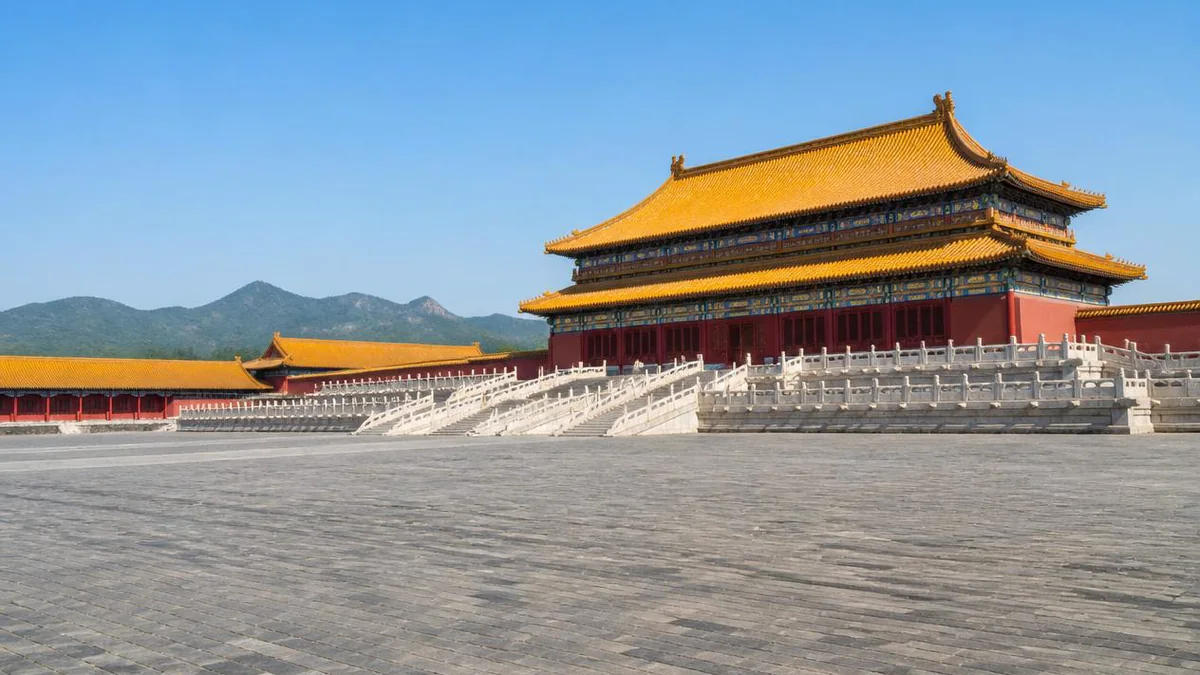
The largest of the parks is the Ming and Qing Palace, a full-scale reconstruction of the core of Beijing’s Forbidden City and its imperial garden quarters, built in the early 2000s.
This is the set that answers the question the article opened with. The Palace Museum in Beijing is a UNESCO-listed site with six centuries of fragile timber, painted surfaces and several million visitors a year, and its tolerance for film crews — cabling, lighting, crowd scenes, horses — is close to zero. Meanwhile the Ming and the Qing are the two dynasties Chinese screenwriters write about most, because they are recent enough for documented court politics and distant enough for costume.
The result is that an enormous share of Chinese period television has been shot inside this copy in Zhejiang. Empresses in the Palace, the 2011 serial that reset the standard for Qing court drama and is watched and rewatched to the point of being quotable, was made here. So was Story of Yanxi Palace, the 2018 hit that became one of the most streamed dramas in the world in its year. If you have seen a Chinese emperor cross a courtyard on television in the last twenty years, you have most likely seen this courtyard.
Walking it as a tourist is a strange experience, and the strangeness is worth sitting with. The proportions are right. The gate towers are right. The vermilion is fresh rather than faded, the stone is unworn, and there is no queue, because everyone who wants the real thing is in Beijing. What you are standing in is not a fake Forbidden City. It is a working Forbidden City — one whose function is not to have housed emperors but to keep producing the images through which a billion people picture emperors.
A painting, standing up
The third of the big historical parks reconstructs a specific object rather than a place: Along the River During the Qingming Festival, the handscroll attributed to Zhang Zeduan (c. 1085–1145), which shows the streets, canal, bridge, shops, porters and crowds of the Northern Song capital at Kaifeng in obsessive detail. It is the single most important visual document of everyday urban life in pre-modern China, and Chinese schoolchildren know it the way English ones know the Bayeux Tapestry, except more so.
Hengdian’s version turns it into streets you can walk down, with the rainbow bridge, the waterfront and the shopfronts built out at full size.
It is not the only one. The Song capital’s own city, Kaifeng, opened a walk-in version of the same painting in 1998, and CCTV’s older base at Wuxi built a Qingming street in the 1990s so that its adaptation of Water Margin would have somewhere Song-shaped to film. Three separate three-dimensional constructions of one scroll, put up within a few years of each other, for three different reasons: a theme park on the correct ground, a television set on the wrong lake, and — here — a production facility that needed a generic Song city and chose to derive it from the best surviving evidence.
That last point is the defensible one. When you need a Song street and no Song street survives, building from a Song painting is not a bad method. It is, in fact, roughly what an archaeological reconstruction drawing does, executed in timber at 1:1 and rented out by the day.
The real ones
There is one corner of Hengdian where the wood is genuinely old, and it is the part almost nobody photographs.
The Ming and Qing residences museum is presented as an assembly of authentic timber-framed houses of those periods, taken down elsewhere in the region where they stood in the way of something, moved here, and re-erected: halls, screen walls, carved brackets, courtyards. It is separately rated 4A in the national scenic-area directory — a different listing from the 5A that covers the film city — which is a small administrative signal that even the classification system regards it as a different kind of object.
There is a reason this is happening in this particular county rather than anywhere else. Dongyang has been a centre of the building trades for centuries and is the home of Dongyang woodcarving, one of the major regional carving traditions of China, listed as national intangible cultural heritage. Dongyang carpenters and carvers travelled to work on buildings across the country for generations, and the county’s construction companies remain unusually strong today.
Which reframes the whole enterprise. The town that built a fake Qin palace, a fake Forbidden City and a fake Song street was not improvising. It was the county with the deepest available bench of traditional carpenters, joiners and carvers deciding to point that skill at film sets. The replicas are convincing because the people who made them come from a lineage of people who made the originals.
Relocated buildings raise their own questions, of course. A house re-erected two hundred kilometres from the ground it was built on has lost most of what made it a document. But it has kept its timber, and the alternative offered to most of these houses was a demolition contractor.
The drifters
The most interesting population at Hengdian is not on any ticket.
They are called hengpiao — literally Hengdian drifters, formed on the model of beipiao, the Beijing drifters, the term for young people who move to the capital without a residence permit to chase a career. Hengdian’s drifters come for screen work: extras, background crowd, stunt falls, spear-carriers in armour, occasionally a line. They register with an actors’ guild the studio established in the early 2000s, which issues a card, posts calls, and — this is the part that distinguishes Hengdian from an ordinary casting free-for-all — sets floor rates and handles payment.
Numbers in circulation run to tens of thousands of registered card-holders, with a much smaller number actually working in any given week. Day rates for crowd work have historically been low: enough for a bed in a shared room and food, not enough to save. The standing joke, which is not really a joke, is that a hengpiao can spend a decade dying in battle scenes.
Peter Chan’s 2015 film I Am Somebody was made about exactly this population and cast largely from it, and it is the most direct route into the subject for a foreign viewer who wants to understand what the crowd in the courtyard is.
It is also the thing to look for while you are there. The costumed figures moving between sets in the mid-afternoon, checking phones in Ming armour, queuing at a noodle window with their helmets under one arm, are not entertainment staff hired to decorate your visit. They are the workforce of an industry, on a break.
The palace that was burned, rebuilt
The most disputed thing at Hengdian is the newest.
In 1860, during the Second Opium War, British and French forces looted and then burned the Yuanmingyuan — the Old Summer Palace, an enormous complex of gardens, halls, lakes and European-style fountains northwest of Beijing that had been built up over more than a century by the Qing emperors. The destruction is one of the central injuries in modern Chinese historical memory, and the site in Beijing is preserved as ruins, deliberately unrestored, precisely so that the injury remains visible.
Xu Wenrong’s late project was to rebuild it. Not to restore the Beijing site, which was never on the table, but to construct a full-scale version of the vanished gardens at Hengdian — announced in the late 2000s, begun in the 2010s after prolonged argument, and opened in stages from around 2015 as the New Yuanmingyuan. Reported budgets ran into the tens of billions of yuan, and Xu stated that the money was raised by donation and by the group rather than from public funds. The reported figures vary widely between sources and should be treated as claims rather than accounts.
The objections were immediate and came from several directions at once: heritage specialists arguing that a full-size replica cheapens the ruins it copies; the administration of the Beijing site distancing itself; historians pointing out that the Yuanmingyuan’s appearance is imperfectly documented, so that any reconstruction is substantially invention; and critics who simply found the idea of monetising a national wound distasteful. Supporters argued that a generation that has only ever seen broken stones deserves to see what stood there, and that no one is confusing Zhejiang with Beijing.
Both positions are worth taking seriously, and the visit is sharper if you arrive holding both. Note also the symmetry the studio’s own history supplies without comment: Hengdian was founded in 1996 to film the first Opium War, and its last great project rebuilds what the second one destroyed.
Night, water, and the rest of it
Hengdian is not only history parks, and the newer half of the business is frank about being a theme park.
Dream Valley is the evening operation — a water park and outdoor spectacle venue on a lake, built around large-scale live shows using pyrotechnics, released water, staged collapses and hundreds of performers. The signature pieces stage disaster: a torrential flood, a burning palace. They are loud, extremely wet in the front rows, and much closer in spirit to a stadium event than to anything on the historical sets. They are also, for a substantial share of visitors, the reason to stay a second night.
Around the edges there is more: a Buddhist temple complex, a landscape park in a limestone gorge on the hills behind town, a 1930s Shanghai bund street for Republican-era productions, and hotel capacity out of all proportion to a town this size. The 5A rating — awarded in 2010, according to the most commonly cited accounts — attaches to the film city as a whole, which is why the boundaries of what is and is not “in” the 5A area are unusually vague on the ground.
What the numbers say, and how far to trust them
Every account of Hengdian, including the studio’s own, comes with a wall of superlatives, and they deserve the standard treatment.
The claims most often made are that Hengdian is the largest film and television production base in the world by area; that it hosts several hundred productions a year; that a very large share of all Chinese period drama is shot here; and that it receives visitors in the tens of millions annually. The reported figures for each move around considerably depending on the year, the source and whether the count is of the film city, the group, or the town.
What can be said with more confidence is qualitative and less flattering to nobody. First, the scale is genuinely exceptional — there is no comparable concentration of standing historical sets anywhere else on earth, including in the countries with older film industries. Second, the visitor economy long ago overtook the production economy in revenue terms, which is the same reversal that overtook Wuxi, and it introduces the same tension: crews are disruptive to visitors, and visitors are disruptive to crews. Third, the specific figures should be quoted the way the studio’s own marketing quotes them, which is to say approximately.
What a copy is for
The question every foreign visitor arrives with is whether any of this is worth seeing, given that all of it is fake.
The more useful question, as at every constructed site in China, is what the thing is evidence of. Hengdian is not evidence of the Qin, the Song, the Ming or the Qing. It is first-rate evidence of something else: of what a Chinese village collective enterprise was able to do in the reform era, of how a national film industry was assembled from very little in about fifteen years, and of the images through which contemporary China pictures its own past — because those images are manufactured here, on these specific staircases, and then transmitted to an audience of hundreds of millions.
There is also a plain argument on the buildings themselves. Reconstruction from evidence is a legitimate scholarly activity; museums do it constantly at the scale of a room. Hengdian does it at the scale of a city, commercially, with the region’s inherited carpentry, and the results are — with the exception of the Yuanmingyuan, where the underlying evidence is weakest — reasonable representations of what the scholarship says these buildings looked like.
And the honest counter-argument stands too. Full-scale copies compete with the originals for attention, they flatten the difference between a surviving building and a proposal about one, and they train an audience to accept reconstruction as heritage. At Wuzhen, two hours north, the same argument runs through a town where genuinely old fabric was restored to within an inch of its life. Hengdian is the extreme case, and it is more honest than most, because it never claimed to be anything but a set.
Visiting
Practicalities, briefly, and check everything locally before relying on it.
Hengdian sits in the hills of central Zhejiang; most visitors come via Yiwu or Dongyang and then by road, and the town is comfortably reachable from Hangzhou or Shanghai for a weekend. Tickets are sold per park and in combination packs whose composition and price change; there is no single all-in ticket you can count on. Shuttle buses link the gates, and the distances are too great to walk. Give it two days minimum, three with the evening shows.
The parks reward different things. The Qin Palace is the one to see if you only see one — it is the most architecturally serious and the most photographed set in Chinese cinema. The Ming and Qing Palace is the largest and the most likely to have a crew in it. The Qingming street is the most interesting to think about. The Ming and Qing residences are the quietest and the only old wood. The New Yuanmingyuan is the one to argue about on the way home.
And if you get lucky, the thing you will actually remember will not be a building. It will be a costumed crowd of two hundred people standing very still in the sun on someone else’s mark, waiting for a first assistant director to release them — which is what all of this is for, and what none of the dynasties it depicts ever contained.
The LoreLens app can tell you which dynasty a set at Hengdian is imitating, how close the copy is to the building it is based on, and which films were shot on the spot where you are standing.
Location profile
Where it is

Frequently asked questions
What is actually inside the Hengdian 5A area?
Not one site but a scatter of separately gated parks across a whole town, each a set built for a specific production and then kept. The ones most visitors do are Guangzhou Street and Hong Kong Street, the Qin Palace, the Ming and Qing Palace complex modelled on Beijing's Forbidden City, the walk-in reconstruction of the painting Along the River During the Qingming Festival, Dream Valley for the evening water shows, and the New Yuanmingyuan gardens on the edge of town. Tickets are sold per park and in combinations, and the combinations change. There is no single loop and no walking route between them; shuttle buses connect the gates.
Can you actually see filming?
Usually yes, and that is the main reason to come rather than visit any other reconstructed ancient city in China. Hengdian is a working production base with crews in it on ordinary weekdays, so it is normal to round a corner and find lighting rigs, a costumed crowd and a first assistant director shouting. What you cannot do is plan it. Crews close individual courtyards or whole sections at short notice, schedules are not published, and the set you most wanted to see may be the one that is shut that morning. Treat any filming you witness as a bonus.
Is any of it old?
Almost none of it. The oldest sets date from 1996 and most are younger. The exception is the Ming and Qing residences museum, which is presented as genuine timber-framed houses of those periods dismantled elsewhere in the region and re-erected here, and which carries its own separate 4A rating in the national scenic-area directory rather than being part of the 5A designation. It is the quietest part of Hengdian and the only part where the wood is actually old.
Why is the film industry here at all, in a town with no history of it?
Because the sets are free. Around the turn of the millennium the founder made location use free of charge to production companies and moved the business model onto everything a crew consumes instead: extras, costumes, props, horses, equipment hire, hotel beds, catering and post-production services. No other Chinese base could match that, work concentrated here, and the concentration then became self-reinforcing, because Hengdian is where the crews, the costume warehouses and the willing extras already are.
What is the best time to go, and how long does it take?
Two full days is the honest minimum for the main parks, three if you want the evening shows as well. Late spring and October give the most comfortable weather, but the first week of May and the first week of October are national holidays when the whole country travels at once and the palace courtyards fill solid. Summers in inland Zhejiang are humid and heavy, and the palace sets are unshaded stone and brick with very little cover. Winter is cold but quiet, and crews work through it.