Zhejiang · Jinhua
Shuanglong Cave: The Ten Metres Everyone in China Has Read About
Most famous caves are famous for what you can see in them. This one is famous for ten metres in which you can see nothing at all, cannot sit up, and are forbidden to lift your head — because a school essay written in 1957 put that ten metres into the national curriculum, where it has stayed for most of a lifetime.
5A View location, maps and nearby scenic areasMost famous caves are famous for what you can see inside them.
Shuanglong is famous for ten metres in which you can see almost nothing, cannot sit up, cannot kneel, cannot turn over, and are specifically forbidden to raise your head.
You travel those ten metres lying flat on your back on a boat with almost no freeboard, while an attendant hauls it through on a rope. The rock ceiling is close enough above your face that the standard instruction — keep your head down, keep your hands inside the boat — is a safety rule rather than theatre. It takes well under a minute. Then the roof lifts away and you are in a chamber of some thousands of square metres, and you sit up.
This is the single best-known cave experience in China, and the reason has nothing to do with geology. In 1957 a writer named Ye Shengtao made this trip and wrote a plain, short account of it. That account went into the national primary-school Chinese textbook and stayed there. Several generations of Chinese children have read about lying in that boat before they were old enough to be taken to it. When they finally arrive, they are not discovering the passage. They are checking it.
A cave in a middling city in central Zhejiang is thus one of the few tourist sites in the world whose central experience the visitor has already rehearsed in a classroom.
The ten metres
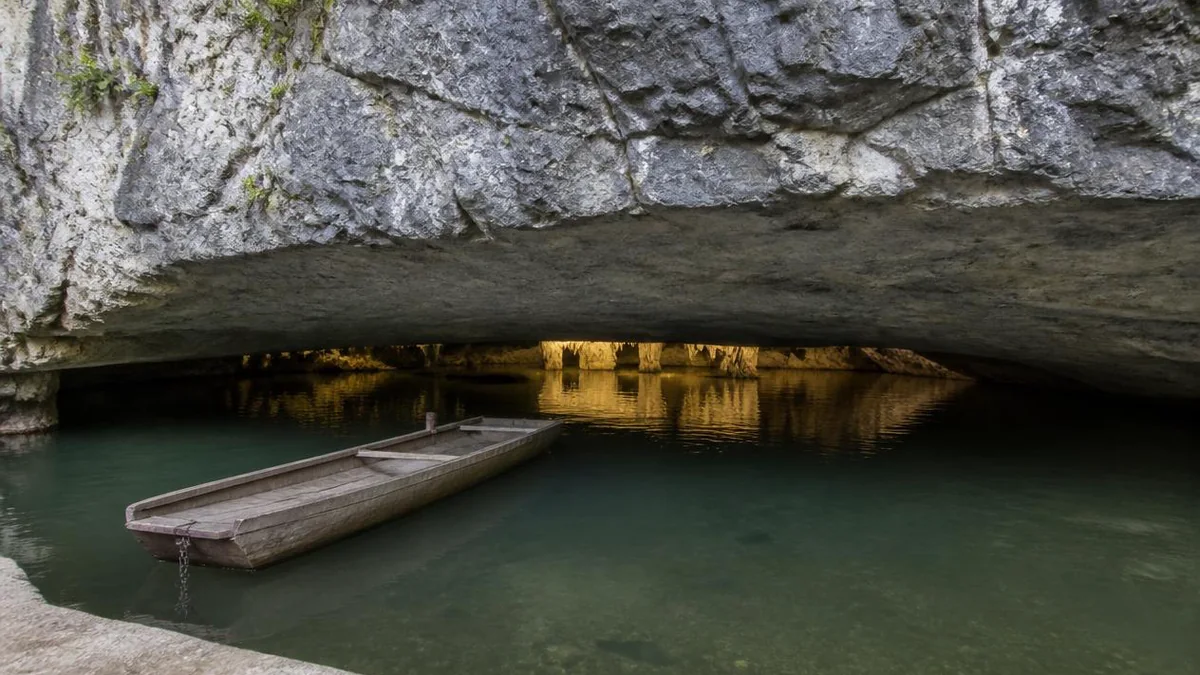
The cave sits on the southern flank of Beishan — North Mountain, also called Jinhua Mountain — a limestone range rising behind the city of Jinhua. The entrance is a wide, low arch with a stream running out of its right-hand side. Inside is the outer chamber, a single dry hall that Chinese sources usually put at around 1,200 square metres.
The inner cave is bigger. Between the two there is no walkable connection at all. There is only the stream channel, and the channel is almost entirely full of water.
The figures vary between sources, as they always do: the crevice is generally given as roughly ten metres long and a few metres wide, with something on the order of thirty centimetres of air between the water and the rock above it. What is not in dispute is the operational consequence. A boat that fits under thirty centimetres of clearance is a boat you lie down in. Historically it took two people side by side and no more; the boats in service today are longer and take several pairs, but the posture has not changed and cannot.
Ye Shengtao’s description of the crossing is the passage every Chinese schoolchild has parsed. He writes that he lay back until the back of his head, his shoulders, his back, his hips and his heels were all pressed against the bottom of the boat, and only then said ready, and the boat began to move; that the light went and the rock on both sides and overhead seemed to be pressing in on him; and that he felt sure that if he raised his head even slightly he would split his forehead and scrape his nose.
It is not a beautiful sentence. It is an exact one, which is why it works on ten-year-olds, and why it still describes the experience seventy years later.
There is one thing the essay does not tell you, because it did not happen to him. The gap you travel through is the top thirty centimetres of a stream. When the stream rises, the gap is not there. After heavy rain the passage is suspended, and the headline attraction of a 5A scenic area is simply switched off by the weather until the water drops.
The man who wrote a cave into the curriculum
Ye Shengtao (1894–1988), born Ye Shaojun in Suzhou, is not a minor figure who happened to write a good travel piece.
He was a novelist — Ni Huanzhi, 1928, a standard novel of the Republican period about a schoolteacher’s disillusion — and he effectively invented modern Chinese children’s literature with The Scarecrow in 1923, usually described as the first original collection of fairy tales written in vernacular Chinese for Chinese children. He spent his working life in publishing, at the Commercial Press and then Kaiming Books, editing other people’s prose.
And after 1949 he ran the People’s Education Press and served as a vice-minister of education.
So the man whose travel essay sits in the primary-school textbook was, for much of the period it sat there, in charge of the organisation that made the textbook. Whatever one makes of that, the outcome is unusually clean: the essay is a genuinely good piece of instructional prose, written by someone who knew exactly what a fourth-grader can hold in their head.
The scale is the part outsiders tend to miss. Chinese school readers are centrally compiled, and since 2019 a single national set has been in use across the country. An essay in a book like that is not read by some children. It is read by essentially every child in the cohort, in the same year, with the same exercises attached — a readership in the hundreds of millions. Ye’s essay has moved between grades and editions over the decades and currently sits in the fourth-grade reader, but it has not left.
What the essay actually says
A Record of Jinhua’s Double Dragon Cave is taught as a model of one specific thing: how to organise a travel account in the order you travelled it. It opens with a bare date, the fourteenth of April, and then moves in a line.
Out of Jinhua about five kilometres to Luodian, and then gradually into the hills. Azaleas on the slopes, tung trees in flower. A stream alongside the road that widens and narrows and speeds and slows, so the sound of it keeps changing key. Then the mouth of the cave, and the outer chamber — which he compares to a great assembly hall, and about which he makes the observation that has followed the cave ever since: that eight hundred or a thousand people could hold a meeting in it and not feel crowded.
Then the crevice, the boat, the ten metres.
Then the inner cave, where the first thing he names is the pair of dragons on the ceiling — one yellow, one green — followed by stalactites and stone pillars, which he declines to catalogue on the grounds that the shapes are what you make of them.
And running through all of it, the water. The spring flows out at the right-hand side of the entrance; in the outer chamber he notices it again; in the inner cave he finds it along the right-hand wall with its source somewhere back in the darkness. Without saying so, the essay traces the drainage of the system from the outlet inward. A writer following a stream because it was there arrived at the structure of the place.
The practical effect today is that the guiding is half redundant. Chinese visitors do not need to be told what the outer chamber is like; they were examined on it. They have come to check whether it matches.
Two dragons, or two stalactites
The name means Double Dragon, and the standard explanation is on the ceiling.
Just inside the inner cave, two long calcite formations run across the roof and come down towards the water gap, one stained yellowish and one greener. They are read as two dragon bodies with their heads dipped towards the crevice, and every guide’s torch goes to them first, as Ye’s eye did.
There is also a folk story about two dragons who took up residence, circulating in several versions.
The honest position is that the causality cannot be recovered. Dragons are the default explanatory animal for Chinese cave and spring names, and this name is old. Whether people saw two dragon-shaped deposits and named the cave for them, or knew the cave as Double Dragon and then found the dragons overhead, is not a question the sources can settle — and on a ceiling that is also officially home to a hanging bat, a spirit of longevity, a peach, a tortoise and a flying horse, the second explanation is at least as likely as the first.
Worth flagging for a first-time visitor to a Chinese show cave: the tour is partly a tour of resemblances. A torch is played over a formation, a name is announced, and you either see it or you politely do not. It is a real tradition rather than a modern gimmick — but reading rock as pictures is not the same activity as looking at rock.
Three caves stacked on one stream
The reason to give this hillside a whole day rather than an hour is that Shuanglong is the bottom cave of a set.
Above it is Binghu Cave — the Ice Pot — and above that Chaozhen Cave, higher, drier and a longer climb. They are not three unrelated holes on the same slope. They are levels of one karst system in the same limestone, cut by the same water at different stages, and the water is still cutting.
That gives the visit an unusual coherence. The stream running out of the mouth of Shuanglong is, by the standard account, the same water you will shortly hear falling inside Binghu. You walk up the outside of the mountain, the water comes down the inside of it, and the two of you meet again at the bottom. A connecting passage now links Binghu down into Shuanglong so the sequence can be walked rather than retraced — a modern convenience laid over a natural arrangement.
One more consequence of being inside a mountain: temperature. The caves hold somewhere around fifteen degrees all year, while Jinhua sits in the Jinqu basin, a bowl of low ground that is reliably one of the hottest places in Zhejiang in July and August, with highs that reach forty. A gap of twenty degrees and more between the car park and the inner cave is why so many August visitors are locals, and why you should carry a layer in a month when carrying a layer feels absurd.
The waterfall inside the mountain
Binghu is the one that surprises people who came for the boat.
It is named for its shape — a vessel with a narrow neck and a wide belly, entered from above by a long stair down through the neck. You hear it before you see it. Somewhere in the dark a stream comes in through the roof and falls, and the sound in an enclosed limestone room is out of all proportion to the water. The drop is commonly given at around fifteen metres. Lit from below, with no horizon and no sky, it reads less as a waterfall than as a rumour of one.
Underground waterfalls of any size are rare, and this massif has produced a second and larger claim. Xianpu Cave, elsewhere in the same range, is promoted on a drop usually quoted at seventy-two metres and billed as the tallest waterfall inside a cave in the world. Treat superlatives of that shape with caution: the category is narrow, the measurement conventions are not standardised, and I have found no independent verification. The drop is real and large. The world ranking is a marketing sentence.
The people who came before the textbook
The caves were not discovered by a schoolteacher in 1957. They appear in gazetteers and literati travel writing long before, and the cliffs around the entrances carry carved inscriptions of several periods. I have not been able to verify the attributions given on the signage, so I am not repeating them.
One earlier visitor is worth naming, because he is the patron saint of exactly this kind of trip. Xu Xiake (1587–1641) was a gentleman of independent means who spent some thirty years walking China with a notebook, and whose field diaries — the temperature of springs and the direction of rock dips recorded as carefully as the scenery — are the founding work of Chinese geographical travel writing. He was a serious describer of caves at a time when almost nobody was doing it systematically.
He reached Jinhua’s caves on his Zhejiang journey in the autumn of 1636 and wrote them up. If you have come to Zhejiang partly for Tiantai Mountain, you have already met him: the dated entry that opens his surviving diary is a Tiantai entry, which is why the anniversary of that day is now China’s national tourism day.
The shepherd boy who shouted at the stones
The other half of this mountain’s fame is a god, and he started as a boy with sheep.
The story is told in the Traditions of Divine Transcendents, a collection of Daoist hagiography attributed to Ge Hong (283–343), the Jin-dynasty alchemist whose Baopuzi is the foundational text of Chinese alchemy — roughly the position Paracelsus holds in Europe, several centuries earlier and considerably more systematic.
According to that account, a Jinhua boy named Huang Chuping, fifteen and working as a shepherd, was taken into these mountains by a passing Daoist and shut himself in a stone chamber to cultivate. He stayed forty years. His elder brother Huang Chuqi searched the whole time and eventually, with a diviner’s help, found him on the mountain.
The brother’s first question was about the sheep.
They are on the eastern hill, said Huang Chuping. The brother went and looked and saw only white stones. Huang Chuping came, shouted at them — sheep, get up — and, the story goes, tens of thousands of sheep stood up out of the rocks. The brother gave up his household and stayed; both became immortals; Huang Chuping took the name Master Red Pine.
The phrase for it, shouting at stones to make them sheep, is still a live idiom in Chinese. The stone chamber is identified with Chaozhen Cave, the highest of the three. Red Pine is a place name on the mountain.
None of this is history and it is not offered as history: a fourth-century text describing events with no independent record, and the identification of a particular cave with the stone chamber is later still. What is historical is everything that happened to the story afterwards.
How a Jinhua shepherd became one of Hong Kong’s busiest gods
Huang Chuping is better known outside the mainland as Wong Tai Sin — the Cantonese reading of Huang Daxian, the Great Immortal Huang.
The cult travelled. The usual account has it moving into Guangdong through a spirit-writing altar in the late nineteenth century, then to Guangzhou, then to Hong Kong around the First World War, when a devotee carried a portrait south. A temple was established at Chuk Yuen in the early 1920s under the Sik Sik Yuen charitable organisation, and it grew into one of the most visited temples anywhere in the world: fortune sticks shaken from bamboo cylinders, Chinese New Year queues that make international news, a reputation summarised in the promise that every request is answered. The surrounding Hong Kong district is now simply called Wong Tai Sin. So is its MTR station.
Then, from the 1990s, the traffic reversed. Hong Kong and Southeast Asian devotees put money into rebuilding the ancestral temple on the mountain where the story started, and the complex you can now visit inside this scenic area is the result — a substantial modern Daoist temple group on the slope above the caves, built partly with offshore money returning to a source it left centuries earlier.
That is the genuinely unusual thing about this hillside. A shepherd boy became a text, the text became a cult, the cult emigrated, prospered abroad, and came home as construction finance.
Dates in this chain vary between sources and I have not been able to reconcile them, so I have given decades rather than years.
The mountain that named a school of philosophy
There is a third layer here, invisible on the ground and worth ninety seconds on the walk up.
To make sense of it you need one name. Zhu Xi (1130–1200) was the philosopher whose synthesis of Confucian thought became the official reading of the classics, and therefore the syllabus of the imperial civil-service examinations, for roughly six hundred years. He holds a position close to the one Thomas Aquinas holds in Catholic theology: not the founder, but the systematiser whose version became the version.
Jinhua had a considerable stake in that world. Lü Zuqian (1137–1181), a Jinhua man, was one of the leading thinkers of his generation and the person who in 1175 convened the meeting at Goose Lake between Zhu Xi and his rival Lu Jiuyuan — the most famous face-to-face philosophical debate in Chinese history, still argued over today. Lü’s own tradition, the Wu learning of Jinhua, was more interested in history and practical statecraft than in Zhu Xi’s metaphysics.
Then came the lineage that took its name from this mountain. The Four Masters of Beishan — He Ji (1188–1268), Wang Bo (1197–1274), Jin Lüxiang (1232–1303) and Xu Qian (1269–1337) — transmitted Zhu Xi’s teaching through four successive generations in Jinhua, He Ji having studied under Zhu Xi’s own son-in-law and disciple. The mountain with the boat cave in it is, in the standard histories of Song and Yuan philosophy, the name of a school.
The line kept going. Song Lian (1310–1381), out of the same Jinhua scholarly world, became tutor to the founding Ming emperor’s heir and chief compiler of the official history of the Yuan — a provincial teaching lineage on this hillside writing the state history of a fallen empire.
Partway up the mountain, at Lutian, an old academy building survives in a late-Qing rebuilding — a quiet stop that almost nobody who came for the boat goes into.
The city below, and the two streams
Jinhua itself deserves an afternoon, and it starts with the name.
The traditional explanation reads Jinhua — golden splendour — from an astrological line about the planet Venus and the Wu maiden star contending in brilliance over this place. Hence the old name Wuzhou, which survives in Wuju, one of Zhejiang’s major traditional opera forms and one of the more acrobatic.
Two rivers meet in the city, and the confluence is called Shuangxi, the Twin Streams. Which means that Jinhua’s two best-known place names are Twin Streams at the bottom and Twin Dragons at the top.
The Twin Streams have a poem attached, by one of the most celebrated writers in the language. Li Qingzhao (1084–c.1155) is China’s pre-eminent woman poet: a scholar’s daughter and an art collector’s wife whose settled life ended when the Jurchen conquest drove her south in 1127, and whose later work is the standard reference point for loss in Chinese literature. She was in Jinhua in the mid-1130s as a refugee, and there she wrote the lines about hearing that spring was still good at the Twin Streams and thinking of taking a boat out — then fearing that the little grasshopper boats there could not carry so much sorrow. She also left a couplet on Jinhua’s Eight Chants Tower: the glamour of a thousand years gone, the rivers and hills left for later generations to grieve over.
Two footnotes, because visitors are routinely surprised by what else is in this prefecture. Yiwu, half an hour away, is the largest wholesale market for small manufactured goods on earth and the source of an astonishing share of the world’s Christmas decorations, hair clips and promotional keyrings. And Hengdian, in Dongyang, is the largest film studio complex in the world by area. A cave from a school essay, the global tinsel exchange and China’s Hollywood are administratively the same city.
The pig with two black ends
You will see the ham before you eat it: dark red, dense, hanging in shop windows on the bone.
Jinhua ham is one of the few Chinese ingredients that translates without explanation, because the European equivalent is exact. It is a dry-cured hind leg — salted in the cold months, pressed, washed, sun-dried, aged — and it stands in the same relation to Chinese cooking that prosciutto does to Italian. The traditional pig is the local two-ends-black, a breed with a black head and black hindquarters and a white middle, which is as literal a name as livestock breeding has ever produced.
The difference from Parma is in the use. Jinhua ham is more often a seasoning than a course: a few slices steamed on a fish, laid over a chicken, or simmered to give a stock its savoury backbone. Honey-glazed ham with lotus seeds is the classic banquet treatment.
Tradition credits the invention to Zong Ze (1059–1128), a general from Yiwu who commanded the defence of the Song capital against the Jin and is a standard emblem of loyal resistance in Chinese memory. The story goes that he sent salted pork from his home district to the throne, and the emperor, struck by the colour of the cut meat, named it fire leg. Widely repeated, and tradition rather than record. The further claim that Marco Polo carried the technique to Europe has no support at all.
The other two local specialities are the Buddha’s-hand citron, a fragrant many-fingered fruit grown here as ornament and medicine, and the flaky sesame-crusted pastries sold hot off the oven wall.
Going
Give the hillside most of a day, and go up it in order: Shuanglong first, Binghu above it, Chaozhen if your legs are willing, the Huang Daxian temple complex and the Lutian academy after that.
Go early. The bottleneck is arithmetic — the boat passage moves a handful of people at a time, in both directions, through a single channel, and no amount of site management can change that. On a public holiday the queue at the crevice is the reason to be at the gate when it opens.
Two practical warnings: carry a layer whatever the season, and if there has been serious rain in the preceding days, check that the passage is running before committing to the trip.
Finally, an honest calibration. Shuanglong is not a great cave by world standards — not Mammoth, not Postojna, not the enormous flowstone chambers at Zhijin in Guizhou. The chambers are modest, the lighting is coloured, the formations have names assigned to them, and the whole thing can be walked in ninety minutes.
What it has instead is something almost nowhere else has. For seventy years a specific ten metres of this cave has sat in a schoolbook that a nation’s children read at the same age, described in flat, exact, unshowy sentences by a man who went on to run the ministry that printed it. Half the people in the queue can still recite the bit about the back of the head and the shoulders and the heels. They are not queuing for a cave.
They are queuing for a paragraph, and it is still true.
The LoreLens app can identify the named formations in Shuanglong’s inner cave, the halls of the Huang Daxian temple complex and the plants on the walk up, and explain what Ye Shengtao’s essay says about the spot you are standing on, in your own language, offline.
Location profile
Where it is

Frequently asked questions
What is actually inside the Shuanglong 5A area?
Three caves stacked up one hillside — Shuanglong at the bottom, Binghu above it with a waterfall inside, and Chaozhen higher and drier — plus the Huang Daxian ancestral temple complex and the old mountain academy at Lutian. The names cause confusion. Shuanglong Cave is one cave; Shuanglong Scenic Area is the mountainside it sits on; the State Council's national scenic and historic interest area covers a wider stretch of the same range. A ticket to one is not automatically a ticket to all.
Do you really have to lie flat in a boat, and can it be skipped?
Yes, that is genuinely the only way the water passage is travelled: flat on your back on a low boat an attendant hauls through on a rope, hands inside the gunwales, head down. The clearance above the water is usually quoted at around thirty centimetres, and the rule about not raising your head is enforced rather than suggested. If enclosed spaces are a problem, ask at the gate what the alternatives are that day — arrangements vary and the staff on duty are the only reliable source.
When does the passage close?
After heavy rain. The gap you travel through is the top thirty centimetres of a stream channel, so when the stream rises the gap disappears and the crossing is suspended until it drops. Jinhua sits in the East China rain belt and the plum rains of June are the most likely disruption. This is worth checking before a long detour, because the boat is the reason most people come.
What is the best season?
Mid-April is the month in Ye Shengtao's essay, and it is a fair recommendation — azaleas on the slopes, comfortable walking, the stream running. High summer has a different logic: Jinhua sits in a basin that is one of the hottest places in Zhejiang, regularly touching forty degrees, while the caves hold somewhere near fifteen degrees all year. Bring a layer whatever the month; people arrive in shorts and come out shivering.
Is the Huang Chuping story connected to Hong Kong's Wong Tai Sin?
It is the same figure. Wong Tai Sin is the Cantonese reading of Huang Daxian, the Great Immortal Huang, and the hagiography places his cultivation on this mountain outside Jinhua. The cult reached Guangdong in the late nineteenth century and Hong Kong in the early twentieth, where the temple at Chuk Yuen became one of the most visited in the world and gave its name to a whole Hong Kong district. From the 1990s the traffic reversed, and Hong Kong and Southeast Asian devotees helped fund the ancestral temple you can visit here.