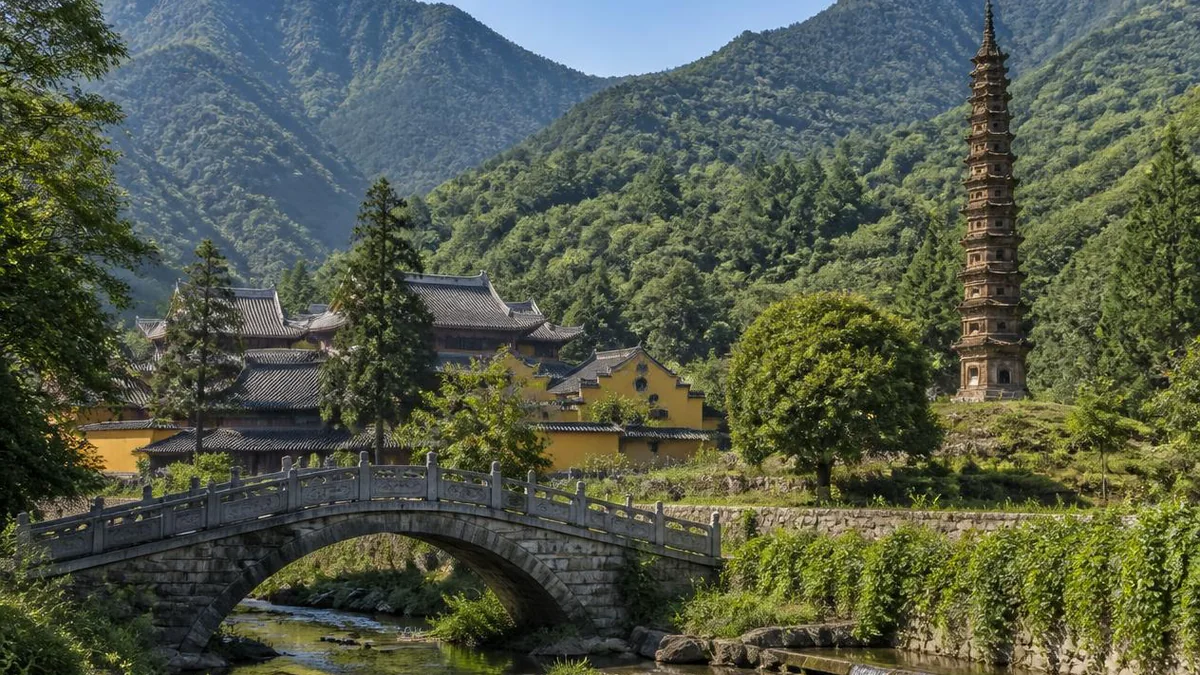
Zhejiang · Taizhou
Mount Tiantai: The Mountain That Exported a Religion
China's National Tourism Day falls on 19 May because that is the date, in 1613, on which a twenty-six-year-old opened a diary and walked into this mountain. Twelve centuries earlier a Japanese monk had walked out of it carrying the texts that became Tendai, and, if the shrines are right, a handful of tea seeds.
5A View location, maps and nearby scenic areasChina has a national holiday for tourism. It falls on 19 May, and the date was not chosen for the weather.
On the last day of the third lunar month of the guichou year — 19 May 1613 by our calendar — a twenty-six-year-old from Jiangyin named Xu Xiake (1586–1641) walked out of the west gate of Ninghai and began keeping a diary. He kept it for twenty-six years, and it became the Travel Diaries of Xu Xiake, the founding work of systematic field geography in China. In 2011 the State Council took the date of its opening sentence and made it China’s National Tourism Day. The book’s first chapter is called Diary of a Journey to Mount Tiantai; he entered the mountain the next morning.
That is one claim this place makes. Here is the other. In 804 a Japanese monk landed at Ningbo, walked south to this mountain, stayed 135 days copying everything he could, and went home to found the school of Buddhism that trained almost every major religious innovator in medieval Japan. Two and a half centuries later a Korean prince did something structurally similar.
So a mountain in a small county in eastern Zhejiang is the origin point of Japanese Tendai and Korean Cheontae, an ancestral seat of Daoist internal alchemy, the birthplace of the folk saint Jigong, the cliff of the poet Western readers know as Cold Mountain, and the first page of Chinese travel literature. It is 187.1 square kilometres, and its highest point is under 1,100 metres.
First, which Mount Tiantai
The name is not unique, and the confusion is getting worse.
This mountain is in Tiantai County, Taizhou, in eastern Zhejiang, about 220 kilometres from Hangzhou. A different Mount Tiantai sits at Qionglai near Chengdu, in Sichuan: 29.1 square kilometres, a main peak of 1,812 metres, danxia gorges — and promoted to 5A in December 2024, so China now has two 5A-rated Mount Tiantais. A third, at Baoji in Shaanxi, covers 133.34 square kilometres of Qinling granite, has been a national scenic area since 1994, and is bound up with the legend of the Yan Emperor. Two of the three hold that national title, so the phrase distinguishes nothing. What distinguishes the Zhejiang one is that a school of Buddhism is named after it.
The name is astronomical. The Liang-dynasty Daoist scholar Tao Hongjing (456–536), in the Zhen’gao, describes a mountain of eight folds lying under the Ox and Dipper lodges and corresponding above to the tai asterism, the Three Terraces. Hence Tiantai, the Heavenly Terrace. The rock is granite, and the main peak, Huading, reaches 1,098 metres.
The man who gave his name to a school
Zhiyi (538–597) is the reason any of this exists.
By formal lineage he is the fourth patriarch of the Tiantai school; in practice he is its founder, and Chinese tradition calls him the Little Śākyamuni of the East. He came into these mountains in 575, at thirty-eight, and made them his base.
Chinese Buddhists of the sixth century had received the Indian scriptures in no particular order, in translations of wildly varying quality, and the sutras contradicted one another. Zhiyi’s answer was a periodisation — the five periods and eight teachings — sorting the whole received library into a developmental sequence in which the contradictions become stages of a single pedagogy. It is the closest thing in Chinese religion to a systematic theology, and later schools had to argue with it rather than ignore it.
Two formulas carry his metaphysics. The threefold truth holds that emptiness, provisional existence and the middle are not three sequential insights but one, mutually containing. The three thousand realms in a single moment of thought holds that every possible state of existence is present, entire, in any instant of ordinary mind. The school takes the Lotus Sutra as its highest teaching, and is also called the Lotus school.
In 591 the future Emperor Yang of Sui — then Yang Guang, Prince of Jin and governor of Yangzhou — had Zhiyi administer the bodhisattva precepts to him. Zhiyi gave the prince the dharma name Zongchi; the prince gave Zhiyi the title Zhizhe, the Wise One, by which he has been known ever since. He refused repeatedly and agreed only after four conditions were accepted, which is a rare glimpse of a monk negotiating terms with a Sui prince.
He died in 597, aged sixty, on the road at Shicheng, and was buried at Folong on this mountain. His tomb complex, now the Zhizhe Pagoda Court, holds a stone pagoda about seven metres high and a stele of 811 composed by the Hanlin academician Liang Su. Pilgrims from Japan, Korea and Southeast Asia generally walk the five kilometres up.
A temple built on a dead man’s instruction
Guoqing Temple was begun in 598, the year after Zhiyi died, at his own instruction and at Yang Guang’s expense.
Its name comes from a dream. The Southern Song Jiading Gazetteer of Chicheng records that the deity Dingguang appeared to Zhiyi and said when the temple is built, the country will be at peace. The plaque reading Guoqing — country at peace — was conferred in 605.
The published figures disagree in a way worth flagging. Chinese sources give 73,000 square metres of ground, 28,000 of building and more than eight hundred rooms; English-language accounts more often say around 23,000 square metres, fourteen halls and some six hundred rooms. Nobody is lying: the walled precinct and the built footprint are different objects, and the sources rarely say which they mean.
What you actually see, in order:
- The Sui pagoda, on the slope before the gate. Hexagonal, nine storeys, sides of 4.6 metres, surviving height 59.4 metres (a few sources say 59.3). Yang Guang raised it in 598 as a pagoda of repaying kindness, for the precepts Zhiyi had given him. Fire took the wooden eaves and bracket sets, so the shaft stands open at the top and hollow through the middle, the brick oxidised to a deep crimson. Repaired in 1128 and again in 1973.
- The Sui plum, beside the main hall, traditionally planted by Guanding (561–632), Zhiyi’s disciple, the compiler of his lectures and the fifth patriarch — which would make it over 1,300 years old. The temple’s own story is that it died back for several years and put out flowers again in 1973, when restoration began. Hold that one lightly: the tree is real, the timing is a temple story.
The 1973 restoration was ordered on Zhou Enlai’s instruction, ahead of the Japanese delegations everyone knew were coming. Guoqing was listed as a nationally protected site in 2001, in the fifth batch — some write-ups say 2006 and the sixth batch, which is a different list. Admission is free.
Kyoto, Seoul, and three stone slabs
Saichō (767–822) joined the Japanese embassy to Tang China, and his ship reached Ningbo in 804. Given leave to travel to Mount Tiantai, he was introduced to Daosui, the seventh patriarch, and studied also under Xingman. He could read Chinese but not speak it. He stayed 135 days, spent most of them making accurate copies of Tiantai texts, and was home by the sixth month of 805. He founded Enryaku-ji on Mount Hiei above Kyoto.
The consequence is larger than the school. Mount Hiei became the training seminary of Japanese Buddhism, and the founders of nearly every later Japanese school passed through it: Hōnen and Shinran of the Pure Land traditions, Dōgen of Sōtō Zen, Eisai of Rinzai, and Nichiren. Tiantai texts had reached Japan earlier — tradition credits Jianzhen, the blind monk who got there in 753 after five failed crossings — but they did not take root until Saichō.
The Korean transmission is later and different in character. Ŭich’ŏn (1055–1101), fourth son of King Munjong of Goryeo, ordained at eleven, left for Song China in 1085 without royal permission. He met Emperor Zhezong and is recorded as having held discussions with more than fifty eminent monks. He returned in 1086 convinced that Tiantai doctrine could reconcile the long quarrel between the doctrinal and meditation schools at home. The Korean Cheontae school is traditionally dated to 1097.
The modern relationship has a monument. The Japanese Tendai school proposed stelae at Guoqing in 1980, and the unveiling was held on 19 October 1982. Three stelae stand in a triangle inside a hexagonal pavilion aligned with the Sui plum: at the centre an ode in praise of Great Master Zhizhe, 2.6 metres high and 1.26 wide; on the right Xingman’s farewell poem to Saichō; on the left a record of Saichō obtaining the dharma at Tiantai. The faces were composed and written by Zhao Puchu, president of the Buddhist Association of China. At the unveiling Yamada Etai, 253rd abbot of Enryaku-ji, led a delegation of 146 people. The plaque reads the milk of the dharma, a thousand autumns.
Tea went the same way
Along the same route, according to the temples, went tea.
The tradition at the Hiyoshi tea garden in Ōtsu, at the foot of Mount Hiei, is that Saichō brought seeds back from Tiantai and planted them there in 805, which would make it the oldest surviving tea garden in Japan. The caveat is chronological and severe: the earliest Japanese text recording the story is the Hiyoshi-sha Shintō Himitsuki, compiled around 1575 to 1577, nearly eight centuries after the event. Korea has a parallel note of the same kind — the Samguk Sagi records that in 828 a Silla envoy named Daeryeom brought tea seeds back from Mount Tiantai, planted on Jirisan.
The better-attested link is Eisai (1141–1215), who entered Song China twice and on the second visit spent four years under Xu’an Huaichang at Wannian Temple on this mountain and at Tiantong near Ningbo. He carried home the Linji line of Chan, which became Japanese Rinzai Zen, and, in 1191, tea plants and seeds; he founded Kennin-ji in Kyoto and wrote the Kissa Yōjōki, Japan’s first book about tea.
Take all of it as monastic tradition rather than agronomic history — more than one place claims Japan’s oldest tea garden. The pattern is what holds: for four centuries this was a mountain people came to and left carrying things.
One stone across the sky
Twenty-two kilometres north of the county town, a slab of granite spans a gorge with a waterfall going under it. Shiliang — the Stone Beam — is the most photographed thing on the mountain and the one Xu Xiake found most alarming.
It is a granite natural bridge, which is unusual; natural bridges normally form in limestone or sandstone. Fieldwork by the academician Wang Sijing and the researcher Yang Zhifa attributes it to two steep joint sets and one gently inclined set inside the rock mass, plus a stepped waterfall supplying enough scour to exploit them.
Its dimensions vary by source in a way that is almost comic given how small it is. Baidu Baike gives a length of six metres, a cavity height of 2.3 metres, a back only 0.2 to 0.3 metres wide, and a fall of 35 metres; Zhejiang Online gives over seven metres long, twenty centimetres at the narrowest, and a fall of thirty-odd metres. The Song calligrapher Mi Fu (1051–1107) carved four characters here meaning the first wonder; the late-Qing reformer Kang Youwei carved the name of the fall itself.
The gorge also carries the oldest arhat cult in China. In the Xingning era of the Eastern Jin — 363 to 365 — the monk Tanyou is said to have dreamt of five hundred arhats lingering among the eight peaks and two streams, which Chinese sources treat as the first manifestation of the five hundred arhats on Chinese soil. Three temples called Fangguang grew up around the fall: the upper one, twice burned and now gone; the middle one, the Tanhua Pavilion, put up by the Southern Song chancellor Jia Sidao so that his elderly father could sit and watch the water; and the lower one, rebuilt in 1101, its name-board written by the Ming calligrapher Dong Qichang, still holding a hall of gilt arhats. On the first day of the lunar new year local people go in to count the arhats as a form of divination.
Four hundred and fifty-one poets
Eastern Zhejiang has a marketing name for a real phenomenon: the Tang Poetry Road, running from the Qiantang River through Shaoxing, along the Cao’e River and Shan Creek and up into the hills. Of the more than 2,200 poets in the Complete Tang Poems, 451 are reckoned to have travelled it, leaving over 1,500 poems — about a fifth of all the named poets in the anthology. The destination at the far end is this mountain.
The text that started it is older than the Tang. Sun Chuo (c. 314–371), an Eastern Jin literatus, wrote the Rhapsody on Roaming Mount Tiantai, the founding document of Chinese landscape writing about this range — and, on the internal evidence, the work of a man who may never have got there. Li Bai (701–762) supplies the line everyone quotes: in Dream Journey to Tianmu he measures another mountain’s height by saying that Tiantai, forty-eight thousand zhang tall, tilts southeast before it. Sources disagree about how often he actually climbed it, some saying twice and some three times.
Cold Mountain, who may not have existed
Some thirty li southwest of the county town there is a cliff with a cave in it called Hanyan, Cold Cliff. Around three hundred poems survive under the name Hanshan — Cold Mountain — attributed to a recluse who took the name from the rock he lived on, and who reportedly wrote on tree trunks, boulders, cave walls and the walls of other people’s houses.
In Chinese and Japanese painting he appears as one of a trio: himself; Shide, “Foundling”, a kitchen hand at Guoqing said to have been abandoned as a child and raised by the monk Fenggan; and Fenggan, who rides a tiger. The story binding them comes from a preface attributed to an official named Lüqiu Yin: Fenggan tells him that Hanshan is Mañjuśrī in hiding and Shide is Samantabhadra, and when the official goes to pay his respects the two men laugh at him and refuse to speak. Guoqing built a Hall of the Three Worthies for them in 1015.
Almost none of this survives scrutiny. Modern scholarship treats the preface as a later fabrication; the critic Shi Zhecun pointed out that the earliest record of Hanshan describes him simply as a Tiantai hermit whose poems were edited into three fascicles by a Daoist of Tongbai Palace named Xu Lingfu — no Fenggan, no Shide, no Guoqing Temple. The dates offered for him span nearly two centuries: the Zhenguan era (627–649), the Xiantian era (712–713) and the Dali era (766–799). The claim that he lived here seventy years may be a misreading, since the old preface locates Cold Cliff seventy li west of the county seat.
What is not in doubt is what happened to him afterwards, twice.
In 1733 the Yongzheng emperor canonised Hanshan as the Sage of Harmony and Shide as the Sage of Union — the He-He Erxian, who became the Chinese folk gods of concord and of marriage. They are the two laughing boys on wedding furniture and door panels across Jiangnan, one holding a lotus and the other a covered box, both objects being homophones for the syllables of their title. Taizhou now brands itself around “harmony culture” on this basis.
Then, in 1953, a graduate student at Berkeley named Gary Snyder was told by his professor Chen Shih-hsiang that if he wanted Buddhist poems in the vernacular, Han Shan was his poet. Snyder translated twenty-four and published them with Riprap in 1956; Jack Kerouac dedicated The Dharma Bums to Han Shan. A hermit whose historical existence is doubtful thereby became both a Chinese wedding deity and a patron saint of the American counterculture, out of the same three hundred poems.
The Daoist half
The mountain’s own slogan is ancestral seat of Buddhism, source of Daoism, and the second half is not decoration.
Chicheng Hill, two kilometres north of the town, is the red gate of the range: 1.3 square kilometres of horizontally bedded Mesozoic red sandstone and conglomerate, textbook danxia landform. Near its summit is Yujing Cave, ranked sixth of the ten great grotto-heavens of Daoism. The Liang Consort Pagoda stands 29.7 metres, four-sided, seven storeys of mixed brick and clay, at an elevation of 307.6 metres; tradition dates its founding to 538, when a prince of the Liang house built it for his consort, which would make it the oldest structure on the mountain. The building you photograph was rebuilt in 1947 and repaired in 1978.
The more consequential Daoist site is Tongbai Palace. A hall is said to have been founded here in 238 by the alchemist Ge Xuan at the order of Sun Quan, ruler of Wu; an observatory was established by imperial edict in 711; it was raised to the rank of gong, palace, between 907 and 910. Sima Chengzhen (647–735), the most politically connected Daoist of the high Tang, lived here for forty years.
And here Zhang Boduan (983 or 984–1082), a Tiantai man, wrote the Wuzhen pian in 1075 — a manual of internal alchemy in verse that rejects laboratory alchemy for physiological and meditative cultivation, and argues that the great recluse hides in the marketplace rather than the mountains. He is the founder of the Southern School of internal alchemy. Where he wrote it is disputed: the Ming monk Chuandeng’s Tiantai shan fangwai zhi makes him a Tiantai man who composed it here, while Linhai claims his residence and the writing of the book, and some scholars doubt the Linhai case.
Then, in 1973, the Tongbai reservoir filled and the palace went under the water. Some buildings and objects were moved to the nearby Minghe Guan, and rebuilding on a new site above the waterline began in 2005. Note the coincidence of dates without over-reading it: the same year the state restored Guoqing Temple for its foreign guests, it drowned the ancestral seat of Daoist internal alchemy for a reservoir.
Two stories the mountain tells about itself
The first is the oldest tourist legend in China about getting lost on purpose.
Liu Yiqing’s fifth-century Youming lu tells of Liu Chen and Ruan Zhao, two men from Shan county who came into these hills to gather bark for paper, lost the way out, and after thirteen days had eaten all their food. They climbed a cliff, found peach trees, went down to drink, and saw turnip leaves and sesame rice floating down the stream. Following it up, they met two women who knew their names and took them home. They stayed half a year. When they got back to their village, seven generations had passed, and they could not find the way in again; the creek where they stood is called Chóuchàng, Rueful. The story is a candidate source for Tao Yuanming’s Peach Blossom Spring and was painted as a handscroll by Zhao Cangyun now in the Metropolitan Museum of Art.
The second is a man who really lived. Daoji (1148–1209, though some sources give 1130), born Li Xiuyuan in what is now the Chicheng subdistrict of this county, is the monk the whole Chinese-speaking world knows as Jigong — the drunken, rule-breaking wonder-worker of several centuries of storytelling, opera and television. The biography behind the legend is ordinary: he studied as a boy at a cave on Chicheng Hill, lost both parents, entered Guoqing Temple, took full ordination under Xiatang Huiyuan and the name Daoji, then went to Lingyin Temple in Hangzhou, where the folklore properly begins. He is counted the fiftieth patriarch of Chan. His rebuilt former residence covers about 16 mu, with 6,310 square metres of building.
What the 5A rating actually covers
As with a lot of Chinese 5A designations, the answer is a container rather than a place, and the container has at least three published sizes.
The national scenic area, approved by the State Council in 1988, is 187.1 square kilometres, divided into thirteen sub-areas — among them Guoqing, Chicheng, Folong, Shiliang–Tonghu, Huading, Qiongtai and Hanshan Lake. The 5A rating was announced in October 2015: the list was posted for comment on 8 October and confirmed the next day, making Mount Tiantai and Shenxianju jointly Taizhou’s first 5A areas. The county’s response was a public promise of more A, no more yuan.
But the scenic area’s own website separately describes a tourism scenic area of 5.4 square kilometres, comprising just two blocks, Guoqing and Shiliang. And the material prepared for the original 5A application spoke of 131.75 square kilometres in fifteen areas. Three numbers, all official, none wrong, describing three different administrative objects. In practice what you buy is individual tickets, priced at the time of writing and worth re-checking before you go: Guoqing free, Shiliang 60 yuan, Qiongtai Xiangu 65, Huading forest park 50, Jigong’s former residence 30, Chicheng Hill 15, the Grand Waterfall 100, with a Guoqing-plus-Shiliang combination at 70.
The Grand Waterfall needs its own paragraph, because it is the most spectacular single sight in the area and the most complicated to describe honestly. Its total drop is 325 metres across a stepped series, with a maximum width given as 90 or 100 metres, and it is promoted as the highest waterfall in China. It was dry for roughly sixty years, because the Tongbai hydroelectric station had the water. The flow was restored in April 2020, and on 31 December 2020 the block was rated 4A — a 4A sight inside the 5A mountain’s marketing, and a natural landform whose water supply is a management decision. The same block carries the Huixian Bridge, opened on 1 October 2021, with more than a hundred metres of drop beneath it. If you want the mountain of Zhiyi and Hanshan, this is not the block to start with.
Visiting
Until 8 January 2022 this county had no railway of any kind. That day the Hangzhou–Shaoxing–Taizhou high-speed line opened — 266.9 kilometres, designed for 350 km/h, and the first majority privately-owned railway built in China — with a station called Tiantaishan about twelve kilometres from the scenic area. Hangzhou to Taizhou now takes about an hour, and the station’s name-board characters are adapted from the handwriting of Zhao Puchu, the man who wrote the 1982 stelae inside Guoqing.
Season matters more here than at most places. Huading is a national forest park with forest cover above 95 per cent, and its cloud-brocade rhododendrons flower from late April to mid-May: trees three to four metres tall, six to twelve blooms to a cluster. Summer is when locals come up to escape the heat of the coastal plain. In hard winters the Shiliang fall freezes into a hanging column of ice.
Two days is the honest minimum: Guoqing and Qiongtai on one, Chicheng, Jigong’s house and Shiliang on the other. Most sites open around 08:00 and stop selling tickets by 16:00. Prices change with the season, so confirm on arrival rather than from any article, this one included.
And go to Guoqing early, before the coaches. It charges nothing, it is a working monastery with a two-yuan vegetarian meal, and it is the only place in the country where you can stand in a courtyard between a 1,400-year-old brick pagoda, a plum tree a disciple of the founder is said to have planted, and three stone slabs erected in 1982 by monks from Kyoto who came to say that everything they have came from here.
The LoreLens app can identify the halls, pagodas and stone inscriptions at Guoqing and Shiliang, and explain who Zhiyi, Hanshan and Jigong were, in your own language, offline.
Location profile
Where it is

Frequently asked questions
What is actually inside the Mount Tiantai 5A area, and what costs money?
The national scenic area covers 187.1 square kilometres in thirteen sub-areas, but only a handful are ticketed sights, and they are sold separately rather than as one gate. Guoqing Temple is free; Shiliang Waterfall is 60 yuan, Qiongtai Xiangu 65, Huading forest park 50, Jigong's former residence 30, Chicheng Hill 15, the Grand Waterfall 100, with a Guoqing-plus-Shiliang combination at 70. The scenic area's own website separately describes a 5.4-square-kilometre core of just two blocks, Guoqing and Shiliang. Prices change every season, so check before you buy.
Is the Grand Waterfall part of the 5A, and is it natural?
It is marketed under the Mount Tiantai umbrella but carries its own 4A rating, awarded on 31 December 2020. The 325-metre drop is a real landform, but it ran dry for roughly sixty years after the Tongbai hydroelectric station took the water, and was returned to flow in April 2020. So the biggest spectacle in the area is, in a literal sense, switched on. Treat it as engineering theatre on a genuine cliff rather than untouched nature.
Why do Japanese and Korean visitors come here?
Guoqing Temple is the ancestral temple of the Tiantai school, which became Tendai in Japan and Cheontae in Korea. Saichō studied here for 135 days in 804 to 805 and went home to found Enryaku-ji on Mount Hiei, the seminary where Hōnen, Shinran, Dōgen, Nichiren and Eisai all later trained. The Goryeo prince-monk Ŭich'ŏn travelled to Song China in 1085, and the Korean Cheontae school is traditionally dated to 1097. In October 1982 the abbot of Enryaku-ji brought a 146-person delegation to unveil three stelae inside Guoqing, still standing there today.
Which Mount Tiantai is this? I keep finding a different one.
There are at least three. This is the one in Tiantai County, Taizhou, in eastern Zhejiang. A separate Mount Tiantai at Qionglai near Chengdu, in Sichuan, was itself made a 5A area in December 2024, which makes the confusion worse rather than better. A third, at Baoji in Shaanxi, has been a national scenic area since 1994 and is tied to the legendary Yan Emperor. Searching for Guoqing Temple, Zhiyi, or the Tiantai school will get you the Zhejiang one.
When should I go, and how do I get there?
Late April to mid-May, for the cloud-brocade rhododendrons at Huading, the 1,098-metre main peak, where the flowering trees stand three to four metres tall. Summer is the coolest air in the region and autumn the clearest. In deep winter the Shiliang fall sometimes freezes into a hanging ice column. The Hangzhou–Taizhou high-speed line opened on 8 January 2022 and gave the county its first railway station of any kind, Tiantaishan, twelve kilometres from the scenic area.