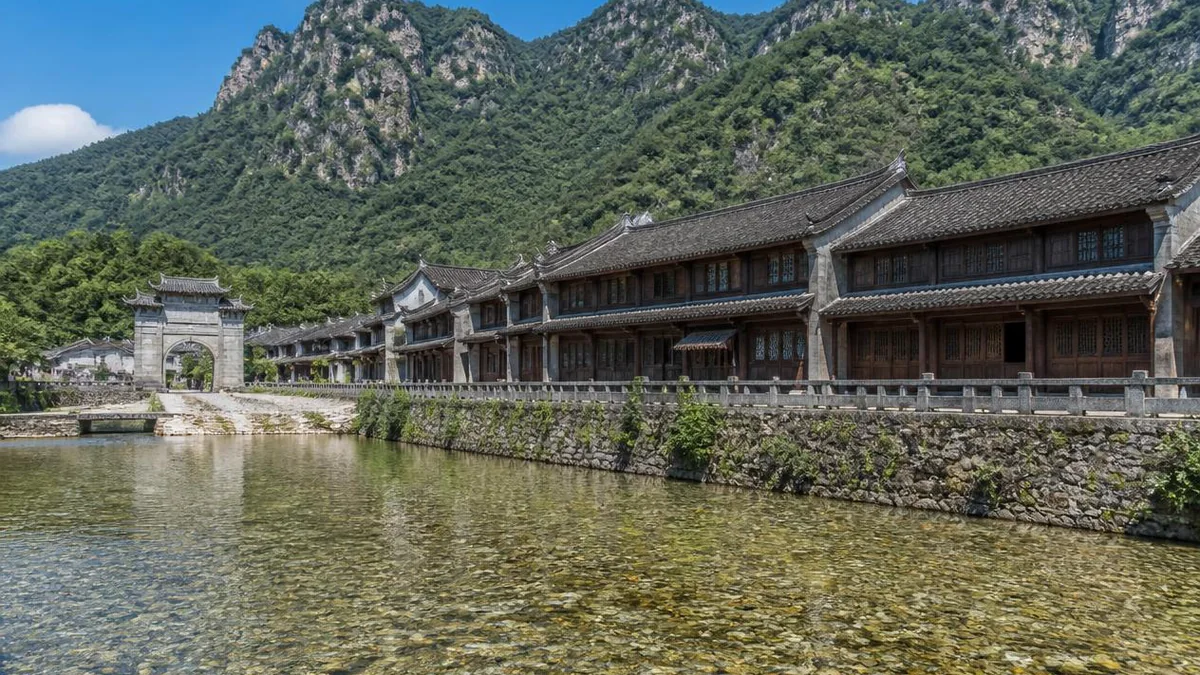
Zhejiang · Ningbo
Xikou and Tengtou: A Birthplace, a Buddha and a Model Village on One Ticket
In April 1949 Chiang Kai-shek came down from his mother's grave above Xikou, got into a boat on the Shan Stream, and never saw the mainland again. His salt-shop birthplace, the temple mountain behind it, and — a short drive away — a village that became nationally famous in the 1990s for its refusal of polluting factories are all bundled into a single 5A designation. Nothing connects them except the county line.
5A View location, maps and nearby scenic areasOn 25 April 1949 a man in his early sixties came down from a grave enclosure on a hillside in eastern Zhejiang, walked to the water, and got into a boat.
He was Chiang Kai-shek (1887–1975), and depending on which week you asked, he was either the President of the Republic of China or a private citizen — he had announced his retirement from the presidency three months earlier and had gone home, while continuing to direct the Nationalist party and, by most accounts, the government with it. His armies were losing the civil war faster than anyone had forecast. Nanjing, the capital, had fallen two days before.
He had arrived in Xikou in January. He spent the intervening three months receiving visitors, walking in the hills above the town, and running a collapsing state by telephone from the village where he was born. Then he left, and he never returned to the mainland.
Fifty years after his death he is still not buried. His coffin, and his son’s, remain in temporary entombment in Taiwan, on the stated understanding that they will one day come back to Xikou.
That is one half of a 5A scenic area.
The other half is a village a short drive away that became nationally famous in the 1990s for composting, for planting trees, and for turning down factories.
One rating, two unrelated subjects
The 5A designation is China’s top tier of scenic-area certification, and it is worth understanding what it does and does not claim. It grades facilities, management, signage, toilets, transport and visitor throughput as much as it grades content. It says nothing at all about coherence. Roughly a third of the country’s 5A areas are containers — administrative baskets that hold several things at once, sometimes an hour apart, because a joint application clears the bar that a single site would not.
Xikou–Tengtou Tourist Area, in the Fenghua district of Ningbo, is one of the more honest examples, because the hyphen is right there in the name.
The Xikou side is a town of about three streets along the Shan Stream, where the Chiang family lived, plus the mountain immediately behind it. Its content is of two completely different kinds: a set of preserved residences belonging to the most consequential and most contested Chinese political figure of the twentieth century, and a Buddhist temple mountain with a famous waterfall, patronised by emperors and, later and rather usefully for the temple, by Chiang himself.
The Tengtou side is a functioning agricultural village of a few hundred households in Xiaowangmiao, near Fenghua’s town centre. Its content is a landscape of orchards, nurseries, canals and demonstration plots, and a forty-year institutional story about rural environmental policy.
Fenghua itself was a county-level city until it was converted into a district of Ningbo in the 2010s, which is why older signage and older sources call the same places by different administrative names. The joint 5A rating was granted in 2011, some years after each half had built its own reputation independently.
Nothing in the Chiang residences explains Tengtou. Nothing in Tengtou explains the Chiang residences. If you go expecting a single narrative, you will spend the day trying to construct one, and the constructions available are all political. It is better to treat this as two trips that happen to share a ticket office — the way Wuzhong Lake Tai in Suzhou is really three trips, or the way you would not expect the Tianyige library and Moon Lake in central Ningbo to be about the same thing.
The salt shop
Start at the eastern end of the old street, at a two-storey building with a shop front.
Yutai Salt Shop was the Chiang family business. Salt in imperial China was a state monopoly distributed through licensed retailers, which made a salt shop a respectable small-merchant living rather than a peasant one — a distinction that matters for reading everything that follows. Chiang’s father and grandfather ran it. Chiang was born in an upstairs room here on 31 October 1887, in the thirteenth year of the Guangxu reign.
The building has burned and been rebuilt more than once, and what stands today is a reconstruction with a stone marker identifying it as the original site. The reconstruction is honest about itself. The shop interior is fitted out with scales, jars and ledgers of the period.
Four names are useful before you go further into the site, because the labels use different ones and visitors reasonably assume they refer to different people:
- Ruiyuan, the milk name a Chinese child was called at home
- Zhoutai, the genealogical name entered in the clan register
- Zhiqing, and later Zhongzheng, the formal given names — Zhongzheng is the name he is known by in Taiwan to this day, and the one on the Taipei memorial hall
- Jieshi, the courtesy name, which in the southern pronunciation of his own region comes out as Kai-shek
So Chiang Kai-shek is a Cantonese-flavoured rendering of a courtesy name, and Chiang Chung-cheng is the same man under his formal name. Nothing in the Chinese signage will tell you this.
A house named after two vanished capitals
Two hundred metres along the street is the compound the family actually lived in, and its name is the best single detail on the site.
Fenggao Fang — the Feng-and-Hao House — is named for Feng and Hao, the twin capitals of the Western Zhou dynasty (roughly the eleventh to eighth centuries BC). The Zhou is the dynasty Confucius looked back to as the lost golden age; Feng and Hao stood near modern Xi’an and have been archaeological sites rather than cities for close to three thousand years. According to the standard local account, the Chiang brothers’ inheritances were each named after an ancient capital, and the choice of the Zhou capitals for this one pairs with Chiang’s genealogical name, Zhoutai — Zhou again.
A family of provincial salt retailers naming its rooms after Bronze Age imperial capitals tells you something about the aspirational literacy of the Chinese small-merchant class, and it was done long before the boy in the upstairs room was anybody.
Chiang rebuilt and greatly enlarged the compound in 1929, two years after he had taken Nanjing and become the dominant figure in the Nationalist government. The figure usually quoted for the enlarged compound is about 4,800 square metres, arranged in the standard Ningbo pattern: a screen wall, a front hall, side wings, an inner courtyard, an ancestral altar room. The carved and painted woodwork of the courtyard beams is the thing to look at — local Ningbo craftsmanship of the late 1920s, at the moment when a returning native son had unlimited money and no particular interest in restraint.
Inside, the rooms are presented as a period residence with captioned photographs. The most quietly informative object in the house is the seating plan of the ancestral hall, because it records exactly where in the family hierarchy each person was placed.
Wenchang Pavilion, and the room where a son was re-educated
Above the western end of the street, on a bluff over the stream, are two buildings that belong to the 1930s rather than to the family’s merchant past.
Wenchang Pavilion began as an eighteenth-century village pavilion dedicated to the god of literature — the standard piece of civic architecture a Chinese town built to encourage examination success. Chiang had it rebuilt in the 1920s as a private villa and study, and he and Soong Mei-ling (1898–2003), the American-educated youngest of the three Soong sisters whom he married in 1927, used it as their retreat when they came to Xikou. It was destroyed in a Japanese air raid in 1939 and reconstructed in 1987; the current building is therefore a replica on the original footprint, which the signage states.
Next to it is the Little Western House, a plain three-bay building in a vaguely Western idiom, and it is the more interesting of the two.
Chiang Ching-kuo (1910–1988) — Chiang’s elder son, and later President of Taiwan from 1978 to 1988, presiding over the end of martial law — had gone to Moscow as a teenager in 1925 to study, and stayed for twelve years, much of it effectively as a hostage to the state of relations between his father’s party and the Soviet Union. He worked in a factory, joined the Communist Party of the Soviet Union, married a Belarusian woman, and at one point publicly denounced his father in print.
He came home in 1937. He was sent to Xikou, installed in the Little Western House, and given a tutor and a reading list of Chinese classics — the standard summary is that he had to be made Chinese again before he could be made useful. He read here for months.
The most affecting object in the whole scenic area is nearby, and it is a stone.
Wash blood with blood
Mao Fumei (1882–1939) was Chiang’s first wife, married to him in an arrangement made when they were both very young, and Chiang Ching-kuo’s mother. Chiang divorced her before marrying Soong Mei-ling; she remained in the Xikou compound, in an arrangement of continued residence that Chinese sources describe with some delicacy.
In December 1939 Japanese aircraft bombed Xikou. Mao Fumei was killed in the raid, in the compound. Chiang Ching-kuo, then twenty-nine, is recorded as having had four characters cut into a stone at the spot: 以血洗血 — wash blood with blood.
The stone is there. It is small, and it is the one thing on the site that has no interpretive frame around it at all.
Mao Fumei’s grave is at the Moheh Hall on the edge of the town, separate from the Chiang family tombs, which is itself a legible fact about her position in the family after 1927.
The tomb road
South of the town a stone path climbs a wooded hillside for something over half a kilometre to the grave of Wang Caiyu (1864–1921), Chiang’s mother.
She was widowed young, raised him in reduced circumstances, and by every account including his own was the decisive figure in his early life. She died in 1921, before he was famous. The tomb enclosure, the memorial hall beside it where Chiang stayed on his visits, and the stone-paved approach were built and rebuilt over the following decade.
The grave inscription — four characters reading the tomb of Mother Chiang — is attributed to Sun Yat-sen (1866–1925), the physician-turned-revolutionary who is the one modern political figure honoured on both sides of the Taiwan Strait, and who at the time of Wang Caiyu’s death was Chiang’s patron. The attribution appears on the site’s own signage and in the standard accounts; the calligraphy of the longer epitaph text alongside it is credited variously in different sources, and it is not worth pretending the record is settled.
The tomb was damaged during the Cultural Revolution (1966–1976) and repaired at the end of the 1970s. This is stated flatly in Chinese accounts of the site and it is the fact that makes the survival of everything else legible: the protection of the Chiang properties was a policy, and like all policies it had years when it was not being enforced.
It was from this enclosure that Chiang walked down to the boat on 25 April 1949.
Three months in 1949
The 1949 residence is the part of Xikou’s history that the site itself handles most carefully, and the sequence is worth having straight.
Chiang announced his retirement from the presidency on 21 January 1949, with the Nationalist military position in northern and central China effectively broken, and returned to Xikou the following day. The vice-president took over as acting head of state. Chiang retained the leadership of the party, and the practical question of who was actually issuing orders during those three months is one historians still argue about; the least contested version is that a great deal of consequential instruction left this valley by telephone and courier while the formal government negotiated in Nanjing.
He stayed in the town and on the mountain above it. Miaogaotai, a terrace on Xuedou Mountain where he had built a villa in the late 1920s, is where he is recorded as having spent much of the period, and it is now the single most-visited point on the mountain for that reason.
Nanjing fell on 23 April. He left on 25 April, by boat down the Shan Stream and then to Shanghai. Taiwan followed at the end of the year.
Read the exhibition captions here with the same care the article on Huaqing Pool recommends for the 1936 Xi’an Incident rooms. This is a memorial landscape assembled after the fact by an administration with its own view of the events, in a building that has been repaired and re-presented several times. The dates and the buildings are documented. The framing is authored, and it has been re-authored at least twice since 1949 — once when these properties were an enemy’s house, and again when they became a shared ancestral site in the language of cross-strait relations.
Why the houses are still standing
This is the question every foreign visitor asks within twenty minutes, and it deserves a straight answer.
The properties survived 1949. The claim in almost every Chinese account is that the order came from the very top — that instructions were given to the advancing armies not to damage Chiang’s house or his family graves, on the reasoning that a leader’s ancestral home was worth more intact than destroyed. The story is usually traced to later recollections by senior commanders rather than to any published directive, so the honest label is tradition, widely repeated, plausibly true, not documented in the form usually claimed.
What is documented is the outcome. The Chiang family residences at Xikou were placed on the national register of protected cultural relics in the 1990s, in the fourth batch of national listings, and they have been presented since as heritage rather than as evidence. The current interpretive language leans on shared ancestry, the Ningbo diaspora and cross-strait family ties, which is a political frame, and a considerably gentler one than the frame of the 1960s.
Both facts should be held at once: the buildings were preserved as policy, and the graves on the hillside were smashed anyway during the decade when policy lapsed.
The waterfall, and a Song reformer who came to see it
Now change subject entirely, because the cable car goes up from the western end of town and what is above it has nothing to do with any of the above.
Xuedou Mountain is the eastern shoulder of the Siming range, a hill country of ridges around 800 metres with a warm wet climate and dense cover. Its landscape reputation is much older than the Chiangs’ and rests mostly on water.
Qianzhangyan — Thousand-Fathom Cliff — is the set piece: a single stream reaching the lip of a cliff and dropping in two stages, the commonly quoted figure being about 186 metres, onto a rock shelf partway down that breaks the column into spray. There is a viewing pavilion at the lip and a path to the plunge pool at the bottom, and the walk down and back is the honest way to see it. Like all rain-fed falls in this climate it is a completely different object in April and in a dry September.
Wang Anshi (1021–1086) came here. He is one of the two or three most consequential statesmen in Chinese history — the architect of a sweeping programme of fiscal and administrative reform under the Northern Song, and the permanent centre of an argument about state intervention that has been running for nine hundred years. Before any of that he served as magistrate of Yin county, the district that is now Ningbo, in the late 1040s, and he is recorded in local sources as having visited Xuedou and written about the waterfall. That a young provincial administrator in his twenties climbed this hill on his rounds, and that the poem is still quoted on the signage, is a fair sample of how Chinese landscape reputation is actually built: not by scenery but by who has been on record admiring it.
The other water on the mountain is Sanyintan, the Three Hidden Pools — a stepped cascade descending through a narrow valley in three stages, upper, middle and lower, with a long stair-and-boardwalk descent between them. The lower pool is the one most day visitors turn back before reaching, and it is the best part. There is a further fall, Xufuyan, on the far side of the mountain, on a cliff edge with a viewing platform.
The fifth famous mountain
China has four canonical Buddhist mountains, each the seat of a bodhisattva: Putuo for Guanyin, Wutai for Manjushri, Emei for Samantabhadra, Jiuhua for Kshitigarbha. The convention is centuries old and, until recently, closed.
Xuedou is promoted as the fifth, the seat of Maitreya — the Buddha who is not yet a Buddha, waiting in a heaven to be born into the world at some enormous remove in the future, and the only major figure in the Buddhist pantheon whose story is still to come.
The local basis for the claim is a person. Qici, who died in 916, was a wandering monk of this district who by tradition carried a cloth sack, ate whatever he was given, slept where he stopped, and talked in riddles to children. He is the cloth-sack monk — and he is, without any qualification, the single most widely reproduced Buddhist image on earth outside Asia: the enormously fat, bare-chested, laughing figure in every Chinese restaurant from Lima to Lisbon. Western visitors almost invariably believe that figure is the Buddha. It is not. It is a tenth-century monk from Fenghua whom Chinese tradition came to regard as a manifestation of Maitreya.
The death verse attributed to him is four lines that tradition says he spoke at Yuelin Temple in Fenghua before dying, and they are the reason the identification stuck: Maitreya, the true Maitreya — divided into a hundred thousand million bodies, again and again he shows himself to the people of the age, and the people of the age do not know him. Whether he said it or whether it was supplied later is exactly the sort of question that has no answer; what is certain is that it circulated widely enough to convert a local eccentric into an incarnation.
Xuedou Temple, below the summit, is old — founding traditions place it in the fourth century, under a different name referring to the waterfall — and it was genuinely important in the Chan Buddhist institutional world, ranked in the medieval list of the leading mountains and monasteries of the school. A Song emperor’s inscription naming it the mountain of the dream is recorded, on the tradition that a reigning emperor dreamed of the place before he ever saw it. The Republican-era reformer Taixu (1890–1947), the monk who did more than anyone to drag Chinese Buddhism into engagement with modernity, served as abbot here in the 1930s; his relic stupa is on the mountain.
The temple burned in the 1960s and was rebuilt from the 1980s onward, so the halls are new. What is not new in intent, and is certainly not small, is the bronze Maitreya completed in 2008 on the slope above the temple: a seated, laughing, open-chested figure whose total height including base is given as 56.74 metres. It is the physical assertion of the fifth-mountain claim, and it is visible from most of the valley.
The village that got famous for what it did not do
Now the other half of the ticket, and the shift in register is abrupt.
Tengtou is a village of a few hundred households. In the 1960s it was, by its own telling, a poor one: uneven land, poor drainage, sandy soil left by the river, and a local rhyme about fields that were not level, roads that were not level, and a yield of two hundred catties and no more. Over the following decades the village levelled the land, dug channels, planted windbreaks and shifted from grain into nursery stock, fruit and ornamental plants — the high-value end of agriculture, which is what actually pays in a delta economy with a city next door.
What made Tengtou nationally and then internationally known was the environmental framing. It was named to the United Nations Environment Programme’s Global 500 Roll of Honour in the early 1990s, which is the fact every account of the village leads with, and it has collected national ecological-demonstration designations since. Its most-quoted institutional detail is a village-level environmental assessment committee with the power to veto incoming investment projects on pollution grounds — an unusual thing for a village of this size to have, in a province where the standard 1990s path to prosperity was to accept exactly those factories.
The number of projects the committee is said to have rejected is quoted in the dozens, and the figure has risen over the years in successive retellings, which is a useful signal: it is a talking point rather than an audited count. The underlying claim — that this village turned down industrial money and made its living from plants instead — is visible on the ground, which is the better evidence anyway.
Tengtou’s high-water mark of visibility was the 2010 Shanghai World Expo, where it was the only village with its own case pavilion in the Urban Best Practices Area. A settlement of a few hundred households had a building at a world’s fair, on the strength of its drainage and its tree cover.
What you actually walk through today is a landscaped agricultural park: orchards, nursery beds, canals, a bonsai and ornamental-plant collection, planted avenues, boat rides, a farm-experience area and a village museum-cum-exhibition hall of the sort that Chinese model villages invariably build. It is manicured. It is also a real village with real residents, real greenhouses and real production, which distinguishes it from most rural attractions in the region.
Approach it as an exhibit about rural policy rather than as scenery and it is genuinely interesting. Approach it as scenery immediately after a 186-metre waterfall and it will disappoint you, which is an argument for doing them on different days or in that order rather than the reverse.
Peaches, taro and layered pastry
Fenghua’s real fame inside China is neither the residences nor the village. It is fruit.
Fenghua honey peaches are a nationally recognised local product with protected geographical status, picked in high summer, and the reason a substantial share of Ningbo’s population drives out here in July. They are the soft, dripping, eaten-over-a-sink kind rather than the firm kind. The other local speciality is Fenghua taro — a large round taro head, starchy and slightly slippery, usually simmered until it collapses, and the standard test dish for whether a Ningbo restaurant is any good.
In Xikou town the thing sold on every third shopfront is thousand-layer cake, a flat laminated pastry with seaweed and sesame, salty rather than sweet, made in stacks and sold warm. The local origin story ties it to a Qing-era shop in the town and, inevitably, to the Chiang family’s fondness for it. The pastry is good regardless of whether that is true.
How to actually use the place
Two days if you can, one long day if you cannot.
Xikou town is a flat two to three hours: the salt shop, Fenggao Fang, the ancestral hall, Wenchang Pavilion and the Little Western House, and the stone with the four characters. Add forty minutes for the tomb road, which is a genuine walk uphill and the quietest part of the whole site.
Xuedou Mountain is a half day at minimum. There is vehicle and cable-car access from the town, and a shuttle between the mountain-top points; the temple, the great Maitreya and Miaogaotai are all near the top and easily combined. Qianzhangyan needs the descent to the pool to be worth anything. Sanyintan needs a couple of hours and a decision, partway down, about whether you are really going to the bottom. Take the descent seriously in wet weather — these are steep wet stone stairs in a subtropical climate, and moss is the actual hazard on the mountain.
Tengtou is ninety minutes and it is flat.
Tickets have historically been sold both as separate site admissions and as combined passes across the two halves, and the combinations change; confirm at the gate rather than from any article, this one included. The mountain sites and the town sites are separately gated even within the Xikou half.
And the thing to hold in mind on the drive between the two gates.
There is no reading of this scenic area in which the two halves illuminate each other, and every attempt to make one is an argument rather than an observation. What the ticket actually contains is a preserved merchant house belonging to a man who lost a civil war and whose descendants are entombed across a strait awaiting a settlement that has not come; a cliff that a twenty-something county magistrate climbed a thousand years ago and wrote a poem about; a tenth-century beggar-monk who became the most reproduced religious image outside Christendom; and a village that got into a world’s fair by refusing factories.
Four unrelated things, all of them real, in one valley system in eastern Zhejiang. The rating is the only thread, and it is not a story. If you want the story of a Zhejiang Buddhist mountain told properly on its own terms, Tiantai is the place for it. Here, take them one at a time.
The LoreLens app can identify the buildings in the Chiang compound at Xikou, read the stone inscriptions on the tomb road, and explain what the great Maitreya on Xuedou Mountain is doing there, in your own language, offline.
Location profile
Where it is

Frequently asked questions
What is actually inside the Xikou-Tengtou 5A area?
Two administratively separate things joined for the purposes of one rating. The Xikou half contains the Chiang family properties in the town itself — the Yutai Salt Shop, Fenggao Fang, Wenchang Pavilion, the Little Western House, the Chiang ancestral hall, Wuling Gate and the Wuling School — plus the tomb road of Chiang's mother on the hillside and the whole of Xuedou Mountain above the town, which is a Buddhist and waterfall landscape with its own gates, cable car and shuttle. The Tengtou half is a working village of a few hundred households run as an agricultural and ecological demonstration site. They are not adjacent and they share no subject matter.
How far apart are Xikou and Tengtou, and can you do both in one day?
You can, but only if you are content to skim. Tengtou sits near Fenghua's town centre and Xikou is up the valley to the west; the transfer between the two gates is a short road journey rather than a walk, and there is no through path. Realistically the Chiang residences take two to three hours, Xuedou Mountain takes a half day or a full one depending on how far down the Sanyintan cascade you walk, and Tengtou takes ninety minutes. Two days is the comfortable version; one long day means choosing between the mountain and the village.
Is it true that the Communists deliberately protected Chiang Kai-shek's house?
The buildings did survive 1949, and the story that the order came from the top is repeated in almost every Chinese account of the site — usually in the form of an instruction not to damage Chiang's house or his family graves. It rests on later recollection rather than a published order, so treat it as tradition. What is documented is the outcome: the properties stood, the compound was formally listed as a nationally protected site in the 1990s, and the site is now presented in a cross-strait register of shared ancestry. Not everything survived intact — the family graves were damaged in the Cultural Revolution and repaired afterwards.
Is Xuedou Mountain really one of China's famous Buddhist mountains?
It is promoted as the fifth, added to the canonical four — Putuo for Guanyin, Wutai for Manjushri, Emei for Samantabhadra, Jiuhua for Kshitigarbha — as the seat of Maitreya, the Buddha of the future. The claim has a real local basis: the tenth-century wandering monk Qici, better known as the cloth-sack monk and familiar worldwide as the fat Laughing Buddha, came from Fenghua, and Chinese tradition treats him as a manifestation of Maitreya. But the four are a centuries-old convention and the fifth is a modern designation promoted by the province and the temple, crowned by a very large bronze Maitreya completed in 2008. Both things are true at once.
When should you go?
Late March to early April for blossom on the terraces and the fullest water in the waterfalls, or July for the reason locals come — Fenghua honey peaches, which are a nationally recognised local product and are picked in high summer. Autumn is the most comfortable walking weather on the mountain. Avoid the first week of May and the first week of October, when the whole of China travels at once. The waterfall is fed by rainfall, so a dry spell in late summer can reduce the 186-metre drop at Qianzhangyan to something considerably less dramatic than the photographs.