Jilin · Yanbian
Yun Dong-ju's House at Mingdong: A Poet Three Countries Claim
A Korean-language poet was born in a village in Jilin, studied in Pyongyang, Seoul and Kyoto, and died in a prison in Fukuoka in 1945. Korea, China and Japan each commemorate him, and they do not mean the same thing by it.
Almost every element of Yun Dong-ju’s life sits in a different country from the one his readers assume.
He was born on 30 December 1917 in Mingdong, a farming village in what is now Zhixin township, Longjing, in the Yanbian Korean Autonomous Prefecture of Jilin. He wrote in Korean, in a village his grandparents’ generation had built on the Chinese side of the Tumen. He went to school in Pyongyang and Seoul, then to university in Tokyo and Kyoto, and died in a prison in Fukuoka on 16 February 1945, six months before the war ended. He was twenty-seven, and he had never published a book.
Three countries now commemorate him and they do not agree on what he was. That disagreement is the most interesting thing about visiting the house.
Mingdong was built on purpose
This is not an ordinary village and the poems make more sense once you know that.
In 1899 several families from Hamgyong Province — the names usually given are Kim Yak-yeon, Kim Ha-gyu and Mun Byeong-gyu — led some 140 dependants across the Tumen and settled here in a planned group migration. Yun’s grandfather Yun Ha-hyeon joined them and became a small landowner by clearing ground. The settlement was named Mingdong, which reads as “the place that brightens the east.”
Kim Yak-yeon set up a Confucian academy called Gyuamjae in 1901, intending a model village on Mencian lines. That changed when the teacher he recruited, Jeong Jae-myeon, made Bible teaching and worship a condition of employment. Kim converted, trained at the Pyongyang seminary and became a Presbyterian minister, and the village turned into a Christian community with a church and a school attached. Yun’s family had entered the church by about 1910; his grandfather was an elder and his father taught at the school.
Myeongdong School ran from 1908 until it was closed by the authorities in 1925, and is credited with roughly 1,200 graduates in seventeen years. Japanese forces destroyed its buildings in October 1920. Kim Yak-yeon signed the Musan Declaration at Jilin in November 1918, helped draft a declaration in Jiandao in March 1919, led the demonstrations of 13 March that year, and served two years in prison for it. That is the household Yun was born into: a village founded deliberately, on land that was not the founders’ own country, around a school.
The house, and what “former residence” means here
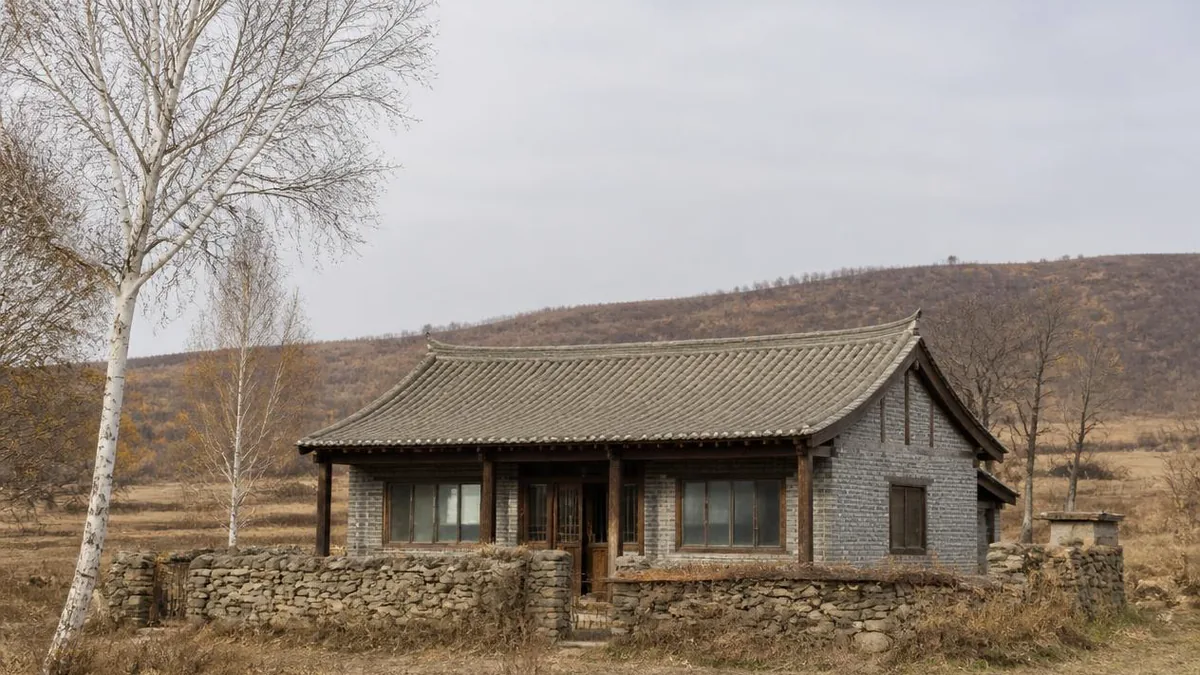
The building you visit was put up around 1900 by Yun Ha-hyeon, in the traditional Korean style of the region. Yun Dong-ju was born in it. When he transferred to a middle school in Longjing town the family moved with him and the house passed to other owners.
Then it went. Chinese sources say it was demolished in 1981; Japanese sources say it stood empty that year and was taken down the next, with the timber and stone reused in nearby houses. The roof tiles are the detail worth carrying: they had been moulded with a taegeuk pattern, hibiscus flowers and a cross, and during the Cultural Revolution the order came to grind the cross motifs off. Supervision lapsed, and a few tiles survived intact. In 2002, through Yanbian Television, they were given to Yonsei University in Seoul.
The house was rebuilt on the original site in August 1994. It was designated a Longjing municipal protected site on 3 June 1997 and a Yanbian prefectural one on 28 December 2007. Around October 2012 an exhibition hall, a pavilion and stone monuments were added, and the site became something closer to a small museum.
Call it what it is. This is a reconstruction of a demolished house, in a village where the school it was built around is also gone and replaced by a museum on its site. What is authentic here is the ground, the layout of the settlement, and the surrounding farmland.
Three school systems before he was twenty
Yun’s education traces the political geography he was born into, which is why it is worth listing rather than summarising.
He entered Myeongdong School in 1925 and produced a magazine with his cousin Song Mong-gyu. He graduated in 1931, spent a year at a Chinese county school in Helong, and moved with the family into Longjing, entering the Christian Eunjin Middle School in 1932 — the same year Manchukuo was founded and the region came under effective Japanese control.
In 1935 he transferred to Soongsil Middle School in Pyongyang, in Japanese-ruled Korea. Soongsil was shut down in 1936 after its principal refused Shinto shrine attendance. Yun went back to Longjing and finished at Gwangmyeong Academy, a Japanese-run school. So within four years he passed through a Korean mission school, a Korean Protestant school in the colony, and a Japanese school in Manchukuo, and wrote in Korean throughout.
In 1938 he entered the literature faculty of Yonhi College in Seoul, now Yonsei University, where he studied Korean with the linguist Choe Hyeon-bae. He graduated in December 1941.
The book that was not printed
At graduation Yun selected nineteen poems for a collection he wanted to call Haneulgwa baramgwa byeolgwa si — sky, wind, stars and poetry. His teachers advised against publication on wartime grounds and he dropped it.
Instead he hand-copied the manuscript three times. One copy went to the teacher he had consulted, one to his friend Jeong Byeong-uk, and he kept one. Jeong was later conscripted as a student soldier and left his copy with his mother in Gwangyang, in South Jeolla; she is said to have kept it in a jar. That surviving copy is why the poems exist.
The book was published in Seoul by Jeongeumsa in early 1948, three years after his death, with thirty-one poems and a preface by the poet Jeong Ji-yong. A 1976 third edition, assembled by relatives from further manuscripts, brought the total to 116.
Kyoto, a changed name, and the Peace Preservation Law
In late 1941 the family registered a Japanese surname, Hiranuma, under the name-change system. Korean accounts are consistent that this was done because the paperwork for study in Japan could not be obtained otherwise, and that Yun found it painful; he wrote the poem “Confession” days afterwards. He also applied in January 1942 to have his given name read in the Japanese pronunciation.
He crossed to Japan in March 1942, entered Rikkyo University in Tokyo on 2 April, and transferred that October to the English department at Doshisha University in Kyoto. Song Mong-gyu had gone to Kyoto Imperial University the same spring.
On 10 July 1943 Song was arrested under the Peace Preservation Law; Yun was arrested on the same charge on 14 July and held at a Kyoto police station. Both were indicted on 22 February 1944, and on 31 March 1944 the Kyoto District Court sentenced Yun to two years. The judgment text, which survives and is quoted in Korean sources, states that he had absorbed national consciousness through schooling and friends and had harboured resentment at discrimination between Japanese and Koreans. Both men were sent to Fukuoka Prison.
Japanese scholarship notes a nuance here that Korean popular accounts often flatten: the charge sheet listed several grounds, and one specialist reading holds that a general assessment of him as heavily influenced by Western thought carried more weight than any organised activity. The conviction and the sentence are not in question; what he was actually doing is read differently.
16 February 1945, and what is not known
Yun died in Fukuoka Prison at about 3:36 in the morning on 16 February 1945. A telegram reached the family in Longjing on 26 February. His father and an uncle travelled to Japan to collect the body, which was cremated; the funeral was held in March and the ashes buried at Longjing.
Roughly ten days after the death telegram, a postal notice arrived offering release on bail, adding that in the event of death the body could be collected or handed to the Kyushu Imperial University medical faculty for dissection. His brother Yun Il-ju later wrote about the family’s reaction to receiving the two documents in that order.
The cause of death is where the record stops. His cousin’s account, relayed through the family, was that prisoners were being given regular injections of an unidentified substance; from this grew a wider claim of human experimentation. Song Mong-gyu died in the same prison a few weeks later. Japanese and Korean reference works both record the claim and both describe it as unconfirmed. There is no autopsy, no admission and no archival finding either way, and this guide is not going to invent one.
The grave on the eastern hill, and the man who found it
For forty years the grave was effectively lost, and the reason is the strangest fact in this article: in Yanbian, where Yun was born and where many of his relatives still lived, nobody knew he had become famous.
On 14 May 1985, Ōmura Masuo — a professor of Chinese and Korean literature at Waseda University, then working in Yanbian — located the grave in the former East Hill church cemetery outside Longjing, using a map drawn for him by Yun’s younger brother Yun Il-ju. He later wrote that the literary community in Yanbian had known neither the poet nor the work, and that Yun’s relatives there had no idea he was revered in South Korea.
The headstone is a white stone that had been prepared for his grandfather. Ōmura, who died in 2023, spent his career on Korean-language literature in Japan and China; the sentence to hold is that a Japanese scholar found the grave of a Korean poet in China, and that all three of those facts were necessary.
Whose poet? Three positions, stated as they are
There is a live dispute here and it should be laid out rather than resolved.
South Korea treats Yun as a national poet. He was awarded the Order of Merit for National Foundation in August 1990, the Yun Dong-ju Literary Prize has run since 1985, a poem stele went up at Yonsei in 1968 and a memorial hall in 2020, and a literature museum operates in Jongno district in Seoul. Surveys in the 2010s found near-universal recognition among young Koreans.
China commemorates him as a patriotic poet of the Korean ethnic minority within China, and that framing is the one under which the Longjing birthplace was restored and presented. South Korean commentary has objected to the wording used at the site and in Chinese reference works; the most frequently cited instance is a statement by the Seoul Poets’ Association on 20 April 2016 accusing Chinese authorities of distorting his nationality. Chinese-language encyclopaedias list him with a Chinese nationality field, which Korean critics note is anachronistic given that ethnic Koreans in China took citizenship in the 1950s.
Japan commemorates him too, and in more than one register. A stone bearing his poem “Prologue” in Korean and Japanese was set up at Doshisha University in 1995; the Kyoto arts campus that stands where his lodgings were put up another in 2006 and holds a memorial gathering on the anniversary; Rikkyo University established a scholarship in his name in 2010; Doshisha conferred an honorary doctorate on the eightieth anniversary of his death in February 2025. There is also a Japanese critical strand, associated with the Kyoto scholar Ogura Kizo, that objects to reading the poems as nationalist statements at all.
Three positions, each with dates attached. Nothing here needs a verdict from a travel guide.
Two poems, read on the ground they came from
Two lines are worth carrying to the village, in transliteration, because Korean sound does not survive translation.
“Prologue,” dated 20 November 1941, opens: Jungneun nalkkaji haneureul ureoreo / han jeom bukkeureomi eopgireul — until the day I die, to look up at the sky and find not one speck of shame. It is the text on the Yonsei stele and on the Doshisha stone.
“Counting the Stars at Night,” written in Seoul in November 1941, opens: Gyejeori jinaganeun haneureneun / gaeullo gadeuk cha itseumnida — the sky where the seasons pass is filled to the brim with autumn. Further in he counts out the names of childhood classmates and of foreign poets, then buries his own name under a hill of earth.
Both were written in Seoul, not here. But the village in “Counting the Stars” is this one, and standing in the yard of a house that had to be rebuilt is a fair place to notice that the poet’s home was already a memory when he wrote about it.
Getting there, and what the visit is like
Yanji is the entry point — an airport, high-speed rail, and the prefectural capital. Longjing is a short drive south, and Mingdong is out in the countryside beyond it in Zhixin township. There is no practical bus; hire a car or a taxi for a half-day and combine the stops.
In the village: the rebuilt house, the exhibition hall added in 2012, a museum on the site of Myeongdong School, a statue of Kim Yak-yeon, the former Song Mong-gyu house, and old Korean-style dwellings. In and around Longjing: the grave on the eastern hill, a memorial room at Longjing Middle School — which traces its descent from the Korean-run schools of the period, and where a stele carrying “Prologue” was erected in September 1992 — the former Japanese consulate building of 1926, and the well the city is named for.
Yanbian is a Korean Autonomous Prefecture; signs, shopfronts and government buildings carry Korean alongside Chinese, and Korean speakers will find it far easier going than elsewhere in China. Winters are long and cold and the countryside is genuinely rural. Opening hours, admission, and whether the village site is open at all vary — call ahead or check the current notice before driving out.
There is a temptation, at reconstructed birthplaces, to feel that the building is the point. Here it is not. The building is a 1994 copy of a house pulled down in the early 1980s, in a village founded in 1899 by people who had left their own country, around a school shut down in 1925, for a poet who left at fourteen and never came back alive.
The one object with an unbroken line to him is the white stone on the eastern hill, which was cut for his grandfather, and which nobody in the neighbourhood could point to until a Japanese professor turned up in 1985 with a map drawn in Seoul.
The LoreLens app can identify Korean vernacular architecture, memorial steles and mission-era school buildings across Yanbian and explain the history attached to them.
Location profile
Where it is

Frequently asked questions
Is the house at Mingdong the original building?
No. The house Yun Dong-ju was born in was built around 1900 by his grandfather Yun Ha-hyeon. The family left it when they moved into Longjing town in the early 1930s and it passed to other owners. Accounts differ on the end: one says it was demolished in 1981, another that it stood empty in 1981 and was taken down the following year, its materials reused in neighbouring houses. Either way, what stands today was rebuilt on the original site in August 1994, and an exhibition hall, pavilion and stone monuments were added around October 2012. A handful of original roof tiles survived — the cross moulded into them had been ordered ground off during the Cultural Revolution — and were donated to Yonsei University in Seoul in 2002. So the house is a reconstruction with a documented lineage, not a preserved building, and the site says so if you read the panels closely.
Whose poet is Yun Dong-ju?
That question has three standing answers and no agreed one. South Korea treats him as a national poet: he was awarded the Order of Merit for National Foundation in 1990, a literary prize carries his name, and he appears in the school curriculum. China commemorates him as a patriotic poet of its Korean ethnic minority, the framing under which the Longjing birthplace was rebuilt; South Korean bodies have objected to it, most visibly when the Seoul Poets' Association issued a statement on 20 April 2016 accusing Chinese authorities of distorting his nationality. Japan hosts memorials too — a stone with his poem at Doshisha University in Kyoto since 1995, another at a Kyoto arts campus since 2006, a Rikkyo University scholarship in his name since 2010, and an honorary doctorate conferred by Doshisha in February 2025. The underlying facts are not disputed; what each country does with them is. He was born in China, wrote in Korean, and died in Japan.
How did he die, and is the cause settled?
He died in Fukuoka Prison on 16 February 1945, aged 27, while serving a two-year sentence handed down by the Kyoto District Court on 31 March 1944 for violating the Peace Preservation Law. That much is documented. The cause is not. Korean and Japanese sources both record a claim, originating with the family and with his cousin Song Mong-gyu, that prisoners were given regular injections of an unidentified substance, and some accounts extend this to human experimentation. Japanese and Korean reference works alike describe the claim as unproven. Song Mong-gyu, sentenced alongside him, died in the same prison weeks later. A separate documented detail: a postal notice offering release on bail reached the family about ten days after the telegram announcing the death.
How do I actually get to Mingdong, and what else is nearby?
The regional gateway is Yanji, which has an airport and high-speed rail; Longjing is a small city a short drive south, and Mingdong is in Zhixin township, in the countryside outside it. There is no convenient public transport to the village itself, so most visitors hire a car or a taxi for a half-day from Yanji or Longjing. Yanbian is a Korean Autonomous Prefecture and signage is bilingual in Chinese and Korean, which makes navigation easier for Korean speakers than almost anywhere else in China. Also in or near Longjing: the grave on the eastern hill, the memorial room at Longjing Middle School with the 1992 poem stele, the former Japanese consulate building, and the well that gave the city its name. Opening hours, any admission charge, and whether a site requires booking all change — confirm on the day, and check whether the village site is open at all before making the drive.
Sources and further reading
Background references for the history and place names in this guide. Opening hours, ticketing and access change often — always confirm with official local information before travelling.