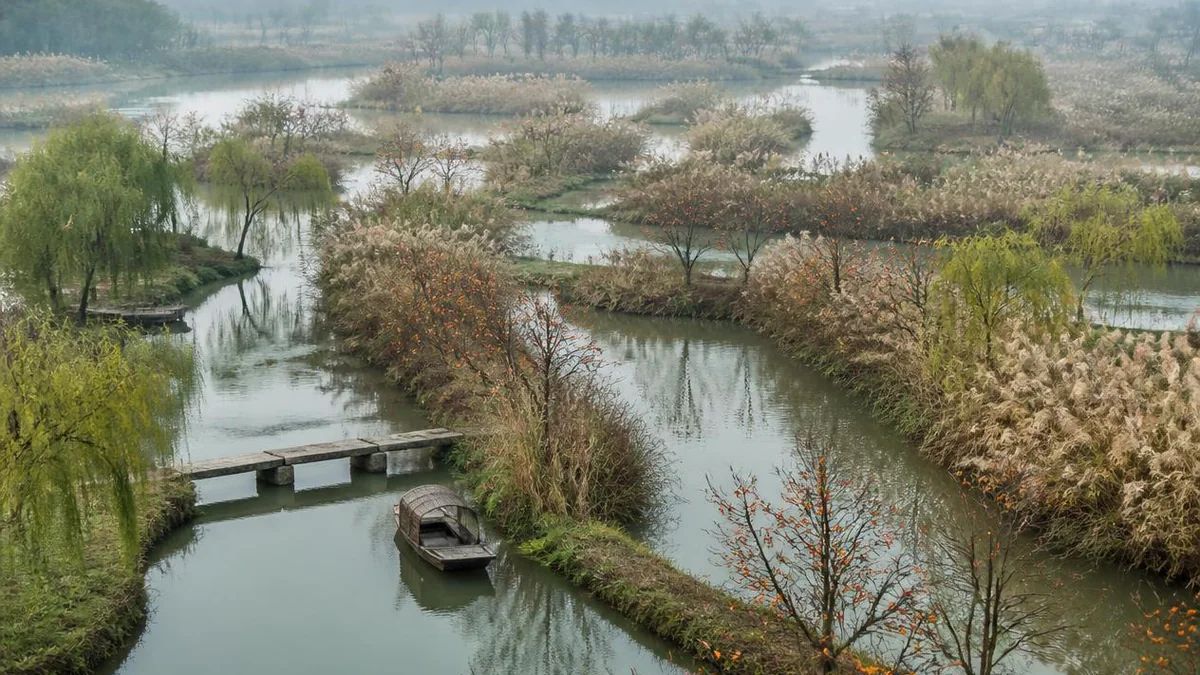
Zhejiang · Hangzhou
Xixi: The Wetland That Farmers Built and the City Bought Back
China's first national wetland park is not wilderness. The thousands of ponds are fish ponds, the reeds and persimmons are crop infrastructure, and between 2003 and 2017 more than four thousand households were moved out so the marsh could be restored. On the first Duanwu after the park opened, the dragon boat gathering was the thinnest anyone could remember — the rowers had been rehoused.
5A View location, maps and nearby scenic areasAlmost everything you will photograph at Xixi is a piece of farm equipment.
The thousands of small ponds are fish ponds. The reeds standing in white drifts each November were harvested for thatch, matting and fuel. The persimmon trees whose fruit turns the water orange in October are not ornamental — they are planted along the pond dykes because the roots hold the earth wall together and the fruit is a second crop off the same square metre. Chinese sources are direct about this. They call Xixi a secondary wetland inside a city, and they date the pond system to something on the order of a thousand years of continuous farming.
Which makes what happened next unusual. Between 2003 and 2017 the city of Hangzhou moved more than four thousand households out of this landscape, dissolved the villages as administrative units, spent somewhere between 8.8 and 14 billion yuan depending on which official figure you take, and rebuilt the marsh as China’s first national wetland park — designated on 2 February 2005, which is World Wetlands Day, and opened to the public that April.
Then, seven weeks after the opening, the dragon boat gathering that had run in these channels since at least the Ming was the thinnest in living memory. A provincial newspaper covering it in June 2005 ran the headline came excited, went home dejected, and quoted a township official explaining why: the three villages inside the core scenic area had been demolished and their people scattered.
That is the honest frame for Xixi. It is a genuinely successful restoration of a landscape that people made, from which the people were removed, and to which some of them have since been hired back.
Five kilometres from the most famous lake in China
Xixi sits on the western edge of Hangzhou, straddling Xihu District and Yuhang District, less than five kilometres from the West Lake. Planned area is 11.5 square kilometres. More than 100 kilometres of watercourse run through it, and roughly 70% of the surface is water — rivers, ports, ponds, shallow lakes locally called yang, and marsh. It is rated 5A, the top band of China’s tourist-area scale, under the name Xixi Wetland Tourism Area.
Historically Hangzhou grouped three places under one phrase, the Three Xi: Xihu the West Lake, Xiling the seal-carvers’ hill beside it, and Xixi the west creek. Two of those three became national symbols. The third was, until very recently, the back of the city — the place the West Lake’s tourists never reached, and by the 1990s the place the West Lake’s neighbours did not want to smell.
The name means simply west creek, after the Xixi River. It is one of the most common hydronyms in China; there are Xixis in Fujian, Hunan, Jiangxi, Sichuan and Taiwan. This is the one people mean.
Xixi, let it stay
The founding story is a sentence, and the sentence is why the neighbouring town has the name it does.
In 1129, with the north lost to the Jin and the Song court in flight, the emperor Gaozong — personal name Zhao Gou, the man who would eventually settle the dynasty at Hangzhou and preside over the execution of the general Yue Fei — is said to have passed through this marsh and considered founding his capital in it. He chose Phoenix Hill instead. On leaving, tradition has him say: Xixi, let it stay for now.
The town three kilometres up the road is called Liuxia, which means stay behind, and the story is the explanation given for the name.
Handle it as tradition. The earliest source usually cited is the Guangxu-era Qiantang County Gazetteer, a late-Qing compilation written roughly 750 years after the supposed remark, and no contemporary Song document is produced for it. What can be said flatly is that the phrase is now the single most quoted thing about Xixi in Chinese — helped enormously by Ge You saying it, deadpan, in Feng Xiaogang’s 2008 comedy If You Are the One, which shot several scenes in the reed beds and at Shentankou and turned a regional wetland into a national destination in one holiday season.
The clan that wrote the opera
The western third of the park is called Hongyuan, the Hong Garden, and it is there because of a family.
Local accounts trace the Xixi Hongs to Hong Hao (1088–1155), the Southern Song envoy who was sent to negotiate with the Jin in 1129, was detained by them for fifteen years, refused every office they offered, came home unbroken and was afterwards called the second Su Wu — Su Wu being the Han diplomat held nineteen years by the Xiongnu, the standard Chinese emblem of a man who will not defect. Hong Hao’s son Hong Mai wrote the Rongzhai Suibi, a sprawling notebook of essays generally rated the finest of its genre in the Song. The Hongyuan’s own account says Hong Hao built a ducal mansion at Xixi, and that his descendant, the Ming minister Hong Zhong, rebuilt on the site in retirement.
The clan’s official scoreboard is quoted two incompatible ways. One version, repeated on Chinese state cultural-affairs sites, credits the Ming Hongs alone with four officials of prime-ministerial first rank and three of ministerial second rank. Another, in a provincial paper, says that across the Song and Ming together the family produced three chancellors and five ministers. The family’s own longevity at Xixi is variously given as more than 600 years and eight hundred years. Nobody appears to have reconciled these, and the article you are reading is not going to either.
What is not in dispute is the descendant who matters most. Hong Sheng (1645–1704) wrote The Palace of Eternal Life, the kunqu opera about the Tang emperor Xuanzong and his consort Yang Guifei — a work that sits in the Chinese repertoire roughly where a Mozart opera sits in the Western one, and which got its author expelled from the imperial academy for staging it during a period of court mourning. Another Hong, Hong Pian, was the Ming publisher who issued the Qingpingshantang Huaben, one of the earliest printed collections of vernacular short fiction in the language.
The Hongyuan you walk through today is a reconstruction, built during phase three of the restoration and opened from 2008. It is not the Ming garden. It is a modern garden on the recorded site of one, and the marketing line — water town in the city, birthplace of Hong Sheng — is honest about which half is old.
One thousand and forty-four poets on an island
The best thing at Xixi is small, hard to reach, and about reed grass.
Qiuxue’an, the Autumn Snow Hermitage, sits on an islet in the central water. It was founded in the Song, in the early Chunxi years — the 1170s — under the name Dasheng An. In 1634 the Shen brothers of Xixi rebuilt the derelict buildings and installed a monk of reputation. The present name was given in the late Ming by Chen Jiru (1558–1639), an eminent scholar-painter, who took it from a Tang line about autumn snow dim on the fishing boat: the reeds go white in late autumn and, under a moon, read as snowfall.
By the Republic it had fallen down again. Between 1919 and 1921 a Nanxun silk-and-salt magnate and antiquarian named Zhou Qingyun rebuilt it — one account specifies 7,000 silver dollars raised in 1920 for the main hall — and wrote a four-volume gazetteer of the place. And he added something no other hermitage has.
Inside, Zhou installed the Ancestral Hall of the Ci Poets of the Two Zhes, a shrine to 1,044 named poets of eastern and western Zhejiang, their names carved onto large wooden boards. The central niche holds the Zhejiang natives; one flank commemorates poets who merely served here as officials, another those who lived here in exile; separate niches hold the monks and the women. First on the list, at the head of all 1,044, is the Tang poet Zhang Zhihe (c. 730–810), whose Fisherman’s Song — egrets flying before the western hills, a man in a bamboo hat who does not go home in the rain — is a poem most educated Chinese can recite. It is an oddly perfect choice for a building on a reed island.
The hall was destroyed by 1958. It was rebuilt in 2005 as part of phase one, and the commemoration was restarted: scholars and poetry societies now gather at Qiuxue’an each year on the tenth day after Frost’s Descent, which in 2024 fell on 2 November.
Kangxi’s bamboo window
On the eastern side, Gao Zhuang — properly the Xixi Villa — was the country house of Gao Shiqi, a Qiantang scholar and imperial favourite. The Palace Museum gives his dates as 1645–1703; other sources say 1704. He was a connoisseur, calligrapher and collector who rose from very modest beginnings to become one of the Kangxi emperor’s most trusted literary companions.
In 1689, on the imperial southern tour, Gao received the Kangxi emperor at this villa. The emperor, taken with the bamboo pressing against the windows, wrote out two characters — Bamboo Window — and gave them to him as a plaque, along with a poem on the villa. In 1701 Kangxi sent a further couplet. The estate itself is dated to somewhere between 1657 and 1664, and the imperial visit is why one of the ten classic views of Xixi is called the imperial trace at Gao Zhuang.
What stands there now is again a reconstruction, rebuilt during the restoration. The interest is the fact of the visit rather than the fabric of the building: it establishes that this marsh, long before it was a park, was where Hangzhou’s literary establishment went to be private.
What the water looked like in 2003
Then industry arrived.
Xixi was transferred to Hangzhou municipal and Xihu District administration in 2002, by which point the area had absorbed factories, workshops, pig sheds and the sewage of a growing peri-urban population. Water quality had collapsed to below Class V, the bottom of China’s five-band surface water scale — that is, worse than the worst named category, unfit for any use including agriculture.
The photographer Li Zhong documented the dragon boat gathering in these years. His account of what he saw once the racing stopped and he looked at the water is the most useful single description of pre-restoration Xixi: an oily green algal sheen, grey water bubbling, and floating in it dead fish, dead rats and the carcasses of pigs and dogs.
That is the thing being restored. Not a wilderness — a working farm landscape that had been overrun.
Three phases, thirteen thousand people
The comprehensive protection project launched in 2003. Sources say August in some accounts and September in others; the discrepancy is small but it is there, and it is typical of how this project’s dates are reported.
- Phase one, Xihu District. Opened 30 April 2005 — though one contemporary report says 1 May — covering about 3.46 square kilometres. Xixi had already been named China’s first national wetland park on 2 February that year.
- Phase two, limited opening in October 2007, extending the protected and usable area well beyond phase one.
- Phase three, the Wuchang block in Yuhang District. Construction from May 2007, limited opening 1 October 2008, trial operation from Chinese New Year 2009, full opening later that year. Yuhang put the phase-three budget alone at more than 4.3 billion yuan, described at the time as the largest project the district had ever undertaken.
Total investment is reported as 8.84 billion yuan in one planning case study and 14 billion in a 2022 national newspaper piece; the second figure presumably includes later work. The relocation figures are firmer and more sobering. More than 4,000 households. More than 13,000 people. The villages inside the wetland were formally dissolved and their residents rehoused in new estates — Jiangcun Garden, Xixi Garden — on the northern rim.
The pace is worth spelling out, because the round numbers hide it. In May 2004, phase one’s core area had 511 households scheduled for removal, of which 310 had signed. Phase one’s rehousing was not completed until September 2009, when the last 366 households finally took possession of flats. Phase two, from 2006, touched 87% of all farm households in Jiangcun township. The last village of all, Xixi Village, was demolished in 2017. Jiangcun’s resettlement ran fourteen years end to end.
The financing model is locally famous and locally named: jade set in gold. The wetland is the jade, the appreciating land ring around it is the gold, and the claim is that Xixi opened in 2005 carrying zero debt because the surrounding development paid for the restoration. Whether you find that admirable or merely efficient is a matter of temperament. It is, at minimum, the reason the restoration happened at this scale.
The dragon boats, and the year they thinned out
Duanwu, the fifth day of the fifth lunar month, is when Xixi stops being a park.
The Jiangcun Dragon Boat Gathering is not a race. The local word for what the boats do is closer to display: crews drive their boats into the crowded water at Shentankou, throw up spray, spin, and show off handling in a mass of other boats, with the umbrella-decked and the deliberately undecorated bare-hull boats each doing their own thing. Between one and two hundred boats have historically converged; 160-odd were reported in 2018, and more than 300 at the 2025 gathering. Afterwards the villages eat dragon boat wine by village.
Chinese intangible-heritage documentation traces the custom in Jiangcun to the Ming and says it has not been interrupted since. Tradition adds that the Qianlong emperor, on a southern tour, watched the boats here, exclaimed a grand gathering, a grand gathering, and wrote the four characters himself — which is the standard shape of a Chinese imperial-endorsement story and should be read as such.
In 2011 the Jiangcun gathering was inscribed on the third batch of China’s national intangible cultural heritage list, as item 451, code X-3, filed under the Duanwu festival. The Wuchang gathering on the Yuhang side is separately listed, alongside the eighteen martial arts of Wuchang; its own numbered series reached its eleventh edition in 2024, which tells you when the western half’s revival was formalised.
And then there is 2005, the first Duanwu after the park opened, when the water at Shentankou was conspicuously empty. The explanation given at the time was the obvious one: the three villages in the core area had been cleared, and their crews were living somewhere else. A gathering that survived the Ming, the Qing, the Republic and the twentieth century wobbled hardest in the year the wetland was saved.
Counting species, which is also a scorecard
Restoration projects in China are audited in species counts, and Xixi’s have been published repeatedly. Set out as a series, they make the case:
- 2005, at opening: roughly 221 vascular plant species, 477 insect species, 69 bird species — the baselines implied by the later “increase of” figures
- 2020: 696 plants, 867 insects, 181 birds; water quality raised from below Class V to Class II
- 2021: 711 plants, 898 insects, 193 birds
- 2022: 784 plants, 898 insects, 196 birds, with fish stable at 56 species
- End of 2024: 971 vascular plants, 918 insects, 224 birds — increases of 750, 441 and 155 species respectively against the 2005 figures
Two footnotes. First, the numbers are not perfectly self-consistent between releases; the 2021 and 2022 plant counts in particular imply different accounting. Second, and more usefully for a visitor: the English Wikipedia article on Xixi still reports 221 vascular plant species and 89 bird species as current. Those are, near enough, the pre-restoration figures. The most-read English description of the park is quoting the scorecard from before the work was done.
Protected species are given as two under national first-class protection and twenty under second-class among animals, plus four second-class plants. The park’s persimmons are counted two ways as well — 2,802 old trees in one widely copied figure, more than 7,000 trees on the pond dykes in another, which are probably measuring different things and are never distinguished.
Three dykes, ten views, and two versions of the list
Movement through Xixi is organised by three long causeways.
- Fudi, the Fortune Dyke: north–south, 2,300 metres by 7 wide, running the length of the eastern park and crossing six bridges each named with the character for fortune
- Lüdi, the Green Dyke: east–west, 1,600 metres by 7, edged with fish ponds, and the site of the spring flower displays
- Shoudi, the Longevity Dyke: north–south, 3,600 metres by 4.5, in phase three, the longest of the three
The classic sights are packaged as ten views, and here is a small, characteristic inconsistency. The Hangzhou culture and tourism bureau’s list includes the dragon boat gathering; the Chinese Wikipedia list instead has boats meeting at the deep shallows. Eight of the ten agree: snow of reed flowers in autumn, fire persimmons on the water, egrets on the lotus shallows, lingering echoes at Hongyuan, moon on the reeds, mist and rain over the fishing village, plum blossom by the winding water, the imperial trace at Gao Zhuang, and opera heard at Hezhu. The tenth depends on who published the list.
Nobody at Xixi will tell you the list is contested, because nobody there thinks it matters. It matters to the extent that it shows what these curated sets are: marketing language settling into apparent canon.
The boats and the people who row them
The right way to see the interior is a hand-poled boat. The polers work a stern oar standing up, at walking pace, into channels the electric shuttle boats cannot enter. Electric boats run a fixed circuit with stops — north gate, Jiangcun Market, Hezhu Street, Qingfu Bridge, Gao Zhuang and others — and are the efficient option; the hand-poled boats are the reason to come.
Who is rowing matters. After the clearances, the park set out to hire the displaced back. By 2020, over 70% of the guides, shuttle drivers and boat polers — about 300 people — were former residents of the demolished villages. A municipal write-up in 2025 put it in the villagers’ own frame: four thousand households left, and some have come back as polers and fishers.
It is not a solved problem. In February 2025 Xixi went recruiting outside Zhejiang province for boat polers, because the skill is now scarce enough that the neighbourhood cannot supply it. Poling a boat is not a job the grandchildren of rehoused fishermen grow up doing.
Ashore, Hezhu Street and Jiangcun Market are the rebuilt commercial lanes — shops, snacks, the Hezhu pagoda, local craft including the provincially listed Xixi flower baskets. Treat them as reconstruction, which they are. At Shentankou, on the south bank of the dragon boat water, three very large old camphor trees stand where the village used to be. They are the oldest continuously present things in the eastern park.
The calendar
Xixi runs a year-round festival cycle, and it is the clearest guide to when to come:
- Plum blossom, roughly mid-February to mid-March, at the winding water where the seeking plum view is
- The Flower Goddess Festival, spring’s main event, revived here and by 2025 running around fifteen consecutive years — flower-god boats in procession, a period costume programme, and a display area of some 15,000 square metres on the Green Dyke. In 2025 it ran 26 March to 8 May
- Duanwu and the dragon boats, one day, late May or June
- The Fire Persimmon Festival, mid-September to mid-October — the 2024 edition ran 15 September to 13 October — when the dyke persimmons come in and visitors pick them
- The Reed Listening Festival, roughly November into early January; the 2022 edition ran 2 November to 2 January. This is the season Xixi was historically famous for, and the reason Qiuxue’an has the name it does
- The Pond Draining Festival, deep winter: ponds are drained down and the fish taken by hand, which is a genuine survival of the farming calendar rather than a costume of one
Practicalities
The China Wetland Museum sits at the southeastern corner, opened 2 November 2009, about 20,200 square metres, the only national museum dedicated to wetlands approved by the national forestry administration, and rated a second-grade national museum in September 2018. Its design buries most of the volume under a green mound.
Standard adult admission has been 80 yuan, half price for ages 6–18 and 60–69, free over 70. Since 29 October 2020 the eastern and western sections are integrated — one ticket, one entry to each on the day — and the free-access area was enlarged from about 2 to 5.79 square kilometres, with the Green Dyke opened to everyone at no charge. Hours are 8:30–18:30 from 1 April to 31 October and 8:30–17:30 the rest of the year, with the gates closing to new entries an hour before. Metro line 3 reaches Xixi Wetland South for the Zhoujiacun entrance; line 19 serves Xixi Wetland North. Confirm prices and hours before you go rather than from any article, including this one.
Allow a full day if you want the interior and the museum; half a day gets you a boat, a dyke walk and Hezhu Street. Single-day attendance has broken 68,000 in a May holiday, so a weekday is worth a great deal.
What you are actually looking at
Hold two things at once, because Xixi rewards it more than most 5A sites do.
The first is that this landscape was made by people who are no longer allowed to live in it. Every pond edge is a farmer’s decision. The persimmons are a crop. The reeds were a harvest. Thirteen thousand people were moved out so that the water could be cleaned, and the restoration deliberately kept the pond geometry rather than sculpting a naturalistic marsh — which is why, even now, the place looks like farmland that has been given permission to flood.
The second is that it worked. Water that was below the bottom of the national scale is now Class II. Bird species have more than tripled. The dragon boats came back and now draw three hundred hulls. The poetry hall on the reed island has its annual rite again, a hundred years after a salt merchant paid to carve 1,044 names onto wooden boards.
Both are true. What Xixi will not let you conclude is that either one was free.
The LoreLens app can identify the persimmon-dyke ponds, the dragon boat types at Shentankou and the shrine buildings at Qiuxue’an, and explain what the ten views are named after, in your own language, offline.
Location profile
Where it is

Frequently asked questions
What exactly does the Xixi 5A area cover?
One wetland park of about 11.5 square kilometres, spread across two districts of Hangzhou — Xihu in the east, Yuhang in the west — and built in three phases between 2003 and 2009. The eastern side holds the ten classic views, Qiuxue'an, Gao Zhuang, the Hezhu Street commercial lane and the Shentankou dragon boat water. The western side, phase three, is Hongyuan, themed on the Hong clan. Since 29 October 2020 a single ticket covers both, and the free-access area was widened from about 2 to 5.79 square kilometres.
When is the best time to go?
It depends entirely on what you want. Plum blossom runs roughly mid-February to mid-March. The Flower Goddess Festival occupies late March into early May and is the busiest. Dragon boats are Duanwu only, one day. The Fire Persimmon Festival is mid-September to mid-October, when several thousand persimmon trees on the pond dykes turn orange at once. Reed season, the thing Xixi was historically famous for, is roughly November into early January.
Did Emperor Gaozong really say 'Xixi, let it stay'?
The story is that in 1129 the fleeing Song emperor Zhao Gou considered siting his capital at Xixi, chose Phoenix Hill instead, and said the phrase on leaving — which is why the neighbouring town is called Liuxia, 'stay behind'. The earliest citation usually given is the Guangxu-era Qiantang County Gazetteer, compiled some 750 years after the event, so treat it as tradition rather than record. It reached a global audience anyway: Ge You says the line in Feng Xiaogang's 2008 film If You Are the One, partly shot here.
Is the wetland natural?
No, and it does not claim to be. Chinese descriptions call it a secondary wetland inside a city. The pond system is agricultural — thousands of fish ponds whose dykes were planted with persimmon, mulberry or bamboo, a technique built up over many centuries of farming. By 2003 the water had degraded badly. The restoration kept the pond geometry rather than erasing it, which is why the landscape still reads as farmland that has been allowed to flood.
What happened to the villagers?
They were rehoused. Reported totals run to more than 4,000 households and over 13,000 people, spread across three construction phases from 2003 and a resettlement process in Jiangcun that was not finished until 2017. Most went into new estates on the wetland's northern edge. Former residents were then recruited back as staff: by 2020 around 300 people, over 70% of the guides, shuttle drivers and boat polers, were from the villages that had been cleared.