Jiangsu · Suzhou
Shajiabang, Yushan and Shanghu: The Town That Renamed Itself After an Opera
In 1964 Mao Zedong watched a Peking opera about wounded soldiers hiding in a reed marsh and suggested it be named after the fictional village where it was set. Twenty-eight years later the real township next to that marsh abolished its own name and took the opera's instead.
5A View location, maps and nearby scenic areasIn March 1992, a township in Changshu petitioned to abolish its own name.
It had been Hengjing commune since 1958. In May 1981 it was renamed Ludang — reed marsh — commune, and in July 1983, when communes were dissolved, it became Ludang township. Then, in March 1992, Ludang township was abolished and Shajiabang township established in its place.
Shajiabang had never been a place. It was a name invented for a Shanghai opera in 1959, chosen as the title of a Peking opera by Mao Zedong in 1964, and broadcast to every corner of China as one of the eight model works of the Cultural Revolution. By 1992, that fictional name was worth more to the local economy than the real one. So the real one went.
This is the single most interesting fact about the Shajiabang and Yushan-Shanghu Tourism Area, which was approved as a 5A site on 11 April 2013 — one day before the Suzhou Taihu area on the other side of the city. It comprises three parts: the wetland at Shajiabang, the hill called Yushan, and the lake called Shanghu. And the three of them, taken together, hold about twenty-five centuries of Chinese history arranged in almost exactly the wrong order, with the newest thing being the most famous.
Thirty-six wounded men
The historical event at the bottom of it is documented and small.
In 1957, Liu Fei, then deputy commander of the Shanghai garrison, was convalescing on Mount Mogan and dictated an eighty-thousand-character memoir of his war experience around Yangcheng Lake, titled The Spark. He asked Cui Zuofu — a former Xinhua war correspondent, by then deputy head of a divisional cultural section — to go to southern Jiangsu and collect material on the war against Japan.
Cui spent three months interviewing along the lakeshore and produced a piece of reportage: Names Written in Blood — an account of the struggle of thirty-six wounded and sick New Fourth Army soldiers. The title echoes a line in the New Fourth Army’s own anthem, drafted by Chen Yi: our names are written in blood. The thirty-six men were real; the unit they grew into was real; the regiment that traced its descent from them was still in existence when Cui wrote.
What happened next is a case study in how a documented event becomes a national myth.
From reportage to Shanghai opera
Also in 1957, the Shanghai People’s Shanghai-Opera Troupe was looking for material on the war. Its party secretary, Chen Ronglan, and its playwright Wen Mu went to the Nanjing Military Region’s political department to ask. Chen and Cui Zuofu were old comrades, so Cui handed over his manuscript.
Wen Mu adapted it in 1959 as Red Flag on Clear Water. Then the company visited Liu Fei in hospital, was struck by the title of his own memoir, and renamed the play Sparks Amid the Reeds.
The adaptation made one decisive change. The reportage was about thirty-six wounded men hiding in a marsh. The opera made it about a teahouse proprietress named Sister Aqing concealing eighteen wounded men and outwitting the enemy by her wits. That invention — a woman running a teahouse as a covert liaison point, matching her enemies line for line across a table — is the reason anyone remembers the story at all.
In May and June 1960, Liu Fei arranged for more than sixty members of the company to live with the successor unit on Yangcheng Lake. The play opened at the Victory Theatre in Hangzhou on 27 November 1960, moved to Shanghai’s People’s Grand Stage, and ran more than 370 performances in nine months to an audience of some 560,000.
Mao names it
On 3 May 1963, Jiang Qing, convalescing in the south, saw Sparks Amid the Reeds at that same Hangzhou theatre and sent for the script. The Ministry of Culture passed it to the Beijing Peking Opera Troupe for adaptation. The first Peking opera version was called The Underground Liaison Agent; the writing team included Wang Zengqi, later one of modern China’s finest short-story writers.
On the evening of 23 July 1964, Mao Zedong watched the Peking opera version in the small auditorium of the Great Hall of the People. He said the play was good, and praised the drawing of three characters in particular — Hu Chuankui the puppet commander, Sister Aqing, and Diao Deyi, the sardonic staff officer who is the most memorable villain in the model-opera repertoire. He asked for two changes: give the armed struggle more weight, and change the ending. In the existing version the New Fourth Army infiltrated a wedding party disguised as musicians; Mao wanted them to simply fight their way in.
Then he came to the title, and made the remark that produced a place name. A reed marsh, he observed, is all water — how is a revolutionary spark supposed to spread from it? By that time the situation was not a spark but a blaze. The story happens at Shajiabang. China has plenty of operas named after places. Call it Shajiabang.
The revised script was staged again in March 1965. It was subsequently designated one of the eight model revolutionary works of the Cultural Revolution — twice over, in fact, since the symphonic Shajiabang also made the list. For roughly a decade, it was among the very few dramatic works most Chinese people were permitted to see.
Which is how a marsh got a name
The scenic area today is built on that. There is a revolutionary education zone, a reconstructed Chunlai Teahouse — Sister Aqing’s establishment, built because the opera required it — the Hengjing old street, a folk-culture village and a wetland park. It is a designated national base for patriotic education, and it markets itself in four colours: red for revolutionary history, green for the wetland, gold for the food, and a fourth for film and television.
Published areas do not agree, and the disagreement is worth naming rather than smoothing. The reed-marsh scenic area is given as 2,500 mu. Another account says the open reed beds grew from an original 150 mu to 2,200 mu, while the whole Shajiabang scenic area covers 6,000 mu. These are different objects being measured — the reed marsh, the managed reed beds, the whole park — and the figures should not be read against each other.
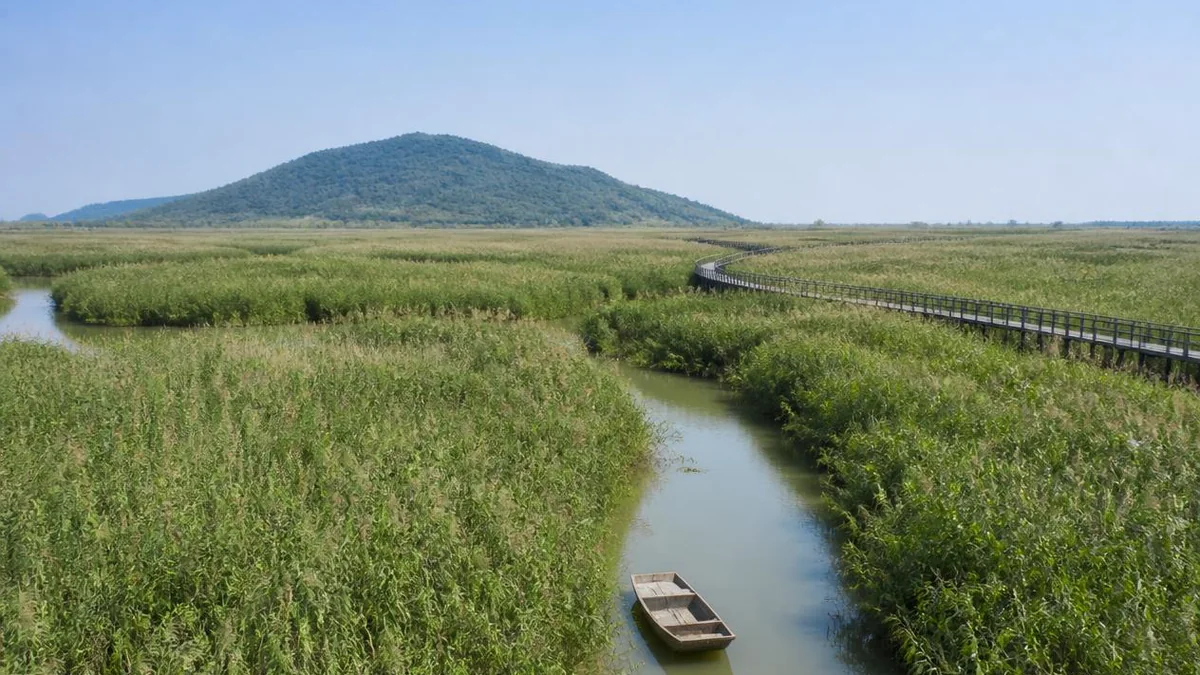
What is genuinely worth doing here is taking a punt through the reed channels, because the reeds are tall enough to close over a boat and the geography stops being an abstraction. Thirty-six men could disappear into this. That was the point.
The hill next door is two thousand years older
Yushan rises immediately northwest of Changshu’s old town and runs 6.5 kilometres to the southeast, with its far end inside the line of the old city wall. The local phrase is ten li of green hill, half of it inside the city. It reaches 263 metres, was approved as a national forest park by the Ministry of Forestry in March 1989, and holds 1,260 hectares of forest at 96% cover. Its old name was Wumu Hill.
It is named after a dead man. Zhong Yong — also called Yu Zhong — was, in the traditional account, the second ruler of the state of Gouwu at the turn from Shang to Zhou, and one of the ancestral figures of Wu civilisation. He was buried on this hill, and the hill took his name. His tomb, on the eastern slope, is the oldest in Changshu.
Yushan is sometimes described as a museum of tombs, and the description is close to literal. Provincially protected graves on the mountain include Zhong Yong’s; the tomb of Zhou Zhang, counted the first ruler of Wu; the tomb of Yan Yan; the tomb of Huang Gongwang, one of the Four Masters of Yuan-dynasty painting; the tombs of Wang Fu, Qu Shisi and Qu Jingchun; the tomb of the painter Wang Hui; the tomb of Weng Tonghe, tutor to the Guangxu emperor; a group tomb of four eminent monks; and the joint listing of Qian Qianyi and Liu Rushi.
Zhong Yong’s tomb and Yan Yan’s are neighbours on the eastern slope, with Zhou Zhang’s inconspicuous mound between them. Huang Gongwang’s is remote enough that reaching it means going out of the west or north gate and round half the mountain to a small stone cave.
Confucius’s only southern student
Yan Yan (506–443 BCE) was born here, went north, and studied under Confucius. Of three thousand students and the seventy-two worthies, he was the only one from the south. He was noted for literary accomplishment, served as magistrate of Wucheng in the state of Lu — where he governed by teaching ritual and music to the general population, an approach Confucius commented on — and then came home. The formula for what he did next is that he opened the Way in the southeast, and the title that attached to him is Southern Master.
His tomb is on the eastern slope, north of Zhong Yong’s. Its founding date is lost; the first recorded repair is Western Han. It faces east and climbs the slope in stages: a spirit way, three arches, a pool and the Literature Bridge, three stone pavilions, a terrace, an enclosure and the mound. Two stelae stand behind it, one from 1636 and one Qing, reading tomb of the former worthy Lord Yan Ziyou and tomb of the former worthy Yan Zi.
The imperial attention is stacked up in the inscriptions. The middle stone pavilion carries Kangxi’s four characters literature opened Wu and Hui. The second arch carries Qianlong on both faces: the Way opened the southeast, and the spirit gathered in Gouwu. The third arch carries Southern Master, written by a Yongzheng-era provincial administration commissioner. The tomb was listed as a provincially protected relic on 18 October 1956.
The water was cold
Under Fushui Cliff on the southwestern slope lie two graves about fifty metres apart, and the space between them contains one of the most uncomfortable arguments in Chinese literary history.
Qian Qianyi (1582–1664) was tanhua, third in the palace examination, in 1610. He was the great synthesising figure of late Ming and early Qing letters and led the literary world for some fifty years, rising to Minister of Rites. When the Qing armies came south, he participated in the surrender of Nanjing.
Liu Rushi (1618–1664) was his consort. Born Yang Aier in Wujiang, later styled the Lady of Hedong, she took the name Rushi from a line by Xin Qiji — I expect the green mountains see me thus. She was one of the eight famed beauties of the Qinhuai.
When the Ming fell, by the account that has come down, she urged him to drown himself rather than live under the conquest. He declined, on the grounds that the water was cold.
He served the Qing, was labelled a turncoat, resigned, and then involved himself in Ming restoration plotting anyway. She shaved her head and became a nun for a period, retired to a villa at Baimao, and supported the resistance. The Qianlong emperor eventually ordered his writings suppressed and destroyed. In the twentieth century the historian Chen Yinke made an argument on the other side, spending his blindness and his last years on a vast study of Liu Rushi, and holding that the writings of these two suffice to make manifest our nation’s spirit of independence and its freedom of thought.
Qian’s tomb is a family plot: the stone arch and spirit way are gone, and what survives is a terrace, an enclosure and a mound across 743.4 square metres. Liu’s is nearby at Huayuanbang, its stele reading simply tomb of the Lady of Hedong; she was buried there from the third year of the Kangxi reign, and the Changshu magistrate Chen Wenshu restored the mound in the Jiaqing period. The two were listed together as a provincial relic in 2002. The couplet on the stone pavilion in front reads: the shallow and deep of flowing water, heard within the qin; the near and far of green hills, seen within the painting.
Visitors have reached a verdict. Liu Rushi’s grave has an unbroken supply of fresh flowers. Qian Qianyi’s, fifty metres away, is quiet.
A school of painting and a school of the qin
Two things named after this mountain travelled much further than the mountain did.
Wang Hui (1632–1717), from Changshu, came from five generations of painters, trained under Wang Shimin and Wang Jian, and is grouped with them and Wang Yuanqi as the Four Wangs. His programme was to use the brush and ink of the Yuan masters to move the hills and valleys of the Song, enriched with the atmosphere of the Tang. By around forty he was called the sage of painting and first in the realm. He was commissioned by the Kangxi emperor to lead the painting of the Southern Inspection Tour scrolls, and received in return an imperial plaque reading landscape in clear light. His followers — Yang Jin, Gu Fang, Song Junye and others — formed a school around him, and because he was from Changshu and Changshu has Yushan, it was called the Yushan school. In 2017, the tercentenary of his death, Changshu Museum mounted an exhibition of more than eighty Yushan-school works borrowed from Nanjing, Shanghai, Suzhou and its own collection, and named it after that plaque.
The Yushan qin school was founded by Yan Tianchi (1547–1625), son of the Grand Secretary Yan Ne. He served as prefect of Shaowu, and he organised the Qinchuan Society, the first qin society of the Wanli era. His school’s doctrine was that the note must accord with the law, and that sound matters more than words — a deliberate correction to a fashion for setting texts to the instrument. Its aesthetic is summed up in four characters: clear, subtle, restrained, distant. Technically, Yan Tianchi moved the tradition from many notes and little resonance toward few notes and much resonance, which made the left hand’s work far more delicate.
The score he oversaw, the Songxianguan Qinpu, is the only Ming-dynasty qin handbook admitted to the Complete Library of the Four Treasuries. Fifteen or more collections came out of the school between the Ming and the Qing, including Xu Shangying’s Dahuange Qinpu and his treatise The Aspects of the Qin at Stream and Mountain, which is still read. The Guangling school that formed in the early Qing took its cue from Yushan.
The lake where Jiang Ziya fished
Shanghu lies against the southern flank of the hill, and it is named after a man fishing.
The story is that Jiang Shang — Jiang Ziya, the strategist who helped bring down the Shang and is one of the most-invoked figures in Chinese political legend — lived in seclusion here and fished. The lake’s name preserves his. Whether he was ever within a thousand kilometres of it is not a question the lake asks.
The main water surface is about 800 hectares. It is a national urban wetland park, and holds seven islets — Hexiang Zhou, Diaoyu Zhu, Mingqin Zhou, Taohua Dao among them — producing the effect the Chinese phrase describes as islands within the lake and a lake within the islands. There is a Taigong Island with a hall on Jiang Shang’s life and legend, occupying about 950 square metres in its newer wing, and a fishing terrace attributed to him; also the Fushui villa, a ship-model museum and a Jiangnan peony hall. Egrets nest here in numbers.
From the ridge at Jianmen on Yushan you can see the whole of Shanghu at once, which is the single best reason to climb.
A winding path to a quiet place
On the northern slope, beside the Poluo ravine, stands Xingfu Temple, and one line written about it is among the most quoted in the Chinese language.
The temple’s own gazetteer history begins in the Southern Qi, when a Changshu man named Ni Deguang, prefect of Chenzhou, gave up his house to found it as the Daci Temple. It was renamed Xingfu in 537. In the Zhenguan era of the Tang, tradition says a black dragon and a white dragon fought here and gouged out the ravine, which gave the temple its second name, Poshan — Broken Hill — Temple. In 868 the throne granted it a great bell and the Xingfu name plaque. A separate tradition explains the name differently: that during Liang-dynasty expansion a stone was dug up whose veining read as the character for flourish from one side and fortune from the other, and that the stone was kept. It became one of the four great monasteries of Jiangnan.
Some time in the Tang, the poet Chang Jian wrote eight lines on its wall about arriving early in the morning. The middle couplet runs:
A bamboo path leads to a secluded place; the meditation hall is deep in flowers and trees.
The poem entered the Three Hundred Tang Poems. In circulation the first character shifted, so that bamboo path became winding path — and a winding path leads to a secluded place became a standing phrase in Chinese, used of gardens, of architecture, of any approach that conceals its destination. The line’s origin is this temple. Ouyang Xiu is said to have admired the poem so much that when he came back from visiting the temple intending to write his own, what came out of his mouth was Chang Jian’s couplet, and he concluded he could not better it.
The east garden holds the Mi stele pavilion, containing a stone carved with the poem in the hand of the Song calligrapher Mi Fu — who altered several of Chang Jian’s characters in the process. By the stele’s own inscription, the prefect of Xiangyang, Yan Rusi, commissioned the carver Mu Dazhan to cut it at the Mid-Autumn of the thirty-seventh year of Qianlong, to repair an absence at the temple. The result accidentally combined a Tang poem, Song calligraphy and Qing carving in a single object, and acquired the name stele of three perfections.
Its attribution is disputed, and the dispute is specific rather than vague: critics point to weak brushwork of amateur standard and an unconventional layout, with the title and signature set on their own line at the same size as the poem, and report that rubbings shown to the calligraphers Zhou Junjie and Meng Huixiang produced the judgement that Mi Fu could not have written it.
The temple covers about 13.5 mu. Most visitors also eat a bowl of noodles in oil rendered from wild Yushan mushrooms, of which the shops here are said to sell more than a thousand a day.
The man whose scroll was burned in half
On the western slope is the grave of Huang Gongwang (1269–1354), and it is the one place on this mountain where mourners leave writing brushes.
He was born Lu Jian. When the Yuan armies took Changshu he was a small child, and he was given in adoption to a Huang family from Yongjia in Zhejiang who lived on Yushan, taking their surname. He became a landscape painter, and is conventionally placed first among the Four Masters of the Yuan — the group whose brushwork became the grammar of Chinese landscape painting for the following six centuries. Wang Hui’s programme, three hundred years later, opened with the words use the brush and ink of the Yuan masters, and Huang Gongwang is chief among the masters he meant.
Between 1347 and 1350, in his late seventies, he painted Dwelling in the Fuchun Mountains for his younger fellow-disciple Zheng Chu, the monk Wuyong. It took him three years. It is called the Lanting of painting and the first divine work of landscape, and it is one of the ten most famous scrolls in Chinese art.
In the late Ming it came into the hands of the collector Wu Hongyu, who on his deathbed ordered it burned so that it could accompany him. His nephew pulled it out of the fire. By then it was in two pieces. The longer rear section, the Wuyongshi scroll, is in the National Palace Museum in Taipei. The front fragment, the Shengshan tu — remaining mountain — is in the Zhejiang Provincial Museum. Reassembled, the work measures 33 centimetres by 1,036.9. From 1 June to 5 September 2011, the two halves were exhibited together in Taipei for the first time in roughly 360 years.
Huang Gongwang was buried in the family plot at the southern foot of the small hill by his old house. In the Jiaqing period his sixteenth-generation descendant Huang Tai, a magistrate at Langzhong, judged the grave too cramped, bought a piece of hillside on the western slope of Yushan known as Huangjia Hill, and moved him there. It is a walk to find it, and the people who make the walk are mostly painters. They bring flowers, and they bring the four treasures of the study.
Visiting
Treat Shajiabang and the Yushan-Shanghu pair as two half-days, or two days if you want the tombs.
Shajiabang is out to the east of Changshu, and its core is the boat trip through the reeds plus the reconstructed teahouse and street. Yushan can be entered from several points — a cable car by Xingfu Temple, or on foot from the Yan Yan tomb, or from Yushan South Road — and the walking route takes in Weimo villa, the osmanthus garden, Jianmen and Canghai Temple. Shanghu is flat and best done slowly.
And if you have time for exactly one thing, make it the fifty metres between two graves under Fushui Cliff.
Because the tourism area is named after a mountain of tombs and an opera, and the opera is the reason people come. There is nothing dishonest in that. A stage name became a legal name in 1992 because a story about thirty-six wounded men hiding in reeds was, for a while, one of the only stories anyone in China was allowed to tell — and the reeds are still there, and they really are tall enough to hide in. But half an hour away is a man who would not jump into cold water for a dynasty, buried within sight of a woman who told him to, and the flowers are all on her side. Both are Changshu. Only one of them was ever a title.
The LoreLens app can explain who is buried in each of the Yushan tombs, and what the inscribed arches on the Yan Yan tomb actually say.
Location profile
Where it is

Frequently asked questions
Was Shajiabang a real place name before the opera?
No. Changshu had no place called Shajiabang. The events the story draws on — New Fourth Army wounded surviving in the wetlands during the war against Japan — happened around Tangshi town and the Yangcheng and Kuncheng lakes. Shajiabang was invented for the stage, in the same act of writing that invented Sister Aqing. The administrative sequence ran the other way: Hengjing commune, renamed Ludang commune in 1981, made Ludang township in 1983, and abolished in March 1992 to create Shajiabang township. The stage name became the legal name.
What is the opera Shajiabang?
One of the eight model works of the Cultural Revolution. Its ancestry: a 1957 reportage piece by the war correspondent Cui Zuofu about thirty-six wounded New Fourth Army soldiers, drawing on an oral memoir by the commander Liu Fei; then a 1959 Shanghai-opera adaptation, renamed Sparks Amid the Reeds in 1960; then a Peking opera version by a Beijing troupe. Mao Zedong watched it on 23 July 1964, asked for the armed struggle to be given more weight and the ending changed, and remarked that since a reed marsh is all water, a revolutionary spark could hardly spread from it — the story happens at Shajiabang, so call it Shajiabang.
Who was Yan Yan, and why is he called the Southern Master?
Yan Yan, also known by his style name Ziyou, lived from 506 to 443 BCE and was from Changshu. Among Confucius's three thousand students and seventy-two worthies, he was the only southerner. He went north to study, was noted for literary accomplishment, served as magistrate of Wucheng in Lu where he taught the population ritual and music, and returned south. The phrase used for what he did is that he opened the Way in the southeast, and the honorific that followed is Southern Master. His tomb is on the eastern slope of Yushan, and the Kangxi, Yongzheng and Qianlong reigns all added inscribed arches to it.
Why is Liu Rushi's grave covered in flowers while Qian Qianyi's is deserted?
They lie about fifty metres apart under Fushui Cliff, and visitors have made a clear judgement. Qian Qianyi was the third-place palace graduate of 1610 and led the literary world for fifty years, rising to Minister of Rites — and then surrendered the Ming capital at Nanjing to the Qing, which earned him the label of turncoat. Liu Rushi, his concubine, had urged him to drown himself rather than serve the conquerors; he declined on the grounds that the water was cold. She later shaved her head and became a nun, and supported Ming restoration activity. The Qianlong emperor ordered Qian's works destroyed. Visitors still bring flowers to her.
When did the area become a 5A site?
On 11 April 2013, when the national committee on scenic-area quality grading approved the Shajiabang and Yushan-Shanghu Tourism Area as 5A. That is one day before the Suzhou Taihu Tourism Area in Wuzhong district received the same grade. Before that, Shajiabang had held a 4A rating on its own. Published figures for the combined area's size are inconsistent and none appear to come from an official source, so treat any single number with caution.