Hainan · Sanya
Sanya Bay: The City's Own Beach, and What It Cost
Twenty-two kilometres of free, ungated sand in front of a tropical city — the one bay in Sanya that belongs to nobody in particular, plus the reclaimed island that showed, in public and at length, what that arrangement costs to keep.
Sanya has five big bays, and four of them have been turned into something. Yalong Bay is a national tourist resort with an unbroken wall of international hotels. Haitang Bay, developed last, is a duty-free mall with resorts attached. Dadonghai is a compact tourist beach. Yazhou Bay is going industrial and academic.
Sanya Bay is the one that stayed the city’s.
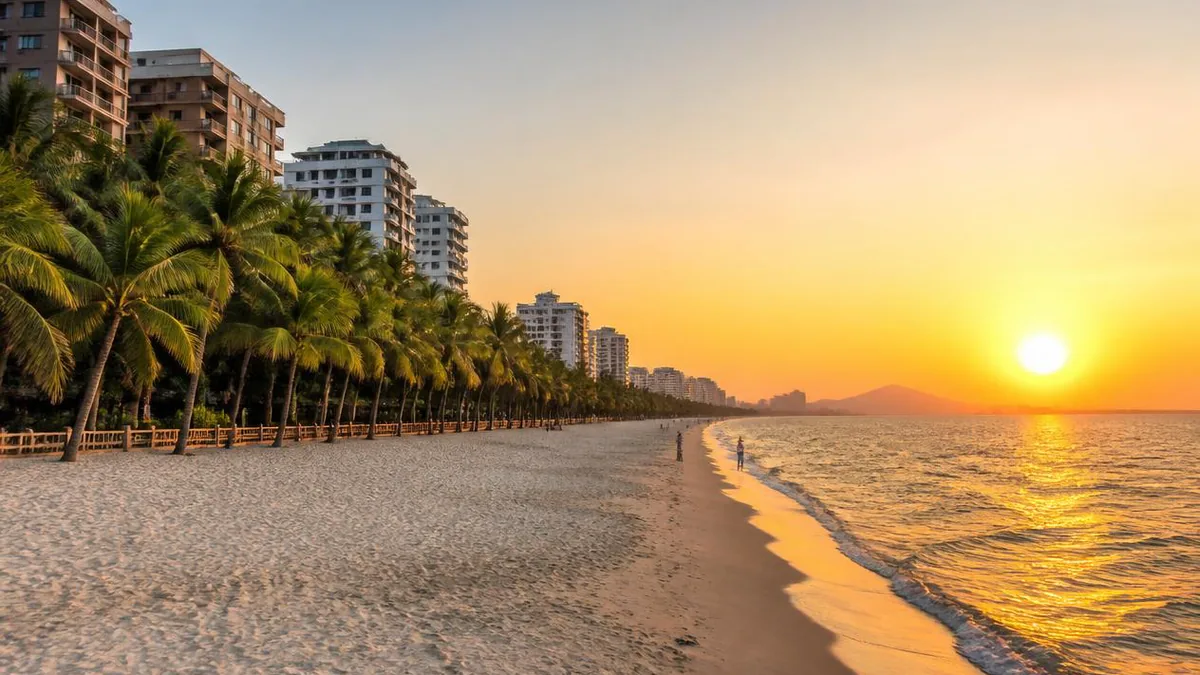
It is the longest of them, commonly given as 22 kilometres, it has no ticket office, and the road that runs its whole length is an ordinary municipal road with buses on it. On one side, apartment blocks, noodle shops, hotels of every price, a hospital, a market. On the other, sand and the South China Sea. Nothing separates the two but a strip of coconut palms and a kerb.
That arrangement is rarer than it sounds, and the last twenty years here are largely the story of what it takes to keep — including an attempt to add land to the bay that ended with the land being taken back off.
Twenty-two kilometres with no gate
Start with the number and its caliber. The 22 kilometres usually quoted is the length of the Sanya Bay strip and of Sanya Bay Road, which runs beside it for essentially its whole extent, in the city’s Tianya District. It is not a claim about a single continuous swimming beach: the strip includes river mouth, harbour approach, plazas, seaside parks and stretches where the sand narrows to almost nothing.
Chinese official tourism descriptions are unusually plain about the place. Free area. Open all day. Shallow water, stable hydrological conditions, suited to swimming. Coconut trees on the sand. Squares and a seafront park. Beach camping as a main activity. No superlative anywhere in that, which is a good sign.
The bay is bookended by things that are not beach. Its eastern end is the harbour mouth, with the Luhuitou headland — a park of about 82.88 hectares rising to roughly 181 metres, carrying the deer sculpture that gives Sanya its nickname of Deer City — standing between it and Dadonghai on the far side. Its western end runs out past Sanya Phoenix International Airport, which opened on 1 July 1994 and sits about 14 kilometres from the city centre and about 5 kilometres from Tianya Haijiao, the cape at the end of the earth some 24 kilometres west of downtown.
So the strip has a gradient built into it: dense city at the east end, thinning to resort, then to airport and open coast in the west.
The bay as a piece of city
Sanya’s own geography explains why this bay became the lived-in one. Chinese descriptions of the city set it in a bowl: mountains to the north, east and south-east, the sea to the south, ridges reaching down between the districts. The built-up core sits on the flat ground between those ridges and the water, which means the city has nowhere to grow except along the coast.
Sanya Bay is the piece of coast the core actually touches. The Sanya River, which rises at the Shuiyuanchi reservoir and runs south, reaches the sea at the eastern end of the bay, and the older city grew on both of its banks. Everyday Sanya — the wet markets, the schools, the buses, the hospitals — is within a few minutes of this sand in a way it is not within a few minutes of any other bay.
The city’s own figures on how much coast it has do not agree, which is worth noting rather than smoothing over: the same official material gives Sanya’s coastline as 209.1 kilometres in one place and 258.65 kilometres in another, with 19 harbours and bays and around 40 islands. Different measuring conventions, presumably; nobody publishes which. What is consistent is that the city administers a lot of coast and uses one bay of it as a daily room.
The sunset is the product
Every bay in Sanya has sand. This is the one with a reliable sunset over water.
The reason is orientation. The Sanya Bay strip runs broadly east to west with the sea on its southern side, so the sun tracks along the line of the beach and drops into open water off the western end for most of the year. Yalong Bay and Haitang Bay, on the eastern side of the city, face the morning instead. If you have one clear evening in Sanya, this is where it should be spent, and Chinese photo collections of the bay are dominated by sunset frames for exactly that reason.
Practical version. Be in place well before the sun reaches the horizon; in the tropics the useful light is short and the drop is fast. The western half of the strip gives the cleanest sightline down the water, with the offshore silhouette of West Island in the frame. The eastern half gives you the sun going down behind Phoenix Island and the harbour — a different, more urban picture. The palm colonnade puts a foreground in every shot whether you want one or not.
One caveat: this is a monsoon coast, and a flat grey evening is entirely possible. Give yourself more than one attempt if the sunset is why you came.
Why the water is not the water in the photographs
This is where a guide should be blunt, because the gap between expectation and arrival does real damage here.
Sanya Bay’s water is usually less clear than Yalong Bay’s, and the reasons are structural rather than seasonal. A river mouth discharges at one end. A working harbour occupies the same corner. The whole strip is shallow with a gentle gradient, so wave action keeps fine material in suspension close inshore. The city itself drains toward this frontage. None of that is scandal; it is what a city beach is.
There is also a specific, documented human contribution. After the first phase of the Phoenix Island reclamation was completed, beaches nearby began to degrade; the municipal government commissioned a specialist team, and the finding was that the phase-one island had changed water movement and was causing shoreline erosion. That finding is the hinge of everything in the next two sections, but it belongs here too, because it is the clearest available answer to a visitor asking why the sand looks thinner in some stretches than in the photographs.
Set your expectations by function. Sanya Bay is for swimming in warm, shallow, sheltered water, for walking a long way in the evening, and for watching the sun go down. For the water that appears in Hainan advertising, the reef coast to the east is where it is.
Phoenix Island, first phase: the island that moved the sand
Phoenix Island is the object in the middle of the bay that every visitor asks about. It is entirely artificial, built on a natural reef flat, and Chinese descriptions give it as roughly 1,250 metres long and 350 metres wide, an area of 547.5 mu — about 365,000 square metres, or 36.5 hectares — connected to the city by a sea bridge of about 395 metres. Total investment is put at over ten billion yuan, across a hotel and international conference centre, resort and villa functions, a waterfront commercial street, a yacht club, an Olympic-themed plaza and the Phoenix Island international cruise terminal.
One clean piece of history attaches to it: the domestic leg of the 2008 Beijing Olympic torch relay began here.
The mechanism worth carrying is legal. Under China’s Sea Area Use Law, passed on 27 October 2001 and in force from 1 January 2002, sea areas belong to the state, and using them requires a sea-area use right; reclamation projects of 50 hectares or more must go to the State Council for approval, with anything below that threshold decided under authority delegated to provincial governments. Phase one’s 36.5 hectares sits under that line. The same statute also provides that land formed once a reclamation project is completed is state-owned, and that the holder of the sea-area use right must register it and convert to a state land-use certificate.
So an island appeared, legally, in the middle of a public bay — and then the beaches near it started to go.
Phoenix Island, second phase: the case that went all the way up
The second phase is the part of this story that ended up in national politics, and it is on the public record in unusual detail.
By the time phase two was under discussion, the erosion finding already existed, and Chinese accounts state that a number of officials objected on that basis. Those accounts describe the then mayor of Sanya failing to report the phase-one ecological problems truthfully to the provincial marine authorities, which allowed the phase-two sea-area use right to be approved; instructing the municipal planning bureau to issue a siting opinion irregularly so the project could clear approval; and convening meetings to push it through as a special case. The project started in April 2014, and the main reclamation was completed in 2016.
In July 2017, a central ecological and environmental protection inspection team found that the phase-two project was seriously damaging the environment, named it, and ordered rectification. What followed is the instructive part. Rather than executing the assessed package — which included demolishing the island’s connecting structure — the incoming municipal party secretary put forward a substitute confined to dredging and widening the Sanya River mouth, and argued publicly for preserving “the integrity of Phoenix Island.” Through three rounds of inspection to 2020, rectification did not move. Only after that official was himself placed under investigation was the phase-two reclamation demolished in full, with environmental restoration following.
Stand on the promenade and you can read the outcome directly. One island, not two, and twenty-two kilometres of public sand behind you.
Morning shift, evening shift
The reason to write about Sanya Bay at all is not its scenery ranking. It is that this is the only bay in Sanya with a daily rhythm that belongs to residents.
The shape of it is roughly this. Early, while the light is still low, the sand is used by people who live behind it: swimmers who go straight in and straight out, walkers on the promenade, groups exercising under the palms, older residents in the shade before the heat arrives. The middle of the day empties out — Sanya’s average annual temperature is about 26.5°C and the hottest month is June at around 29.5°C, which is not weather for standing on open sand at noon. Then the strip refills in the late afternoon and stays busy long after dark, because the sea breeze makes the beach the coolest public space in the city. Fishing and harbour traffic run alongside all of it at the eastern end, part of the texture rather than a nuisance.
Camping has been a fixture too, and a managed one: a 2013 Xinhua report described the beach carrying more campers than it could absorb, with industry voices calling for more designated camping points. Whether camping is permitted, and where, changes between seasons and administrations — check locally rather than assuming.
One title it does not have, and one it does
Sanya Bay collects labels it has not been given, so here is the tidy version.
It is not a 5A tourist area. Sanya’s four 5A areas are Nanshan Cultural Tourism Area, the Nanshan Daxiao Dongtian area, Tianya Haijiao and Wuzhizhou Island. Not one of them is a bay beach, and Sanya Bay is not on the A-grade list at all — which follows from it being a free public shoreline with no operator to be rated.
It is also, on the evidence, not a national tourist resort, despite Chinese-language sources that say so. The State Council decided in August 1992 to pilot national tourist resorts, approved eleven that October, and settled the list at twelve after 1995; that list carries exactly one Hainan entry, Yalong Bay. Treat the Sanya Bay claim as a label that migrated across the city rather than as a second designation.
What it does hold is an environmental listing. Sanya Bay appears on the Ministry of Ecology and Environment’s roster of national beautiful bays, among the cases marked outstanding — as do Yalong Bay, Haitang Bay and Haikou Bay. That is a judgement about water quality and shoreline management, the right kind of credential for a beach whose whole proposition is that it is open and usable.
The winter city
The last thing to understand about Sanya Bay is that its high season is the opposite of most beaches you have used.
The climate sets it up. Sanya has a tropical wet-and-dry regime: a wet season from roughly May to October, heaviest from July into October, and a pronounced dry season from November to April. The coolest month is January, averaging about 22.3°C; annual rainfall is around 1,417.5 millimetres and annual sunshine about 2,425 hours. In other words, the months that are miserable almost everywhere else in China are this bay’s best weather.
The population data show what that produced. Sanya’s resident population passed a million in the 2020 census, having grown by more than 50 percent in a decade. Layered on top is a seasonal migration: northern Chinese, and north-easterners in particular, began moving here in numbers from the 1990s, and one tally reported by The Paper counted close to 400,000 non-local older people wintering in Sanya as of November 2014, of whom roughly 200,000 were registered in Harbin.
That is why Sanya Bay in January feels like a functioning northern neighbourhood transplanted to a beach, and why accommodation along the strip prices itself accordingly. If you want the bay quiet, the trade is heat, humidity and the chance of a typhoon.
Using the strip
Practical notes, kept to what does not expire quickly.
Pick your end. East for the urban picture — harbour, Phoenix Island, quick access to the old city and the Sanya River. West for width, quiet and the clean sunset sightline toward West Island. The strip is far too long to walk end to end casually; treat it as several beaches sharing one road.
Time of day matters more than season. Early morning and the two hours before dark are when this beach works. Midday sun this close to the tropics is punishing, and shade on the sand is limited to the palm line.
Sea conditions are a daily question. The wet season runs roughly May to October, and Hainan’s typhoon exposure falls in the same window. Whether swimming is open, whether boats are running, whether a stretch is closed for works — none of that is knowable in advance from an article. Check signage, flags and local notices on the day.
Verify anything with a price attached. Ticketed sites nearby change their terms: Tianya Haijiao was announced as free to enter from 1 June 2023, exactly the kind of fact that can be reversed. Confirm admission, transport and operating hours locally.
And one framing to take onto the sand. This is the only long shoreline in Sanya that was not converted into a product. The water is not its best feature and the sunsets are; its real distinction is a negative one — no gate, no operator, no resort frontage — and the record of the last two decades shows that this was neither inevitable nor self-defending.
The LoreLens app can identify coastal landforms, reclamation structures and shoreline vegetation, and explain how they got there, while you are standing in front of them.
Location profile
Where it is

Frequently asked questions
Is Sanya Bay free, and is there a gate?
Yes, and no. Chinese official tourism material describes Sanya Bay as a free area, open around the clock, shallow and hydrologically stable, mainly used for swimming and beach camping. There is no ticket office, no closing time posted at an entrance, and no single operator: the beach is simply the seaward edge of a 22-kilometre city road, and you reach it by crossing that road. That is unusual in Sanya, where the headline attractions are ticketed scenic areas. What can change without notice is everything layered on top — whether a particular stretch is fenced for shoreline works, whether swimming is permitted on a given day, whether camping is being restricted after crowding, whether lifeguards are on duty. A 2013 Xinhua report already described beach camping here running over capacity. Read signage and any flag system on the day rather than trusting a description written earlier, including this one.
Is the water at Sanya Bay as clear as at Yalong Bay?
Usually not, and it helps to know why before you arrive. Sanya Bay is the city's own frontage: the Sanya River reaches the sea at its eastern end, the working harbour is there too, the airport sits behind its western end, and the whole strip is shallow with a gentle gradient. Fine sediment stays in suspension in shallow, worked water. Yalong Bay, about ten kilometres east of the centre, sits on a reef coast inside a national coral-reef nature reserve with far less river and port influence, and Chinese and English descriptions consistently rank its water clearer and its sand finer. There is also a documented human factor at Sanya Bay: after the first phase of the Phoenix Island reclamation, the municipal government commissioned specialists who concluded the island had altered local currents and caused shoreline erosion. Come to Sanya Bay for length, access and sunsets, not for visibility.
What actually happened to Phoenix Island?
The first phase still stands: an artificial island built on a reef flat in Sanya Bay, described as about 1,250 metres long and 350 metres wide, roughly 36.5 hectares, joined to the city by a bridge of about 395 metres, carrying hotel, conference, marina and cruise-terminal functions. The second phase is the case. Chinese accounts date its start to April 2014 and the main reclamation to 2016; in July 2017 a central ecological and environmental protection inspection team named the project for serious environmental damage and ordered rectification. Rectification then stalled across successive rounds of inspection, with officials proposing lighter substitute measures instead of the assessed package. After the Sanya party secretary of the period was placed under investigation, the second-phase reclamation was demolished in full and restoration work began. If you stand on the promenade today, the single island you see is phase one.
Is Sanya Bay a 5A scenic area or a national tourist resort?
Neither, and the confusion is worth clearing up. Sanya has four 5A-rated tourist areas — Nanshan Cultural Tourism Area, the Nanshan Daxiao Dongtian area, Tianya Haijiao and Wuzhizhou Island — and no beach in the city is among them. China's list of national tourist resorts, established by the State Council from 1992 and settled at twelve, includes exactly one entry in Hainan, and it is Yalong Bay, not Sanya Bay; some Chinese-language sources nevertheless apply the label to Sanya Bay, and that appears to be an error rather than a second designation. What Sanya Bay does hold is an environmental listing: it appears among the Ministry of Ecology and Environment's beautiful-bay cases, and as an outstanding one. That is a water-quality and shoreline-management commendation, not a scenic-area rating, which is a fair description of what the place is.
Sources and further reading
Background references for the history and place names in this guide. Opening hours, ticketing and access change often — always confirm with official local information before travelling.