Hainan · Sanya
Yalong Bay: Who Owns the Sand
A seven-kilometre crescent that was a State Council policy before it was a beach, ringed by international hotels — and a statute that says the water and the wet sand still belong to the state, which is the whole practical question here.
Most beaches acquire their hotels. Yalong Bay acquired its hotels because a document said it should.
In August 1992 the State Council decided to pilot national tourist resorts — a category defined, in the language of the policy, as comprehensive tourist areas meeting international holiday standards, primarily serving overseas visitors, with defined boundaries suitable for concentrating resort facilities, and open to investment from foreign, Hong Kong, Macau and Taiwan companies under preferential terms. That October, eleven were approved. After a 1993 renaming and a 1995 substitution, the list settled at twelve, and it has not grown since.
Hainan got exactly one. It was this bay.
Everything a visitor notices at Yalong Bay follows from that: the unbroken line of international hotel brands, the absence of a public high street, the manicured central plaza, the fact that the beach is superb and that almost every way of enjoying it is owned by somebody. The interesting question here is not whether the sand is nice. It is where the line runs between what is yours and what is theirs — and Chinese law gives a surprisingly precise answer.
A crescent, and two numbers for it
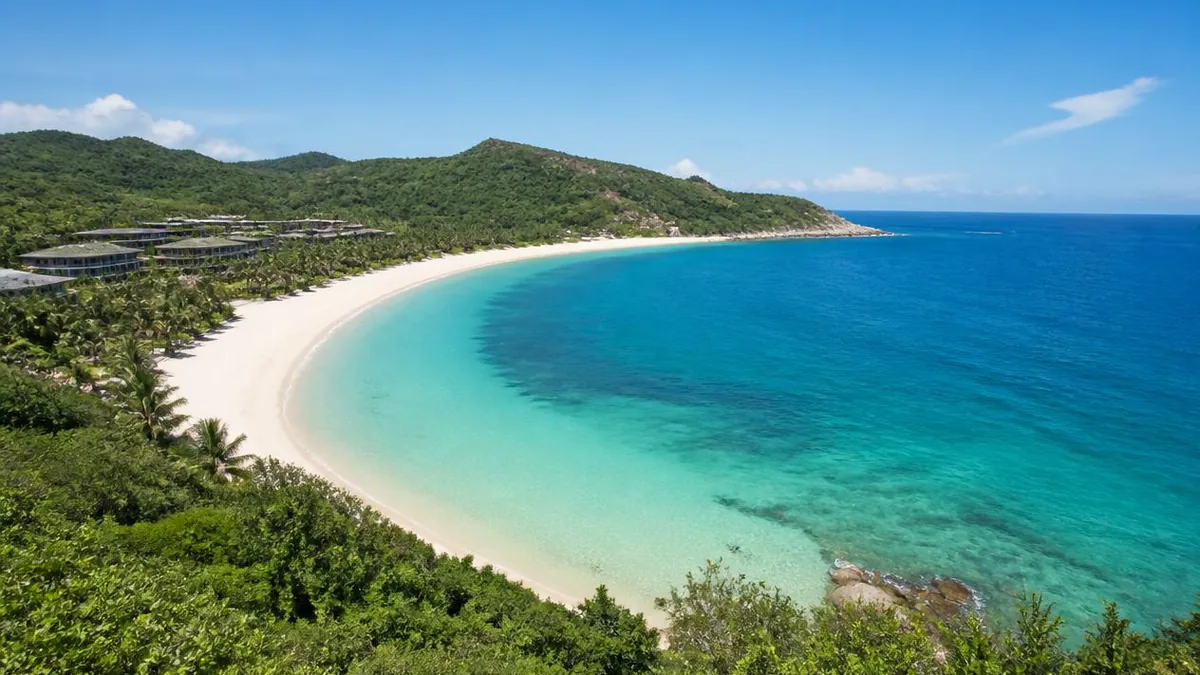
Yalong Bay lies on the eastern side of Sanya, described in Chinese sources as about 10 kilometres from the city centre. It is a crescent, sheltered at both ends by headlands, and its beach is described as silver-white and fine-grained.
Its length is given two ways. Chinese sources most often say 7 kilometres; English-language sources commonly say 7.5 kilometres. Nobody publishes which measurement convention produced which figure, so carry both and do not treat either as precise.
The bay is not empty water. Wild Boar Island sits offshore near its centre, with Dongzhou and Xizhou islands to the south and the Dongpai and Xipai reefs to the west — the geography that makes this a water-sports coast rather than just a swimming beach. The two headlands, Jinmu Cape and Yalong Cape, are described in Chinese sources as good rock-climbing ground.
One boundary matters for planning. The eastern portion of the bay is naval, part of a base area, and it is not open to visitors. The public and resort coastline is the western and central arc; do not plan on walking the full crescent end to end.
The bay was a policy before it was a resort
It is worth sitting with the 1992 decision, because it explains the entire built environment.
The national tourist resort was not a conservation designation or a scenic rating. Chinese descriptions place it in the same family as national-level development zones: a bounded area, created to attract investment, with the explicit aim of shifting Chinese tourism from sightseeing to holidaying and of capturing overseas visitors. The State Council approved eleven in October 1992; in 1993 the two centres under the Jiangsu Taihu resort were renamed as the separate Suzhou Taihu and Wuxi Taihu resorts; in 1995 an approval moved Shanghai’s resort from Hengsha Island to Sheshan. Twelve, and no more.
Read the list and Yalong Bay’s company is instructive: Dalian Jinshitan, Qingdao Shilaoren, Hangzhou Zhijiang, the two Taihu resorts, Shanghai Sheshan, Wuyishan, Meizhou Island, Guangzhou Nanhu, Beihai Silver Beach, Kunming Dianchi. Mostly northern and eastern coastal or lake sites serving nearby cities. Yalong Bay was the tropical entry — the one place in the group that could sell a winter beach.
Thirty-odd years later, that is exactly what it does. The point is that the resort was designed as national industrial policy first, and only afterwards became a place people describe with the marketing phrase “Oriental Hawaii” — a promotional nickname, and worth labelling as one.
What the policy built
The physical result is a continuous frontage of large hotels along the crescent.
International operators reported on the bay include the St. Regis, Sheraton, Marriott, Ritz-Carlton, Pullman, Grand Hyatt and MGM Grand properties, alongside domestically operated resorts including Resort Horizon, Mangrove Tree and Cactus. There is a golf club. There is a central plaza area with a shell museum and an aquarium-style attraction, and there are water-sports operators working off the beach.
What that adds up to, for a visitor, is a coastline with no ordinary street life against it. There are no fishing boats pulled up on the sand, no rows of small restaurants opening straight onto the beach, no informal use of the shoreline by people who live there — because almost nobody lives there. Everything between the road and the water is a property.
This is not a complaint. It is the specification being met. But it does mean two things practically: prices inside the resort strip bear no relation to prices in Sanya’s city districts, and if you are not a hotel guest, your relationship to this beach is defined almost entirely by the question in the next section.
Who owns the sand
Here is the mechanism, and it is cleaner than most travel writing admits.
China’s Sea Area Use Law was passed on 27 October 2001 and took effect on 1 January 2002. Three of its provisions matter here.
Article 2 defines the sea areas the law governs as internal waters and the territorial sea — water surface, water body, seabed and subsoil — with internal waters running from the territorial-sea baseline landward to the coastline. That is the crucial line: the sea side of the coastline, including the intertidal sand that the tide covers, is sea area.
Article 3 states that sea areas belong to the state, with the State Council exercising ownership on its behalf, and that no unit or individual may occupy, buy, sell or otherwise illegally transfer them. Using a sea area requires a sea-area use right obtained under the law.
Article 23 protects the rights holder, and then limits it: the holder of a sea-area use right may not obstruct non-exclusive uses of the sea that do not impede its own lawful use. Sea-area use rights are also time-limited — Article 25 caps tourism and recreation sea use at 25 years.
So the water is not private, and cannot be sold. The dry land behind the beach is another regime entirely: leased land, with buildings, planting, pools, loungers, umbrellas, showers, towels, security and staff on it, all of which belong to the hotel.
The honest practical summary is therefore a seam, not a wall. You can be on the shoreline; you should reach it by a public access route rather than through a resort’s grounds; and the furniture and services on the sand are somebody’s business, not a public amenity. Where access points are, how they are signed, and how strictly the boundary is policed varies between properties and over time. Ask locally, use the marked routes, and do not read any of the above as a technique for getting a free lounger.
The reef under it
Yalong Bay’s water quality is not only a matter of being far from the city. The bay sits on a reef coast, and Chinese sources describe it as part of the Sanya coral reef national nature reserve, citing Hainan provincial government material. The reserve appears on China’s national list of state-level nature reserves, and Chinese accounts date its national designation to 1990, in the period when China’s first marine reserves were established.
That has two consequences.
The first is why people come: coral close to shore, water described as clean and transparent, and diving and snorkelling as the core of the local product rather than an add-on. Chinese descriptions single out the visibility of the coral itself.
The second is what a reserve implies about behaviour. Coral is damaged by standing on it, by anchors, by sediment and by collection, and reef areas inside Chinese national nature reserves carry zoning that restricts activity. Current reef-condition monitoring figures and present zoning boundaries could not be verified here from a citable source, and no numbers will be invented to fill the gap. What is safe to say: this is protected reef, the rules are real, and the operators running trips are the ones who know which areas are open in the current season.
The hill above the bay, and the film that is usually misremembered
On the ridge behind the north side of the bay is the Yalong Bay Tropical Paradise Forest Park, a hillside park with viewpoints over the crescent, walkways, a rope bridge and villa accommodation. It is a 4A-listed operation, it is ticketed separately from the beach, and it is the reason many Chinese visitors know Yalong Bay’s name at all.
Its most cited structure is the glass walkway: about 400 metres long, described as Hainan’s first glass bridge, built from 30-millimetre toughened glass, rated to hold 1,000 kilograms per square metre, with its deck around 100 metres above the lowest point beneath it.
Now the correction, because it is repeated wrongly almost everywhere in English. The film associated with this hillside is If You Are the One 2 (2010), Feng Xiaogang’s December 2010 sequel, in which the leads rent a scenic hillside villa in Sanya. It is not the 2008 original: that film’s main locations were Beijing, Zhejiang and eastern Hokkaido — Lake Akan, Kushiro and Shiretoko — and it has nothing to do with Hainan. If you see a caption crediting the 2008 film for this park’s fame, the year is wrong by two.
Practically, treat the park as a separate half-day with its own ticket, its own transport up the hill and its own opening hours, all of which should be confirmed on the day.
Two seasons running opposite to the rest of China
Sanya’s calendar inverts the one most travellers carry.
The climate is tropical wet-and-dry: a wet season from roughly May to October, heaviest from July into October, and a pronounced dry season from November to April. The coolest month is January at about 22.3°C and the hottest is June at about 29.5°C — note that it is June rather than July or August, unlike most of China. Annual rainfall is around 1,417.5 millimetres, annual sunshine about 2,425 hours, and the 1991–2020 annual mean about 26.5°C, with 2024 running roughly 0.8°C above that baseline.
So the season that empties beaches elsewhere in China fills them here. The demographic evidence is striking: northern Chinese, and north-easterners in particular, have been moving to Sanya since the 1990s, and one tally reported by The Paper counted close to 400,000 non-local older people wintering in the city as of November 2014, roughly 200,000 of them registered in Harbin.
Yalong Bay is the expensive end of that flow. Hotel rates through the winter peak and around the Chinese New Year period bear no relation to the same rooms in September, and the beach is at its busiest when the rest of the country is frozen.
Water temperature, typhoons, and the daily decision
Two things visitors get wrong about the sea here.
The first is temperature, where sources disagree and neither has been reconciled with the other. Chinese descriptions of Yalong Bay give winter air around 27°C and winter sea temperature around 20°C; a nearby Sanya beach is described the same way, with winter water lows near 20°C. English-language summaries of Sanya’s climate instead state that water temperatures stay above 22°C year-round. Both are in print. Take the practical implication rather than the number: swimming is possible all year, and the winter sea is noticeably cooler than the air, which catches out visitors who assume tropical means bath-warm in January.
The second is typhoons. Hainan’s exposure falls in the wet season, broadly the same May-to-October window, with the heaviest rainfall months from July into October. What that means on the ground is not cancelled holidays so much as cancelled days: boat trips, diving, water sports and sometimes swimming itself are suspended when conditions require it, and those decisions are made locally and at short notice.
The rule to carry is simple. Anything on this coast that involves a boat, a reef, an engine or deep water is a same-day decision made by someone with a radio, not something you can lock in from home. Check flags, signage and official notices on the day.
Getting there, and moving along a seven-kilometre strip
Yalong Bay is about ten kilometres from central Sanya, and it has its own railway station on Hainan’s high-speed loop, Yalongwan station, as well as bus connections that have historically included routes serving Sanya Phoenix International Airport and routes running through downtown and Dadonghai toward Nanshan. Route numbers, fares and airport shuttle lines change; treat any specific number you read, here or elsewhere, as needing confirmation on the day.
The more useful planning point is internal. This is a strip roughly seven kilometres long with hotels side by side and no continuous public promenade running behind them, which means moving between properties on foot generally means walking on the beach, and moving any distance means a taxi or a hotel shuttle. The central plaza area is the closest thing to a shared node.
Budget accordingly. A day trip from the city to “see Yalong Bay” usually means seeing one arrival point and one stretch of sand, and that is a reasonable use of a morning. Staying here means accepting that the resort is the destination and the city is a taxi ride away.
Where this bay sits among the five
Sanya is conventionally described as having five major bays, and the comparison is the fastest way to place this one.
Sanya Bay is the city’s: about 22 kilometres, free, ungated, west-facing and therefore the sunset bay, with less clear water because a river mouth, a harbour and an airport share the frontage. Dadonghai is the compact tourist beach nearest the centre, with the Luhuitou headland beside it. Yalong Bay is the original resort bay, approved in 1992, with the reef and the hotel wall. Haitang Bay, with a coastline given as 42.8 kilometres and lying about 28 kilometres from the centre, was developed last and is the newest and largest concentration of luxury resorts, with Wuzhizhou Island off its southern end. Yazhou Bay, on the western side, is the industrial and academic one.
Both Sanya Bay and Yalong Bay appear on the Ministry of Ecology and Environment’s national beautiful-bay list, and both among the cases marked outstanding — a water-quality and shoreline-management judgement rather than a tourism rating.
Which leaves the sentence worth taking onto the sand. Yalong Bay is the best beach in Sanya and the least public one, and both halves of that are the same fact: a bay that was designated, bounded and built to a policy specification in 1992, on a coastline that the law still says belongs to everybody.
The LoreLens app can identify reef and coastal landforms, shoreline vegetation and resort-era architecture, and explain how they got there, while you are standing in front of them.
Location profile
Where it is

Frequently asked questions
Can I use Yalong Bay beach if I am not staying at one of the hotels?
In law, the sea and the wet sand are not private. China's Sea Area Use Law, passed on 27 October 2001 and in force from 1 January 2002, states that sea areas belong to the state, defines internal waters as running landward from the territorial-sea baseline to the coastline, and requires anyone using a sea area to hold a sea-area use right; it further provides that a rights holder may not obstruct non-exclusive uses of the sea that do not interfere with its own lawful use. What the hotels hold on the land side is a separate matter: the dry ground behind the beach is leased land with buildings, gardens, pools, loungers, umbrellas, showers and staff on it, and none of that is public. The practical result is a seam rather than a wall. Reaching the water usually means using a public access point rather than walking through a resort, and the furniture and facilities on the sand belong to whoever put them there. Treat this as an edge to respect, not a loophole to work; and expect signage, security practice and access points to differ between properties and to change.
Is Yalong Bay a 5A scenic area?
No. Sanya has four 5A-rated tourist areas — Nanshan Cultural Tourism Area, the Nanshan Daxiao Dongtian area, Tianya Haijiao and Wuzhizhou Island — and Yalong Bay is not among them. Its listing in China's A-grade system is 4A, and the ticketed operation on this coast is the Yalong Bay Tropical Paradise Forest Park on the hillside above the north side of the bay, which is a separate site with separate admission from the beach. The designation that actually shaped Yalong Bay is different in kind: the State Council approved it as a national tourist resort in October 1992, in the first group of such resorts, and it remains the only one in Hainan. That is a development-zone status aimed at building international resort capacity, not a rating of scenic quality, which explains why the bay looks the way it does.
Yalong Bay or Sanya Bay?
They answer different questions. Yalong Bay, roughly ten kilometres east of the city centre, is the resort bay: a crescent of fine pale sand on a reef coast inside a national coral-reef nature reserve, with clearer water, a hotel wall along the shore, and almost nothing to do that is not run by a hotel. Sanya Bay is the city's own beach: about 22 kilometres of free, ungated sand along an ordinary municipal road, with the water and the sand less pristine because a river mouth, a harbour and an airport share the frontage, and with the city's best sunsets because it faces west along the water. If you want swimming, snorkelling and a resort, Yalong Bay. If you want a long evening walk, cheap food behind you and a sunset, Sanya Bay. Many visitors split the days rather than choosing.
When should I go, and what does typhoon season mean here?
Sanya's peak is the northern winter, which surprises first-time visitors. The city has a tropical wet-and-dry climate: the wet season runs roughly May to October and is heaviest from July into October, the dry season November to April; January averages about 22.3°C and June, the hottest month, about 29.5°C, with roughly 1,417.5 millimetres of rain and about 2,425 hours of sunshine a year. That dry, mild winter is why Sanya fills with visitors from northern China from around November, a pattern that has run since the 1990s. The trade-offs are straightforward: winter brings the best weather and the highest prices and crowds; summer and early autumn bring heat, humidity, heavier rain and Hainan's typhoon exposure. Sea conditions, water sports, boat trips and beach access are decided locally, day by day, so check the flags, signage and official notices on the day rather than planning around a forecast written weeks ahead.
Sources and further reading
Background references for the history and place names in this guide. Opening hours, ticketing and access change often — always confirm with official local information before travelling.