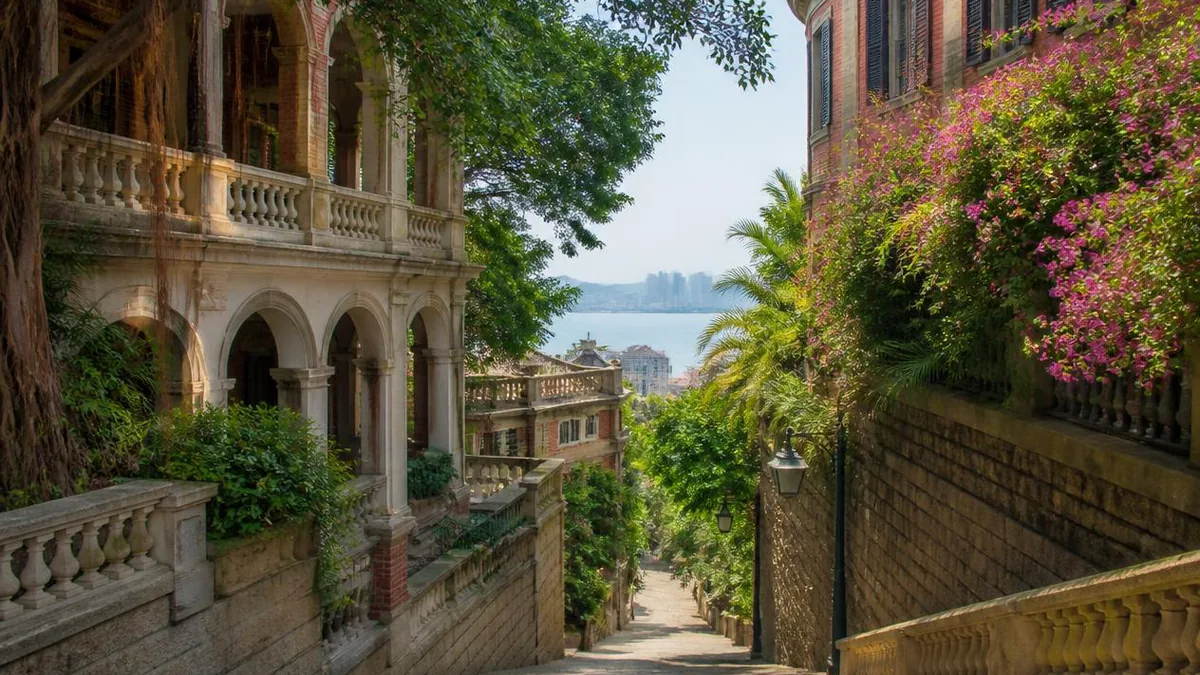
Fujian · Xiamen
Gulangyu: No Cars, and a Great Many Pianos
Two things make this island different from anywhere else in China: nothing with an engine drives on it, and it is full of keyboard instruments. Neither is charm. Both are what is left of an administrative arrangement that ran from 1902 to 1945.
5A View location, maps and nearby scenic areasMost islands are visited for what is on them. Gulangyu, a short ferry crossing from Xiamen, is more interesting for what is absent: no cars, no bicycles, no road bridge, no way in that is not a boat.
That absence is usually sold as atmosphere. It is closer to a residue. So is the other thing the island is known for, the pianos. Both are what remains of an administrative arrangement that ran on this piece of land from 1902 to 1945, and the world heritage listing says so in its own title. The property inscribed in 2017 is called Kulangsu, a Historic International Settlement. Not a garden, not a scenic island. A settlement.
Read the island as a former jurisdiction and the details start to line up.
A treaty port, and an island beside it
Xiamen was one of the five ports opened by the Treaty of Nanking of 1842, with the port opening the following year. British forces had occupied Gulangyu during the war and withdrew in 1845.
The British then took a strip of foreshore on the Xiamen side for a small concession, which was a commercial district and little else. Gulangyu, across roughly a kilometre of water, developed differently: consulates, mission compounds, schools, hospitals and houses. The split matters. One side was for business; this side was where people lived.
What “lived” meant is visible in the institutions. The Union Church, the island’s first, was begun in 1863 and rebuilt in 1911. Hope Hospital opened in 1898. So did a kindergarten founded by the British missionary couple Wei Yuzhen and Wei Aili, described in Chinese sources as the first in China and still operating under a later name. Girls’ schooling started early here too, with a school at Tianwei dated 1884.
Those institutions produced people, which is the part worth carrying. Lin Qiaozhi, the obstetrician who became one of modern China’s best-known physicians, was born on this island and is commemorated in a memorial garden here. Lin Yutang married Liao Cuifeng in her family’s villa on Zhangzhou Road in August 1919. Neither is an ornament to the settlement story; both are outputs of a small place with an unusual density of schools and hospitals.
The trigger for formalising all of this came from elsewhere. After Japan took Taiwan in 1895, the Qing government, worried that Xiamen was next, sought what the Chinese sources call joint protection by the powers. The settlement was, in that framing, requested. What followed was not a request.
What “international settlement” meant on paper
On 10 January 1902 the consuls at Xiamen and Yannian, the Qing daotai of the Xingquanyong circuit, signed the Land Regulations for the Kulangsu International Settlement. The venue was the Japanese consulate on the island.
The signatory count is not agreed. One Chinese-language account lists nine states: Britain, the United States, Germany, France, Spain, Denmark, the Netherlands, Sweden-Norway and Japan. Another lists ten, adding Italy. The regulations were approved by the Chinese government in May 1902, and the Kulangsu Municipal Council, the gongbuju, was seated in January 1903. Around and after that, 13 countries came to hold consulates here.
The machinery was the machinery of Shanghai in miniature: a municipal council, a police force in which Sikh constables recruited through British India served, a Mixed Court, and land rules. Whether Gulangyu was one of two or one of three such settlements in China is itself disputed; English-language accounts often say only Shanghai and Gulangyu, Chinese-language accounts add Wuhu.
The end came in stages. Britain’s Xiamen concession was returned in 1930, leaving this one. Japan took Xiamen in 1938 and the settlement became a refuge island; Japanese troops moved in after the Pacific War opened in December 1941; the United States and Britain gave up their extraterritorial rights in January 1943; the settlement was taken over in May 1943 and formally recovered by the National Government in September 1945.
Amoy Deco, and why the buildings look mixed
The world heritage description does not call the architecture colonial, and that is deliberate. It names several strands present at once: traditional southern Fujian building, Western classical revival, and the veranda colonial type. Then it names something that is not a strand but a fusion.
Amoy Deco Style is the term the nomination uses: a synthesis of early twentieth-century modernism with Art Deco, developed locally. In practice it means what you will see repeatedly on the lanes here, a facade with Ionic or Tuscan columns and a deco parapet sitting over red southern-Fujian brick, laid by local masons for owners who were mostly not Europeans at all.
That last point is the one most tours skip. A large share of the grandest houses were built by overseas Chinese who had made money in the Philippines, Indonesia, Singapore or Vietnam, and came back to build here. The style is a fusion because the clients were.
Bagua Building, 1907: a doctor’s drawing, a red dome
The building everyone photographs from the ferry is the Bagua Building on the slope of Bijia Hill, begun in 1907 and finished in 1920, its site covering about 10,886 square metres and the building about 5,786.
Its owner was Lin Heshou, of the Lin family of Banqiao in Taiwan, who had moved to Gulangyu after 1895. Its designer was John Abraham Otte, the Dutch-American physician who ran Hope Hospital on the island and offered the drawings free because Lin had funded his hospital. Money ran out; by 1913 there was a main block with no roof. The octagonal third floor and the red dome, modelled on the Dome of the Rock, came later, over 78 round columns and four square ones on the lower storeys, with French bond red brickwork at the corners.
After that it was a Japanese school, a refugee shelter in 1938, a university dormitory, an art school, a capacitor factory, a computer factory. It became the Xiamen Museum in 1988 and the organ museum in 2006. Not the piano museum.
Shuzhuang Garden, 1913: a private garden that stayed
The piano collection is here instead, in the grounds of Shuzhuang Garden on the southern shore below Sunlight Rock, built from 1913 by Lin Erjia, whose courtesy name Shuzhuang gives the garden its name.
Lin was the son of Lin Weiyuan of the same Banqiao family, and the garden is a copy in spirit of the villa they had left behind in Taipei. It is organised in two halves whose names state their method: bushan, mending the hill, on the land side, and canghai, storing the sea, on the water side, the idea being that you enter and the ocean is already framed for you by a pavilion opening. The zigzag causeway out over the water, the Forty-Four Bridge, is named for the owner’s age when it was built.
Lin died in Taiwan in 1951 and his widow gave the garden to the Xiamen municipal government. A private garden built by a family displaced by one treaty ended up public property; the pianos arrived later.
Five more addresses, with owners and dates
The listed fabric here is domestic, and the useful way to look at it is owner by owner.
- Fanpo Lou, Anhai Road, 1927, built by Xu Jingquan, an overseas Chinese in the Philippines. The name translates awkwardly and is local slang; the house was built for his mother.
- Huang Rongyuan Tang, Fujian Road, 1920, later bought in 1931 by Huang Zhongxun. It has served as the China Record Museum.
- Haitiantanggou, Fujian Road, 1920s, five buildings by Huang Xiulang and Huang Nianyi, both from the Philippines. This is the group usually used to illustrate the fusion argument.
- The former Japanese consulate, Lujiao Road, main building 1897–1898, with a police headquarters block added around 1928–1929 that has five small cells in its basement.
- Hope Hospital, Guxin Road, founded 1898 by Otte, restored around 2010, and since 13 May 2017 the Palace Museum’s Gulangyu gallery of foreign artefacts.
Most of the rest are private homes and do not admit visitors, which is worth saying plainly before you go looking for interiors.
Sunlight Rock, and the military layer underneath
Everything above sits on an older story. Zheng Chenggong, the Ming loyalist commander known in English as Koxinga, used the island as a garrison and training base against the Qing in the mid-seventeenth century, and the remains attributed to that period, a naval drill platform and the site of a stone fort gate, are on Sunlight Rock.
The rock is the island’s high point, given as 92.68 metres, a granite mass at the top of Longtou Hill with a circular platform on top and Sunlight Rock Temple at its foot. From the platform you can see the whole island at once, which is the fastest way to understand how small it is.
The commemorations are modern. The stone statue of Koxinga in Haoyue Garden was completed in 1985 at a height given as 15.7 metres; a local story holds that the figure matches his own height of 1.57 metres, which is repeated everywhere and sourced nowhere. Two villas nearby carry the aftermath: Kanqing Villa (1918) was refitted as Chiang Kai-shek’s temporary headquarters in 1949 and used for a single night, on 23 July, and Guo Moruo wrote a play about Koxinga in it in 1962; Xilin Villa (1927) next door is the Koxinga memorial hall.
The piano claim, sorted
The island is marketed as the Piano Island, and the standard sentence is that it has the highest piano ownership per capita in China. Treat that as a claim without a published count behind it. Nobody has produced the census.
What is checkable is more interesting anyway. The mission schools brought Western music teaching from the late nineteenth century, and the island produced musicians out of proportion to its size: the pianist Yin Chengzong, the pianist Xu Feiping, the violist Yang Jing, and earlier the singer and composer Zhou Shu’an, the vocal teacher Lin Junqing and the conductor Chen Zuohuang. Two specialist schools sit on the island, a music school attached to Xiamen University founded in 1990 and a piano school attached to the Central Conservatory founded in 2006. The Chinese Musicians’ Association named it the Island of Music in 2002. English-language accounts give a figure of more than 200 pianos on the island; that number, too, comes without a method.
So the honest version: the music is real and institutional, the ranking is folklore, and the instruments you can actually count are in two museums.
No cars: the rule, and what it does to a day here
The rule is simple and absolute in one direction. No cars, no bicycles. What runs is a fleet of licensed electric sightseeing buggies, electric service vehicles, and a small number of fire engines.
The practical consequences are worth planning around. Luggage is your problem: there are no taxis and the lanes climb. Deliveries move on wooden handcarts, pulled uphill by teams, and the island’s supply chain is visible in a way it is nowhere else. The background sound is different, and on the quieter lanes at the north end of the island it is genuinely quiet, which is the single strongest argument for staying overnight rather than doing a day trip.
The island is small enough for this to work: figures for its area vary with the boundary drawn, from 1.77 to 1.88 to 1.91 square kilometres depending on the source, which is to say you can cross it on foot in well under an hour if you do not stop.
Ferries, caps, and who the island is for
The pressure is documented, and the mechanisms answering it are documented too.
Visitor numbers climbed steeply once the heritage bid began in 2008: reported arrivals of close to 6 million in 2009 and 11.36 million in 2012. Family-run guesthouses on the island went from 12 in 2008 to more than 400 by 2014. Over the May holiday in 2013 the island was averaging close to 60,000 arrivals a day, against an estimated limiting daily capacity of 39,000 in a study by the Xiamen urban planning and design institute.
Three interventions followed, in order. Ferry fares for non-residents were raised sharply from 20 October 2013. Residents and visitors were separated onto different terminals and routes from 20 October 2014. And Xiamen municipal government document 2017 No. 201, dated 1 June 2017, set the daily maximum carrying capacity of the scenic area at 50,000 visits from 30 June 2017, five weeks before the inscription. Note that the cap adopted is above the planners’ estimated limit, not below it.
An earlier attempt had failed outright: a proposed 80-yuan landing fee in early 2003 was dropped after public objection, on the argument that Gulangyu was not a theme park but part of the city where people lived.
That argument is the live one. Resident counts differ by basis and date — a registered population of 15,373 for the subdistrict, an English-language figure of 12,509 for 2023, older Chinese accounts still saying around 20,000 — but the direction is not in dispute, and the same lanes now carry guesthouses, cafes and souvenir shops where households used to be. The island has handled this better than some peers; the comparison with Lijiang’s old town is exact in mechanism and different in degree.
Walk up to the platform on Sunlight Rock in the first hour after the earliest sailings, before the day’s quota lands, and the whole argument is laid out below you: red-brick roofs with deco parapets, built by returning merchants and by consulates that answered to a municipal council; lanes too narrow for anything with an engine; a garden built by a family that left Taiwan in 1895; and a strip of water a kilometre wide that has done more to preserve this place than any regulation, because it is the reason nothing can be driven here.
The LoreLens app can identify Amoy Deco facades, veranda colonial types and southern Fujian brickwork, and explain the owners and dates behind them.
Location profile
Where it is

Frequently asked questions
Why are there no cars on Gulangyu?
Because there is no road onto the island and a standing rule against motor traffic on it. Gulangyu is reachable only by ferry, and its lanes were laid out for walking before motorisation, narrow and steep. Cars and bicycles are both barred. What does move is a fleet of licensed electric sightseeing buggies, electric service vehicles for government and utility work, and a small number of fire engines. Freight goes up the lanes on wheeled wooden handcarts pulled by teams of men, which is worth watching for a minute because it is how everything sold on the island got there. One more piece of machinery was subtracted rather than added: a 202-metre cable car built in 1993 between Sunlight Rock and Yingxiong Hill, at the time described as the world's shortest, was put on the clean-up list for the world heritage bid and dismantled from 8 June 2012.
Is the piano museum in the Bagua Building?
No, and this is the most common mix-up on the island. The Bagua Building, the red-domed landmark begun in 1907, has housed the organ museum since 2006; before that it was the Xiamen Museum, from 1988. Japanese-language accounts of the organ collection put it at 64 instruments including a British pipe organ of 1909. The piano museum is in the grounds of Shuzhuang Garden at the southern shore, a separate site with a separate approach. If a guide sends you to the domed building for pianos, you will find organs, which is not a bad outcome, but it is not what you were promised.
How do the ferries work, and is there a limit on visitors?
There are two things to understand. First, residents and visitors have been routed through different terminals since 20 October 2014: the Siming ferry pier in central Xiamen was reserved for residents plus night sailings and emergency use, while daytime visitor traffic was moved to the cruise-terminal pier in Huli district and the Songyu pier in Haicang district, landing at Sanqiutian and Neicuo'ao on the island. Second, there is a formal cap. Xiamen municipal government document 2017 No. 201, dated 1 June 2017, set the scenic area's daily maximum carrying capacity at 50,000 visits, effective 30 June 2017. Routes, sailing times, fares and how tickets are released all change by season and by year, so buy from the official channel and check the day's notice rather than an old blog post.
How long does Gulangyu take, and when should I go?
A full day is the honest answer if you want the museums as well as the lanes, and a half day gets you Sunlight Rock, Shuzhuang Garden and a loop of the streets at speed. Early morning is materially different from midday: the first sailings land before the day's crowd, the lanes off the main commercial spine are quiet, and the light on the east-facing facades is better. The island is small enough that you will walk the whole of it without meaning to, and steep enough that you will notice. Individual houses, museums and gardens keep their own hours and many of the listed buildings are private homes that do not admit visitors at all, so treat any itinerary, this one included, as a starting point.
Sources and further reading
Background references for the history and place names in this guide. Opening hours, ticketing and access change often — always confirm with official local information before travelling.