Shandong · Qingdao
Badaguan: The Rulebook Is the Architecture
Two hundred-odd villas in twenty-odd national styles, laid out under a 1930s Chinese municipal ordinance that capped site coverage, banned solid walls and gave each street a single species of tree. The rules, not the styles, are why it still looks like this.
The standard sentence about Badaguan is that it is an exhibition of world architecture: Russian, German, British, French, American, Japanese, Danish, more than twenty national styles in a couple of hundred houses on a headland above the sea.
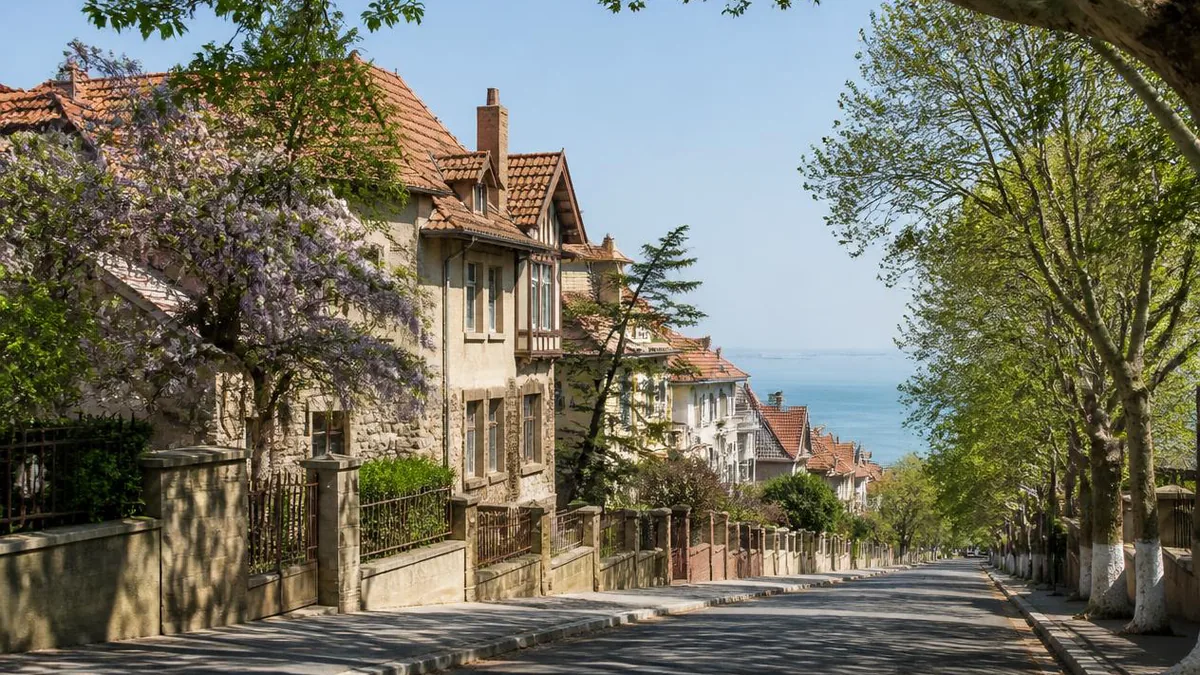
That is true, and taken alone it misleads, because it suggests the district is a collection. It is not. It is the product of one set of municipal rules, written by a Chinese city government, specifying how much of each plot could be built on, what the fences had to look like, and what would be planted along each street. The styles vary because the owners and their architects varied. What makes Badaguan legible as a single place — the low density, the deep gardens, the sightlines through hedges rather than over walls, the quiet — is the ordinance.
Two other facts follow from that and shape any visit. Because the rules were about setting rather than style, the district survived intact when denser neighbourhoods did not. And because of what happened to these houses after 1949, most of them are still closed to you.
Eight passes, ten roads
Start with the name, because it is wrong in an instructive way.
The streets here are named after historic military passes of imperial China. Eight of them were laid first, and the district took its name from that count. Ten are now normally listed: Zijingguan, Ningwuguan and Shaoguan running roughly north to south, and Wushengguan, Jiayuguan, Hanguguan, Zhengyangguan, Linhuaiguan, Juyongguan and Shanhaiguan running east to west.
Chinese reference sources state the name derives from eight roads and then list ten in the same paragraph, without dating the additions. The protection schedule offers a check: houses on Hanguguan Road carry dates from 1934 onward and 2 Linhuaiguan Road is dated 1932, so the extra roads were early rather than modern. The name simply stopped counting.
The district occupies the south slope of Taiping Mountain between two headlands, Huiquan and Taiping, in Shinan District. Its area is given as 666,000 square metres — which is the same figure as the “roughly one thousand mu” quoted in accounts of the original zoning, a rare case of two sources agreeing exactly.
Three administrations, and where the villas fall
Qingdao changed hands three times in twenty-five years, and Badaguan belongs to the gap after the third change.
German warships landed on 14 November 1897; the lease over Jiaozhou Bay was signed on 6 March 1898, for ninety-nine years. Japan took the territory by force in 1914, occupying the bay on 7 November of that year, and held it until it was returned to Chinese administration on 10 December 1922. Qingdao became a special municipality in 1929. Japanese forces occupied the city again from the late 1930s — start dates of 1937 and 1938 are both in print, depending on whether the count runs from the outbreak of the war — until 1945.
Badaguan was zoned and largely built in the interval between the 1922 restitution and the second occupation, with construction continuing through the occupation and into the late 1940s. That is the plain answer to the question every visitor asks: the German administration had been gone for roughly seven years before the zone was designated, and for more than a decade before most of these houses were begun.
The rules that made it
The founding document is a zoning designation, and its clauses are the most useful thing in this article.
The area east of Rongcheng Road, north to Zhanshan Road and south to Taiping Bay, was designated a specially regulated building zone. Within it: site coverage had to stay below 50 per cent, green space was to be protected, and boundary fencing had to be open — see-through railings and hedges, not solid walls.
Attribution of the designation is where accounts diverge slightly, and the divergence is worth stating rather than smoothing. The general article on the district credits the zoning to the mayoralty of Shen Hongli, given as 1931 to 1937. The article on Shanhaiguan Road — described as the first street of the zone to be built — dates the planning to 1929. Both can be partly right: 1929 is when Qingdao became a special municipality, and a designation begun then could well have been enforced and extended under a later mayor. No source available here resolves it, so do not repeat either date as the settled one.
What the clauses produce is exactly what you see. A 50 per cent coverage cap on generous plots forces detached houses with gardens. Protected planting keeps the canopy. Open fencing makes the gardens read as continuous landscape from the street, which is why the district feels like a park with houses in it rather than a street of walls. Three sentences of regulation, one urban character.
One species per street
The planting rule is the part visitors notice without knowing it is a rule.
Each of the ten roads was planted with a single species, so that the district flowers in sequence rather than all at once. The assignments repeated in Chinese sources are flowering peach on Shaoguan Road, pink in spring; crape myrtle on Zhengyangguan Road, flowering through summer; cedar along Zijingguan Road, evergreen; crabapple on Ningwuguan Road; and London plane on Shanhaiguan Road, the seafront street.
Juyongguan Road is the one that will not settle. The same reference article names it as five-lobed maple, colouring red in autumn, in one paragraph, and as golden ginkgo in autumn in another. Both are autumn trees and both claims are made about the same street in the same text, so treat the street as unresolved and look up.
Two later additions are where people congregate. A grove of peach trees at the north-east corner draws spring crowds; at the south-west, paired evergreens along a path form a run of enclosures that acquired the local name Lovers’ Corner.
Who actually built these houses
The protection listing is the best available inventory, and it disposes of several romantic assumptions.
On 25 June 2001 the State Council listed the modern architecture of Badaguan in the fifth batch of Major Historical and Cultural Sites Protected at the National Level, with 236 individual buildings as sub-items. That number sits alongside the commonly quoted figure of “over 200 villas”; they are different counts of overlapping things, and neither is wrong.
Read down the schedule and the pattern is clear. Construction dates run from 1929 to 1949, clustering in the 1930s and 1940s. Owners named in the records include Russian émigrés, Chinese officials and businessmen, a Japanese flour company that built staff housing on Hanguguan Road, and a Japanese trading firm. The architects named repeatedly are Russians working in Qingdao — Lavrentiev appears on at least four houses — alongside Chinese architects such as Liu Yaochen and Wang Pingfan; the contractors are local Qingdao building firms.
That is the honest description of an “exhibition of world architecture”: a Chinese municipal zone, developed by mixed private owners, designed largely by émigré and Chinese architects, built by Chinese firms, in whatever style the client wanted.
For the German-built part of Qingdao, which is genuine and is a different place, see our guide to the Tsingtao Brewery Museum.
Huashi Lou, and what can and cannot be said about it
The single most photographed building stands at the south end of Zijingguan Road, at 18 Huanghai Road, on rock above the sea beside the Second Bathing Beach.
Huashi Lou — the flower-stone building — is faced in stones of several colours and finishes, which is where the name comes from, with a turret, coloured glass and an eclectic Gothic-leaning silhouette. The protection schedule dates it to 1931; English-language sources commonly say 1932. Chinese accounts credit the design to Liu Yaochen, whose name is also transcribed with a variant character in some texts.
Ownership is where care is required. The general article on the district says the house was first the private residence of a Russian merchant transcribed as Laibichi, was later sold to a British owner, and served as the residence of the British consul in Qingdao. The itemised protection schedule, however, attaches the name Laibichi to the neighbouring house at 16 Huanghai Road, completed in 1930 to a different architect. He may have built both; the sources have not been reconciled, and merging them is exactly the kind of shortcut that turns into a fact.
The Chiang Kai-shek story needs the same treatment. What Chinese sources state is that Chiang stayed in the building in the late 1940s. Guides routinely upgrade this to “Chiang Kai-shek’s villa” and add architectural details — a private passage to the shore is a favourite — that are not supported in the reference literature. A documented stay is not ownership, and it is the more interesting claim anyway, because it dates from the very end of the Nationalist period in the city.
The Butterfly Building, and a film about this exact problem
The house at 21 Shanhaiguan Road is the one to visit if you only enter one.
It was built in 1933 for Mary Danilevsky, a Russian émigré, to a design by the Russian architect Lavrentiev, at a recorded cost of 7,500 yuan. It is a single storey with attic and partial basement, in a purplish rough render with imitation quoins under a red-tiled double-hipped roof; the floor area is recorded as 493.64 square metres, with 397.42 given elsewhere.
In 1935 it became the main location for the film Peach Blossom After the Calamity, written by Hong Shen, directed by Zhang Shichuan and starring Hu Die, whose stage name means butterfly — which is how the house came to be called the Butterfly Building. The film is described as the first made about, and shot in, Qingdao. Hong Shen drew on his own family’s experience, and the plot runs across the German period, the Japanese occupation and the return to Chinese rule. A film about property changing hands through three regimes, shot in a villa built in the zone the third regime planned.
After 1949 the house became a ward of the Qingdao sanatorium. It was repaired and opened to the public in the spring of 2016, with display rooms on Chinese film history and on Qingdao’s role in it.
What the district became after 1949
This is the part that explains both the preservation and the closed gates, and it is usually left out.
The villas did not return to private ownership. They were taken into institutional use as sanatoria, guesthouses and reception buildings, and the district became a place where senior figures came to convalesce. The clearest case is 17 Shanhaiguan Road, built in 1940 for a Japanese trading company — its permit applied for by the firm’s representative, designed by the architect Chen Ruiting, with tatami rooms and a Japanese garden. After 1949 it became a guesthouse, and six of the ten marshals of the People’s Liberation Army stayed there at various times, which is why it is now called the Marshals’ Building. Note that the official protection schedule dates this building to 1933 while the research literature dates it to 1940; the two have not been reconciled.
At the Second Bathing Beach, 6 Shanhaiguan Road carries a different kind of record. In July 1957 Mao Zedong held a Politburo meeting and then a conference of provincial and municipal party secretaries partly at this beach and partly at the municipal guesthouse, issuing a paper on the summer’s political situation on 30 July. The site was made a provincial-level protected site in 1977 under a name referring to Mao’s report; that listing was later withdrawn, and in September 2017 the same place was listed at district level under the neutral title of the 1957 conference site. Same building, two commemorative regimes, and the change of name is the document.
Institutional occupation is the reason the streets are empty of traffic and the gardens are intact. It is also the reason you are looking at most of these houses from the pavement.
The sea edge, and the crowd pattern
The district’s southern boundary is coastline, and the coastline is where the density is.
Taiping Bay lies below Shanhaiguan Road, with the Second Bathing Beach on it; the First Beach lies to the west and the Third to the east, so Badaguan sits between them with its own smaller strand. Huashi Lou stands on the rocks at one end, which is why almost every photograph of the beach has the building in it.
Badaguan is also one of China’s busiest wedding-photography locations. On a fine day dozens of couples work the shoreline, the lawns and the villa gateways at once, with photographers, assistants and dress trolleys. It is not an occasional event but the district’s daily weather, and it affects where you can stand.
The practical consequence is a split. The seafront is crowded and photogenic; two streets inland the district goes quiet almost immediately, because there are no shops, no through traffic and nothing to do except look at gardens. Most visitors never make that turn.
Visiting, with expectations set
Badaguan is free to walk through, has no gate, and is best treated as a walk rather than an attraction.
Plan on exteriors. The three buildings usually cited as open to visitors on a ticket are Huashi Lou, the Princess Building on Juyongguan Road, and the Butterfly Building. Everything else is in use. The Princess Building carries a story that it was built to receive a Danish princess; the reference literature says the villa was originally built for a German merchant and that the princess account, though widely repeated, is legend. The listing dates it to 1941.
Allow two to three hours on foot for a loop taking in the seafront, two or three inland streets and one interior. The district climbs away from the water, so wear shoes for slopes. Come in late April or May for the flowering trees, late October for autumn colour, midsummer for the sea and the crowds together. Which houses are open, what tickets cost and whether a building is closed for repair all move; confirm at the door on the day.
Two accolades you will see quoted deserve their labels. Badaguan is reported among the first group of streets designated China Historic and Cultural Streets, a national programme. The much-quoted title of most beautiful urban district in China, awarded in 2005, came from a poll run by a geographical magazine with media partners — a magazine ranking, not an official designation.
Walk east along Shanhaiguan Road with the sea on your right and read the fences rather than the houses. They are railings and hedges, almost without exception, and you can see through every one of them into a garden that occupies more of its plot than the building does.
That is the whole design. A city government wrote down a coverage limit, a planting requirement and a fencing rule, and left the architecture to whoever was paying. Ninety years later the styles have become a tourist slogan and the rules have become invisible, which is the wrong way round: the Danish gables and Russian turrets are the least durable thing here, and the setback line is the most.
The LoreLens app can identify individual Badaguan villas from a photograph and explain their construction dates, original owners, architects and later uses.
Location profile
Where it is
Frequently asked questions
Was Badaguan built by the Germans?
Mostly not, and this is the single most common error told about the district. Germany held Qingdao under a lease signed on 6 March 1898 and lost it to Japan in 1914. Badaguan was laid out and built after the territory came back under Chinese administration: the zoning designation dates from around 1929, the great majority of the villas went up in the 1930s and 1940s, and the sub-items in the national protection listing carry dates running from 1929 to 1949. A minority of buildings do date from the German period. English-language reference material, including the current English Wikipedia article, still describes the area as a German residential quarter, which is why the mistake keeps circulating. The German-built city is real and it is elsewhere in Qingdao, in the old town around the former governor's residence and the brewery.
Why is it called the eight great passes when there are ten roads?
Because the name was fixed before the road count was. All the streets in the district are named after historic Chinese military passes, and eight of them came first, which produced the name. The set now usually listed is ten: Zijingguan, Ningwuguan and Shaoguan running north to south, and Wushengguan, Jiayuguan, Hanguguan, Zhengyangguan, Linhuaiguan, Juyongguan and Shanhaiguan running east to west. Chinese reference sources state plainly that the name comes from eight roads while listing ten, and they do not date the two additions; the protection schedule shows houses standing on Hanguguan Road by the mid-1930s and on Linhuaiguan Road by 1932, so the additions were early. Nobody has renamed the district to match, and there is no reason to expect anyone will.
Can you go inside the villas?
A small number, and you should plan on exteriors. The great majority of the two-hundred-odd houses are in private, institutional or hotel use — several serve as guest accommodation, some are still lived in, and the district has long housed retired officials — so the ordinary visit is a walk past garden walls. Three buildings are commonly cited as open on a ticketed basis: Huashi Lou at 18 Huanghai Road, the Princess Building on Juyongguan Road, and the Butterfly Building at 21 Shanhaiguan Road, which reopened in 2016 with rooms on Chinese film history. Which of these is open, what it costs and whether it has been closed for repair all change from season to season, so check on the day rather than trusting any list.
Which street has which tree, and when should I come?
The design intention is one species per street, flowering in sequence, and the commonly repeated assignments are flowering peach on Shaoguan Road in spring, crape myrtle on Zhengyangguan Road in summer, cedar along Zijingguan Road year-round, crabapple on Ningwuguan Road, and London plane on Shanhaiguan Road. Juyongguan Road is the one to be careful about: the same Chinese reference source names it as maple in one passage and ginkgo in another, so treat it as unsettled and look at the trees. Late April and May give the flowering trees and mild weather; late October gives autumn colour; July and August give warm sea water at the beaches and the largest crowds. Wedding photography runs almost daily in good weather and is heaviest at weekends.
Sources and further reading
Background references for the history and place names in this guide. Opening hours, ticketing and access change often — always confirm with official local information before travelling.