Shandong · Qingdao
Tsingtao Brewery Museum: A City's Identity Document
One brewery on Dengzhou Road changed hands three times in forty-two years, kept a spelling that China officially abolished in 1964, and now runs a museum whose corridor looks down on a production line that is still running.
Almost every Chinese city has a museum about itself. Qingdao has a brewery, and it turns out to do the same job better.
The Tsingtao Brewery Museum sits at 56 Dengzhou Road, inside the buildings where the company started, and the argument it makes without ever stating it is that you can read a century of this city off one product line: who governed here, who owned what, which language the machinery labels were in, and which spelling the world learned the place by.
That last point is where to start, because it is visible on every bottle.
Two spellings of the same word
Tsingtao and Qingdao are the same two characters. The difference is which romanisation system was in force.
Tsingtao is the postal romanisation, the spelling standard used by Chinese postal authorities from the 1890s. Its shape was settled at an Imperial Postal Joint-Session Conference held in Shanghai in 1906, which considered adopting Wade–Giles for postal use and specifically declined, keeping instead a system derived from Herbert Giles’s Nanking syllabary. Wade–Giles would have produced Ch’ing-tao. The German colonial administration, meanwhile, spelled the place Tsingtau.
Pinyin was announced in 1958, postal romanisation was formally abolished in 1964, and Qingdao became the standard English rendering. The beer did not follow. The spelling had been part of the company’s own registered name since 1903, and the beer entered the United States market under it in 1972; a label with recognition value is not something a company throws away for orthographic tidiness.
So the brand name is a fossil of a postal decision made in Shanghai in 1906. Very few consumer products carry a dead romanisation system on the front.
1903: an Anglo-German company in a German leased territory
The founding date is 15 August 1903. The founder was not a German brewer with a dream but a company: the Anglo-German Brewery Co. Ltd., a joint-stock firm registered in Hong Kong with British and German investors, which established the Germania-Brauerei Tsingtao Co. Ltd. in what was then the Kiautschou Bay leased territory—552 square kilometres leased to Imperial Germany from 6 March 1898.
The capital figure is one of the article’s genuine disagreements. English-language records give 400,000 Mexican silver dollars in 4,000 shares of 100 dollars each; Chinese-language records give 400,000 German marks. The number 400,000 is stable; the currency is not. German equity is put at roughly 70 per cent.
The plant went up on Hauptmann-Müller-Straße, now Dengzhou Road, with an initial design capacity of 2,000 tonnes a year and equipment imported entirely from Germany—described at the time as the largest and most advanced brewery in Asia. The first beer was served on 22 December 1904. The brewery directors were Heinrich Seifart to 1907 and Ernst Siemssen thereafter; the brewmasters were R. Schuster in 1904–05 and Martin Wehle from 1906 to 1914.
For the first decade the customers were mostly Europeans living in China. The beer was a German product made in China for Germans.
Three sets of owners in forty-two years
This is the thread that makes the place more interesting than the marketing line about a century-old brand.
Germany, 1903–1916. The Siege of Tsingtao in 1914 ended German rule; Japanese forces occupied the city from 7 November 1914. The brewery kept operating.
Japan, 1916–1945. On 16 August 1916 an extraordinary general meeting in Shanghai appointed liquidators and resolved to sell the company to the Dai-Nippon Brewery; the Japanese military administration in Qingdao approved the liquidation on 9 September. The plant was renamed as Dai-Nippon’s Qingdao works and also produced Asahi. Note the clock mismatch: the city was returned to Chinese sovereignty on 10 December 1922 under the Washington Conference settlement, but the brewery had been sold as a private asset and stayed Japanese-owned through the 1920s, the 1930s and the second Japanese occupation from 1938.
China, 1945 onward. After Japan’s surrender the plant was confiscated with other Japanese assets and taken over by the Qingdao municipal authorities. On 14 June 1947 it was bought by Qilu Enterprise Co. Ltd., a Nationalist Party commercial enterprise—English-language accounts instead describe the buyer as the Tsui family under Nanjing government supervision, and the two versions have not been reconciled. In 1949 it became a state-owned brewery. It was privatised in the early 1990s, merged with three other Qingdao breweries in 1993, and listed H shares in Hong Kong that year—the first mainland Chinese company to do so, in June by one account and July by another.
Same buildings, same water source, three flags.
The buildings you are standing in
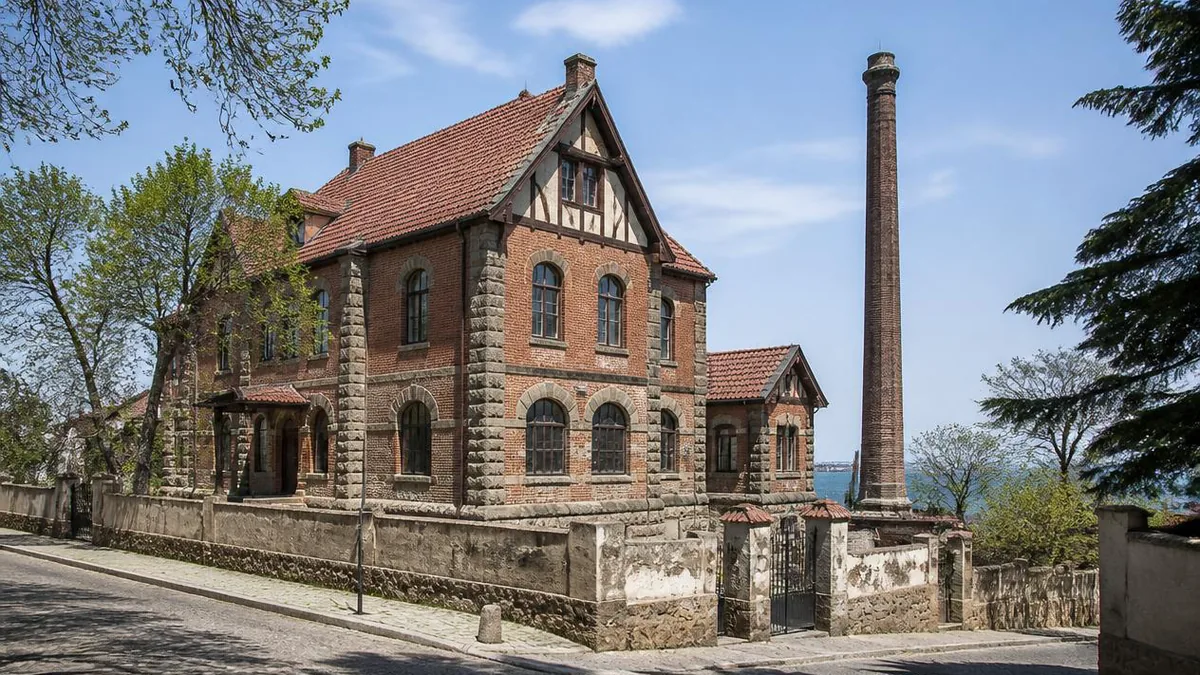
The two original red-brick structures flank the brewery’s south gate and are described as German Jugendstil with a three-part vertical composition: granite base, brick body, pitched red-tile roof.
West of the gate is the administrative block, in two parts. Building A is two storeys and about 150 square metres, with plainly carved interior woodwork; Building B is three storeys and about 765 square metres, on a red granite base, with elaborately carved woodwork—it housed the offices and the accommodation of the foreign senior staff. East of the gate is the brewing office and the brewhouse itself.
The complex is a National Key Cultural Relic Protection Unit and is on China’s national industrial heritage list. The museum holds AAAA scenic-area status and is rated a national first-grade museum, with a collection given as more than 30,000 items.
The point worth carrying inside: you are not in a purpose-built museum with a brewery theme. You are in the brewery, and the exhibition has been fitted around what was already there.
A museum that shares a wall with a live production line
Planning began in 2002 and the museum opened on 15 August 2003, the brewery’s hundredth birthday, to the day.
The route is organised as two halls. Hall A covers history; Hall B covers brewing, and it is Hall B that does the thing other brand museums cannot. The path runs past the original saccharification vessels, then along a glazed corridor looking down onto a working packaging line—bottles moving, robotic arms filling cases, the noise coming through the glass.
That line is not a token. The Qingdao plant was named by the World Economic Forum in March 2021 as the world’s first Industrial Internet Lighthouse Factory in the beer and beverage sector, and in October 2024 it was designated the first Sustainability Lighthouse in the global food and beverage industry. The museum’s own description of the effect is a dialogue between wooden fermentation vats and fully automatic filling equipment, which is marketing language for a real spatial fact: two production eras are about four metres apart, separated by a pane of glass.
Five objects worth slowing down for
The collection includes a run of first-grade national relics, and they reward attention more than the panels around them.
The 1911 brewery drawings are two sheets of dark blue paper, hand-lettered in German, drawn in fine white line: the floor plan of the original mash house, with sections through the key structures and the building dimensions. They sat in the brewery’s own archive for most of a century.
The Siemens motor is dated 1896, was imported from Germany, entered service here in 1903, and ran until 1995. It is 65 by 28 centimetres. Its job was to turn the paddle that stirred the mash.
The four copper vessels are the heart of the display and, unusually, are labelled with what each one did. The cereal cooker gelatinises the rice adjunct; the mash tun mixes malt with water so starch converts to sugar; the lauter tun separates wort from spent grain; the wort kettle boils the wort, coagulates protein, adjusts gravity and takes up the hop character. All four are German originals from 1903, each holding about nine tonnes, all four in service until 1995.
The oak fermentation tun is also from 1903, bound with iron, holding about six tonnes.
And in Hall B there is an open fermentation pool built in 1903, the kind of shallow uncovered vessel that has almost vanished from industrial brewing.
Ninety-two years of continuous service is the number to hold. The vessels that made the first bottle in 1904 were still working when Deng-era China was already exporting the beer worldwide.
The tilted room and the beer you cannot buy
Two experiences get mentioned more than anything else on the route.
The first is the Drunk House, a small room built out of true—sloping floor, skewed frames—so that walking through it produces the disorientation of mild intoxication in someone entirely sober. It is a gimmick and it works, and it is the single most photographed thing in the building.
The second is yuanjiang. Chinese brewing vocabulary distinguishes it from the pasteurised bottled product and from chunsheng, the unpasteurised draught: yuanjiang is the unfiltered beer drawn straight from the process, cloudy with yeast, with a very short shelf life. Practically speaking it does not travel, so drinking it on the premises is the only ordinary way to have it. Standard tickets include a 0.15-litre glass of yuanjiang and one of chunsheng, with a bag of beer nuts; larger packages extend the flight to pilsner, wheat beer, IPA and dark. There is also a bread made with brewer’s yeast.
Around this sit the newer attractions: a light-and-projection special exhibition, a 1903 theatre, a 4D cinema, an evening projection show, and an immersive drama game with costumed staff, locked-room puzzles and a route that opens the third floor of Hall A and the basement cellar. Whether these improve the visit depends entirely on who you are travelling with.
Two beer festivals that are not the same festival
Qingdao’s festival is frequently called a Chinese Oktoberfest. It was consciously modelled on Munich, and it is a different event.
The Qingdao International Beer Festival was proposed by the brewery in 1991 and backed by the municipal government. The first edition opened on 23 June 1991 in Zhongshan Park, with close to a hundred domestic and foreign brewers exhibiting. The second moved to Huiquan Square; from the third the dates settled into mid-August; and in 1994 a permanent venue, the International Beer City, was built in Laoshan District. Editions one to six were run by Qingdao; from the seventh, central government ministries co-hosted. It now opens on the second weekend of August and runs about sixteen days, though the length is given as fourteen in some accounts.
Oktoberfest began on 12 October 1810 as a public celebration of the marriage of Crown Prince Ludwig of Bavaria to Princess Therese of Saxe-Hildburghausen, on the meadow outside Munich that was named Theresienwiese after her. The Munich city council took control in 1819 and made it annual. It now runs from mid-September to the first Sunday in October and draws around seven million people.
So: different centuries, different months, different reasons, one of them a royal wedding and one of them a brand initiative. The borrowing was real and openly acknowledged—Qingdao even put up a commemorative sculpture in imitation—but they are not two branches of one tradition.
What in Qingdao is actually German
The old town does hold a substantial body of German colonial architecture from the 1898–1914 lease, and the brewery is part of it. One common confusion is worth clearing up on the way.
Badaguan, the villa district that most visitors are sent to for European architecture, is mostly not German. It was laid out and built in the 1930s, under a municipal plan that capped site coverage below 50 per cent and required open fencing; a minority of its buildings date from the German period. Its roughly 200 houses represent styles from more than twenty countries, which is why it is nicknamed the exposition of world architecture. It became a National Key Cultural Relic Protection Unit in 2001.
Two other details. The beer’s long-running claim to be brewed with Laoshan mineral water now applies only to beer actually produced in Qingdao, not to output from the company’s other plants. And the pavilion on the Tsingtao logo is the Huilan Pavilion at the end of Zhanqiao Pier, on the city’s southern shore—a beer label using a municipal landmark rather than a brewery image, which is as concise a statement of the relationship as you will find.
Visiting
Hours change four times a year, which catches people out. The museum’s own schedule runs 08:30–17:30 from 1 January to 30 April and again from 1 November to 31 December; 08:00–18:30 from 1 May to 30 June and from 1 September to 31 October; and 07:30–19:30 from 1 July to 31 August. Last admission is one hour before closing in every band.
Tickets are real-name and booked in advance, through the museum’s official channels or the usual travel platforms, and you will be checked more than once inside, so keep the QR code and your ID to hand. Pricing is tiered rather than single: two-hall entry with tastings, three- and four-hall combinations that add the projection exhibition and the 1903 theatre, tasting-flight upgrades, a VIP ticket requiring two days’ notice, and the drama-game tickets. Guided tours are priced per group of up to ten and run about 50 minutes, with a higher rate for foreign languages; audio guides are cheap and include headphones.
Concessions are unusually broad. Free entry covers over-70s, children under 1.4 metres accompanied by an adult, disabled visitors, serving and retired military personnel, firefighters and provincial talent-card holders. Half price covers 60- to 69-year-olds, veterans, and full-time students aged 23 and under. Documents must be originals.
Allow two hours for the two halls, more with add-ons. There is a customer line and there are official booking channels; every price and time above is subject to change, so confirm on the day. And since the whole point is that they pour you beer at the end, do not drive.
The best moment on the route is not the copper. It is the glazed corridor, standing between four German kettles that stopped in 1995 and a filling line that will still be running when you leave.
A company founded by British and German investors in a leased territory, sold to a Japanese brewer during one war, confiscated by a Chinese government after another, nationalised, privatised, listed in Hong Kong and now exported to more than sixty countries under a spelling the state retired in 1964. Qingdao did not adopt the brewery as a symbol because the beer is good, though it is. It adopted it because there is nothing else in the city on which the whole of the last hundred and twenty years is legible in one place.
The LoreLens app can identify German colonial-era architecture and industrial heritage buildings around Qingdao and explain the history layered onto them.
Location profile
Where it is

Frequently asked questions
Is Tsingtao a German beer?
It was founded by a German-and-British company in a German leased territory, brewed by German brewmasters to German methods, and it has not been German-owned since 1916. The founding company on 15 August 1903 was the Anglo-German Brewery Co. Ltd., a joint-stock firm registered in Hong Kong; the brewery it built was called the Germania-Brauerei Tsingtao. German equity is put at around 70 per cent. After the 1914 siege the company was liquidated at a shareholders' meeting in Shanghai in August 1916 and sold to the Dai-Nippon Brewery of Japan, and it stayed Japanese-owned until 1945. The German inheritance that survives is technical and architectural—the buildings, the copper vessels, the recipe lineage—not corporate.
Why is it spelled Tsingtao when the city is Qingdao?
Because the brand kept a romanisation the country stopped using. Tsingtao is the postal romanisation, the system Chinese postal authorities adopted at a conference in Shanghai in 1906; the same conference specifically declined to adopt Wade–Giles, which would have given Ch'ing-tao. The German colonial spelling was Tsingtau, with a u. Pinyin, which produces Qingdao, was announced in 1958, and postal romanisation was formally abolished in 1964. By then the spelling had been part of the company's registered name for over half a century and the label was worth more than the consistency. So the two spellings on a Qingdao street sign and a Tsingtao bottle are the same word, sixty years apart.
Do you actually see beer being made?
Yes, and this is the museum's real distinction. The route runs through the original 1903 brewery buildings and then along a glazed corridor overlooking a live packaging line, so you are looking at current production rather than a reconstruction. The Qingdao plant was named the world's first Industrial Internet Lighthouse Factory in the beer and beverage sector by the World Economic Forum in March 2021, and in October 2024 it was designated the first Sustainability Lighthouse in the food and beverage industry. The old mash vessels stopped work in 1995 and are now exhibits; the line beyond the glass has not stopped.
How long does it take, and is the beer included?
Allow about two hours for the two main halls, longer if you add the special-effects theatre or the immersive drama game. Tastings are built into the tickets rather than sold separately: standard packages include a 0.15-litre glass of yuanjiang, the unfiltered beer drawn on site, and one of chunsheng draft, with a bag of beer nuts; larger packages add pilsner, wheat, IPA and dark. Guided tours run about 50 minutes and are priced per group, with a separate rate for foreign languages, and audio guides are available. Booking is real-name and made in advance, hours change four times a year, and prices move—confirm on the day.
Sources and further reading
Background references for the history and place names in this guide. Opening hours, ticketing and access change often — always confirm with official local information before travelling.