Shandong · Qingdao
Qingdao Olympic Sailing Centre: Where a Race Venue Became a Waterfront
Walk the marina and breakwater to see how a former shipyard supported the 2008 Olympic and Paralympic regattas, then became a public yet still-working harbour.
5A View location, maps and nearby scenic areasStop at the marina railing and watch a boat come home. Crew lower sail, fenders appear, a dockhand takes a line and the hull slows from open-water motion to a berth. The skyline photographs well, but this small sequence explains the place: the Olympic Sailing Centre is not merely a monument to sport; it is a machine for moving between land and sea.
In 2008, that machine launched, measured, serviced and recovered the boats used in the Beijing Olympic and Paralympic sailing competitions. Today its broad quays and breakwater form one of Qingdao’s best-known public waterfronts, while pontoons, service boats, sailing schools and restricted work areas continue to operate. The achievement is not that work disappeared after the Games, but that a specialised venue learned to share its edge.
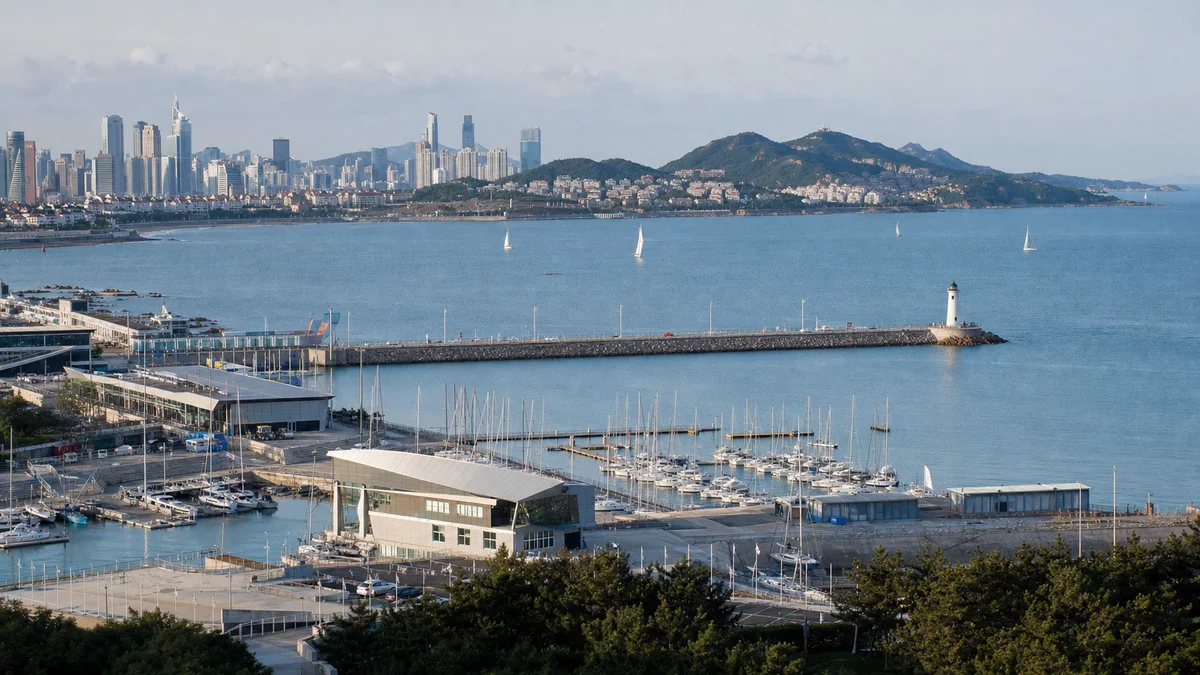
Orient yourself by water function: the inner marina is sheltered space for berthing and preparation; the long main breakwater protects that basin and now offers a seaward walk; event-era buildings and plazas sit on the former industrial shore; open race water lies beyond the harbour, not between the restaurant terraces. May Fourth Square is a nearby continuation along Fushan Bay, not part of the sailing venue itself.
A shipyard became an Olympic shoreline
Before the flag plaza, polished quays and yacht masts, this was the Fushan Bay site of Beihai Shipyard. Shipbuilding and repair required deep-water access, heavy workshops, cranes, slipways and a controlled industrial edge. Ahead of the 2008 Games, the shipyard relocated and the waterfront was comprehensively remade for sailing.
That change is easy to describe as beautification, but it was also an economic and labour transition. Industrial land moved elsewhere; construction workers created the venue; event staff and volunteers briefly occupied it; later, marina crews, coaches, cleaners, security workers and tourism businesses took over daily operations. The smooth pavement hides several generations of work.
Little of the former yard reads as an industrial museum. Instead, use the harbour geometry as evidence. Wide aprons could hold boats and equipment. Ramps connect dry land to water. Large service buildings and turning space reflect logistics rather than a picturesque fishing port. The Olympics changed the architecture, but the need to organise vessels remained.
The racecourse was offshore; the centre was its engine room
Visitors sometimes imagine Olympic yachts circling inside the marina. The harbour was far too confined. Racing took place on temporary courses laid in the open waters off Qingdao, where officials positioned start lines, turning marks and finish lines according to conditions. The shore centre handled the enormous work around those minutes of competition.
Boats had to be stored, inspected and launched; sails and equipment were measured under class rules; athletes needed changing, medical and recovery spaces; race officials, meteorologists, media, rescue teams and volunteers needed command posts. Even a sport powered by wind depends on dense infrastructure.
The 2008 Olympic regatta awarded medals across eleven sailing and windsurfing events, followed by three Paralympic sailing events. Those numbers are less important than their operational meaning: different boat classes required different cradles, ramps, crews and course plans, while racing schedules had to adapt to wind and visibility. A quiet quay today once worked to a clock set by weather.
Yin Jian’s board and the Paralympic legacy
China’s defining home-water result came from Yin Jian, who won the women’s RS:X windsurfing gold medal in Qingdao—China’s first Olympic gold in sailing. Windsurfing can look effortless from shore, but the athlete continuously shifts body and rig to turn unstable wind into controlled speed. Her result connected a new venue to years of training far from public spectacle.
The Paralympic regatta adds a second, essential reading. Sailors with physical impairments competed in adapted keelboats, supported by transfer systems, dock teams and accessible athlete routes. The harbour was not only a stage for elite speed; it was a test of whether land-side systems could make that competition possible.
Judge the current waterfront against that memory without assuming it is uniformly accessible. Broad promenades and ramps can help, yet long distances, gradients, gangways, cobbles and temporary barriers remain. Ask about step-free routes and accessible toilets before arrival. A venue that celebrates Paralympic heritage should make present-day access visible, specific and continuously maintained.
Read the breakwater as protection, not only a view
The main breakwater—popularly called Lovers Dam—extends roughly half a kilometre into Fushan Bay. Its public appeal is obvious: water on both sides, city towers behind, a light marker towards the outer end and a horizon wide enough to make the dense city feel distant.
Its engineering role comes first. A breakwater absorbs and redirects wave energy so the basin behind remains calmer. That protects moored hulls, reduces strain on lines and pontoons, and makes launching more manageable. Compare water texture on the exposed and sheltered sides when wind is blowing; the difference turns harbour design into something visible.
Do not confuse calm water with harmless water. The outer edge can be windy, spray can cross the paving, and algae or ice can make surfaces slick. Barriers and closed gates protect operational or weather-sensitive areas. If the seaward section is closed, the correct response is to use an inner viewpoint, not climb around it for a lighthouse photograph.
The marina is a workplace with a public gallery
Rows of masts create the centre’s signature image, but each berth is a small work zone. Lines cross decks, shore power and water may be connected, fuel and batteries require care, and boats manoeuvre with limited stopping distance. Rescue craft, maintenance teams and commercial operators share the basin.
Public promenades function like a gallery around that work. Stay outside signed pontoons, do not board a vessel without crew permission, and keep children away from gaps, cleats and moving gangways. A rope that looks decorative can tighten without warning. Fishing, swimming and drone use may be restricted even where no permanent fence is obvious.
This coexistence is the venue’s strongest post-Olympic quality. A purely memorial park would freeze 2008 in plaques. A functioning marina lets sailing continue through training, community events and commercial trips, although participation costs and private berths mean access to the water is not equally shared. Watching carefully is free; boarding is a regulated service.
Wind, current and a living sea decide the schedule
Sailing has no fixed playing surface. Wind shifts in direction and strength; current moves the boat sideways; waves change speed and fatigue; fog reduces visibility. Race committees can move marks or postpone starts, and today’s operators can delay or cancel departures. A forecast is evidence, not a guarantee.
The 2008 preparations also revealed a less photogenic sea. A large green-tide bloom of floating algae reached Qingdao’s coastal waters before the Games. Soldiers, local workers and volunteers joined an intensive removal effort around the competition area. Researchers have continued to study its sources and drivers; it should not be reduced to one simple cause or one dramatic photograph.
That episode belongs to the venue’s legacy. Olympic sailing depended on a managed shoreline and a living marine system that could not be commanded like a stadium roof. Today, avoid feeding birds, dropping fishing line or leaving single-use plastic near the water. Clean-looking harbour water is not merely scenery; it is habitat and working medium.
What survived the mega-event
Many event venues struggle after the closing ceremony because their specialised buildings have no ordinary use. Qingdao’s answer was to combine memorial, marina, exhibition, commercial and public-space functions. Olympic symbols and interpretation preserve the event story, while quays and basins continue serving boats.
This is not a complete conversion into unrestricted parkland. Conference or hospitality facilities, ticketed attractions, leased berths and security areas create boundaries. Those limits are part of the legacy too: mega-event infrastructure is expensive, and post-event use requires revenue, maintenance and governance as well as public access.
Look for the tension rather than expecting a perfect verdict. A family can walk beside the same basin where a technician services a yacht; a medal story can sit beside a shopping frontage; an event designed for television can become a daily route for residents. The centre works when none of those uses pretends to be the only one.
Choose a harbour loop or a longer bay walk
For a compact Olympic loop, begin with event interpretation or the museum if it is open, continue to a marina overlook, then walk as far along the main breakwater as conditions allow. Return on the sheltered side and compare the skyline view with the working basin. This route gives history, harbour engineering and public legacy without chasing every pier.
For a sailing-focused visit, spend more time near launching and training areas that are legally visible from public space. Watch rigging and docking without entering controlled pontoons. If you have booked an authorised sail, confirm the exact meeting point; “Olympic Sailing Centre” can refer to a large waterfront, not one boarding gate.
For a long Fushan Bay walk, continue west towards May Fourth Square after completing the sailing centre. Treat its red “May Wind” sculpture and civic-square history as a separate chapter. Waterfront connections, road crossings and temporary gates can change, so use a current map rather than assuming an uninterrupted promenade.
The public surfaces are mostly broad, but distances are substantial. Wheelchair users should check which breakwater sections, museums and toilets are step-free; tide-related gangways to boats can be steep even when the quay is level. Benches may be exposed to sun and wind. Carry water, allow rests and keep enough energy for the return.
Boats, lights and the photograph after sunset
Commercial sails and bay cruises can offer the most direct understanding of the venue, but only when weather, vessels, crew and permits align. Confirm operator credentials, lifejacket provision, age or mobility restrictions, cancellation terms and the actual route. Fog may remove the skyline; weak or strong wind can change a sailing plan; a motor cruise is not the same experience as learning to sail.
After dark, coordinated building lights around Fushan Bay can be visible from the centre, with reflections stretching between masts. The programme is not a natural event or a permanent guarantee. Schedules, start times, participating façades and visibility change. Check current city information and do not stand in a vehicle or service lane for a symmetrical image.
For the best visual explanation, include three layers: mooring lines in the foreground, the protected basin in the middle and the breakwater or skyline beyond. Ask before photographing identifiable crew at close range, keep tripods out of circulation routes and obey drone restrictions. Then watch one boat return without the camera. Sail drops, line crosses water, hull meets berth—the same sequence as at the beginning, now carrying an Olympic history and an ordinary working day at once.
The LoreLens app helps you read the Olympic structures, harbour engineering and working-waterfront details as you walk the Qingdao Sailing Centre.
Location profile
Where it is

Frequently asked questions
Do I need a ticket to enter the Qingdao Olympic Sailing Centre?
Many outdoor promenades are commonly open as public waterfront, but museums, exhibitions, boat trips, sailing sessions and special events may require separate admission. Security zones and event closures can also change access, so check current notices.
Can visitors go sailing from the Olympic Sailing Centre?
Commercial sailing and cruise experiences can operate from the area, but departure points, eligibility, schedules and routes change with licensing, wind, fog, sea state and events. Book only through an authorised operator and confirm the same day.
How long should I spend at the Olympic Sailing Centre?
Allow two or three hours for a relaxed marina-and-breakwater walk with Olympic context. Add more time for an open museum, a confirmed boat trip or a separate continuation along Fushan Bay to May Fourth Square.
Is the Fushan Bay light show guaranteed every night?
No. Lighting schedules, start times, building participation and weather visibility can change, and special events may replace the normal programme. Check a current official Qingdao notice and enjoy the harbour after dark even if no coordinated show runs.