Shandong · Weihai
Huaxia City: Read a Restored Quarry, Not an Ancient Capital
Walk from exposed quarry walls to modern halls, Yu-the-Great imagery and a night spectacle, learning where ecological repair ends and cultural theatre begins.
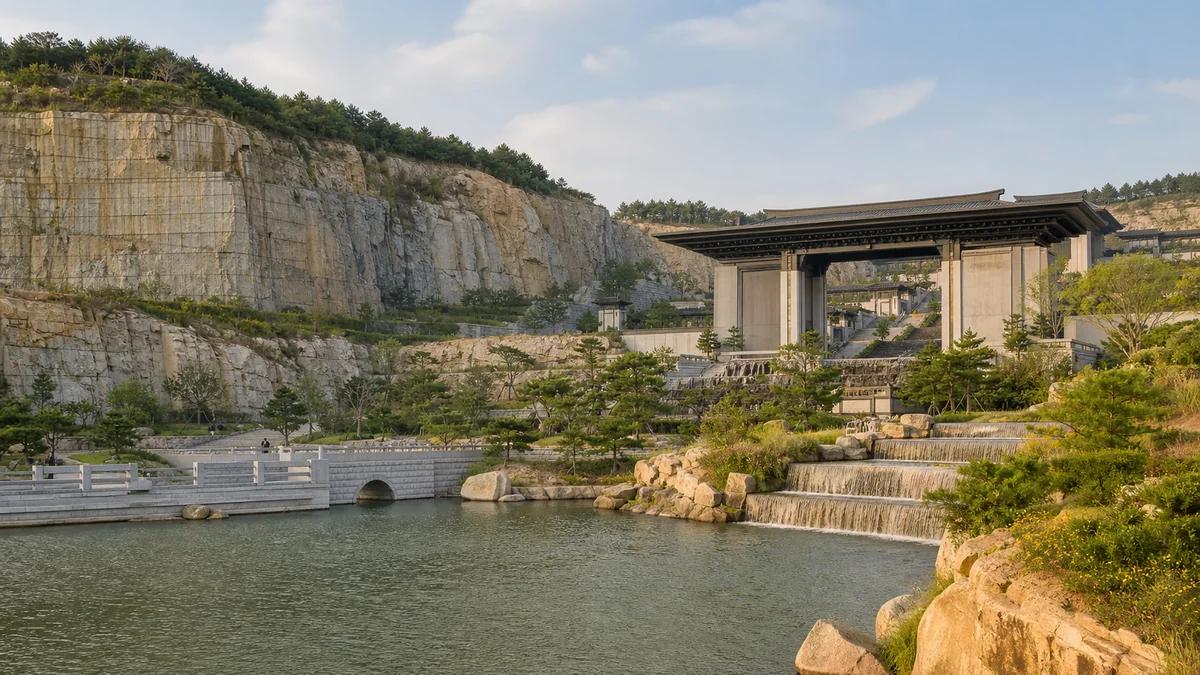
5A View location, maps and nearby scenic areasStand beneath the great gateway and look past its painted brackets. The more revealing line is not across the roof but behind it: a steep wall of rock, vegetation returning in patches, roads and monumental buildings fitted into a cut hillside. Huaxia City is easiest to understand when you read the quarry before you read the palace.
This is not an excavated ancient capital. It is a modern cultural-tourism landscape in Weihai, shaped from the early 2000s around land damaged by quarrying. Its strongest story is the tension between two acts of construction: people first removed a mountain for stone, then moved earth, managed water, planted slopes and filled the resulting space with a deliberately theatrical account of “Huaxia,” or Chinese civilisation.
Orient yourself in four layers: the entrance gateway establishes spectacle; the lower cultural areas introduce Jiaodong life and broad historical themes; the hillside halls and temple zone add climbing and long views; the separate night theatre turns the quarry terrain into a stage. Not every attraction, ride or performance belongs to one continuous walking circuit.
Read the cut mountain before the monuments
At an old masonry building, age is often visible in worn thresholds and repaired timber. Here, the most important evidence is negative space. A quarry is a place defined by what has been removed: abrupt faces, unnatural benches and bowls where a continuous slope once stood.
Some of those forms remain legible around Huaxia City even after planting and construction. Look for exposed rock that ends too sharply, terraces with unusually regular edges, and water or buildings occupying hollows. They explain why the site feels part valley, part amphitheatre and part theme park.
The greenery is real, but “green” does not mean the hill has returned to a pre-quarry condition. Ecological repair can stabilise loose ground, reduce dust and runoff, restore vegetation and create habitat. It cannot put extracted geology back. A planted slope, a reservoir and a theatre can all be successful new uses while still carrying the cost of the earlier landscape.
From extraction ground to a tourism complex
The operator dates development to 2003 and describes a long programme of filling, slope treatment, water management and tree planting across dozens of former quarry pits on Longshan. It later added cultural buildings, performance venues and other visitor businesses; Huaxia City received China’s national 5A tourist-attraction rating in 2017.
Promotional accounts attach very large totals to earth moved, trees planted and pits repaired. Those figures come largely from the developer and depend on what the wider project boundary includes, so the safer onsite test is more modest: can you identify treated slopes, controlled water, planted ground and reused quarry voids? Those are visible outcomes. Whether the whole ecosystem is “restored” is a broader scientific question requiring long-term evidence about soil, water and biodiversity.
There is also a human change behind the view. Quarry landscapes are products of labour as well as damage; repair and tourism create different work in engineering, planting, maintenance, performance and hospitality. The polished park should not erase either group. The transition is not nature healing by itself, but people choosing a new economy for an altered hill.
A modern city wearing historical architecture
The huge Huaxia City gateway, the halls, corridors and landscaped courts are designed to compress a civilisational panorama into a visitable route. They borrow bracket sets, rooflines, ceremonial axes and decorative motifs associated with different periods and regions. The result can be visually impressive without being archaeological evidence.
Keep three labels separate as you walk:
- Visible fact: a building, statue, water feature or quarry face stands here now.
- Interpretation: designers use that object to explain a theme such as good government, shared ancestry or rebirth.
- Legend: a story about culture heroes, immortals or imperial visitors gives the theme emotional force.
None of these categories is useless. The problem begins only when a contemporary palace is mistaken for a surviving Xia-dynasty hall, or a stage narrative is treated as a dated historical record. Photograph the architecture as twenty-first-century design and ask what kind of past its builders wanted visitors to imagine.
Great Yu: history, memory and a modern message
The Yu King Palace places Great Yu at the centre of the complex’s moral story. In transmitted Chinese tradition, Yu controls catastrophic floods not by simply blocking water but by dredging and guiding it; he passes his home three times without entering because public work comes first. Later accounts connect him to the founding of the Xia dynasty.
The story has endured because it joins hydraulic skill to political virtue. A ruler earns authority by managing water and accepting personal hardship. That is why Yu is especially legible in a remade quarry: drainage, reservoirs, earthmoving and repaired slopes allow a modern developer to echo the ancient ideal of ordering water and land.
But the palace is an interpretation, not Yu’s residence, and the legend is not evidence that he worked at this Weihai hillside. Archaeology has greatly expanded knowledge of early Bronze Age societies in China, while the precise relationship between those cultures, the traditional Xia chronology and the individual Yu remains debated. Read the installation as a modern ethical claim—responsible building should repair what building damaged—rather than a shortcut through an unresolved ancient past.
Xia Garden and the nearer story of Jiaodong
After the civilisational scale of Yu, Xia Garden brings the lens closer to Jiaodong, the eastern Shandong peninsula around Weihai. Displays and recreated domestic settings evoke regional houses, tools, seasonal customs, crafts and performance traditions. The shift matters: “Chinese culture” becomes more useful when it returns to particular materials, climates and working lives.
Treat the garden as a curated folk-culture venue. Some objects or techniques may preserve genuine local practice; the ensemble itself is arranged for contemporary visitors. Ask which details respond to the peninsula’s windy coastal weather, what work a tool performed, and who did that work. Decorative courtyards are more meaningful when you imagine the farmers, fishers, craftspeople and women whose repetitive labour rarely enters grand palace histories.
Demonstrations and small performances can make this section lively, but programmes change. Check the day’s notices rather than building the whole visit around one craft show. If interpretation is Chinese-only, photographs of labels can help you review names later without blocking a doorway or performer.
Temple space and the problem of continuous age
The hillside Taiping Temple zone introduces Buddhist imagery and a local story linking a temple here to Princess Taiping of the Tang dynasty. The association is part of the attraction’s narrative, but the buildings visitors see belong to the modern redevelopment and reconstruction history; they should not be described as an untouched 1,300-year-old monastery.
That distinction does not make the place spiritually empty. Rebuilt temples can host present-day worship, incense and charitable activity. If a hall is in ritual use, lower your voice, step around rather than across kneeling space, and ask before photographing monks or worshippers. Do not pose on altars, touch statues or treat prayer as costume scenery.
The temple also offers a useful contrast with the Yu narrative. Yu represents good rule through labour on water; Buddhist figures frame suffering, compassion and release. The modern complex places both within one “Huaxia” story, even though they arose in different eras and intellectual traditions. Notice the editorial choice instead of assuming Chinese history always formed one seamless belief system.
When the quarry becomes a moving theatre
The evening Shenyou Legend production makes the site’s theatrical logic explicit. Its signature device is a rotating, moving audience stand that carries spectators between large water, land and aerial stage pictures set against the quarry landscape. Scenes draw on creation myths, ancestral heroes, Great Yu, the Eight Immortals and later tales of eastern voyages.
This is spectacle, not a documentary chronology. Pangu opening the world, Hou Yi shooting suns and the Eight Immortals crossing the sea belong to mythology and folklore. Great Yu sits between transmitted tradition and questions of early history. Qin imperial voyages and the later Xu Fu tradition have historical and legendary layers. The production deliberately blends them to tell an emotionally continuous national story.
That blend is worth analysing as well as enjoying. The audience platform moves, but so does the meaning of the quarry: extraction pit becomes flood, sea, battlefield or cosmic stage. Water, lighting, machinery, performers and technicians make the transformation possible each night. Show dates, effects, seat movement and weather arrangements can change; check current official information, arrive by the stated admission time, and tell staff in advance about vertigo, motion sensitivity or evacuation needs.
Choose a route that matches your legs and time
For a short daylight visit, begin at the gateway, inspect a visible quarry edge, then concentrate on Xia Garden and the Yu-themed core. This preserves the essential contrast—damaged terrain, regional life and a modern civilisational story—without trying to collect every ride or photo set.
For a full daylight circuit, continue uphill towards the temple and higher viewpoints, allowing generous time for slopes and steps. Pause where you can see contemporary roofs against cut rock; those transitions explain the site better than another frontal monument photograph. Return before fatigue turns descents into a hazard.
For a day-and-night visit, treat the theatre as a separate appointment. Confirm whether it requires a separate ticket, where its entrance is, when admission closes and how you will leave afterwards. Internal vehicles or shuttle-style services may operate, but routes and eligibility change. Do not assume a daytime drop-off will run after the show.
The site is hilly. Wheelchair users and travellers who avoid stairs should request a current step-free map and ask which buildings have lifts or ramps. Families should hold children near water, quarry edges, moving platforms and ride areas. After rain, paving and shaded steps can be slick; in summer, exposed courts need water and sun protection.
Photograph the seam, then look back
The most honest wide image is not a roof isolated against blue sky. Frame a modern arch or hall with a quarry face, planted slope or retaining work behind it. That seam records both damage and design. Side light early or late in the day often reveals rock texture, while midday is useful for colour inside roofed corridors. Drones, tripods, flash and commercial equipment may be restricted, so confirm before setting up.
Avoid climbing barriers for a clean composition. In the temple zone, respect worship; in performances, obey no-flash and recording rules. A bright screen distracts nearby spectators and can interfere with carefully controlled darkness. Photograph craftspeople only after permission, especially during demonstrations.
Before leaving, return mentally to the entrance view. The gateway has not become ancient, and the quarry has not disappeared. What has changed is your ability to see both at once. Huaxia City is most compelling neither as a miracle that erased industrial damage nor as “fake history” to dismiss. It is a contemporary argument, built at full scale: an altered mountain can be repaired, reused and narrated—but its new story is clearest when the scar remains visible.
The LoreLens app helps you separate quarry evidence, modern interpretation and legend as you move through Huaxia City’s layered landscape.
Location profile
Where it is

Frequently asked questions
Is Huaxia City a real ancient city?
No. Huaxia City is a modern cultural-tourism complex developed from the 2000s in and around former quarries. Its gateways, halls, gardens and performances interpret Chinese history, mythology and Jiaodong culture; they are not the surviving fabric of one ancient capital.
How much time should I allow at Huaxia City?
Allow roughly half a day for a considered daylight visit, with more time if you walk the hillier sections slowly or add activities. The evening production is a separate time commitment and may use different admission, so check the current official schedule and ticket terms.
Is Huaxia City suitable for visitors with limited mobility?
The lower plazas and some main buildings can be easier, but the site spreads over a hillside and includes slopes, steps and long transfers. Ask the attraction in advance about step-free access, wheelchair-compatible routes and any internal transport operating that day.
Does the Shenyou Legend show run every night?
Do not assume so. Performance dates, start times, ticketing and weather arrangements can change by season and operating conditions. Confirm through the official attraction before travelling, and keep a daylight-only plan in case the show is unavailable.