Shandong · Yantai
Penglai Pavilion: Harbor History, Immortal Seas and Mirages
Climb from Dengzhou Water City to Danya Hill, separating a real maritime-defense landscape from the immortal-island stories and optical mirages that made Penglai famous.
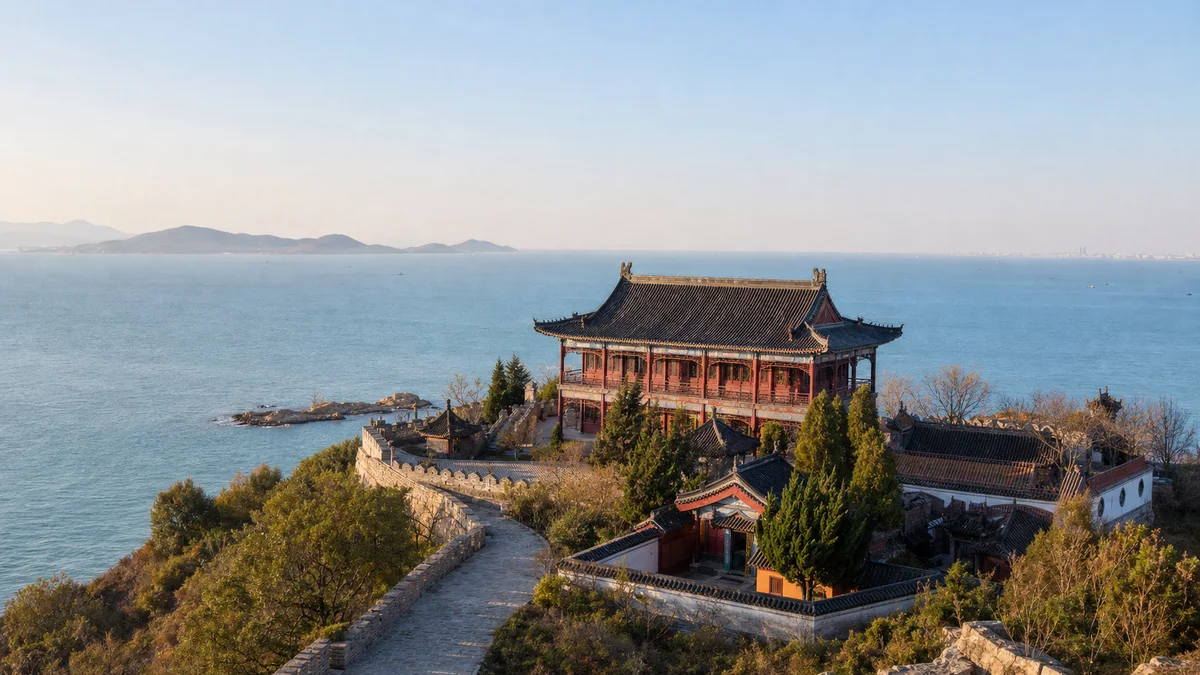
5A View location, maps and nearby scenic areasBegin beside the enclosed water below Danya Hill. Stone walls, a water gate and a harbour basin hold the eye close to sea level; above them, tiled roofs step towards the ridge. Only after looking from water to hill does Penglai Pavilion reveal its full shape. It is not simply a famous balcony placed above a picturesque coast. It belongs to a threshold where ships, soldiers, merchants, worshippers and stories all came ashore.
At the top, the horizon can look limitless or disappear into haze. That instability matters. Penglai’s reputation grew from both an actual maritime landscape and centuries of imagining islands of immortals beyond the eastern sea. The two layers meet here, but they are not the same kind of evidence.
Orient yourself from bottom to top: Dengzhou Water City explains the harbour and coastal-defense setting; the Danya Hill climb passes gates, courtyards and religious halls from different periods; the main pavilion and seaward viewpoints open the legendary horizon. Surviving fabric, repaired or reconstructed structures, and modern displays coexist throughout the route.
Read Penglai from the water upward
Before climbing, find a view that includes both the Water City and Danya Hill. The lower basin shows why this coast mattered in practical terms. Boats could enter through a controlled opening, use protected water and connect with walls, wharves, lookouts and defensive positions. The ridge above offered observation across the approaches.
This vertical relationship is more informative than any single plaque. The pavilion did not create the harbour, and the harbour was not built to provide a reflection for the pavilion. They accumulated through different periods and needs. The water below speaks of movement, supply and defense; the halls above add official patronage, worship, literature and sightseeing.
Look also at the sea beyond. Penglai stands near the passage between the Bohai region and the wider Yellow Sea. Visitors sometimes expect a sharp line between two differently coloured bodies of water. In reality, this is a maritime threshold, not a boundary painted across the surface. Wind, currents, suspended sediment, tide, glare and haze can make contrasts appear, blur them or hide the horizon entirely.
Why Zhu Chuyue built the pavilion in 1061
The documented beginning of Penglai Pavilion is unusually specific. In 1061, the sixth year of the Northern Song Jiayou era, Zhu Chuyue, prefect of Dengzhou, had a pavilion built on Danya Hill. The date anchors the monument in local government and in a functioning coastal prefecture, not in the timeless age of the immortals.
A high pavilion served several purposes at once. It offered a place to survey the sea, receive guests, compose writing and give architectural form to a view already rich in classical associations. Officials moving through China’s bureaucracy often used scenic buildings to mark a place and their own tenure within it. Later inscriptions, poems and repairs added new voices to that first act of construction.
The founding date is therefore important without being a claim that every beam before you is from the Song dynasty. Think of 1061 as the opening of a long architectural biography. What persisted most strongly was the chosen position and the idea of a pavilion facing the eastern sea.
A Song origin is not an untouched Song building
Sea air is hard on timber, plaster, tiles and metal. Fire, storms, warfare, changing ritual use and ordinary decay also reshape a complex over nearly a thousand years. Penglai Pavilion was repaired, altered and rebuilt in later dynasties, then conserved and restored again in modern times. The present ensemble records several periods rather than one perfectly preserved Northern Song moment.
Read the complex accordingly. An old foundation or inscribed stone may have a different date from the roof above it. A hall may preserve a traditional plan while containing replaced structural members. Paint, statuary and display furniture may be much newer than the building they interpret. “Historic” describes the accumulated place; it does not make every visible surface equally old.
Labels are your best local evidence. Notice whether they say built, rebuilt, repaired, moved, restored or reconstructed. Those verbs are not disappointing qualifications. They reveal how successive communities decided that the pavilion mattered enough to maintain. A building that survived through care has a history of intervention, not less history.
Dengzhou Water City joined defense, shipping and daily life
The protected water below the hill has its own longer sequence. In the Northern Song, authorities established a naval stockade known as Daoyu Zhai. In 1376, the ninth year of the Ming Hongwu reign, it was developed into the Water City as part of coastal defense. A major repair followed in 1596, with further expansion and restoration in later periods.
Its working parts mattered more than the modern name suggests: harbour basin, wharf, walls, water gate, platforms or batteries and breakwater formed a connected system. A controlled entrance could shelter vessels while the walls and elevated positions watched the coast. Changes in masonry and restored stretches can help reveal that the system did not arrive complete in one year.
This was not only a military machine. Dengzhou was also a port where goods, information and people moved. Residents, traders and fishers lived alongside officials, troops and sailors. Supplies had to be purchased, boats repaired, catches landed and families supported. Modern restoration, including work begun around the end of the twentieth century, has made parts of the defensive layout easier to read. Recreated offices and displays, however, should be understood as interpretation rather than intact Ming rooms.
Qi Jiguang’s Penglai connection—without moving his campaigns
The Ming commander Qi Jiguang belongs in Penglai’s story, but precision makes the connection stronger. He came from a hereditary military family associated with Dengzhou/Penglai. Local memorial and former-residence interpretation traces that family background, his military education and the wider course of his career.
Qi is most famous for campaigns against coastal raiders in southeastern China and for later frontier defense in the north. Those celebrated southeastern operations did not take place here. Penglai instead helps explain the maritime and hereditary military environment from which he emerged. The Water City’s walls, harbour and reconstructed defense displays offer a setting in which to consider the logistics and institutions behind a commander’s reputation.
Read any “training ground” or recreated command scene carefully. Official local tradition connects Qi with naval training at Dengzhou, but a current room, platform or array of figures should not automatically be treated as his untouched personal workplace. At the memorial, separate surviving or associated remains from later exhibition design, and let the labels identify what evidence supports each claim.
Penglai existed in imagination before the pavilion
Long before Zhu Chuyue built on Danya Hill, early Chinese texts described marvelous islands or mountains in the eastern sea. Penglai became one of the best-known names in that geography of immortality, associated with deathless beings, rare substances and rulers’ frustrated searches for transcendence. The idea changed across texts and eras; it was never a nautical chart to one agreed island.
The coastal place called Penglai gained unusual power because a real horizon could host that inherited imagination. Islands appear and vanish in mist. Distant land can seem to float. A high pavilion turns looking into a deliberate act. Later temples, sculptures, poems and tourism brought several strands of tradition together until the physical town and the immortal mountain became difficult to separate in popular memory.
Keep the chronology clear: ancient immortal-island traditions helped give the later pavilion cultural resonance; the pavilion’s construction does not prove those islands existed. Myth tells us how generations interpreted the sea and their hopes about mortality. Archaeology and official records answer a different set of questions.
The Eight Immortals turn a sea crossing into an idiom
Penglai is also strongly linked in later folklore and literature with the Eight Immortals. Versions differ, but the familiar episode has them cross the sea using their own magical objects or powers rather than sharing an ordinary boat. It gives rise to the saying “八仙过海,各显神通”—“When the Eight Immortals cross the sea, each displays a special power.”
In modern speech, the phrase describes people confronting the same task by showing their individual skills. That afterlife is part of the story’s interest: a fantastic sea passage became an everyday way to talk about resourcefulness, competition and complementary talents. Look for attributes that distinguish the figures in sculptures or paintings; they are characters with separate identities, not simply eight interchangeable gods.
There is no documented historical event in which eight immortals departed this harbour. Treat the tale as local and literary tradition rather than port history. It may still guide close looking. The Water City’s practical question—how does a vessel pass the gate?—sits below a story that imagines crossing the same sea without a vessel at all.
A mirage is real optics, not proof of immortals
Penglai has long been associated with haishi shenlou, “sea-market and tower” apparitions: distant shapes that resemble buildings, islands or inverted coastlines above the water. Mirages are real optical phenomena. They occur when light bends, or refracts, through layers of air with different temperatures and therefore different densities. Under some arrangements, distant objects can appear raised, stretched, stacked, inverted or displaced.
The explanation does not make a mirage easy to see. Air and sea temperatures, vertical temperature gradients, humidity, wind and the position of distant objects all matter. Conditions can change quickly, and haze may obscure the same view that refraction might otherwise transform. No month, time of day or lookout guarantees an apparition.
If the horizon seems strange, first watch it with your eyes and then use a zoom lens for detail. Compare fixed points and observe whether forms alter over several minutes. Do not stare at the sun or cross barriers for a clearer angle. A photograph can record an unusual view; it cannot by itself establish which atmospheric process produced it. The cultural link to immortal islands is meaningful, but optical refraction is not evidence that the legends were literal reports.
Choose a route that keeps harbour and horizon connected
For a focused three- to four-hour visit, begin in or beside Dengzhou Water City. Identify the basin, controlled entrance, walls and hill before entering dense exhibitions. Then climb through the Danya Hill complex to the main pavilion and finish at a seaward viewpoint. This sequence moves from material harbour history to the cultural meanings projected across the horizon.
For a longer visit, add one detailed museum or the Qi Jiguang memorial interpretation, then consider Tianheng Mountain or another outer section only if current access and connections are clear. Do not collect every hall at the expense of reading the landscape. One careful loop through Water City and one sustained view from the hill will explain more than a hurried circuit of unrelated attraction names.
Opening hours, ticket combinations, last entry, internal museums, boats, shuttles and cableway or lift operations can change by season, weather, maintenance and crowd control. Check the attraction’s official notice shortly before visiting. Some mapped links may close even when the main pavilion remains open, so make the core water-to-hill route your plan and treat extensions as optional.
Let weather, steps and respect shape the final view
Danya Hill is modest in height, but the route includes slopes, stone steps, thresholds and sometimes crowded, narrow historic spaces. Shoes with grip are more useful than dress shoes. Carry water and sun protection in hot months; in cooler weather, bring a wind layer because the exposed coast can feel colder than the city. Rain makes worn paving slippery, while fog and pollution can remove the distant view without reducing the site’s historical value.
Visitors with limited mobility should ask specifically which entrance reaches the lower Water City, which hill sections are step-free, and whether any shuttle, lift or cableway is operating that day. An accessible arrival does not mean every hall or viewpoint is accessible. Families should hold children near walls and water, and everyone should obey closures during high wind, storms or maintenance.
Several buildings remain religious or memorial spaces even within a busy scenic area. Speak quietly, do not touch statues or offerings, and ask before photographing worshippers or ceremonies. Follow posted rules for flash, tripods and drones. For the most revealing photograph, include water, wall and roofline together rather than isolating a single ornate eave.
Before leaving, return to a view over the harbour. Below is a defensible port altered by centuries of work; around you is a pavilion founded in 1061 and repeatedly renewed; beyond lies a sea filled with literature, idiom and changing light. Penglai becomes clearest when none of those layers is asked to impersonate another.
The LoreLens app helps distinguish documented history, restored fabric, folklore and atmospheric optics as you climb from Dengzhou Water City to Penglai Pavilion.
Location profile
Where it is

Frequently asked questions
How much time should I allow for Penglai Pavilion?
Allow about three to four hours for Dengzhou Water City, the climb and the main pavilion complex at an unhurried pace. Add more time for museums, Tianheng Mountain or other outlying sections, but confirm their current opening and connection before planning a full day.
Can I expect to see a mirage at Penglai Pavilion?
No. Mirages are weather-dependent optical effects produced when light bends through air layers of different temperatures and densities. Penglai is historically associated with them, but no season, viewpoint or ticket can guarantee one.
Is today's Penglai Pavilion the original building from 1061?
No. The pavilion was founded in the Northern Song in 1061, but the hilltop complex has been repaired, altered and rebuilt repeatedly, with modern conservation as well. Treat the present site as a landscape with multiple historical layers, not untouched Song fabric.
Is Penglai Pavilion accessible for visitors with limited mobility?
The lower Water City and some surfaced paths may be manageable, but slopes, steps, thresholds and narrow historic spaces make the complete hill route difficult. Ask the attraction about current step-free sections and any operating transport, lift or cableway before visiting.