Shandong · Yantai
Longkou Nanshan: A Modern Buddha Above an Older Sacred Hill
Approach the great bronze Buddha through a layered hillside of rebuilt temples, living worship and a modern history park, with routes for different time and mobility needs.
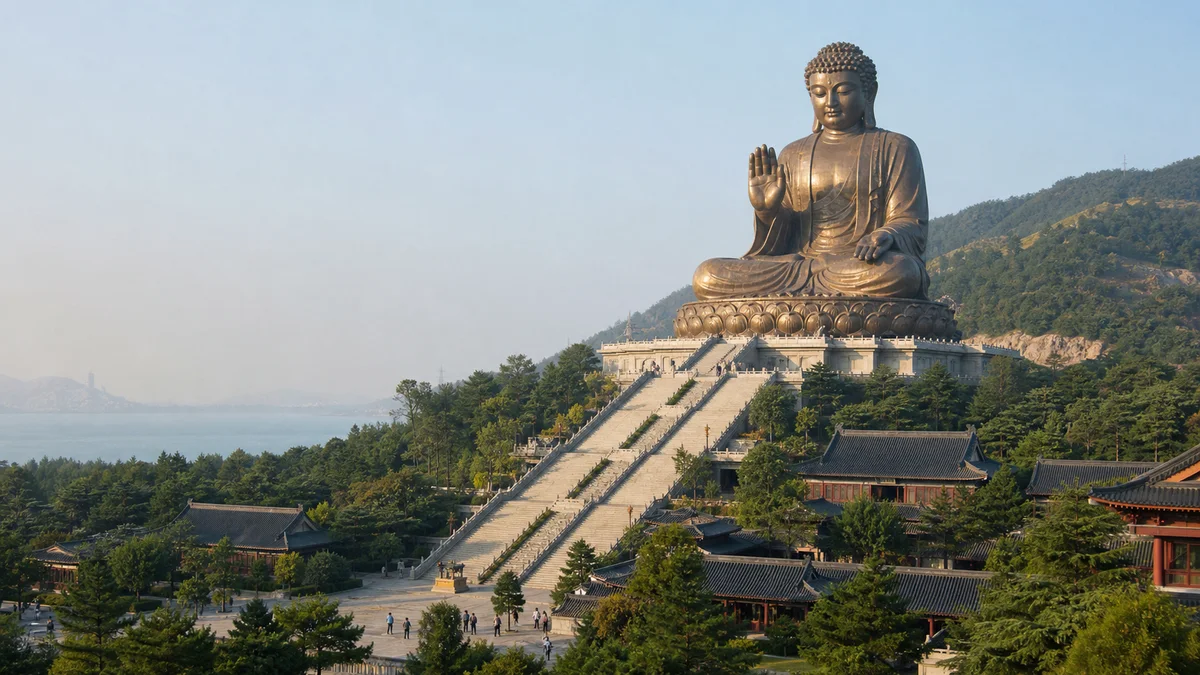
5A View location, maps and nearby scenic areasBefore you start the main staircase, stop where the whole figure first clears the roofs. Use the people on the terraces as your scale. The Buddha appears to sit directly on the green hillside, but the long approach, bronze body, lotus pedestal and ritual buildings were composed to produce exactly that impression.
The first truth of Longkou Nanshan is therefore visible: this is a large modern Buddhist-cultural landscape. The second is quieter. Religious practice on these hills predates the giant statue, though much of what you see has been rebuilt or newly constructed. A useful visit holds those truths together without turning a living sacred place into either an “ancient wonder” or a theme-park prop.
Read Nanshan in three connected zones: the temple courtyards carry an older local religious identity through largely renewed fabric; the central hillside axis culminates in the modern Nanshan Buddha and its interior halls; the Chinese History and Culture Park uses recent architecture and displays to stage a much broader dynastic story. Distances and gradients make them feel more like a campus than one compact temple.
Let human figures measure the Buddha
The seated Nanshan Buddha is commonly given a height of 38.66 metres, roughly the height of a twelve-storey building. That figure refers to the bronze image; descriptions that add the lotus base, terraces or overall hillside produce different totals. Its material, dimensions and commanding placement matter, but “largest” labels are unstable as new statues appear and measurement rules change.
Stand well back before approaching. From below, the head seems close to the sky while the torso compresses in perspective. Move sideways and the lotus seat becomes legible as an engineered platform rather than part of the mountain. Nearer the base, seams and surface panels hint at the difficult work of casting, assembling and supporting a hollow monumental figure.
Scale should sharpen attention, not end it. A small, centuries-old image can carry greater historical rarity; a new giant image can support intense present-day devotion. At Nanshan, size tells you about modern materials, finance, engineering and the desire to make Buddhist presence visible across a wide landscape.
Older roots do not make every hall ancient
The religious history is usually connected to Shiquan Temple, remembered in local gazetteer traditions as one of the older Buddhist establishments in the former Huang County area. Accounts place a temple tradition here as early as the Tang period. More colourful versions say an emperor ordered its foundation and a famous general supervised the work; those details belong to later local narration unless supported by stronger contemporary evidence.
War, decline, repair and reuse affected religious sites across this region. The modern Nanshan Temple presents itself as heir to that older lineage, but inheritance of a name or sacred location is not the same as survival of original timber. Roof frames, painted surfaces, stone paving and axial courtyards visible today were extensively reconstructed or newly built during the area’s recent development.
Use precise language: there is an old religious root, a renewed institution, and mostly modern visible fabric. This distinction does not diminish the temple. It tells a more interesting story about how a community, monastics, donors and a powerful local developer chose to reactivate a sacred geography for contemporary worship and tourism.
A Buddha made at the turn of a century
The great statue belongs to the major redevelopment begun in the late twentieth century and opened as a religious and visitor focus in the early twenty-first. It represents Shakyamuni, the historical Buddha whose awakening and teaching underlie Buddhist traditions across Asia. It is not a surviving image from the Tang or Song dynasty.
Hundreds of tonnes and component counts appear in promotional descriptions, but those figures depend on whether internal supports, panels and other parts are included. What the visitor can verify is already remarkable: bronze surfaces were cast in sections, transported, fitted over a structural system and raised above a complex designed for large crowds.
That work involved sculptors, foundry specialists, structural engineers, builders, painters and craftspeople as well as religious advisers. Their labour is the modern human story behind the serene face. The statue’s calm does not mean it appeared effortlessly; tranquillity was produced through noisy industry, careful tolerances and long-term maintenance.
Read the image as teaching, not magic
From the final approach, look at the broad lotus seat, monastic robe, elongated earlobes and the formal treatment of hair and cranial prominence. These are not a portrait in the modern sense. They are conventional signs that identify an awakened teacher and turn the body into a map of Buddhist qualities.
The most useful idea here is a devotional encounter: seeing an image can focus reverence, recollection and aspiration. Worshippers may bow, offer incense or circumambulate. The statue is not “more powerful” because it is taller, and Buddhism does not reduce to asking a giant deity for luck.
A phrase often associated with the Buddha’s teaching is that all conditioned things are impermanent. A colossal bronze image might seem to contradict it. In fact, weathering makes the lesson visible: metal changes tone, joints need inspection, paint and paving require repair, and every generation must decide how to care for the site. Monumentality does not escape impermanence; it makes maintenance public.
Enter the base, then return to daylight
The pedestal complex contains devotional halls and museum-style interpretation, including displays of many smaller Buddha images. Here the experience shifts from one figure dominating the horizon to repetition, enclosure and artificial light. Check which interior areas are open; religious ceremonies, maintenance and crowd control can alter access.
Move clockwise when signage or worshippers indicate that pattern, and never step over cushions, offerings or people bowing. Hats, bare shoulders and photography rules vary by hall; follow posted guidance and the example of the resident community. Flash can damage atmosphere even when it does not damage bronze, and a phone held in front of an altar can block another person’s prayer.
When you emerge, pause before taking another wide photograph. The interior has changed the exterior: what looked like one enormous object is also a building occupied by smaller images, stories, staff and worshippers. The monumental and intimate scales depend on each other.
Nanshan Temple is not only scenery
Temple courtyards reward a slower pace than the direct climb to the statue. Watch how gates narrow the view, incense smoke makes air visible and thresholds separate ordinary movement from ritual space. Some visitors are sightseeing; others may be making vows, commemorating relatives or joining a service. The same courtyard can be both public attraction and moral landscape.
Keep voices low in active halls, silence calls, and ask before photographing monastics or worshippers. Do not imitate prostrations for a humorous picture, touch statues or lean on offering tables. Donations and incense are voluntary acts; if a seller or guide makes a supernatural guarantee, treat it as a commercial claim rather than Buddhist doctrine.
Vegetarian food or temple-related services may be available, but hours and access change. Avoid assuming that a commercial visitor facility represents monastic daily life. The people maintaining ritual schedules and receiving tour groups have different responsibilities from staff running shops or transport, even when all occupy the same scenic-area system.
The “history park” is contemporary interpretation
The Chinese History and Culture Park extends beyond Buddhism into a landscaped sequence of dynastic themes, ceremonial buildings, gardens and exhibitions. Its ambition is chronological: to make a long, complex national history walkable. That is an educational design strategy, not a preserved ancient city.
Architecture labelled for Qin, Han, Tang or another period should be read as a recent evocation unless a sign identifies a relocated or authenticated historic object. Roof shape and costume can suggest a dynasty, but real historical life also involved regional difference, class, gender, taxation, warfare and ordinary labour—complexities a scenic tableau naturally compresses.
If time is limited, do not rush through every “dynasty” merely to complete a sequence. Choose two or three areas and compare what the designers selected: rulers or workers, court ritual or household life, unity or conflict. The omissions tell you as much about modern historical imagination as the displays themselves.
Choose one hillside day, not an endurance test
For a short core visit, use the most direct available entrance to the temple-and-Buddha axis. Walk enough of the approach to experience the changing scale, visit the base if open, then return through a temple courtyard. This retains devotion, engineering and historical context without covering the entire complex.
For a long cultural visit, add the History and Culture Park and allow most of a day. The zones spread across slopes, and a map that looks compact can hide significant walking. Internal sightseeing vehicles commonly reduce distance, but routes, stops, ticket terms and accessibility can change; photograph the current map and confirm the last practical return before committing to a distant stop.
For travellers with limited mobility, ask specifically about the least-stepped route, not simply whether the site is “accessible.” A shuttle drop-off may still leave ramps, thresholds or stairs; a lift may serve one interior but not the next terrace. Bring a companion if transfer assistance is needed, use handrails and rest before the descent. Rain, leaf litter and winter ice can make shaded paving slippery.
Haze, wind and respectful photographs
The statue’s appearance changes with coastal weather. Clear air separates the bronze from the hills; haze flattens the view and may hide distant landscape; low cloud can erase the head from far below. None is guaranteed. Check the forecast for comfort and safety, but do not treat a misty day as a failed visit—the figure emerging and disappearing can reveal how carefully sightlines were designed.
For scale, include people on the lower terrace without intruding on prayer. A side view shows the lotus platform and hillside engineering; a frontal view emphasises the ritual axis. Morning or late light can model the face, while midday glare may flatten bronze detail. Drone, tripod and commercial-shoot rules can change, so request permission rather than assuming an open hillside means unrestricted airspace.
At the end, return to the place where the Buddha first rose above the roofs. You now know that the calm silhouette is recent, the sacred identity is older, and neither fact cancels the other. Longkou Nanshan is not an untouched ancient monastery, yet it is more than a new statue. It is a living negotiation among memory, faith, corporate patronage, craft, mass tourism and a hill that makes all of them visible from far away.
The LoreLens app helps you distinguish older religious memory, modern construction and living Buddhist practice as you climb Longkou Nanshan.
Location profile
Where it is

Frequently asked questions
Is the Nanshan Buddha an ancient statue?
No. The Nanshan Buddha is a monumental bronze image created during the modern redevelopment of the site around the turn of the twenty-first century. The hill has older religious traditions, but the statue and much of the surrounding ceremonial landscape are recent construction.
How tall is the Nanshan Buddha?
The seated bronze figure is commonly measured at about 38.66 metres, or roughly 39 metres. Published totals may count the statue, lotus pedestal or wider platform differently, so compare like with like rather than relying on record-breaking claims.
How long should I spend at Longkou Nanshan?
A half day can cover the main temple-and-Buddha axis at an unhurried pace. Allow most of a day if you also want the extensive Chinese History and Culture Park, interior exhibitions and regular rests on the hillside.
Can visitors with limited mobility reach the main sights?
Some principal areas may be served by internal vehicles and more accessible approaches, but slopes, steps and long distances remain. Ask the attraction in advance about the current shuttle route, wheelchair access, lifts and the least-stepped approach to the Buddha.