Shandong · Weifang
Qingzhou Ancient City: The Street Plan Outlived the Walls
Walk a regional capital built in layers: reconstructed gates, inherited street lines, merchant fronts, Ouyuan Garden and a living Muslim community rather than one frozen dynasty.
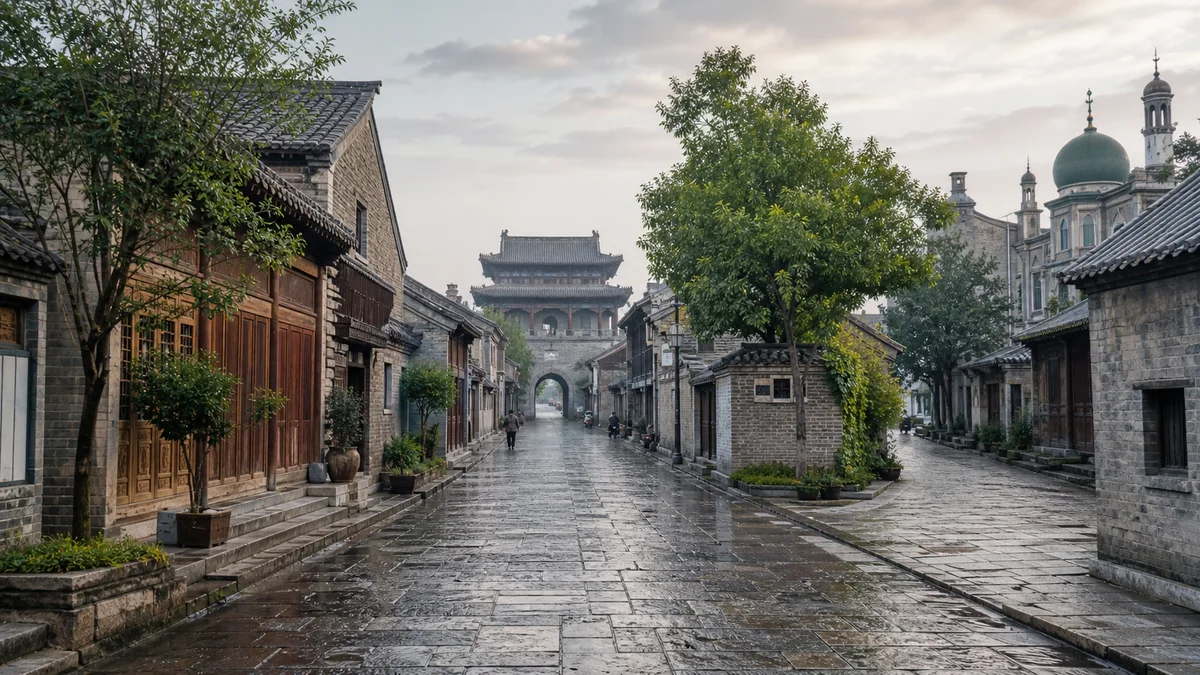
5A View location, maps and nearby scenic areasAt the first major junction, stop looking only at roofs. Look down each street instead. One line carries shops and visitors towards a reconstructed gate; another narrows into courtyards, deliveries, bicycles and front doors. The most durable historical object in Qingzhou is sometimes not a building but a relationship between streets.
That is why the name “ancient city” needs care. Qingzhou was a regional idea, an administrative centre, a trading town and a lived neighbourhood at different scales. The present visitor quarter preserves parts of those histories, repairs others and reconstructs the city wall as a modern frame. No single dynasty owns the whole view.
Read the old city in three bands: the reconstructed gate and walls provide orientation; the main commercial street shows how trade still occupies an inherited axis; Ouyuan, side lanes and the mosque area reveal different households and communities. Qingzhou Museum is a separate archaeological visit, not another courtyard on this walk.
Qingzhou was a region before it was these walls
The Yu Gong chapter of the ancient Book of Documents contains the phrase “Between the sea and Mount Tai lay Qingzhou.” It describes one of the traditional Nine Provinces, a broad imagined and administered region between major landmarks. It does not prove that today’s old streets have stood unchanged since remote antiquity.
Over later centuries, “Qingzhou” referred to jurisdictions whose borders, rank and administrative seat changed. At different times the wider area served as an important political and military centre connecting inland Shandong with routes towards the peninsula and coast. Cities shifted, were damaged and rebuilt, while government offices and markets pulled people back to the regional node.
The current old-city quarter is therefore one late layer in a much longer sequence. Its most legible form belongs largely to later imperial urban life, especially Ming- and Qing-period patterns and their successors. Begin with chronology wide enough to include ancient regional memory, but do not use that memory to assign every brick an impossible age.
The wall is reconstructed; the plan carries memory
Qingzhou’s prominent gates and long visible wall sections help modern visitors understand enclosure, scale and direction. They are also reconstructed. Much of the historic defensive circuit was lost or altered before the present tourism landscape took shape. A new wall can make an old boundary readable without becoming the original fabric itself.
From the gate, compare the broad central axis with the lanes feeding it. Street width, the rhythm of shopfronts, drainage lines, courtyard entrances and turns in the route can preserve older urban habits even when paving and façades are new. Conversely, an old-looking roof may be a recent replacement over a modern shop.
Ask three questions at every photogenic façade: Is the spatial position inherited? Is any material historic? Is the present appearance a restoration, reconstruction or commercial design? Qingzhou becomes more interesting, not less, when those answers differ.
A trading city was made by work, not façades
The main street presents signs, food, craft demonstrations and souvenir counters. Historical commerce was less tidy. Merchants needed storage, credit, transport, apprentices, porters, animal feed, waste removal and rooms behind the shop. Seasonal prices and long-distance connections mattered as much as decorative signboards.
Look at the depth of a plot. A narrow storefront may lead towards successive courtyards where a household cooked, kept stock and negotiated business. Street-facing wealth depended on workers whose names rarely appear in plaques: clerks, craft workers, domestic servants, carriers and vendors without permanent premises.
Today’s businesses continue the street’s economic function but are not automatically historic firms or unchanged crafts. Ask what is made on site, what is sourced elsewhere and whether a demonstration represents daily production or a scheduled performance. Residents also need deliveries and vehicle access; a lane that feels inconveniently “modern” to a photographer may be functioning exactly as a neighbourhood should.
Ouyuan shows the city from an elite courtyard
Ouyuan Garden is associated with the residence of Feng Pu, a senior official of the early Qing and a grand secretary during the Kangxi reign. Its enclosed courts, framed views, rocks, planting and transitions between hall and garden reveal a cultivated elite ideal: a small landscape organised for family life, status, study and reception.
Do not turn one official’s garden into a model for every Qingzhou home. Land, water, decorative stone, skilled construction and maintenance required resources. The quiet composition depended on service work and on a household hierarchy that the surviving rooms may only partly explain.
The garden has also been maintained and restored. Read labels before assigning a rock arrangement, timber or furnishing to Feng Pu’s lifetime. For a useful comparison, leave Ouyuan and enter an ordinary side lane immediately afterwards. The change in plot width and threshold tells you more about social difference than a list of official titles.
The mosque belongs to an active community
Qingzhou’s Muslim history is visible around Zhenjiao Mosque and the surrounding lanes, often associated with the city’s Hui community. Local records commonly date the mosque’s establishment to the Yuan period, while the present complex reflects later rebuilding and repair. As elsewhere in the old city, longevity belongs to a community and institution, not to every untouched beam.
Muslim residents were part of Qingzhou’s trading, craft and neighbourhood life. Their history was not confined to a religious compound, nor was the community identical across centuries. Migration, family networks, military service, commerce and local settlement all contributed to its development.
A mosque is not a themed exhibit. Prayer takes priority over sightseeing. Dress with shoulders and knees covered, keep food and loud conversation away from worship spaces, and ask before photographing worshippers, students or residents. Visitor access, prayer times and permitted rooms can change; a closed door is a boundary, not an attraction withheld.
Longxing Temple’s statues belong in the museum story
Qingzhou’s deeper religious and artistic history is powerfully represented by the Longxing Temple sculptures. In 1996, archaeologists found a cache of hundreds of Buddhist statues and fragments at the temple site. The works span several centuries from the Northern Dynasties into the Northern Song; many are especially valued for refined carving and surviving colour or gilding.
They are not standing in a temple on the tourist street. They are archaeological objects associated with Qingzhou Museum, which should be planned as a separate visit with its own transport, entry and opening arrangements. Current displays can rotate, so confirm before building the day around a specific figure.
The distinction matters. A museum can show controlled lighting, excavated context and close details; the old city shows streets, plots and continuing use. Combining both expands Qingzhou’s history, but pretending the sculptures decorate the lane would collapse two very different kinds of evidence.
Choose between a focused walk and a layered day
For a focused half day, begin at a reconstructed gate to understand the footprint, then follow the main commercial axis towards Ouyuan. After the garden, return through a parallel side lane rather than retracing the same shopfronts. This sequence moves from modern frame, to inherited commercial line, to elite domestic space and everyday neighbourhood.
For a fuller day, continue towards the mosque quarter when access is appropriate, allow time to sit rather than photograph continuously, and add Qingzhou Museum as a separate urban transfer. Confirm the museum, Ouyuan and religious-site arrangements independently; the open streets and individual compounds may follow different schedules or reservation rules.
Daylight makes masonry, thresholds and active businesses easiest to read. Evening lighting can create atmosphere and food streets may become livelier, but illuminations, performances and closing times change. If historical fabric matters, arrive before the day crowd peaks and treat night as a second mood rather than the only view.
Walk at the speed of residents
The principal paved streets are generally the simplest for wheelchairs and strollers, but crowding, bollards, thresholds, garden steps and uneven side lanes can interrupt a step-free route. Reconstructed wall walks normally involve stairs or longer ramps whose access may change. Ask individual sites about current accessible entrances rather than assuming the whole “ancient city” shares one standard.
Wear shoes that tolerate polished stone in rain and summer heat on exposed paving. Keep children close where service vehicles mix with pedestrians. Public transport stops, parking controls, event closures and the best drop-off point can change, so confirm official visitor information before arrival.
Most importantly, remember that windows and doorways can belong to homes. Do not peer inside, block a threshold or arrange residents as background figures. Buy with curiosity but without pressuring craftspeople into a performance; the city does not stop working when a tour group enters.
Photograph layers instead of manufacturing antiquity
Early or late side light makes the street plan visible: photograph down an axis and let gate, shopfront and distant roof overlap. At Ouyuan, use a doorway to frame a second courtyard rather than climbing rockwork. Near the mosque, photograph architectural context only where permitted and never interrupt prayer for a symmetrical image.
Do not hide every modern sign, scooter or delivery cart. Some modern intrusions are visual clutter; others prove the quarter remains inhabited. A photograph of a reconstructed gate should not be captioned as an untouched Ming wall, just as a new shop should not be sold as a centuries-old business without evidence.
Before leaving, return to the first junction and look down the streets again. The view now contains more than “old China”: an ancient regional name, changing seats of government, repaired urban lines, merchants and workers, an official’s garden, a Muslim community, modern reconstruction and ordinary errands. Qingzhou’s continuity survives not because time stopped, but because people kept reusing the plan.
The LoreLens app helps separate reconstructed walls, inherited street patterns, restored courtyards and living community spaces as you walk Qingzhou.
Location profile
Where it is
Frequently asked questions
How much time should I allow for Qingzhou Ancient City?
A focused half day can cover a reconstructed gate, the main commercial spine, Ouyuan Garden and selected side lanes. Allow most of a day if you want to visit the mosque area respectfully, watch residential streets at a slower pace and add Qingzhou Museum as a separate stop.
Are Qingzhou's city walls and gates original?
The present landmark gates and substantial wall sections are modern reconstructions based on the historical city form, not an intact defensive circuit from one dynasty. Older street alignments, courtyards and individual buildings survive unevenly among repairs and newer uses.
Can non-Muslim visitors enter Qingzhou's historic mosque?
Access can depend on prayer, religious events, conservation work and current community rules. Dress modestly, keep voices low, do not interrupt worship, and ask before entering restricted spaces or photographing people; confirm current visitor access locally.
Can I see the Longxing Temple Buddhist statues in the old streets?
No. The celebrated sculptures were excavated from the Longxing Temple site and belong to Qingzhou Museum's archaeological story, not to a street display in the ancient-city quarter. Check the museum's current location, opening arrangements and exhibition status separately.