Shandong · Zibo
Zhoucun Ancient Commercial City: Streets of a Dry Port
Follow an inland dry port through silk and textile trade, merchant institutions, working courtyards, restored displays and the labour behind Zhoucun sesame cakes.
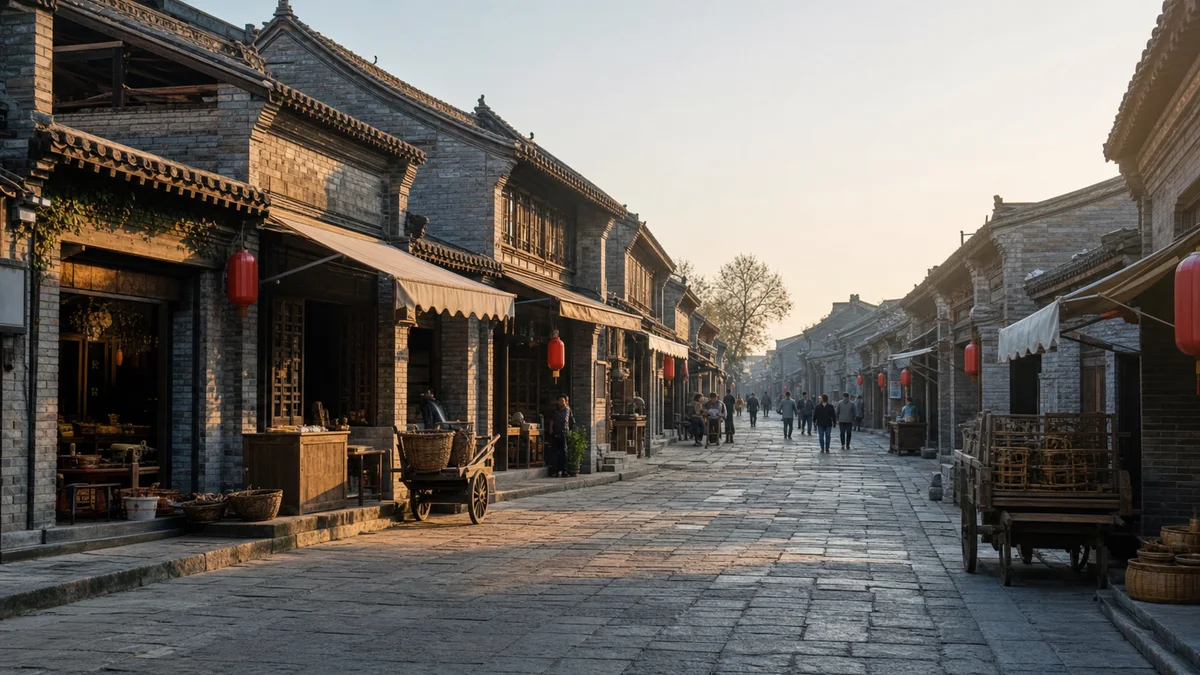
5A View location, maps and nearby scenic areasStand where Dajie, the main street, meets a narrower lane and look at the ground before the signboards. The broad paved line gives carts, porters and customers room to move; the side lane slips towards courtyards where stock could be kept, accounts checked and meals cooked. Zhoucun’s history is not only in a roof. It is in the way movement, storage and negotiation fit together.
That movement explains the famous description “dry port.” There is no harbour basin beside these shops. The phrase means that an inland market gathered and redistributed goods through roads, carts, pack animals and, later, rail and modern road connections. Read it as an economic function, not as a lost waterway legend.
Use four layers to orient yourself: Dajie shows the public shopfront; Silk Market Street points towards the textile supply chain; Silver Market Street raises questions about settlement and credit; side lanes, courtyards and craft displays reveal storage, production and domestic work. Current entrances and ticketed interiors can change, so treat this as a reading sequence rather than a guaranteed official circuit.
A dry port moved goods without a waterfront
Zhoucun grew where routes across central Shandong could bring agricultural products, textiles, people and information into one market. During the Ming and Qing periods, expanding trade and craft production made the town an important inland commercial node. Inns, yards, warehouses, animal feed and repair services mattered as much as the shops now facing visitors.
The dry-port metaphor is useful because it highlights transfer. A water port moves cargo between ship and shore; Zhoucun connected producing households and regional markets to longer-distance buyers by land. Loads arrived in smaller lots, were weighed, graded, repacked, financed and sent out again. Every transfer added labour, time and risk.
In 1904 the Qing government included Zhoucun in Shandong’s policy of opening commercial marts. That administrative change did not create trade from nothing, nor did it make Zhoucun a treaty port with a sea coast. It added a new institutional layer to an older market. The Qingdao–Jinan railway and later roads altered the network again, while war, political change and industrial production shifted the role of traditional firms.
Silk and textiles formed a chain, not one luxury shop
Zhoucun is strongly associated with silk, weaving and cloth trade. The finished bolt in a merchant display was the end of a long chain: raising silkworms and gathering cocoons, reeling thread, weaving, dyeing or finishing cloth, checking quality, packing, carrying and selling. Not every stage occurred in the same courtyard, and materials could arrive from a wider producing region.
Look beyond the most polished silk counter. A trader needed to know fibre quality, measurements, colours, seasonal demand and the reliability of suppliers and buyers. Cloth also had to survive dust, moisture, fire and repeated handling. Shop depth, high shelves, covered courtyards and guarded storage can make those practical needs visible.
The chain also distributed profit unevenly. A famous firm might leave its name on a signboard; women doing household textile work, hired dyers, reelers, carriers and apprentices were less likely to appear in the title. Ask an exhibit which stage it represents and whose labour produced the value before it reached the street-facing counter.
Merchant institutions turned trust into trade
Long-distance commerce could not run on handshakes alone. Zhoucun’s firms used account books, contracts, measures, seals, agents, partnerships and forms of credit to coordinate people who did not meet every day. Money-changing, pawning and remittance services helped settle transactions, while merchant networks carried information about prices and reputation.
Silver Market Street is a useful place to think about that financial layer. Its name does not prove that every current doorway was a historic bank or that one institution occupied the same premises for centuries. When a display presents a draft, ledger, scale or shop rule, read the date and ask whether the object is original, collected from elsewhere or reproduced for explanation.
Institutions could reduce risk but also enforce hierarchy. Owners, managers, clerks and apprentices did not hold equal power. Credit allowed a shipment to move before final payment, yet debt could trap a small producer or worker. A romantic story of merchant honesty is incomplete unless it also explains bookkeeping, enforcement, bankruptcy and who absorbed a loss.
Read Dajie, Silk Market Street and Silver Market Street in sequence
Begin on Dajie and use the repetition of narrow shopfronts to understand the public commercial spine. Do not enter every attraction immediately. First compare widths, thresholds and the depth behind each door. The street creates visibility; the long plot behind it makes storage, workshops and household life possible.
Turn towards Silk Market Street to shift from general commerce to the movement of fibre and cloth. Look for explanations of grading, weaving, dyeing, packing and wholesale exchange rather than treating every length of fabric as local production. Continue towards Silver Market Street to ask how goods were priced and accounts settled.
Then return by a quieter side lane if current access permits. This loop moves from display to supply chain to finance and finally to the less celebrated spaces that supported them. Gates, ticketed courtyards, performances and temporary closures may follow different arrangements; confirm the current map instead of assuming that every named street and interior forms one continuous admission route.
Preserved street fabric is not the same as a restored display
Zhoucun retains an intelligible commercial street pattern: the relationship between main axis, side lanes, narrow fronts and deep plots can carry genuine urban memory. Individual brickwork, timber frames, roof structures and paving may also be old. Their age, however, is uneven, and long-used buildings require replacement and repair.
A restored shop can combine retained structure, repaired materials, a reconstructed counter and newly arranged objects in one room. A mannequin, soundscape or perfectly stocked shelf may help explain a trade but is not direct evidence that the room looked exactly that way on a particular day in the Qing dynasty.
Use four categories: surviving fabric, repair, reconstruction and interpretive display. Check conservation labels before assigning a date to a beam, sign or piece of furniture. Transparent restoration does not make the site less meaningful; it lets the historic evidence and the modern explanation do different jobs.
Shop signs depended on workers without famous names
The main street foregrounds merchants because firms put names above the door and successful owners left records. Commerce also required bookkeepers, apprentices, porters, cart drivers, guards, cleaners, cooks, domestic workers, itinerant sellers and people who repaired tools and buildings. Textile production drew on spinners, reelers, weavers, dyers and finishers working in shops, yards or homes.
Many combined wage work with household obligations, and not all could bargain equally over pay or training. Apprenticeship could transmit skill and provide entry to a trade, while also demanding long hours and obedience. Fire, dye chemicals, dust, heavy loads, cold courtyards, heat and unstable prices made the commercial city a workplace with hazards rather than a permanent festival.
Look for service doors, lifting points, worn thresholds, ventilation and water access. These modest features can say more about ordinary labour than a founder’s portrait. When photographing an active shop, ask permission and avoid blocking the very delivery route that explains how the street still functions.
Zhoucun sesame cake is a process before it is a souvenir
The thin, sesame-covered Zhoucun shaobing is one of the district’s best-known foods. Its useful story lies in process: wheat dough is portioned and spread thin, seasoned, coated with sesame and baked until crisp. Sweet and savoury formulas, thickness and baking equipment can vary by maker and period.
At a demonstration, watch the hands rather than only the package. How is an even circle formed? How are sesame seeds made to adhere? How does the baker control heat so a thin cake dries and browns without scorching? Those questions connect touch, timing and oven work to the final texture.
A visitor workshop or branded counter is a present-day business, even when it draws on an inherited method. Ask what is actually made on site and whether the demonstration is routine production or interpretation. Compare products without declaring one shop the sole authentic survivor. People with wheat, sesame or other food allergies should confirm ingredients and cross-contact before tasting.
Choose depth over the busiest possible checklist
For a focused half day, start on Dajie before the heaviest crowd if possible, follow the street sequence and choose one commercial-history display plus one craft demonstration. A single well-labelled interior is more useful than rushing through a row of recreated shops.
For a slower day, add side lanes, residential edges and more time with account books or textile tools. Revisit the main street after a meal or later light to compare working deliveries, tour groups and evening atmosphere. Lighting, performances, workshop sessions and the opening of individual courtyards can change; confirm current official information rather than building the day around one show.
Main paving may be relatively level, but polished stone, drainage edges, shop thresholds, courtyard steps and upper floors can interrupt a step-free route. Crowds make narrow interiors harder to turn through. Ask each venue about an accessible entrance, and use a quieter lane only after checking that its surface and exit suit your mobility. Keep clear of service carts and do not treat residents’ doorways as rest areas.
Photograph the system, not an invented golden age
Photograph down Dajie so repeated fronts reveal the commercial axis, then turn ninety degrees and show a narrow entrance opening into a deeper plot. In a textile display, pair finished cloth with a tool, ledger or storage space. In a bakery, seek consent before photographing hands or faces and never lean across a hot oven for a closer frame.
Do not remove every modern sign, fire extinguisher or delivery vehicle from the story. Some are visual clutter, but others show that old commercial space must meet present safety and working needs. Caption restored rooms as restored, recreated scenes as interpretation and active businesses as contemporary unless evidence supports a longer continuity.
Before leaving, return to the junction where you first looked at the paving. The stone has not moved, but the route now contains much more than a picturesque market: an inland transfer system, silk and textile labour, contracts and credit, unequal risk, repaired buildings, hot ovens and ordinary errands. Zhoucun’s “dry port” becomes visible when you stop searching for water and start following everything that had to move.
The LoreLens app helps distinguish inherited street structure, repaired fabric, reconstructed shop scenes and the labour systems behind Zhoucun’s dry-port trade.
Location profile
Where it is

Frequently asked questions
Why is Zhoucun called a 'dry port' when there is no harbour?
The phrase describes an inland trade hub where road, cart, market and later rail connections performed some of the concentrating and redistributing functions of a port. It is a commercial metaphor, not a claim that ships once tied up on Dajie.
How much time should I allow for Zhoucun Ancient Commercial City?
A focused half day can cover Dajie, Silk Market Street, Silver Market Street and one or two well-labelled shop or craft displays. Allow most of a day to compare side lanes and courtyards, read commercial exhibits slowly and return after the busiest period; confirm current access for individual venues.
Are Zhoucun's old streets and shops all original?
No. The district retains historic street alignments, plot rhythms and some older building fabric, but roofs, façades and interiors have been repaired at different dates. Some shops are restored historic premises; others are reconstructed or staged displays. Read the label for each site rather than treating the whole quarter as untouched.
Can I watch Zhoucun sesame cakes being made?
Some shops or interpretation venues commonly demonstrate shaping, sesame coating and baking, but demonstrations, workshop access and sales can change. Ask what is made on site and what ingredients are used; the cakes normally contain wheat and sesame, and recipes may also include sugar, salt or other ingredients.