Shandong · Jinan
Jinan Springs: The Underground River That Organised a City
Follow karst groundwater from Baotu's three jets through Five Dragon Pool and Black Tiger Spring to the moat and Daming Lake, reading water level, poetry and city life together.
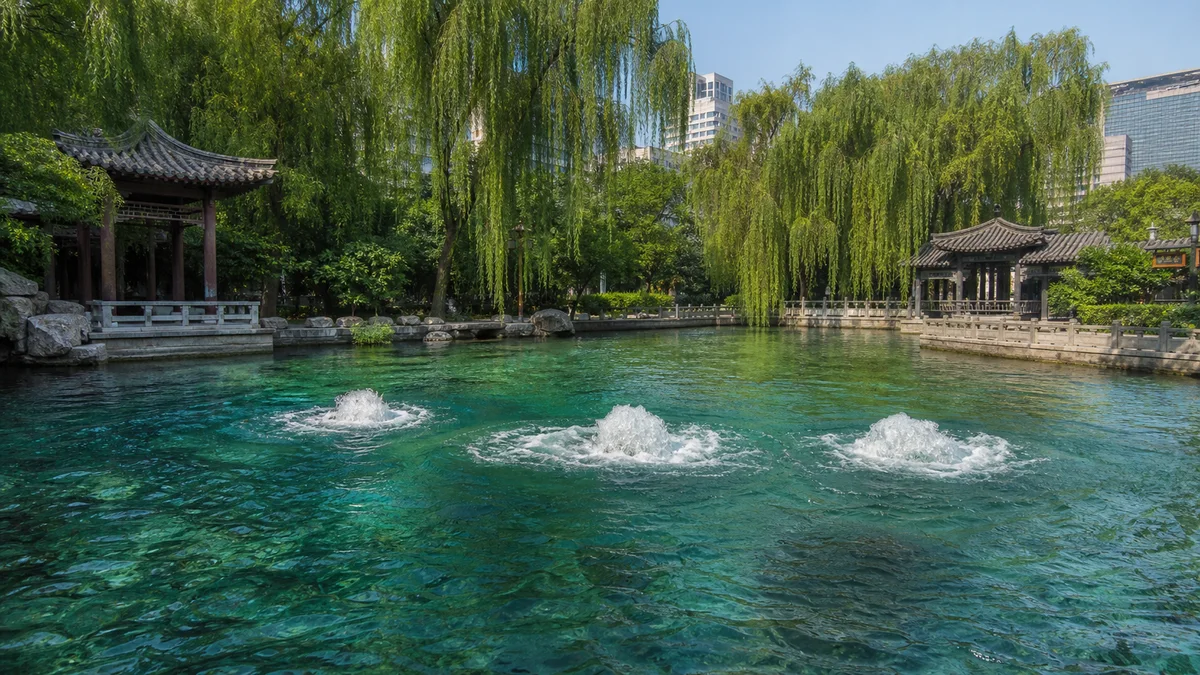
5A View location, maps and nearby scenic areasAt Baotu Spring, choose one fixed edge of the pool and watch the three upwellings for a full minute. They do not behave like fountain nozzles: each dome swells, collapses and gathers again, lifting sand and breaking reflections from below. What you are seeing is not a pump programme but the visible end of a groundwater journey.
That journey organised Jinan. Rain falling on limestone hills south of the city entered fractures and cavities, travelled underground, then rose along the boundary with the northern plain. Springs supplied households, filled channels, fed the old moat and gathered in Daming Lake. Streets and gardens learned to live around water that arrived from beneath them.
Carry a south-to-north map in your head: limestone hills recharge the aquifer; Baotu and Five Dragon Pool reveal pressure in garden pools; Black Tiger Spring pours directly into the southern moat; the moat carries spring water around the old city towards Daming Lake. The scenic area is therefore one connected urban water story, not four unrelated parks.
How a limestone aquifer appears in the city centre
Jinan lies at a geological hinge. To the south, carbonate rocks are exposed in hills and valleys. Rain and surface water can enter cracks, enlarged joints and other karst openings instead of remaining entirely in streams. Gravity and hydraulic pressure move that water northward through the rock.
Near the city, changes in rock permeability and the structure beneath the plain obstruct the underground flow. Water pressure rises and finds faults, fissures and lower outlets, emerging as clusters of springs. This simplified model explains both abundance and location: the old city sits where a regional aquifer meets a barrier and the ground surface.
“Filtered through rock” does not mean sterile or unlimited. Karst systems can transmit water—and pollution—quickly. Paved construction reduces infiltration, wells lower pressure and drought reduces recharge; conversely, heavy rain in the south may take time to influence city springs. Protecting a pool while damaging its distant recharge area would preserve the display case but lose the exhibit.
Baotu Spring is a pressure gauge, not a fixed performance
The name Baotu suggests leaping or bursting water. Northern Song writer and official Zeng Gong, who governed the region in the eleventh century, helped establish the name in the literary record. The main pool’s three prominent outlets became the most recognisable image of Jinan’s spring system.
Look beyond height. Strong flow pushes the water surface into pale domes and keeps ripples radiating even without wind. At lower pressure, the upwellings may be gentler and the pool more reflective. Photographs from a wet year do not promise the same geometry on your visit.
The phrase “First Spring Under Heaven” is traditionally tied to the Qianlong Emperor’s admiration and imperial naming of Baotu. It belongs to the culture of imperial travel, tasting, collecting and ranking famous landscapes. It does not mean hydrologists tested every spring on earth and awarded Baotu first place. The title matters because an emperor’s preference amplified an already famous urban spring—not because it settled science.
“Seventy-two famous springs” is a tradition, not a census
Jinan is often introduced through its Seventy-Two Famous Springs. Treat that number as a historical catalogue and cultural formula. Lists compiled in different periods do not always contain the same names, while modern surveys recognise many more spring outlets and groups.
The difference between an outlet and a spring group also changes counting. Baotu’s three visible upwellings occupy one pool and one famous name; Five Dragon Pool is a landscaped water body within a wider cluster; minor seepages can appear, weaken or shift. A precise total without a definition creates false certainty.
The tradition is still useful. Naming a spring gave residents a story, a landmark and a reason to maintain access. Small springs became tied to lanes, courtyards, temples, trades and neighbourhood memory. “Seventy-two” says the city is saturated with named water, not that outlet number seventy-three is culturally invalid.
Five Dragon Pool teaches you to notice quiet water
Five Dragon Pool, just north of Baotu, offers a productive contrast. Its broad, tree-shaded water and surrounding smaller springs can appear calmer than Baotu’s three jets. That does not make the hydrology less active. Look for sand trembling on the bed, plants moving where there is no surface breeze and clear water slipping over an edge into a channel.
The garden demonstrates why spring watching requires time. A famous vertical surge attracts crowds; slow lateral movement reveals the same aquifer entering a different basin geometry. Stonework, dredging and landscaping have also shaped how the water looks, so “natural spring” and “designed garden” are not opposites here.
Do not throw coins into the pool or feed fish. Metal, food and packaging add work to a protected water system. Keep to bridges and marked edges; wet stone under trees can be slippery, and leaning over a low rail for a reflection is a poor trade for falling into a spring-fed basin.
Black Tiger Spring puts groundwater into daily life
At Black Tiger Spring, water issues from a rock cavity and rushes through three carved tiger heads into the moat. The name is commonly explained by the roar of strong water against stone. Unlike Baotu’s framed central pool, this spring makes discharge and onward flow immediately legible.
It is also a social space. Residents have long come to collect water, and the rhythm of bottles, kettles and conversation turns hydrogeology into daily practice. Watch without treating people as picturesque props. Leave collection points clear, do not photograph faces at close range without permission and never wash food, hands or equipment in the protected outlet.
Visible use does not guarantee untreated water is medically safe for every visitor. Water quality, designated taps and public-health advice can change. Use an official treated drinking point if one is provided; do not fill from any tiger head, pool or channel simply because someone else does. The spring’s cultural intimacy deserves the same caution as its geology.
The moat carries the story to Daming Lake
The city moat is where separate spring names become one urban system. Black Tiger’s discharge and water from other spring channels enter the encircling waterway. Along its banks, bridges, willows, walls, exercise, tea and boat landings show that infrastructure can also be public landscape.
Follow the flow and the old city becomes easier to read. Water that emerged under courtyards and cliffs is collected, conveyed and eventually joins Daming Lake to the north. The lake is not simply a large spring mouth; it is a receiving basin shaped by spring inflow, rainfall, drainage, channel management and outflow.
Lotus, willow reflections and open water can conceal this engineering. Water levels, circulation and clarity require management in a dense city. Moat cruises may connect parts of the scenic area, but stops, water conditions, operating periods and wheelchair access change. A boat offers the water’s perspective; walking shows where channels meet streets.
Li Qingzhao belongs to Jinan, but not to a false house
Inside Baotu Spring Park, a memorial hall honours Li Qingzhao (1084–c.1155), one of China’s greatest lyric poets. She was born in Zhangqiu, now part of Jinan, into a scholarly family. With her husband Zhao Mingcheng, she collected and studied inscriptions on bronze and stone; their work contributed to the Record of Metal and Stone.
War transformed that life. The fall of the Northern Song pushed them south; much of their collection was lost, Zhao died in 1129, and Li’s later years were marked by displacement and grief. The clarity and compression of her later ci poetry cannot be reduced to “a talented woman writing beside pretty springs.” It came from scholarship, political catastrophe and survival.
Her famous line “Row, row—startling a whole bank of gulls and herons” evokes an exuberant boating scene, but its exact water setting should not be confidently labelled Daming Lake. Likewise, the park memorial is a later commemorative space, not her verified residence. Jinan’s claim is strong enough without invention: this region formed her early world, and the city now chooses to remember her beside its most famous water.
Spring level is a record of choices as well as rain
Jinan’s springs have weakened and, in modern periods, some major outlets have stopped flowing for extended intervals. Rainfall shortage matters, but no single cause explains every low-water episode. Groundwater withdrawal, urban growth, loss of infiltration, reservoir and river operations, artificial recharge and conservation policy all affect the system at different scales.
Protection therefore extends beyond decorative railings. It includes limiting extraction near sensitive zones, conserving southern recharge land, saving water, monitoring groundwater and supplementing recharge when conditions and policy allow. These interventions help maintain flow, but they do not make a seasonal aquifer into a guaranteed mechanical fountain.
Use current water-level notices as a snapshot. A numerical gauge at one spring does not describe every outlet, and one wet week does not erase a dry year. The responsible visitor can celebrate vigorous flow without calling it permanent, and can appreciate a quiet pool without declaring the spring “dead.”
Walk from pressure to lake, then photograph the connections
For a short spring comparison, visit Baotu early, then cross to Five Dragon Pool. Two nearby gardens show dramatic and quiet discharge without requiring the full old-city circuit. Admission policies and entrances can differ, so confirm current arrangements.
For a hydrology-first route, begin at Black Tiger Spring, follow the moat north towards Daming Lake, then continue west or south through the old city to Five Dragon Pool and Baotu. This orders the day by visible flow and saves the imperial title for the end. A reverse route works equally well; the important thing is to trace channels rather than teleport mentally between landmarks.
For a full mixed route, combine walking with an operating moat boat. Verify boarding points, one-way or loop service, last departures and step-free boarding before committing. Paved promenades are often accessible, but historic thresholds, crowded bridges and waterside steps remain. At Black Tiger, wet collection stairs need particular care.
Photograph evidence, not only pavilions: three upwellings disrupting a reflection, sand moving in Five Dragon Pool, a tiger-head outlet entering the moat, and the widening water at Daming Lake. Avoid blocking collectors and never cross a barrier for a low angle. At the final lake edge, look back south in your mind. Hills, fissures, pools, channels and city have become one route—the underground map has reached daylight.
The LoreLens app helps you trace Jinan’s hidden aquifer through spring pools, moat channels, inscriptions and the stories gathered at Daming Lake.
Location profile
Where it is

Frequently asked questions
Why is Baotu called the 'First Spring Under Heaven'?
The phrase is an imperial and cultural accolade traditionally associated with the Qianlong Emperor's admiration for Baotu Spring. It expresses prestige, taste and courtly authority; it is not a scientific ranking of the world's springs.
Does Baotu Spring always rise in high jets?
No. The visible surge responds to groundwater pressure, which changes with accumulated rainfall in the southern recharge area, extraction, conservation measures and season. Check current official water-level information rather than expecting a fixed height.
Can visitors drink water directly from Jinan's springs?
Do not assume every pool or public spout is safe to drink untreated. Use only designated drinking-water points that local authorities identify as treated and currently open, and follow posted health advice; keep bottles and hands out of protected spring pools.
Can I see Baotu, Five Dragon Pool, Black Tiger Spring and Daming Lake in one day?
Yes, with a full day and a clear route, but the sites are spread around the old city. Walking best reveals the connected water system; moat boats can shorten or enrich parts of the journey when operating, so confirm current stops and accessibility.