Shandong · Jining
Qufu's Confucius Sites: Ritual, Lineage and Power
Walk from Confucius Temple to the Kong Family Mansion and Cemetery, reading three connected landscapes of state ritual, hereditary authority and family memory.
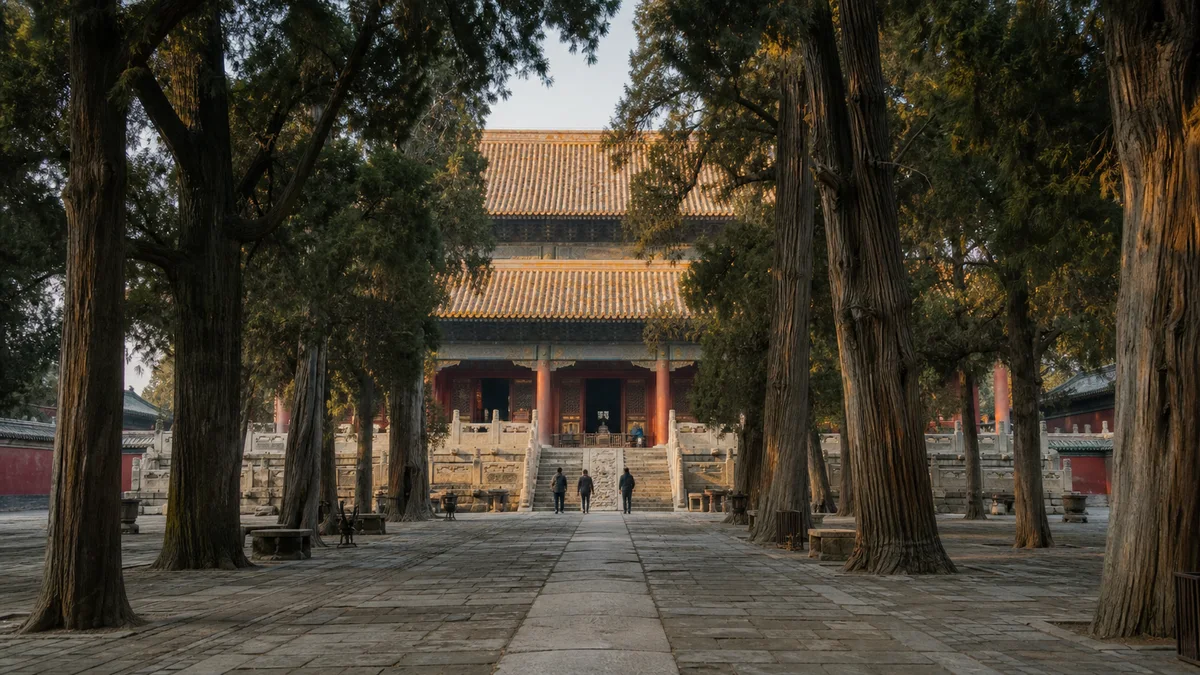
5A View location, maps and nearby scenic areasPause after the first gate of the Confucius Temple and look straight ahead. Another gate frames another courtyard, which frames another roof. The repeated sequence is not empty grandeur. It slows approach, ranks spaces and turns walking into ritual. Then look sideways: minor buildings, service routes and side courts remind you that no central axis worked by symbolism alone.
Qufu’s “Three Confucian Sites” are often sold as three famous attractions. Read together, they are more revealing: the Temple shows how states honoured and reshaped Confucius; the Kong Family Mansion shows how his senior descendants administered ritual, property and household; the Cemetery gives lineage a physical landscape across generations.
Use one question in each place: in the Temple, ask who defined correct ritual; in the Mansion, ask who exercised authority and who made the institution function; in the Cemetery, ask how genealogy became land and memory. The Temple and Mansion are adjacent in the old city, while the Cemetery is a separate, much larger site to the north.
Read the three sites as one social system
The Temple, Mansion and Cemetery correspond roughly to ritual, administration and descent, but the boundaries overlap. Kong descendants organised sacrifices in the Temple. Imperial governments granted titles, land and privileges that helped sustain the Mansion. Burial status in the Cemetery expressed membership in a lineage whose prestige depended partly on state recognition.
Architecture makes that system visible. In the Temple, a long south–north axis culminates in the principal sacrificial halls. In the Mansion, front offices give way to residential courts. In the Cemetery, a formal approach to Confucius’s tomb opens into a wooded burial landscape containing many branches and generations of the Kong lineage. Gates, tablets, archives, kitchens, estates, servants, tenants and ritual specialists all belonged to this world, even when only some remain visible.
This also explains why “Confucian site” is not synonymous with “building designed by Confucius.” Nearly every monumental layer was made after his death. The complex records what later rulers and descendants wanted Confucius to mean—and how they organised people and resources around that meaning.
Confucius lived before the monumental Qufu you see
Confucius, or Kong Qiu, lived from 551 to 479 BCE, during the late Spring and Autumn period. He taught, served intermittently in the state of Lu, travelled among other states and gathered students. The sayings preserved in the Analects were compiled and transmitted by followers; they are not a diary written by him, and later Confucian traditions developed far beyond one lifetime.
The Temple’s institutional beginning is traditionally dated to 478 BCE, the year after his death, when Duke Ai of Lu converted three rooms of Confucius’s former residence into a memorial shrine and kept objects associated with him there. That modest starting point matters. The vast courts now surrounding you did not spring fully formed from the ancient master’s house.
Early commemoration gradually became public orthodoxy. Emperors offered sacrifices, governments awarded posthumous titles, and officials funded repairs or expansions. At the same time, scholars repeatedly reinterpreted the classics. Qufu is therefore not a preserved classroom from 500 BCE; it is a record of more than two millennia of remembering, institutionalising and debating a teacher.
Imperial rebuilding turned memory into state ritual
The Temple was repaired and expanded many times under successive dynasties. Fires, war and age destroyed sections; court patronage and Kong-lineage management rebuilt them. Much of the visible architectural character is Ming and Qing, with older inscriptions, foundations and spatial ideas incorporated into later fabric. Modern conservation adds another layer.
Every enlargement made a political statement. By honouring Confucius, an emperor could present his government as guardian of learning, hierarchy and civil order. Imperial stelae and pavilions record patronage, but they should not be read simply as praise from neutral admirers. The state was also placing itself inside the story of legitimate moral rule.
Notice how movement is ranked. Axial gates and terraces privilege the central route; side halls classify honoured disciples and later scholars; controlled thresholds once distinguished ritual participants by status. The complex materialises an ordered society. That order could create continuity and shared ceremony, but it also made hierarchy appear natural and permanent.
Dacheng Hall gives monumental form to “returning to ritual”
The main ritual focus is Dacheng Hall, the Hall of Great Accomplishment. Approach slowly across its forecourt. The raised terrace, broad roof, front portico and carved stone columns produce authority through scale and controlled distance. Photographing only the dragon carving misses the point: include the open court to show how participants were positioned before the hall.
The present hall is not an untouched ancient structure. A major fire in 1724 damaged the Temple, and the Qing court-sponsored reconstruction of the main complex was completed in the following years. Structural members, surfaces and furnishings have also undergone later maintenance. Older ritual meaning survives through a building repeatedly renewed.
Inside and around the court, distinguish the historical person from the ritual image created after him. Statues, spirit tablets, musical instruments and ceremonial arrangements express specific periods of state and lineage practice. They are evidence for the history of commemoration, not direct portraits of how Confucius taught his students.
In the Analects, Confucius answers a question about benevolence with “克己復禮為仁”—often translated as “Mastering oneself and returning to ritual is benevolence.” In context, li is not merely an impressive ceremony. It includes disciplined conduct, relationships and ways of acting appropriately with others.
Later institutions made ritual monumental. Court dress, ranks, music, offerings and processions enacted a political and moral order before Dacheng Hall. This preserved texts and practices across generations, yet it also turned a teaching about self-cultivation into an apparatus that could validate authority.
That tension is a useful modern echo. Schools, family ceremonies and public commemorations still invoke Confucius, but people disagree about whether ritual nurtures respect, enforces conformity or does both. If a ceremony is scheduled during your visit, treat it as a present-day interpretation with historical roots—not a performance unchanged since Confucius’s lifetime. Times and access can change, so confirm current official notices.
The Kong Family Mansion was an office as well as a home
Walk east from the Temple into the Kong Family Mansion, commonly called the residence of the Duke Yansheng. The title Yansheng Gong was granted to the senior direct descendant in 1055 and continued, with changing privileges and political settings, under later dynasties. The Mansion grew beside the Temple as that hereditary office acquired responsibilities and resources.
Its front-office, rear-residence plan is the key. Public halls received edicts and officials, handled documents, managed ritual affairs and administered an extensive household and properties. Behind them, gates controlled entry to family residential courts. The surviving layout took major form in the Ming period, including reconstruction around 1503, and was expanded or repaired in Ming and Qing times.
Displayed desks, seals, robes, furniture and room settings help explain use, but do not assume every item has remained in its current position for centuries. Ask whether a room preserves historic fabric, has been restored, or contains later museum staging. The Mansion’s importance lies less in one luxurious object than in the union of lineage leadership, bureaucratic work and domestic life.
Rank, gender and labour shaped life behind the gates
The phrase “home of Confucius’s descendants” can make the Mansion sound like one harmonious family residence. It was a stratified institution. Senior male descendants held recognised titles and appear prominently in genealogies and official records. Women’s marriages, births, household management and ritual roles were essential to succession, yet their voices survive less evenly and their movement was structured by inner–outer spatial conventions.
Officials, secretaries, stewards, ritual performers, cooks, guards, servants, craftspeople and agricultural tenants made the establishment work. Grain, textiles, fuel, repairs and ceremonial supplies had to come from somewhere. Their labour is easier to miss than the central audience hall because service spaces and archives rarely receive equal visual emphasis.
Look at side doors, storage, kitchens and narrow passages as seriously as painted beams. They reveal how prestige was produced each day. The long relationship between imperial states and the Kong lineage protected scholarship and heritage, but also concentrated land, privilege and authority. Recognising that trade-off does not dismiss the site; it makes its social history complete.
Kong Cemetery turns genealogy into a landscape
The Cemetery of Confucius, or Kong Lin, lies north of the old city within a large walled woodland. Confucius’s tomb forms the symbolic centre of the visit, with the graves of his son Kong Li and grandson Kong Ji nearby. Over many generations, other members and branches of the Kong lineage were buried across the wider grounds. Paths, mounds, stelae, stone figures and old trees create a record that is spatial rather than chronological.
Not every monument is as old as the person it names. Tomb mounds were repaired, tablets replaced, approaches rebuilt and trees replanted. Read dates and inscriptions carefully. Stories such as the disciple Zigong planting a tree or remaining to mourn longer belong to a powerful commemorative tradition; the present pavilion and carved record are later materialisations of that memory.
This remains a burial ground, not a scenic forest with decorative mounds. Stay on permitted paths, keep voices low near graves and do not climb tombs, lean on stelae, make comic poses or photograph mourners without consent. Fallen leaves and quiet distances are part of the experience; a fast vehicle loop cannot replace walking one respectful section.
UNESCO protects three components, not a timeless city
In 1994, UNESCO inscribed the Temple and Cemetery of Confucius and the Kong Family Mansion in Qufu as a cultural World Heritage property under criteria (i), (iv) and (vi). The listing recognises the artistic and architectural achievement of the complexes, their long development as an ensemble and their exceptional association with Confucius and traditions that influenced East Asia.
The wording matters. The World Heritage property has three named components. It does not certify every tourist street, reconstructed gate, shop or performance in the wider “Ming Ancient City” visitor area as ancient or as part of the inscribed fabric. Nor does UNESCO status mean that nothing can be repaired. Timber architecture survives through inspection, replacement, fire prevention and conservation informed by records and craft knowledge.
Look for conservation boundaries and site labels rather than relying on the atmosphere of red walls and grey paving. Authenticity here is carried by location, layout, historic materials, ritual association, archives and continuing care—not by pretending more than two thousand years passed without rebuilding.
Follow Temple → Mansion → Cemetery, then slow down
For a focused half day, visit the Temple first and the adjoining Mansion second. This preserves the logic from public ritual to the family office-household that supported it. Do not rush the Temple’s first courts; once you understand the axis, later halls become easier to read. In the Mansion, spend time in both an administrative hall and a service or residential area.
For a full three-site day, continue to the Cemetery. It lies roughly two kilometres north of the old city in a straight line, but gate positions and road routes make the practical transfer longer. Walking, local buses, taxis and visitor shuttles may be managed differently by season or traffic control. Confirm the current exit, Cemetery entrance, ticket arrangement, last admission and transport through official channels before leaving the Mansion.
Main courts are often fairly level, but old paving, steps and high thresholds interrupt the route. The Cemetery adds long distances and uneven surfaces. Ask about step-free gates, accessible facilities and operating mobility services rather than assuming a combined ticket implies a continuous accessible path. Heat, rain and holiday crowds can change the sensible route; carry water and leave a quiet buffer.
Photograph relationships, and leave the graves unperformed
In the Temple, use successive doorways to photograph the compression of the axis, then step sideways to include the buildings that supported it. At Dacheng Hall, show terrace, court and people for scale without blocking worship or ceremonies. In the Mansion, a view from office towards residence can express the front-hall, rear-home arrangement better than a close-up of furniture.
Follow posted restrictions on flash, tripods, interiors and drones. Never touch painted wood, carvings, stelae or old trees for a photograph. At the Cemetery, keep cameras discreet and people out of posed contact with graves. If descendants or other visitors are paying respects, their privacy outranks the picture.
At the end, recall the first sequence of gates. It no longer represents abstract “Confucian culture” alone. The axis was maintained by rulers seeking legitimacy, descendants protecting a lineage, scholars interpreting texts, and workers whose names are harder to find. The Cemetery carries both intimate mourning and institutional privilege. Qufu’s achievement is not that one idea remained unchanged; it is that a teacher’s memory was repeatedly built into ritual, household and landscape—and remains open to careful reading today.
The LoreLens app helps distinguish Confucius’s lifetime, later state ritual, Kong-lineage administration and restored heritage as you move through Qufu’s three sites.
Location profile
Where it is

Frequently asked questions
How much time should I allow for Qufu's three Confucius sites?
Allow most of a day to read the Temple and Mansion carefully and still visit the Cemetery without rushing. A focused half day can cover the Temple and adjoining Mansion, but adding the Cemetery requires a separate transfer and enough time for its long paths.
What exactly is included in Qufu's UNESCO World Heritage property?
UNESCO inscribed the Temple and Cemetery of Confucius and the Kong Family Mansion in Qufu in 1994 under cultural criteria (i), (iv) and (vi). The designation concerns those three component sites; it should not be extended automatically to every reconstructed street or visitor facility in the wider Ming Ancient City tourism area.
What is the best order for visiting the three sites?
Temple → Mansion → Cemetery gives the clearest story: state ritual, hereditary household administration, then lineage burial. The Temple and Mansion adjoin one another, while the Cemetery lies roughly two kilometres north of the old city as the crow flies and normally needs a longer road transfer. Confirm current gates and visitor transport.
Are the Confucius sites accessible for visitors with limited mobility?
Many main courtyards are relatively level, but stone paving, high thresholds, steps and long distances remain. The Cemetery is especially extensive. Ask the official visitor service about current step-free entrances, accessible toilets and any operating shuttle or mobility assistance before arrival.