Jiangsu · Zhenjiang
Mount Mao: The First Blessed Land, a Hermit Who Advised an Emperor by Post, and a Monument That Answers Firecrackers with a Bugle
A 372-metre ridge straddling the Zhenjiang–Changzhou boundary — the western slope administered from Jurong, the eastern from Jintan — that Daoism ranks as the first of its seventy-two blessed lands, that a sixth-century recluse turned into a school still named after it, and that now draws a million and a half visitors a year to a war memorial with a documented acoustic anomaly.
5A View location, maps and nearby scenic areasThere is a ridge about twenty kilometres southeast of Jurong, in the low hills where Jiangsu stops being flat, with three summits strung north to south and a high point of 372.5 metres. It is not big. It is, by the reckoning of a religion that took its geography seriously, one of the most important pieces of ground in China.
Daoism kept two ranked lists of sacred places: ten grotto-heavens and seventy-two blessed lands. Mount Mao is the eighth of the grotto-heavens and the first of the blessed lands — a claim you will see cut into the screen wall in front of the lower palace, six characters, no elaboration required.
And on the northern slope, on a hill called Wangmu, there is a 1995 war memorial where people set off firecrackers on purpose, because a bugle answers.
One mountain, two prefectures
Start with the administration, because it explains things that otherwise look inconsistent.
The ridge straddles a boundary. The western side belongs to Jurong, a county-level city under Zhenjiang; the eastern side belongs to Jintan, a district of Changzhou. The 5A designation, awarded in 2014, is for Jurong Maoshan Scenic Area, and the two temples on every itinerary are on the Jurong side.
The third one is not. Qianyuan Guan, on the Jintan side, is a convent staffed by women priests, and it is not administratively part of the Maoshan Daoist Academy — the two do not answer to each other. Three registered places of worship, one mountain, two cities, two institutions.
The mountain also had two earlier names — Goqu, the crooked-hook mountain, and Difei, the earth’s lung — before it took the surname of three brothers.
Three brothers who set up as doctors
The name Maoshan comes from Mao Ying, Mao Gu and Mao Zhong, three brothers who, tradition holds, came to Goqu Mountain during the reign of Emperor Jing of the Western Han, cultivated themselves here, treated the local sick, and eventually attained the Dao on this ground. The three peaks were renamed for them, and the mountain took the short form of their surname.
That is a legend, and it should be labelled one. What is not legend is how thoroughly the built landscape has been organised around it. In the main hall of the summit palace the Three Perfected Lords Mao are the enshrined deities. Immediately behind, a separate hall — the Hall of the Two Sages — is dedicated to their parents.
Give that a second’s thought and you have most of Chinese religion in one floor plan: a mountain where three men became gods, and where the building behind them exists so that the people who raised them are also owed incense.
The hermit who advised an emperor by letter
The figure who matters most here arrived in 492.
Tao Hongjing was a court scholar, a pharmacologist and a Daoist practitioner, and in the tenth year of the Southern Qi Yongming reign he resigned and withdrew to this mountain, styling himself the Hermit of Huayang. He did not withdraw from influence. Emperor Wu of Liang consulted him repeatedly, by correspondence, on matters of state — which earned him one of the best nicknames in Chinese history, the chancellor in the mountains: a man who had formally given up office and was still being asked what to do.
His output was enormous and mostly editorial. He gathered the Shangqing scriptures transmitted from Yang Xi and Xu Mi, sorted the authentic from the interpolated, and compiled the Zhengao — the declarations of the perfected — along with the Dengzhen Yinjue, the Zhenling Weiye Tu, and some two hundred volumes more. The Zhenling Weiye Tu is the strangest and most revealing of them: a ranked chart of the entire spirit world, organised as a civil service. He also produced a commentated pharmacopoeia that remained a reference work in Chinese medicine for centuries.
What he actually founded
Tao Hongjing is counted the ninth patriarch of the Shangqing tradition, which begins with the Jin-dynasty woman Daoist Wei Huacun, Lady Wei of the Southern Peak, and runs through Yang Xi, Xu Mu, Xu Xiang, Ma Lang, Ma Han, Lu Xiujing and Sun Youyue before reaching him.
What he added was a place. He and his disciples built the Huayang and Zhuyang lodges and a working religious community on this ridge, and the lineage that came out of it is called the Maoshan school — Shangqing, continued from a specific mountain. That is why the school carries a place name.
It worked. Through the Sui, Tang and Five Dynasties the mountain was at its height, producing masters — Wang Yuanzhi, Pan Shizheng, Sima Chengzhen — who were summoned to court by emperors who then, in several cases, let them go home.
The palace on the summit, the palace with the seal
The set of buildings later summarised as three palaces and five convents was completed across the Song and Yuan.
The Palace of Nine Heavens and Myriad Blessings sits on the highest peak and is therefore simply called the summit palace. Its present name was conferred by the Wanli emperor in 1598. Its axis runs south to north — spirit-official hall, scripture library, the Taiyuan Hall with the Three Lords Mao, then the Hall of the Two Sages — and behind that an ascension terrace with a stone gateway called the Three Heavens Gate, which stands at the 372.5-metre summit. There is a saying attached to this place about a single stick of incense at the top, and on festival mornings the queue for it is the reason the mountain has a crowd-control problem.
The Palace of the Original Talisman and Myriad Peace, halfway down, is called the seal palace and was completed in 1106, under Emperor Huizong of the Song. Together with the summit palace it forms what is now registered as the Maoshan Daoist Academy.
The Laozi is from 1998
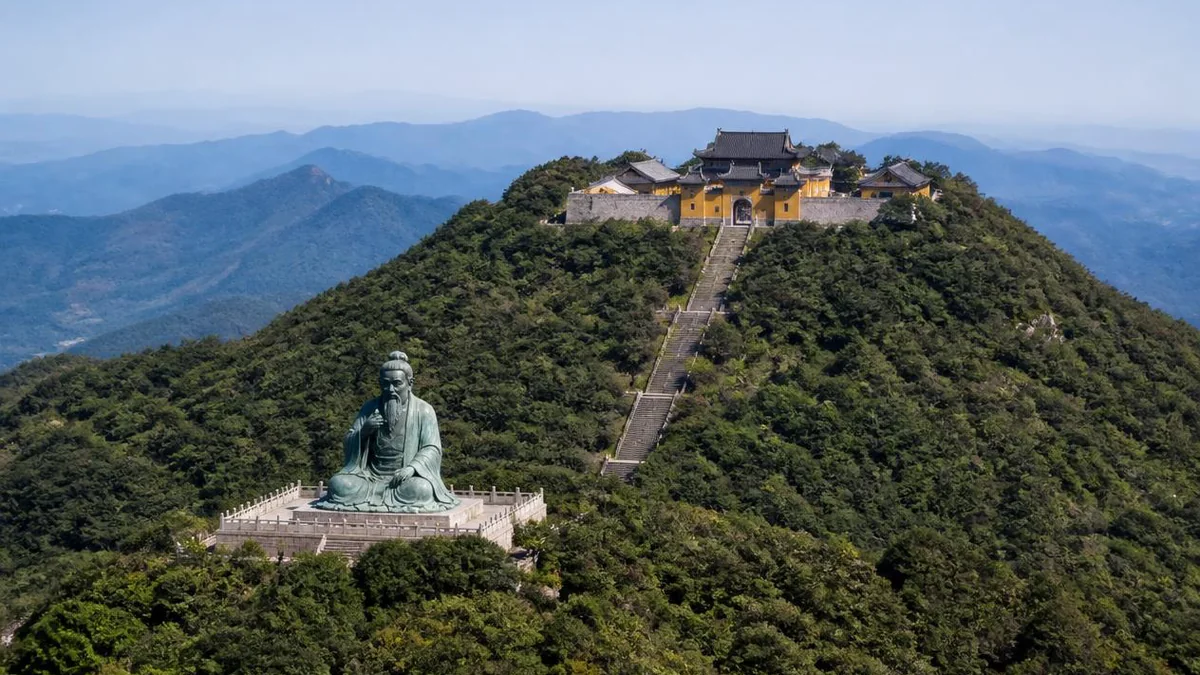
The single most photographed object on the mountain is a seated Laozi at the seal palace, and it is younger than most of the people photographing it.
It was completed in 1998: thirty-three metres high, welded from 226 purpose-made bronze plates, weighing over a hundred tonnes. It is a genuinely impressive piece of fabrication and it is not an antiquity, and the reason to say so plainly is that on this particular mountain the distinction is the whole story.
What was left in 1983
Here is the part most write-ups skip.
After 1949 the three palaces and five convents were merged into a single body, the Maoshan Daoist Academy, and in 1983 the State Council named it one of twenty-one key Daoist temples permitted to reopen nationally. When clergy came back, this is what they found.
The summit palace and the seal palace still had some late-Qing and Republican-era building fabric and some old stone carving. The lower palace — Chongxi Wanshou Gong, the red temple, whose ancestor was the Huayang lower lodge that Tao Hongjing himself established, renamed under the Tang, again under the Song, and given its final name under the Yuan — had been submerged by a reservoir. Yuchen Guan had become a village of ordinary dwellings. The Qianyuan Guan site had been converted into a forestry base. Deyou Guan, Renyou Guan and Baiyun Guan were gone.
The lower palace has since been rebuilt, on a site east of the original, on the southern foot of Dinggong Hill northwest of the main peak, and in 2023 its forecourt hosted the opening of the fifth International Daoism Forum. Its screen wall carries those six characters: eighth grotto-heaven, first blessed land.
So the honest summary is that the fifteen-hundred-year-old thing on this mountain is a body of text and a lineage of transmission. The buildings are mostly a generation old. Both facts are true and only one of them is on the signage.
May 1938
The mountain’s second history begins on a specific order.
In May 1938, on instructions from the Chinese Communist Party’s Central Committee, the New Fourth Army moved east into southern Jiangsu behind Japanese lines and established an anti-Japanese base area centred on Mount Mao — the only one of the six major mountain base areas nationally that the New Fourth Army opened itself. The commanders named on the monument are Chen Yi, Zhang Dingcheng, Tan Zhenlin and Su Yu. The figures on it are five thousand-odd engagements and seven thousand dead.
The Maoshan New Fourth Army Memorial Museum was built at the foot of the mountain in 1985.
A monument built out of arithmetic
In 1995 the Zhenjiang party organisation built a monument on the summit of Wangmu Hill, funded by special party dues from more than three hundred thousand members, and completed it on 1 September. The name on it was written by Zhang Aiping, the former defence minister; a 114-character inscription is on the reverse.
Almost every dimension encodes something.
The base stands 3.13 metres, for the city’s 313,000 party members. The shaft is 28 metres, for the army’s first and second detachments and the eight southern provinces they were drawn from. The approach has 317 steps, sixteen metres wide, in six flights: six for the month of June, fifty per flight for the fiftieth anniversary of victory, and the last seventeen for the seventeenth — 17 June 1938, the day of the Weigang engagement, the New Fourth Army’s first victory after crossing the river. At the top, in blue granite, the army’s marking: N4A.
The total height is usually given as 36 metres, though some accounts — including a People’s Daily piece — give 31.3, which is the shaft and base added together. It is worth noticing that a monument this deliberately numerical has a disputed headline number.
Around it are a victory plaza, a memorial archway, bronzes of Chen Yi and Su Yu, a grove planted for generals, and a small statue of a bugler. That last one was added later, and for a reason.
The bugle
On Lunar New Year’s Eve, 1997, a man named Li Donggui, who lived beside the monument, set off firecrackers on the open ground in front of it, as one does at New Year. A clear bugle call came back out of the air above him.
The effect is repeatable and oddly disciplined. The bugle starts when the firecrackers start and stops when they stop. It works from a kilometre out along the monument’s central axis. Any sufficiently loud, sufficiently short sound will do it.
For years the explanations competed — the 317 steps, the shape of the hill, terrestrial magnetism — with no evidence behind any of them. Then Mao Dongxing, an associate professor at Tongji University’s institute of acoustics, tested points around the site and found something decisive: no bugle from roughly twenty metres off the axis, none from either side of the monument, none from behind it. That killed the terrain theory and the simple-resonance theory in one afternoon.
The account that survives is a two-stage reflection. The monument is hollow; a single sharp pulse excites higher harmonic resonance in the structure, which reflects downward onto the flights of steps; because each flight has a different gradient, each returns a different pitch after a different delay, and the whole arrives at the listener as a sequence of notes rather than an echo. In April 2006 the Shanghai Guinness office certified the monument as the building producing the most notes from a single pulse excitation. The museum’s deputy director puts it more simply: the step dimensions happen to return frequencies that match a bugle.
The obvious suspicion — that somebody installed a sound-activated speaker — is answered by the man who oversaw the museum’s construction, who points out that the place was bare hillside and that attracting tourists with a trick was not on anyone’s mind. And the folk version arrived immediately anyway: a young New Fourth Army bugler, seeing that the war was won, sounding the call. Hence the statue.
Hearing things on this mountain
Mount Mao now takes more than a million and a half visitors a year, and they are not all there for the same mountain.
Some are climbing to the Three Heavens Gate at 372.5 metres to burn the single stick of incense at the top, on a summit whose religious importance was established by a man who left government in 492 and then kept answering the emperor’s letters. Some are on the north slope with a packet of firecrackers, waiting for four seconds of brass.
It is a strange pairing and also a coherent one. For fifteen hundred years this ridge was the place where people came to hear what could not ordinarily be heard — revelations transcribed, spirits ranked into a bureaucracy, a hermit’s correspondence carrying more weight than a minister’s. Now the thing everybody comes to hear is a bugle that was never played, produced by six flights of stairs at different angles, and fully explained.
Both are the same mountain doing the same job. Only one of them has been measured.
The LoreLens app can identify the halls, deities and inscriptions at Maoshan’s palaces and explain who is enshrined where.
Location profile
Where it is

Frequently asked questions
Is Mount Mao in Zhenjiang or Changzhou?
Both, and the split is worth understanding before you buy a ticket. The ridge sits on the boundary between Jurong, a county-level city under Zhenjiang, and Jintan, a district of Changzhou. The western slope is administered from Jurong and the eastern slope from Jintan. The 5A listing is Jurong Maoshan Scenic Area, and the two temples most visitors come for — the Palace of Nine Heavens on the summit and the Palace of the Original Talisman below it — are on the Jurong side, jointly known as the Maoshan Daoist Academy. Qianyuan Guan, the third registered Daoist site on the mountain, is on the Jintan side, in Changzhou; it is a convent staffed by women priests and is not subordinate to the Maoshan Daoist Academy at all. One mountain, two prefectures, two independent religious institutions.
Who was Tao Hongjing and what is the Shangqing school?
Tao Hongjing was a scholar, physician and Daoist who withdrew to this mountain in 492, the tenth year of the Yongming reign of the Southern Qi, and took the name Hermit of Huayang. Shangqing — Highest Clarity — was an existing revelation tradition, and its patriarchal line is counted from the Jin-dynasty woman Daoist Wei Huacun, through Yang Xi, then Xu Mu, Xu Xiang, Ma Lang, Ma Han, Lu Xiujing and Sun Youyue, with Tao Hongjing as the ninth. What Tao did was editorial and institutional: he collected and authenticated the scriptures transmitted from Yang Xi and Xu Mi, compiled the Zhengao and some two hundred-odd volumes of Daoist text including a chart ranking the entire spirit bureaucracy, and built an actual community of halls and disciples here. The result is called the Maoshan lineage, and it carried Shangqing forward — which is why the school is named after a mountain rather than a person.
Why does setting off a firecracker at the war memorial produce a bugle call?
Because of the stairs, according to the explanation that has held up. A resident named Li Donggui discovered the effect on Lunar New Year's Eve in 1997 while setting off firecrackers near the monument; the bugle starts and stops with the firecrackers and is audible a kilometre away along the central axis. Acoustic testing by Mao Dongxing of Tongji University's acoustics institute found no bugle from about twenty metres off-axis, from either side, or from behind — which ruled out the popular terrain and body-resonance theories. The accepted account is that the hollow monument returns higher harmonics from a single short pulse, and those reflections then strike the 317 steps below it; because each of the six flights has a different gradient, each returns a different pitch at a different moment, and the sequence arrives as a run of notes. In April 2006 Shanghai's Guinness office certified it as the building producing the most notes from a single pulse excitation. Nobody installed a speaker; the museum's founder notes the site was bare hillside when it was built.
How old are the buildings you actually see?
Mostly recent, and the mountain is unusually candid about it. The three palaces and five convents were all completed in the Song and Yuan periods, but by the time Daoist clergy returned in the 1980s the losses were near-total: only the summit palace and the talisman palace still had any late-Qing or Republican fabric and old stone carving; the lower palace had been flooded by a reservoir; Yuchen Guan had become a village of ordinary houses; the Qianyuan Guan site had been turned into a forestry base; and Deyou, Renyou and Baiyun Guan were simply gone. Almost everything standing is a modern rebuild, the lower palace on a site east of its original one. The 33-metre bronze Laozi is from 1998. What is genuinely old here is the textual tradition, not the timber.